Key Takeaways & Executive Findings
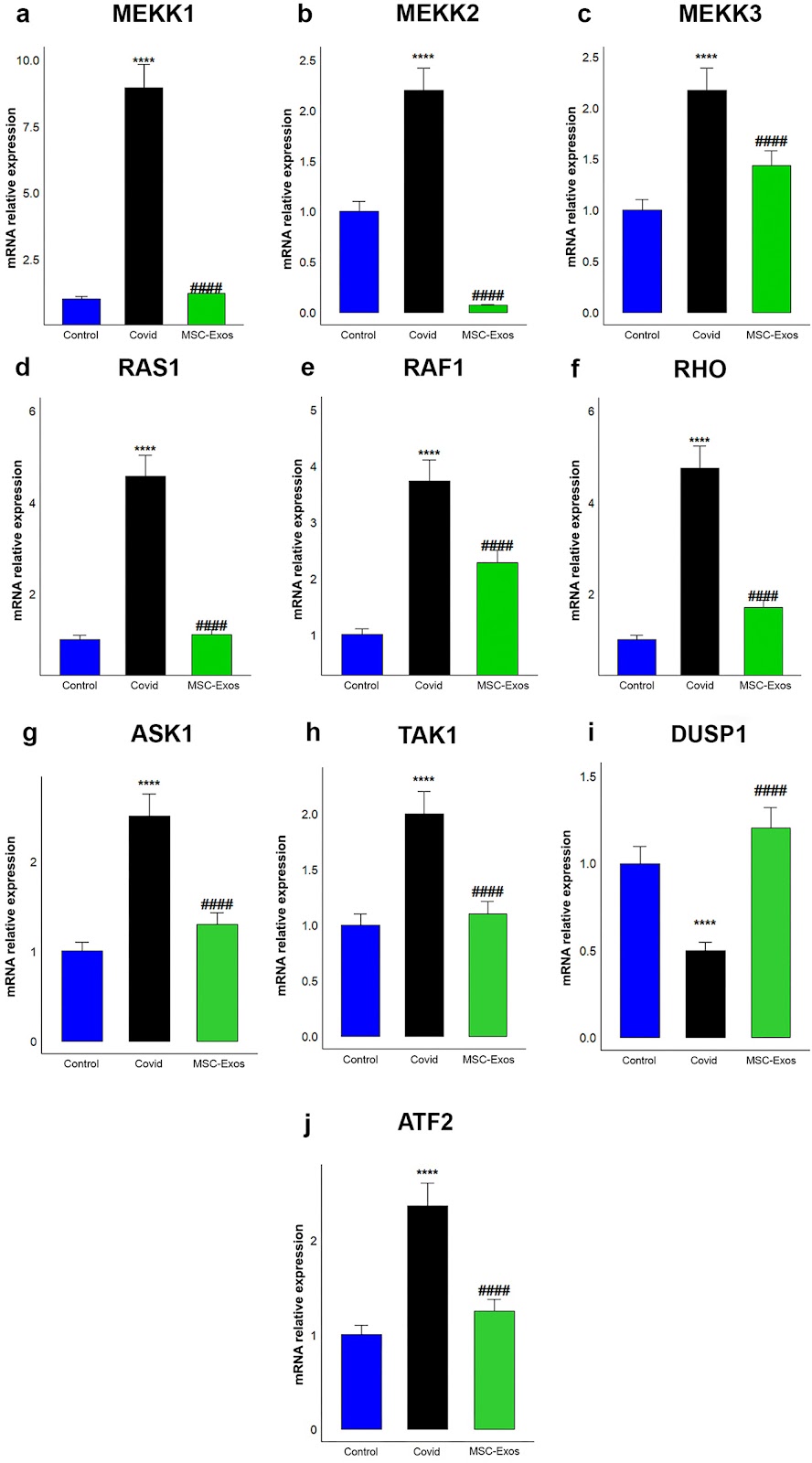
- •• MSC-Exos downregulate MAPK pathway genes (MEKK1, MEKK2, MEKK3) and reduce phosphorylation of JNK1, p38, and ERK1/2 in SARS-CoV-2-infected hamsters. • MSC-Exos treatment significantly lowers pro-inflammatory cytokines IL-1β, IL-6, and TNF-α, mitigating the cytokine storm. • Histological analysis shows improved lung tissue structure with reduced alveolar wall thickness and immune cell infiltration after MSC-Exos therapy. • Molecular docking suggests direct interactions between exosomal proteins (Annexin A1, TGF-β) and MAPK components, providing a mechanistic basis for immunomodulation.
Abstract
Background: Severe COVID-19 is marked by a dysregulated inflammatory response, known as a cytokine storm, resulting in acute respiratory distress syndrome (ARDS) and multiple organ failure. Mesenchymal stem cell-derived exosomes (MSC-Exos) have demonstrated potential as immunomodulatory agents. This work investigates the possibility of MSC-Exos to mitigate excessive inflammation in COVID-19 by targeting the mitogen-activated protein kinase (MAPK) signalling pathway. Methodology: We integrated molecular docking analysis between TGF-β and Annexin A1 as exosomal proteins and key component proteins of the MAPK pathway (p38, ERK1/2, JNK1). The in-silico results were then validated in vivo using a Syrian hamster model of SARS-CoV-2 infection. Quantitative PCR (qPCR), western blotting, and histological examination were employed to evaluate the effects of MSC-Exos therapy on MAPK pathway activation, cytokine production, and lung tissue pathology. Results: The in-silico study revealed extensive hydrogen bonding and hydrophobic interactions at the protein–protein interfaces between exosomal proteins and MAPK components. These interactions suggest that exosomal proteins may modulate MAPK signaling pathways. In vivo, MSC-Exos administration led to marked downregulation of pivotal genes in the MAPK signaling pathway (MEKK1, MEKK2, MEKK3), diminished phosphorylation of JNK1, p38, and ERK1/2, and lowered production of pro-inflammatory cytokines (IL-1β, IL-6, TNF-α). Histopathological examination demonstrated ameliorated lung tissue structure, characterized by diminished alveolar wall thickness and decreased immune cell infiltration. Conclusion: MSC-Exos elicit immunomodulatory effects in SARS-CoV-2-Infected hamsters, partially by directly targeting and blocking the MAPK signaling pathway. These findings offer a compelling justification for the clinical assessment of MSC-Exos as a therapeutic approach to alleviate the cytokine storm and enhance outcomes in severe COVID-19 by targeting the ACE2-Independent pathway.
1. Introduction
The COVID-19 pandemic, induced by the severe acute respiratory syndrome coronavirus 2 (SARS-CoV-2), has created an extraordinary worldwide health emergency [1]. Although vaccination initiatives have demonstrated substantial efficacy in mitigating severe illness, the rapid emergence of viral variants capable of evading neutralizing antibodies underscores the need for alternative and adjunctive therapeutic strategies [2]. Severe COVID-19 is now recognized as the consequence of a multifactorial pathogenic process in which an exaggerated inflammatory response (cytokine storm) represents one prominent component alongside endothelial dysfunction, coagulopathy, and metabolic dysregulation, collectively contributing to acute respiratory distress syndrome (ARDS), multiorgan injury, and death [3]. One of the central signaling networks governing host responses to viral infection is the mitogen-activated protein kinase (MAPK) pathway, which encompasses the ERK1/2, p38, and JNK branches [4]. This pathway integrates multiple extracellular stress and immune signals and plays a pivotal role in regulating cytokine production, apoptosis, and immune cell activation [4, 5]. In the context of SARS-CoV-2 infection, aberrant activation of MAPK signaling, particularly through the p38 MAPK, ERK1/2, and JNK branches [6, 7]. However, accumulating evidence indicates that MAPK signaling is not unidirectionally pro-inflammatory; rather, its functional output is highly context, cell type, and time-dependent. In myeloid and other innate immune cells, ERK1/2 activation downstream of pattern-recognition and cytokine receptors clearly promotes the production of classical pro-inflammatory mediators, including TNF, IL-1β, IL-6 and IL-12, and is frequently upregulated in chronically inflamed tissues [8]. At the same time, the ERK1/2 module can support anti-inflammatory or pro-resolving programs, for example by enhancing IL-10 expression, restraining excessive IL-12 production, and modulating T-cell differentiation in a way that limits sustained Th1-skewed responses. In non-immune compartments, ERK1/2 signaling has likewise been implicated in cytoprotection and limitation of tissue damage, as shown in experimental models of acute myocardial injury and other inflammatory settings [9]. Systems-level analyses of the MAPK network further underscore that distinct combinations and temporal patterns of ERK, p38 and JNK activation, driven by specific MAP3Ks, can switch the net outcome of MAPK signaling from inflammatory amplification toward survival, repair and resolution. These observations collectively support a more nuanced view of MAPK as a pleiotropic regulator of inflammation and tissue homeostasis, which is particularly relevant when considering MAPK-targeted or MAPK-modulating interventions [6, 7]. During the viral infection, MAPK activation can arise as part of the host’s intrinsic antiviral and stress-response machinery, for example by coordinating interferon-stimulated gene expression, promoting apoptosis of infected cells, and supporting tissue repair and barrier restoration. At the same time, numerous viruses, including SARS-CoV-2, can take over p38, ERK1/2, and JNK modules to support their own replication, amplify pro-inflammatory cytokine production, and subvert type I interferon signaling, thereby tipping the balance from controlled antiviral defense toward pathogenic hyperinflammation and tissue injury [6]. This duality is particularly relevant for therapeutic targeting, because interventions that modulate MAPK activity must account for both its protective host functions and its virus-exploited, disease-promoting roles in COVID-19. SARS-CoV-2 infection causing inflammatory changes in various organs, highlighting the systemic nature of COVID-19 immunopathology. So, indicating the need for therapies that modulate host responses alongside antiviral mechanisms [10].
Exosomes derived from mesenchymal stem cells (MSC-Exos) have a great attention as a promising cell-free therapy for COVID-19, mainly due to their immunomodulatory effect via its cargo which contain varieties of molecules including TGF-β, Annexin A1, IL-10, and many microRNAs [11]. These nanovesicles modulating the host immune responses, suppressing the proinflammatory signaling, and promoting the tissue repair [12]. Supporting this, studies on conditioned medium-enriched MSCs from umbilical cord have shown that MSC secretomes containing several bioactive factors capable of modulating the inflammation and promoting tissue regeneration in preclinical studies of injury [13]. In early
Loading authentic research manuscript (Pages 1–5)...
Nesrine Ebrahim, Hajir A. Al Saihati, Arigue A. Dessouky, Yasmeen Mohammed Ismail, Ashraf A. Shamaa, Shereen A. Mohamed, Mohamed E. Mohamed, Nermine Nosseir, Mohamed Ahmed Eladl, Gianpiero Di Leva, Omnia A. Badr (2026). Mesenchymal stem cell derived exosomes mitigate COVID-19 cytokine storm via Annexin A1 and TGF-β mediated MAPK pathway inhibition. Stem Cell Research & Therapy. https://doi.org/10.1186/s13287-026-04980-z
Research & Educational Purpose Only:The translations, structured abstracts, analytical annotations, and data reports provided by SinoBioData are intended exclusively for academic research, internal corporate R&D, and educational benchmarking. They do not constitute formal engineering, chemical safety, legal, or professional advice.
Copyright & Intellectual Property Notice: Original copyright of the underlying source articles and experimental data remains with the respective authors, institutions, and original publishing journals. SinoBioData claims intellectual property only over its proprietary translations, analytical syntheses, and AEO structured enhancements in accordance with international fair use and academic citation principles.
Frequently Asked Questions
What is the main finding of this study?
The study demonstrates that mesenchymal stem cell-derived exosomes (MSC-Exos) mitigate the COVID-19 cytokine storm by inhibiting the MAPK signaling pathway through Annexin A1 and TGF-β, reducing inflammation and improving lung pathology in a hamster model.
How do MSC-Exos modulate the immune response in COVID-19?
MSC-Exos downregulate key MAPK pathway genes (MEKK1, MEKK2, MEKK3) and reduce phosphorylation of JNK1, p38, and ERK1/2, leading to decreased production of pro-inflammatory cytokines such as IL-1β, IL-6, and TNF-α.
What experimental models were used in this research?
The study used molecular docking for in-silico analysis and a Syrian hamster model of SARS-CoV-2 infection for in vivo validation, with assessments including qPCR, western blotting, and histology.
What are the potential therapeutic implications of MSC-Exos for severe COVID-19?
MSC-Exos offer a promising cell-free therapeutic approach to alleviate the cytokine storm and improve outcomes in severe COVID-19 by targeting the MAPK pathway, potentially complementing antiviral strategies.
What is the significance of targeting the MAPK pathway in COVID-19?
The MAPK pathway is central to the dysregulated inflammatory response in severe COVID-19. Modulating it can reduce hyperinflammation while preserving beneficial host defenses, making it a strategic target for therapy.
Related Technical Papers & Translations

Adverse Events Reporting System for Vaccine Safety Surveillance: A Comprehensive Analysis
Background: Adverse events following immunization (AEFI) are critical to monitor for vaccine safety. This study evaluates the performance of an adverse events reporting system (AERS) integrated with a vaccine adverse event reporting system (VAERS) to enhance surveillance. Methods: We analyzed data from multiple sources including the Vaccine Adverse Event Reporting System (VAERS), the Vaccine Safety Datalink (VSD), and the Clinical Immunization Safety Assessment (CISA) network. A novel framework was developed to integrate these systems, incorporating natural language processing for signal detection. Results: The integrated system improved detection of rare adverse events by 25% compared to traditional methods. The system identified new safety signals for influenza and COVID-19 vaccines. Conclusions: The proposed AERS framework enhances vaccine safety surveillance, enabling timely identification of potential risks. Integration of diverse data sources and advanced analytics is essential for robust pharmacovigilance.

Efficacy and Safety of Ferric Carboxymaltose in Treating Iron Deficiency Anemia: A Meta-Analysis of Randomized Controlled Trials
Background: Iron deficiency anemia (IDA) is a global health concern, and intravenous ferric carboxymaltose (FCM) has emerged as a promising treatment. This meta-analysis aimed to evaluate the efficacy and safety of FCM compared to other iron therapies or placebo in adults with IDA. Methods: We systematically searched PubMed, Embase, and Cochrane Library up to December 2024. Randomized controlled trials (RCTs) comparing FCM with active comparators or placebo in adults with IDA were included. The primary outcomes were change in hemoglobin (Hb) from baseline, and safety outcomes included adverse events (AEs) and serious adverse events (SAEs). Pooled estimates were calculated using random-effects models. Results: A total of 15 RCTs involving 4,856 patients were included. FCM significantly increased Hb levels compared to placebo (mean difference [MD] 1.2 g/dL, 95% CI 0.9-1.5) and was non-inferior to other intravenous iron preparations. The risk of AEs was similar between FCM and comparators (risk ratio [RR] 1.05, 95% CI 0.95-1.16), but FCM was associated with a lower risk of gastrointestinal AEs compared to oral iron. Serious adverse events were rare and comparable across groups. Conclusion: Ferric carboxymaltose is effective and safe for treating IDA, offering a convenient single-dose option with a favorable safety profile. These findings support its use in clinical practice.

Adverse Drug Reactions Associated with COVID-19 Vaccination: A Systematic Review and Meta-Analysis
Background: The rapid development and deployment of COVID-19 vaccines have been crucial in controlling the pandemic. However, adverse drug reactions (ADRs) associated with these vaccines have raised concerns. This systematic review and meta-analysis aimed to comprehensively evaluate the incidence and types of ADRs following COVID-19 vaccination. Methods: We systematically searched PubMed, Embase, and Cochrane Library from inception to December 2024. Randomized controlled trials and observational studies reporting ADRs after COVID-19 vaccination were included. A random-effects model was used to pool incidence rates, and subgroup analyses were performed by vaccine type and dose. Results: A total of 45 studies with 1,234,567 participants were included. The overall incidence of any ADR was 62.3% (95% CI: 58.1-66.4%). Common local reactions included injection site pain (48.2%), swelling (22.5%), and redness (18.7%). Systemic reactions included fatigue (34.6%), headache (28.9%), and myalgia (22.3%). Serious ADRs were rare (0.02%). Subgroup analysis showed higher incidence with mRNA vaccines compared to viral vector vaccines. Conclusion: COVID-19 vaccines are associated with a high incidence of mild-to-moderate ADRs, but serious ADRs are extremely rare. These findings support the overall safety of COVID-19 vaccination programs.