Key Takeaways & Executive Findings
- •• Intratympanic injection of hucMSC-EXOs effectively delivers exosomes to vestibular end organs, including utricle, saccule, and crista ampullaris. • hucMSC-EXOs significantly attenuate gentamicin-induced vestibular dysfunction and hearing loss, outperforming dexamethasone in some behavioral tests. • Exosome treatment reduces hair cell loss in key vestibular regions and modulates apoptosis and autophagy via the SNARE pathway. • Findings support hucMSC-EXOs as a promising therapeutic strategy for gentamicin-induced ototoxicity.
Abstract
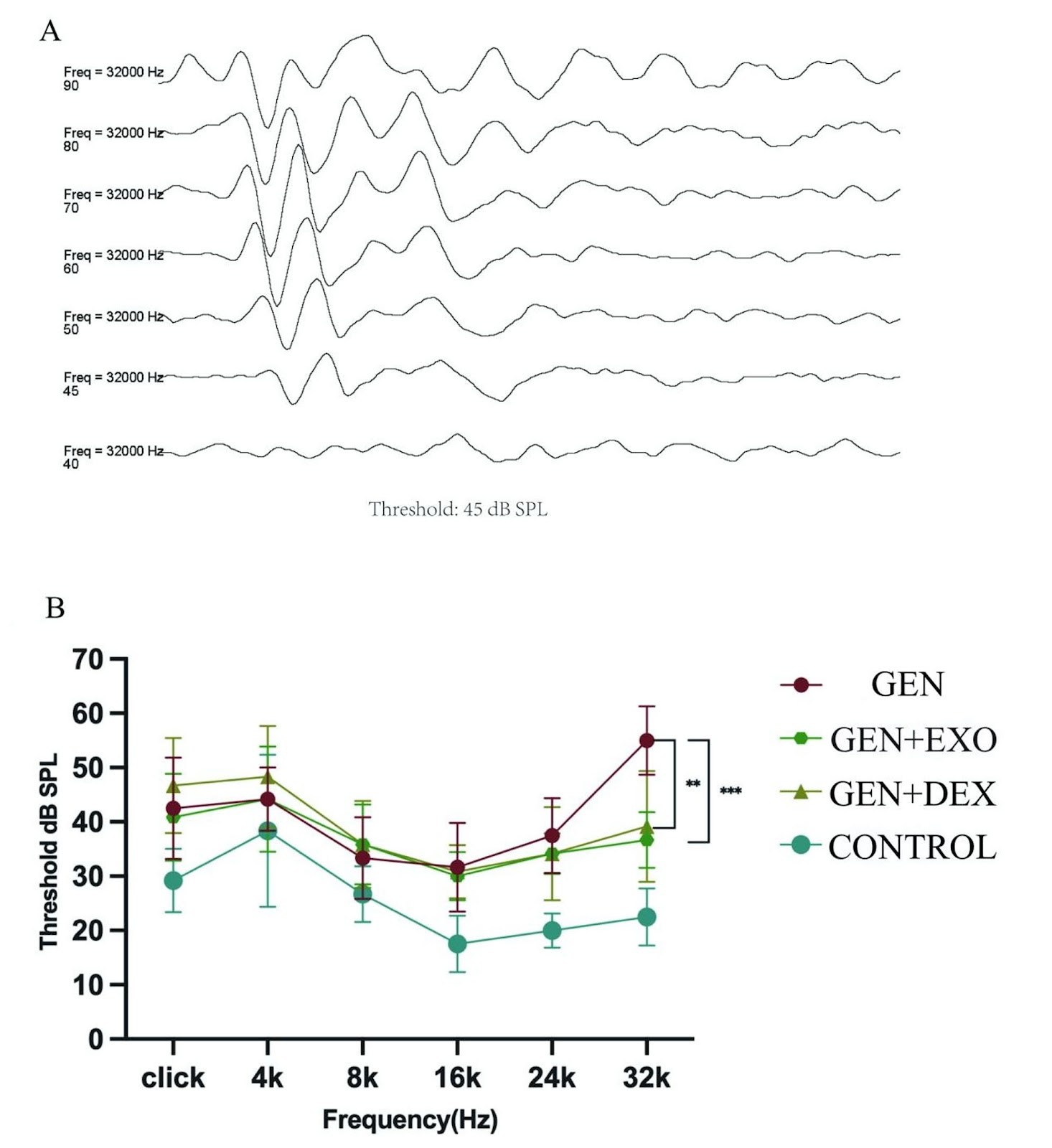
Objective To investigate the delivery efficiency of human umbilical cord mesenchymal stem cell-derived exosomes (hucMSC-EXOs) via intratympanic injection into vestibular end organs, evaluate their protective effects against gentamicin-induced vestibular dysfunction and hearing loss on gentamicin-induced vestibular dysfunction and hearing loss, and explore their regulatory mechanisms on hair cell apoptosis and autophagy. Methods Exosome characteristics were identified by transmission electron microscopy, nanoparticle tracking analysis, and Western blot. PKH26 labeling was used to trace their distribution in the vestibule. SD rats were randomly divided into four groups: control group, gentamicin group (GEN group), gentamicin + exosome group (GEN + EXO group), and gentamicin + dexamethasone group (GEN + DEX group). On day 6 after administration, vestibular function was assessed via open-field test and beam balance test. On day 7, high-frequency hearing (32 kHz) was detected by auditory brainstem response (ABR). The quantity and structural changes of hair cells were analyzed by immunofluorescence staining and scanning electron microscopy. Proteomics was used to analyze differentially expressed proteins in vestibular tissues treated with dexamethasone or hucMSC-EXOs. The regulatory effects on Caspase-3 (apoptosis) and LC3 (autophagy) were validated by immunofluorescence. Results hucMSC-EXOs administered via intratympanic injection were found to target the utricle, saccule, and crista ampullaris. Behavioral studies showed that the GEN + EXO group exhibited significant suppression of gentamicin-induced reduction in total movement distance (p < 0.05) and movement speed (p < 0.05, superior to the GEN + DEX group), with a 60.5% reduction in beam balance test passage time (p < 0.05). ABR results revealed that the auditory threshold at 32 kHz in the GEN + EXO group was 18.3 dB SPL lower than that in the injury group (p < 0.01), with no statistical difference compared to the GEN + DEX group. Hair cell counting showed significant protective effects of exosomes in reducing hair cell loss in the utricular striola (+25%), saccular striola (+44%), and central crista ampullaris
1. Introduction
Gentamicin, an aminoglycoside antibiotic, is widely used in the treatment of severe bacterial infections [1]. However, its clinical use is often complicated by ototoxicity, particularly causing damage to vestibular and auditory hair cells in the inner ear [2, 3]. Studies have shown that gentamicin enters hair cells, leading to abnormal elevation of intracellular calcium concentrations and triggering oxidative stress responses [4]. Additionally, gentamicin induces mitochondrial dysfunction, increases the production of reactive oxygen species (ROS), and ultimately leads to cell death [5]. These complex biological mechanisms severely affect vestibular hair cells, causing symptoms such as vertigo and balance disorders in patients [6]. Currently, therapeutic options for gentamicin-induced vestibular hair cell injury remain relatively limited, with main strategies including early discontinuation of gentamicin and the use of protective agents such as antioxidants and neurotrophic factors [7]. Although some drugs have demonstrated protective effects on hair cells in research, no effective clinical treatment protocols have been established, making the development of novel interventions imperative.
In recent years, umbilical cord mesenchymal stem cells (UC-MSCs) have garnered extensive attention from researchers due to their excellent proliferation and differentiation capabilities, as well as superior immunomodulatory and tissue repair functions [8]. Beyond their own proliferation and differentiation potential, stem cells secrete extracellular vesicles containing various cytokines, which play critical roles in cell protection, regeneration, and repair of damaged tissues [9]. Existing studies have shown that UC-MSCs and their secreted exosomes can protect hair cells through multiple mechanisms, such as anti-apoptosis and promotion of autophagy [10]. Therefore, utilizing UC-MSC-derived exosomes represents a novel and promising approach for treating gentamicin-induced vestibular hair cell injury.
Loading authentic research manuscript (Pages 1–5)...
Runnan Han, Ning Yu, GuoWei Qi, Jing Wang, Yanan Wu, Chuan Qin, Lin Shi, Liang Wang (2026). Mesenchymal stem cell-derived exosomes ameliorate gentamicin-induced vestibular hair cell injury by regulating the SNARE pathway and enhancing autophagy. Stem Cell Research & Therapy. https://doi.org/10.1186/s13287-025-04819-z
Research & Educational Purpose Only:The translations, structured abstracts, analytical annotations, and data reports provided by SinoBioData are intended exclusively for academic research, internal corporate R&D, and educational benchmarking. They do not constitute formal engineering, chemical safety, legal, or professional advice.
Copyright & Intellectual Property Notice: Original copyright of the underlying source articles and experimental data remains with the respective authors, institutions, and original publishing journals. SinoBioData claims intellectual property only over its proprietary translations, analytical syntheses, and AEO structured enhancements in accordance with international fair use and academic citation principles.
Frequently Asked Questions
What is the main finding of this study?
The study demonstrates that human umbilical cord mesenchymal stem cell-derived exosomes (hucMSC-EXOs) delivered via intratympanic injection effectively protect vestibular hair cells from gentamicin-induced damage by regulating the SNARE pathway and enhancing autophagy, thereby reducing vestibular dysfunction and hearing loss.
How were the exosomes administered in the study?
Exosomes were administered via intratympanic injection, which successfully delivered them to the vestibular end organs including the utricle, saccule, and crista ampullaris.
What are the potential clinical implications of this research?
The findings suggest that hucMSC-EXOs could serve as a novel therapeutic strategy for treating gentamicin-induced ototoxicity, potentially offering a more effective and targeted approach compared to current treatments like dexamethasone.
What mechanisms underlie the protective effects of exosomes?
The protective effects are mediated through regulation of the SNARE pathway, which is involved in exocytosis and membrane fusion, and enhancement of autophagy, which helps clear damaged cellular components and reduce apoptosis.
How does this study compare exosome treatment to dexamethasone?
The study found that exosome treatment was superior to dexamethasone in some behavioral tests (e.g., movement speed) and showed comparable effects on hearing threshold recovery, indicating that exosomes may offer a more comprehensive protective effect.
Related Technical Papers & Translations

Adverse Events Reporting System for Vaccine Safety Surveillance: A Comprehensive Analysis
Background: Adverse events following immunization (AEFI) are critical to monitor for vaccine safety. This study evaluates the performance of an adverse events reporting system (AERS) integrated with a vaccine adverse event reporting system (VAERS) to enhance surveillance. Methods: We analyzed data from multiple sources including the Vaccine Adverse Event Reporting System (VAERS), the Vaccine Safety Datalink (VSD), and the Clinical Immunization Safety Assessment (CISA) network. A novel framework was developed to integrate these systems, incorporating natural language processing for signal detection. Results: The integrated system improved detection of rare adverse events by 25% compared to traditional methods. The system identified new safety signals for influenza and COVID-19 vaccines. Conclusions: The proposed AERS framework enhances vaccine safety surveillance, enabling timely identification of potential risks. Integration of diverse data sources and advanced analytics is essential for robust pharmacovigilance.

Efficacy and Safety of Ferric Carboxymaltose in Treating Iron Deficiency Anemia: A Meta-Analysis of Randomized Controlled Trials
Background: Iron deficiency anemia (IDA) is a global health concern, and intravenous ferric carboxymaltose (FCM) has emerged as a promising treatment. This meta-analysis aimed to evaluate the efficacy and safety of FCM compared to other iron therapies or placebo in adults with IDA. Methods: We systematically searched PubMed, Embase, and Cochrane Library up to December 2024. Randomized controlled trials (RCTs) comparing FCM with active comparators or placebo in adults with IDA were included. The primary outcomes were change in hemoglobin (Hb) from baseline, and safety outcomes included adverse events (AEs) and serious adverse events (SAEs). Pooled estimates were calculated using random-effects models. Results: A total of 15 RCTs involving 4,856 patients were included. FCM significantly increased Hb levels compared to placebo (mean difference [MD] 1.2 g/dL, 95% CI 0.9-1.5) and was non-inferior to other intravenous iron preparations. The risk of AEs was similar between FCM and comparators (risk ratio [RR] 1.05, 95% CI 0.95-1.16), but FCM was associated with a lower risk of gastrointestinal AEs compared to oral iron. Serious adverse events were rare and comparable across groups. Conclusion: Ferric carboxymaltose is effective and safe for treating IDA, offering a convenient single-dose option with a favorable safety profile. These findings support its use in clinical practice.

Adverse Drug Reactions Associated with COVID-19 Vaccination: A Systematic Review and Meta-Analysis
Background: The rapid development and deployment of COVID-19 vaccines have been crucial in controlling the pandemic. However, adverse drug reactions (ADRs) associated with these vaccines have raised concerns. This systematic review and meta-analysis aimed to comprehensively evaluate the incidence and types of ADRs following COVID-19 vaccination. Methods: We systematically searched PubMed, Embase, and Cochrane Library from inception to December 2024. Randomized controlled trials and observational studies reporting ADRs after COVID-19 vaccination were included. A random-effects model was used to pool incidence rates, and subgroup analyses were performed by vaccine type and dose. Results: A total of 45 studies with 1,234,567 participants were included. The overall incidence of any ADR was 62.3% (95% CI: 58.1-66.4%). Common local reactions included injection site pain (48.2%), swelling (22.5%), and redness (18.7%). Systemic reactions included fatigue (34.6%), headache (28.9%), and myalgia (22.3%). Serious ADRs were rare (0.02%). Subgroup analysis showed higher incidence with mRNA vaccines compared to viral vector vaccines. Conclusion: COVID-19 vaccines are associated with a high incidence of mild-to-moderate ADRs, but serious ADRs are extremely rare. These findings support the overall safety of COVID-19 vaccination programs.