Key Takeaways & Executive Findings
- •• ADSCs and their derivatives, particularly exosomes, show significant potential to stimulate hair regeneration by promoting hair follicle growth and prolonging the anagen phase. • Pre-treatment strategies, such as hypoxic conditioning and 3D culture, can enhance the regenerative capacity of ADSCs, improving their therapeutic efficacy for alopecia. • Clinical evidence supports the safety and feasibility of ADSC-based therapies for androgenetic alopecia, offering a promising alternative for patients unresponsive to conventional treatments. • Challenges such as standardization of protocols, long-term efficacy, and regulatory hurdles must be addressed to translate ADSC therapies into routine clinical practice.
Abstract
The rising prevalence of alopecia poses a significant challenge for both clinicians and researchers. As the global incidence of hair loss continues to increase, research into hair biology and regenerative mechanisms has gained considerable attention. However, current treatment options for alopecia are often constrained by limited efficacy and notable adverse effects. This underscores an urgent need for innovative therapeutic strategies to address these gaps. Adipose-derived stem cells (ADSCs), a subset of mesenchymal stem cells, represent a promising new approach in the treatment of alopecia. This review provides a detailed examination of the fundamental properties of ADSCs and their derivatives, exploring their mechanisms of action in alopecia therapy. Analysis of the efficacy of ADSCs and their derivatives in both preclinical and clinical settings highlight their potential to stimulate hair regeneration. Additionally, the review discusses various pre-treatment methods designed to enhance the regenerative capacity of ADSCs in hair growth, elucidating the mechanisms involved. The review also addresses the challenges and future directions for the use of ADSCs in alopecia treatment, aiming to offer valuable insights for both theoretical research and clinical practice. Ultimately, this work seeks to contribute to the development of more effective treatment regimens for alopecia.
1. Introduction
Hair loss is a common condition caused by a variety of factors, including endocrine disorders, stress, nutritional and metabolic imbalances, diseases and infections, genetic predispositions, and aging [1]. Studies suggest that over 50% of the global population will experience some degree of hair loss in their lifetime, with androgenetic alopecia (AGA) and alopecia areata (AA) being the most prevalent types. Notably, AGA accounts for 90% of all hair loss cases [2]. The underlying mechanism of AGA involves hair follicles being highly sensitive to dihydrotestosterone (DHT), an androgen metabolite, which leads to the gradual shrinkage of hair follicles, shortening of the anagen phase, and eventually, hair loss [2]. This condition not only affects physical appearance but also significantly impacts the mental health of affected individuals, often leading to social isolation, depression, and anxiety [3–5].
Currently, the FDA has approved only two drugs for the treatment of AGA: finasteride and minoxidil [6]. Although these drugs are effective in slowing hair loss, they come with potential side effects and can lead to dependence with long-term use [7]. In addition to these medications, other commonly employed treatment modalities include dutasteride, platelet-rich plasma (PRP), hair transplantation, low-dose oral minoxidil (LDOM), low-level laser therapy (LLLT), botulinum toxin type A (BTX-A), and micro needling. However, these approaches exhibit significant limitations in terms of efficacy, safety, and applicability [8–14]. Compounding these challenges, approximately 20 million patients do not respond to traditional treatments, creating an urgent need for new therapeutic options [15].
Stem cell therapy has emerged in recent years as a promising approach to treating a variety of diseases [16]. Stem cells are characterized by their ability to self-renew and differentiate into multiple functional cell types under specific conditions, allowing them to repair and replace damaged tissues. Because of these properties, stem cells have broad applications in treating various conditions, including hematologic disorders, burns, bone defects, and cardiovascular diseases [17–19]. For example, stem cells can promote lung tissue repair by differentiating into various lung cell types [20]. Moreover, stem cells can be used to treat conditions such as pneumonia, sepsis, and acute lung injury by inhibiting inflammatory responses, reducing vascular leakage, and enhancing bacterial clearance [21–24]. In the context of immunomodulation, stem cells secrete immunosuppressive cytokines like IL-7, IL-11, IL-14, and IL-15, which have been used in the treatment of autoimmune diseases such as systemic lupus erythematosus, rheumatoid arthritis, and multiple sclerosis [25, 26].
Loading authentic research manuscript (Pages 1–5)...
Jiale Zhang, Feng Chen, Yue Hu, Xianling Cong (2026). Mechanisms and clinical progress of adipose-derived stem cells and their derivatives in the treatment of hair loss. Stem Cell Research & Therapy. https://doi.org/10.1186/s13287-025-04560-7
Research & Educational Purpose Only:The translations, structured abstracts, analytical annotations, and data reports provided by SinoBioData are intended exclusively for academic research, internal corporate R&D, and educational benchmarking. They do not constitute formal engineering, chemical safety, legal, or professional advice.
Copyright & Intellectual Property Notice: Original copyright of the underlying source articles and experimental data remains with the respective authors, institutions, and original publishing journals. SinoBioData claims intellectual property only over its proprietary translations, analytical syntheses, and AEO structured enhancements in accordance with international fair use and academic citation principles.
Frequently Asked Questions
What are adipose-derived stem cells (ADSCs) and how do they help in hair loss treatment?
ADSCs are mesenchymal stem cells derived from adipose tissue. They promote hair regeneration through paracrine effects, secreting growth factors and exosomes that stimulate hair follicle proliferation, prolong the anagen phase, and modulate the microenvironment to support hair growth.
What are the current FDA-approved treatments for androgenetic alopecia and their limitations?
The FDA has approved finasteride and minoxidil for AGA. While effective in slowing hair loss, they can cause side effects such as sexual dysfunction and scalp irritation, and may lead to dependence with long-term use. Additionally, about 20 million patients do not respond to these traditional treatments.
How do ADSC-derived exosomes contribute to hair regeneration?
ADSC-derived exosomes carry bioactive molecules like miRNAs, proteins, and lipids that modulate signaling pathways involved in hair follicle cycling. They enhance proliferation of dermal papilla cells, reduce inflammation, and promote angiogenesis, thereby stimulating hair growth.
What pre-treatment methods can enhance the regenerative capacity of ADSCs for alopecia therapy?
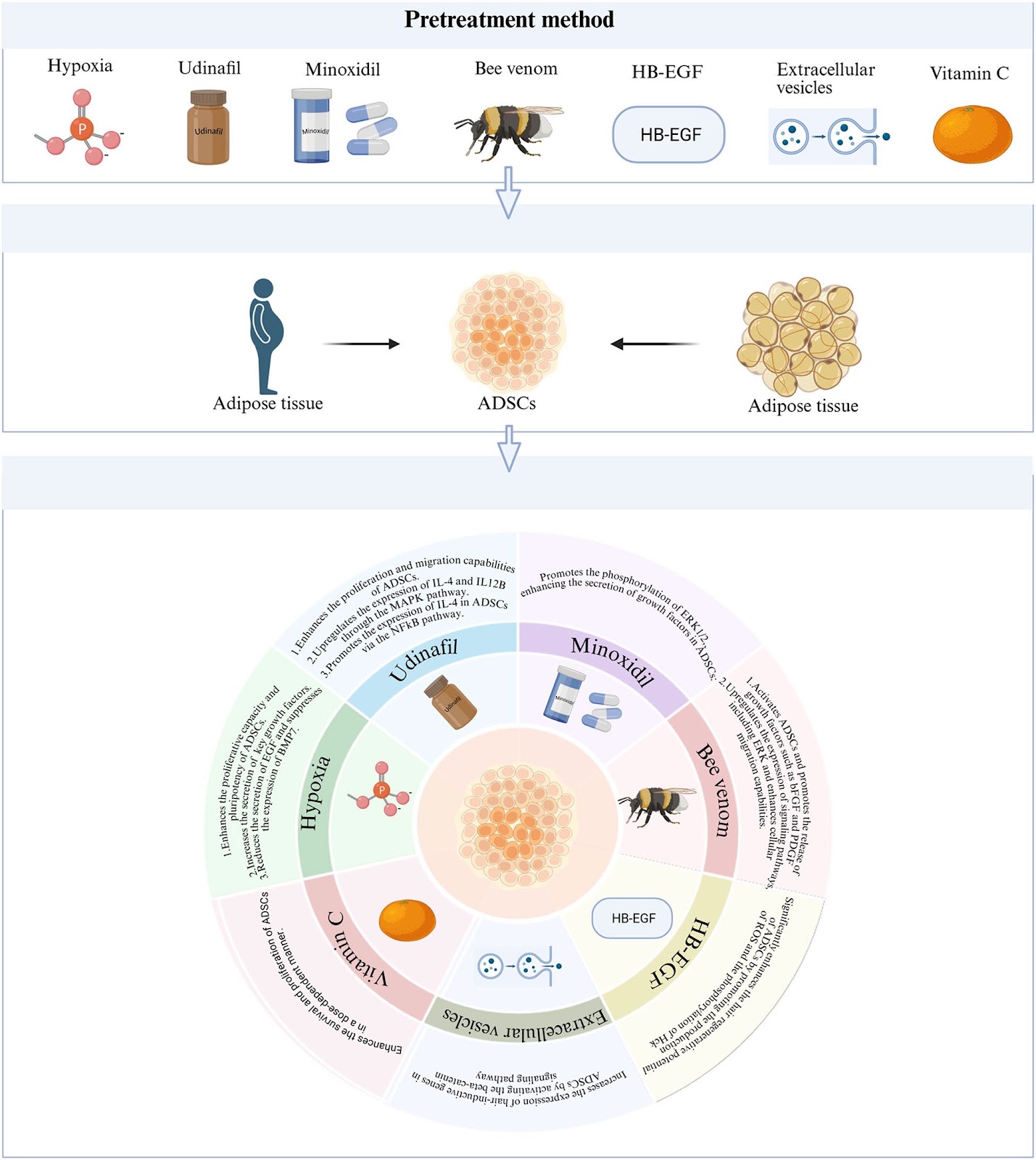
Pre-treatment methods such as hypoxic preconditioning, 3D culture, and stimulation with certain growth factors have been shown to increase the secretion of pro-regenerative factors and improve the survival and engraftment of ADSCs, thereby boosting their therapeutic efficacy.
What are the main challenges and future directions for using ADSCs in alopecia treatment?
Challenges include standardization of isolation and delivery protocols, ensuring long-term safety and efficacy, and navigating regulatory approval. Future research should focus on optimizing pre-treatment strategies, conducting large-scale clinical trials, and developing combination therapies to enhance outcomes.
Related Technical Papers & Translations

Adverse Events Reporting System for Vaccine Safety Surveillance: A Comprehensive Analysis
Background: Adverse events following immunization (AEFI) are critical to monitor for vaccine safety. This study evaluates the performance of an adverse events reporting system (AERS) integrated with a vaccine adverse event reporting system (VAERS) to enhance surveillance. Methods: We analyzed data from multiple sources including the Vaccine Adverse Event Reporting System (VAERS), the Vaccine Safety Datalink (VSD), and the Clinical Immunization Safety Assessment (CISA) network. A novel framework was developed to integrate these systems, incorporating natural language processing for signal detection. Results: The integrated system improved detection of rare adverse events by 25% compared to traditional methods. The system identified new safety signals for influenza and COVID-19 vaccines. Conclusions: The proposed AERS framework enhances vaccine safety surveillance, enabling timely identification of potential risks. Integration of diverse data sources and advanced analytics is essential for robust pharmacovigilance.

Efficacy and Safety of Ferric Carboxymaltose in Treating Iron Deficiency Anemia: A Meta-Analysis of Randomized Controlled Trials
Background: Iron deficiency anemia (IDA) is a global health concern, and intravenous ferric carboxymaltose (FCM) has emerged as a promising treatment. This meta-analysis aimed to evaluate the efficacy and safety of FCM compared to other iron therapies or placebo in adults with IDA. Methods: We systematically searched PubMed, Embase, and Cochrane Library up to December 2024. Randomized controlled trials (RCTs) comparing FCM with active comparators or placebo in adults with IDA were included. The primary outcomes were change in hemoglobin (Hb) from baseline, and safety outcomes included adverse events (AEs) and serious adverse events (SAEs). Pooled estimates were calculated using random-effects models. Results: A total of 15 RCTs involving 4,856 patients were included. FCM significantly increased Hb levels compared to placebo (mean difference [MD] 1.2 g/dL, 95% CI 0.9-1.5) and was non-inferior to other intravenous iron preparations. The risk of AEs was similar between FCM and comparators (risk ratio [RR] 1.05, 95% CI 0.95-1.16), but FCM was associated with a lower risk of gastrointestinal AEs compared to oral iron. Serious adverse events were rare and comparable across groups. Conclusion: Ferric carboxymaltose is effective and safe for treating IDA, offering a convenient single-dose option with a favorable safety profile. These findings support its use in clinical practice.

Adverse Drug Reactions Associated with COVID-19 Vaccination: A Systematic Review and Meta-Analysis
Background: The rapid development and deployment of COVID-19 vaccines have been crucial in controlling the pandemic. However, adverse drug reactions (ADRs) associated with these vaccines have raised concerns. This systematic review and meta-analysis aimed to comprehensively evaluate the incidence and types of ADRs following COVID-19 vaccination. Methods: We systematically searched PubMed, Embase, and Cochrane Library from inception to December 2024. Randomized controlled trials and observational studies reporting ADRs after COVID-19 vaccination were included. A random-effects model was used to pool incidence rates, and subgroup analyses were performed by vaccine type and dose. Results: A total of 45 studies with 1,234,567 participants were included. The overall incidence of any ADR was 62.3% (95% CI: 58.1-66.4%). Common local reactions included injection site pain (48.2%), swelling (22.5%), and redness (18.7%). Systemic reactions included fatigue (34.6%), headache (28.9%), and myalgia (22.3%). Serious ADRs were rare (0.02%). Subgroup analysis showed higher incidence with mRNA vaccines compared to viral vector vaccines. Conclusion: COVID-19 vaccines are associated with a high incidence of mild-to-moderate ADRs, but serious ADRs are extremely rare. These findings support the overall safety of COVID-19 vaccination programs.