Key Takeaways & Executive Findings
- •• Clinical-grade haMSC-EVs were manufactured with standardized quality control, demonstrating stability for up to 6 months at -80°C and suitable lot-to-lot consistency in miRNA and proteomic profiles. • Intratracheal administration of haMSC-EVs at 1.5×10^8 particles/rat/day for 28 days showed no significant toxicity in rats, supporting their safety for preclinical use. • In an LPS-induced ALI/ARDS rat model, intratracheal haMSC-EVs alleviated lung injury and reduced serum inflammatory factors, indicating therapeutic potential. • The study provides a comprehensive framework for GLP-grade preclinical evaluation of nebulized allogenic MSC-EVs, advancing their translation as an off-the-shelf therapy for ARDS/ALI.
Abstract
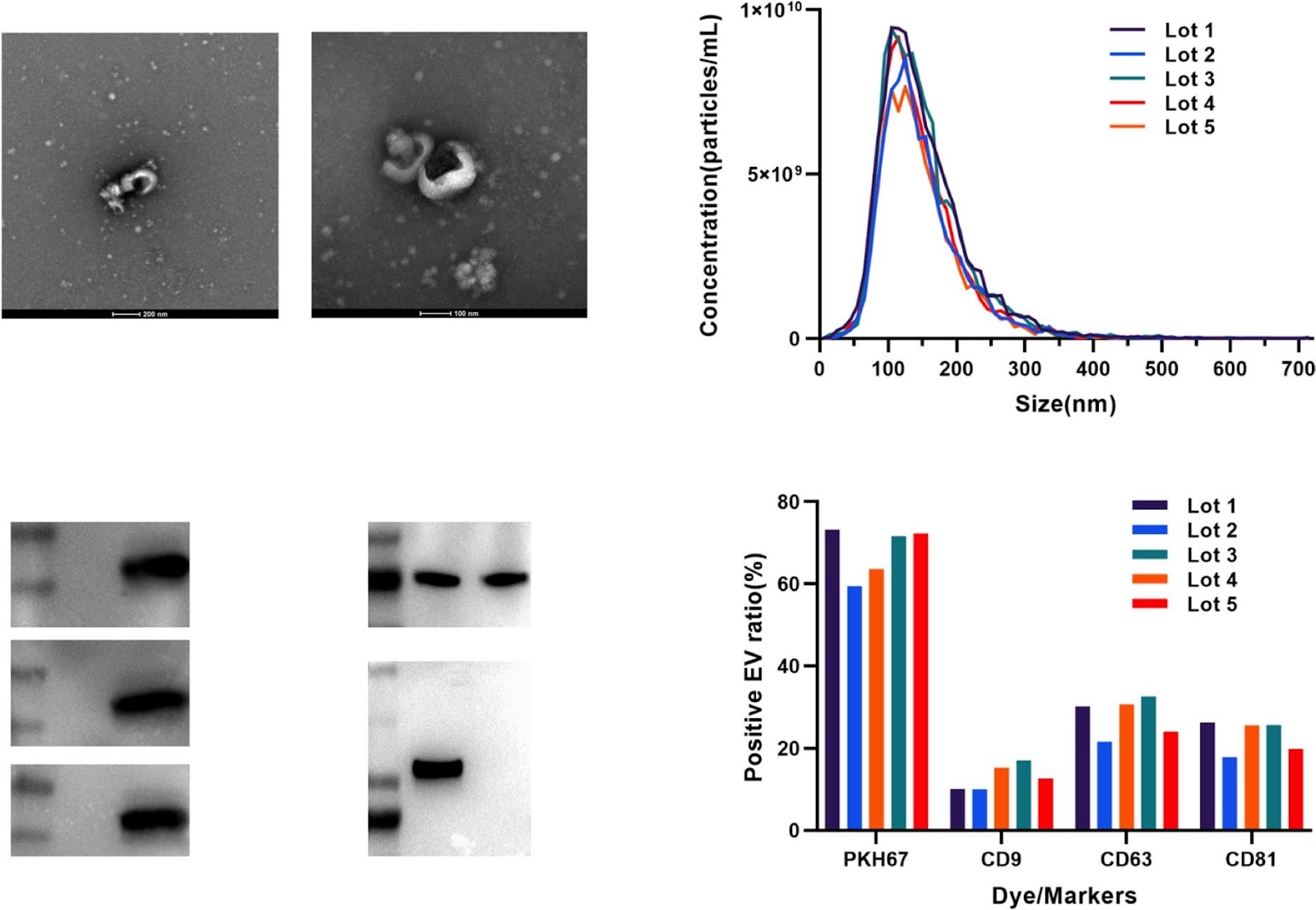
Background Human adipose stromal cells-derived extracellular vesicles (haMSC-EVs) have been shown to alleviate inflammation in acute lung injury (ALI) animal models. However, there are few systemic studies on clinical-grade haMSC-EVs. Our study aimed to investigate the manufacturing, quality control (QC) and preclinical safety of clinical-grade haMSC-EVs. Methods haMSC-EVs were isolated from the conditioned medium of human adipose MSCs incubated in 2D containers. Purification was performed by PEG precipitation and differential centrifugation. Characterizations were conducted by nanoparticle tracking analysis, transmission electron microscopy (TEM), Western blotting, nanoflow cytometry analysis, and the TNF-α inhibition ratio of macrophage [after stimulated by lipopolysaccharide (LPS)]. RNA-seq and proteomic analysis with liquid chromatography tandem mass spectrometry (LC–MS/MS) were used to inspect the lot-to-lot consistency of the EV products. Repeated toxicity was evaluated in rats after administration using trace liquid endotracheal nebulizers for 28 days, and respiratory toxicity was evaluated 24 h after the first administration. In vivo therapeutic effects were assessed in an LPS-induced ALI/ acute respiratory distress syndrome (ARDS) rat model. Results The quality criteria have been standardized. In a stability study, haMSC-EVs were found to remain stable after 6 months of storage at − 80°C, 3 months at − 20 °C, and 6 h at room temperature. The microRNA profile and proteome of haMSC-EVs demonstrated suitable lot-to-lot consistency, further suggesting the stability of the production processes. Intratracheally administered 1.5 × 10^8 particles/rat/day for four weeks elicited no significant toxicity in rats. In LPS-induced ALI/ARDS model rats, intratracheally administered haMSC-EVs alleviated lung injury, possibly by reducing the serum level of inflammatory factors. Conclusion haMSC-EVs, as an off-shelf drug, have suitable stability and lot-to-lot consistency. Intratracheally administered haMSC-EVs demonstrated excellent safety at the tested dosages in systematic preclinical toxicity studies. Intratracheally administered haMSC-EVs improved the lung function and exerted anti-inflammatory effects on LPS-induced ALI/ARDS model rats.
1. Introduction
Mesenchymal stromal cells (MSCs) exist in various adult mesenchymal tissues. They are multipotent and have immunomodulatory abilities [1]. Acute respiratory distress syndrome (ARDS) and acute lung injury (ALI) are life threatening clinical syndromes with high morbidity and mortality; however, there are limited effective clinical interventions for the treatment of ALI/ARDS [2]. Preclinical studies in mice, rats, and sheep have shown that MSC treatments inhibit lung damage, reduce inflammation, suppress immune responses, and promote alveolar fluid clearance, suggesting that MSCs can alleviate ARDS/ALI [3–11]. To date, more than 50 trials have been conducted using MSCs as therapeutic agents in ARDS/ALI (ClinicalTrials.gov). Multiple studies have revealed the safety of MSCs in ARDS treatment, and MSCs may reduce the mortality rate of patients with ARDS [12–15].
However, due to their cell size, MSCs are typically intravenously administered, and the effective dose of MSCs is relatively high (5–1.25 × 10^7/treatment) [16]. It was reported that some of the biological functions of MSCs are mediated by secreted extracellular vesicles (EVs) and mesenchymal stromal cells-derived extracellular vesicles (MSC-EVs) have shown beneficial effects in ARDS treatment [17–19]. EVs are bilayer membrane vesicles secreted by almost all cell types and play important roles in cell–cell communication. EVs are classified by physical characteristics (size or density, such as small EVs, and medium/large EVs); biochemical composition (CD63+/CD81+-EVs; etc.); or by their origin.
Loading authentic research manuscript (Pages 1–5)...
Jing Wang, Zhong-jin Chen, Ze-yi Zhang, Mei-ping Shen, Bo Zhao, Wei Zhang, Ye Zhang, Ji-gang Lei, Cheng-jie Ren, Jing Chang, Cui-li Xu, Meng Li, Yang-yang Pi, Tian-lun Lu, Cheng-xiang Dai, Su-ke Li, Ping Li (2026). Manufacturing, quality control, and GLP-grade preclinical study of nebulized allogenic adipose mesenchymal stromal cells-derived extracellular vesicles. Stem Cell Research & Therapy. https://doi.org/10.1186/s13287-024-03708-1
Research & Educational Purpose Only:The translations, structured abstracts, analytical annotations, and data reports provided by SinoBioData are intended exclusively for academic research, internal corporate R&D, and educational benchmarking. They do not constitute formal engineering, chemical safety, legal, or professional advice.
Copyright & Intellectual Property Notice: Original copyright of the underlying source articles and experimental data remains with the respective authors, institutions, and original publishing journals. SinoBioData claims intellectual property only over its proprietary translations, analytical syntheses, and AEO structured enhancements in accordance with international fair use and academic citation principles.
Frequently Asked Questions
What are haMSC-EVs and how are they manufactured?
haMSC-EVs are extracellular vesicles derived from human adipose mesenchymal stromal cells. They are isolated from the conditioned medium of MSCs cultured in 2D containers, purified using PEG precipitation and differential centrifugation, and characterized by nanoparticle tracking analysis, TEM, Western blotting, and nanoflow cytometry.
What is the stability of haMSC-EVs under different storage conditions?
haMSC-EVs remain stable for up to 6 months at -80°C, 3 months at -20°C, and 6 hours at room temperature, as demonstrated in the stability study.
What were the key findings of the preclinical toxicity study?
Intratracheal administration of haMSC-EVs at 1.5×10^8 particles/rat/day for 28 days showed no significant toxicity in rats, indicating a favorable safety profile for the tested dosages.
How effective are haMSC-EVs in treating ALI/ARDS in animal models?
In an LPS-induced ALI/ARDS rat model, intratracheal administration of haMSC-EVs alleviated lung injury and reduced serum levels of inflammatory factors, suggesting anti-inflammatory and therapeutic effects.
What is the significance of this study for clinical translation?
This study provides a comprehensive framework for manufacturing, quality control, and GLP-grade preclinical evaluation of nebulized allogenic MSC-EVs, supporting their potential as an off-the-shelf therapy for ARDS/ALI.
Related Technical Papers & Translations

Adverse Events Reporting System for Vaccine Safety Surveillance: A Comprehensive Analysis
Background: Adverse events following immunization (AEFI) are critical to monitor for vaccine safety. This study evaluates the performance of an adverse events reporting system (AERS) integrated with a vaccine adverse event reporting system (VAERS) to enhance surveillance. Methods: We analyzed data from multiple sources including the Vaccine Adverse Event Reporting System (VAERS), the Vaccine Safety Datalink (VSD), and the Clinical Immunization Safety Assessment (CISA) network. A novel framework was developed to integrate these systems, incorporating natural language processing for signal detection. Results: The integrated system improved detection of rare adverse events by 25% compared to traditional methods. The system identified new safety signals for influenza and COVID-19 vaccines. Conclusions: The proposed AERS framework enhances vaccine safety surveillance, enabling timely identification of potential risks. Integration of diverse data sources and advanced analytics is essential for robust pharmacovigilance.

Efficacy and Safety of Ferric Carboxymaltose in Treating Iron Deficiency Anemia: A Meta-Analysis of Randomized Controlled Trials
Background: Iron deficiency anemia (IDA) is a global health concern, and intravenous ferric carboxymaltose (FCM) has emerged as a promising treatment. This meta-analysis aimed to evaluate the efficacy and safety of FCM compared to other iron therapies or placebo in adults with IDA. Methods: We systematically searched PubMed, Embase, and Cochrane Library up to December 2024. Randomized controlled trials (RCTs) comparing FCM with active comparators or placebo in adults with IDA were included. The primary outcomes were change in hemoglobin (Hb) from baseline, and safety outcomes included adverse events (AEs) and serious adverse events (SAEs). Pooled estimates were calculated using random-effects models. Results: A total of 15 RCTs involving 4,856 patients were included. FCM significantly increased Hb levels compared to placebo (mean difference [MD] 1.2 g/dL, 95% CI 0.9-1.5) and was non-inferior to other intravenous iron preparations. The risk of AEs was similar between FCM and comparators (risk ratio [RR] 1.05, 95% CI 0.95-1.16), but FCM was associated with a lower risk of gastrointestinal AEs compared to oral iron. Serious adverse events were rare and comparable across groups. Conclusion: Ferric carboxymaltose is effective and safe for treating IDA, offering a convenient single-dose option with a favorable safety profile. These findings support its use in clinical practice.

Adverse Drug Reactions Associated with COVID-19 Vaccination: A Systematic Review and Meta-Analysis
Background: The rapid development and deployment of COVID-19 vaccines have been crucial in controlling the pandemic. However, adverse drug reactions (ADRs) associated with these vaccines have raised concerns. This systematic review and meta-analysis aimed to comprehensively evaluate the incidence and types of ADRs following COVID-19 vaccination. Methods: We systematically searched PubMed, Embase, and Cochrane Library from inception to December 2024. Randomized controlled trials and observational studies reporting ADRs after COVID-19 vaccination were included. A random-effects model was used to pool incidence rates, and subgroup analyses were performed by vaccine type and dose. Results: A total of 45 studies with 1,234,567 participants were included. The overall incidence of any ADR was 62.3% (95% CI: 58.1-66.4%). Common local reactions included injection site pain (48.2%), swelling (22.5%), and redness (18.7%). Systemic reactions included fatigue (34.6%), headache (28.9%), and myalgia (22.3%). Serious ADRs were rare (0.02%). Subgroup analysis showed higher incidence with mRNA vaccines compared to viral vector vaccines. Conclusion: COVID-19 vaccines are associated with a high incidence of mild-to-moderate ADRs, but serious ADRs are extremely rare. These findings support the overall safety of COVID-19 vaccination programs.