Key Takeaways & Executive Findings
- •• L-Glutamate activates EGFR-MEK-ERK-mTFB2 signaling to drive mitochondrial biogenesis and intestinal stem cell (ISC) expansion. • Direct Glu-EGFR interaction was demonstrated in intestinal organoids, linking nutrient sensing to mitochondrial regulation. • Glu functions as a nutrient signal bridging energy sensing to ISC mitochondrial dynamics via EGFR. • Findings highlight a novel nutrient-sensing mechanism with potential therapeutic implications for intestinal health and regeneration.
Abstract
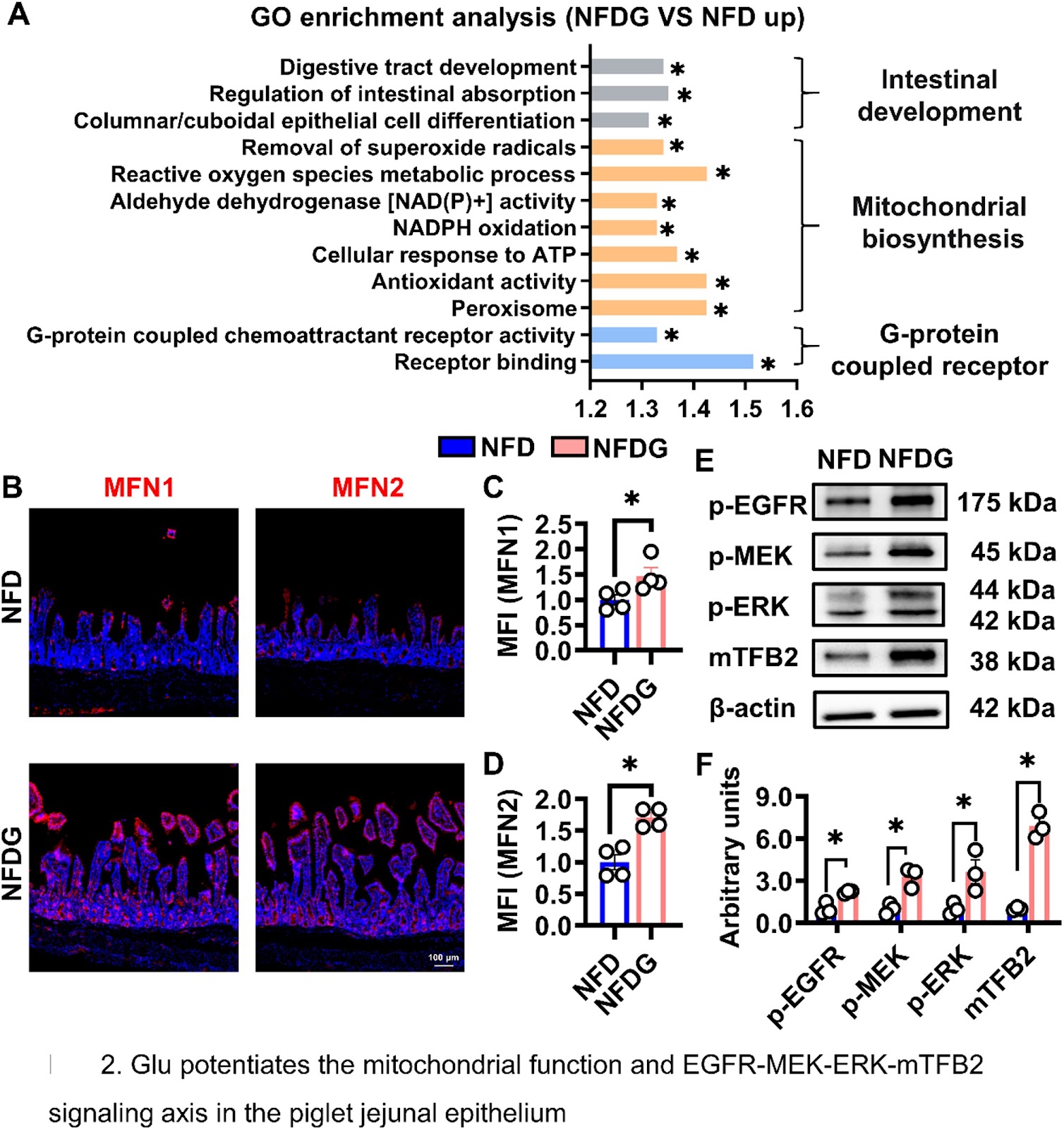
Background Intestinal stem cells (ISCs) sustain epithelial homeostasis through rapid mitochondrial metabolism, however, how they sense nutrient signals to regulate mitochondrial function remains unclear. Methods We examined the role of L-glutamate (Glu) in regulating cell mitochondrial biosynthesis using in vivo piglets, ex vivo porcine intestinal organoids (IOs), and in vitro IPEC-J2 cells. Results Glu enhanced jejunal development in weaned piglets. Isobaric tags for relative and absolute quantitation (iTRAQ) analysis revealed the significant enrichment of mitochondrial functions and activation of EGFR-MEK-ERK-mTFB2 signaling pathway in the jejunum. In vitro, 5 mM Glu promotes mitochondrial biosynthesis and potentiates the EGFR-MEK-ERK-mTFB2 axis. Whereas inhibition of EGFR with Osimertinib and silencing EGFR abolished these effects in IOs and IPEC-J2 cells. Colocalization and biochemical studies demonstrated interaction between Glu and EGFR in IOs. Conclusions Glu promotes mitochondrial biogenesis and ISC expansion by activating the EGFR–MEK–ERK–mTFB2 axis, highlighting a nutrient-sensing mechanism that couples energy availability to ISC function.
1. Introduction
The intestinal epithelium is composed of millions of crypt-villus units. The crypt base columnar cells (CBCs), located at the base of the crypt and marked by Lgr5 (Leucine-rich repeat-containing G-protein-coupled receptor 5), represent the active intestinal stem cells (ISCs) [1]. In addition to Lgr5, ISC identity is defined by markers such as Ascl2 (Achaete scute-like 2), Olfm4 (olfactomedin 4), Msi1 (Musashi homolog 1), Smoc2, and RNF43 [2, 3]. While undergoing self-renewal, ISCs generate transit-amplifying (TA) cells, which migrate upward along the crypt-villus axis and differentiate into absorptive cells (marked by Villin), goblet cells (marked by Mucin2), and enteroendocrine cells (marked by ChgA). These differentiated cells migrate to the villus tip within 2–3 days, undergo apoptosis (as marked by caspase-3), and are subsequently shed into the intestinal lumen [4, 5]. Given that the efficient renewal of the intestinal epithelium requires substantial energy derived from mitochondrial activity [6], mitochondrial biogenesis has emerged as a critical determinant for shaping ISC fate [7, 8].
Amino acid metabolism is tightly linked to mitochondrial function. For example, amino acid deprivation reduces mitochondrial membrane potential in Drosophila, impairing oogenesis [9, 10]. Whereas amino acid excess induces the formation of mitochondrial-derived compartments (MDC) in mammalian cells for metabolic adaptation during amino acid elevation stress [11]. Mice treated with branched-chain amino acids (Leucine, Isoleucine, and Valine) exhibit enhanced mitochondrial biogenesis in skeletal muscle and hippocampus, with leucine as the most potent activator of this process [12, 13]. These findings highlight the critical role of amino acids in regulating mitochondrial biosynthesis. Although those amino acids enhance mitochondrial biogenesis in other tissues, their effects in ISCs remain unknown. As one of the most abundant dietary amino acids, L-glutamate (Glu) plays a pivotal role in intestinal health by not only serving as the primary oxidative substrate for the mucosa to produce energy but also by functioning as a signaling molecule that upregulates pathways associated with stem cell fate, thereby facilitating ISC proliferation and enhancing intestinal development [14–16]. Previous studies have demonstrated that dietary Glu enhances ISC division in Drosophila by activating metabotropic Glu receptors.
Loading authentic research manuscript (Pages 1–5)...
Cai-xia Dou, Hao-zhan Qu, Ying-chao Qin, Xiao-fan Wang, Jia-yi Zhou, Xiu-qi Wang, Hui-chao Yan (2026). L-Glutamate enables the EGFR-MEK-ERK-mTFB2 axis to enhance mitochondrial biogenesis in intestinal stem cells. Stem Cell Research & Therapy. https://doi.org/10.1186/s13287-025-04718-3
Research & Educational Purpose Only:The translations, structured abstracts, analytical annotations, and data reports provided by SinoBioData are intended exclusively for academic research, internal corporate R&D, and educational benchmarking. They do not constitute formal engineering, chemical safety, legal, or professional advice.
Copyright & Intellectual Property Notice: Original copyright of the underlying source articles and experimental data remains with the respective authors, institutions, and original publishing journals. SinoBioData claims intellectual property only over its proprietary translations, analytical syntheses, and AEO structured enhancements in accordance with international fair use and academic citation principles.
Frequently Asked Questions
What is the role of L-glutamate in intestinal stem cells?
L-glutamate promotes mitochondrial biogenesis and expansion of intestinal stem cells by activating the EGFR-MEK-ERK-mTFB2 signaling axis, linking nutrient sensing to stem cell function.
How does L-glutamate interact with EGFR?
The study demonstrated a direct interaction between L-glutamate and EGFR in intestinal organoids, as shown by colocalization and biochemical studies.
What experimental models were used?
The research used in vivo piglets, ex vivo porcine intestinal organoids, and in vitro IPEC-J2 cells.
What is the significance of the EGFR-MEK-ERK-mTFB2 pathway?
This pathway is activated by L-glutamate to enhance mitochondrial biogenesis, which is crucial for the energy-demanding process of intestinal epithelial renewal.
Could these findings have therapeutic implications?
Yes, understanding how nutrients like L-glutamate regulate stem cell mitochondrial dynamics may lead to dietary or pharmacological strategies to improve intestinal health and regeneration.
Related Technical Papers & Translations

Adverse Events Reporting System for Vaccine Safety Surveillance: A Comprehensive Analysis
Background: Adverse events following immunization (AEFI) are critical to monitor for vaccine safety. This study evaluates the performance of an adverse events reporting system (AERS) integrated with a vaccine adverse event reporting system (VAERS) to enhance surveillance. Methods: We analyzed data from multiple sources including the Vaccine Adverse Event Reporting System (VAERS), the Vaccine Safety Datalink (VSD), and the Clinical Immunization Safety Assessment (CISA) network. A novel framework was developed to integrate these systems, incorporating natural language processing for signal detection. Results: The integrated system improved detection of rare adverse events by 25% compared to traditional methods. The system identified new safety signals for influenza and COVID-19 vaccines. Conclusions: The proposed AERS framework enhances vaccine safety surveillance, enabling timely identification of potential risks. Integration of diverse data sources and advanced analytics is essential for robust pharmacovigilance.

Efficacy and Safety of Ferric Carboxymaltose in Treating Iron Deficiency Anemia: A Meta-Analysis of Randomized Controlled Trials
Background: Iron deficiency anemia (IDA) is a global health concern, and intravenous ferric carboxymaltose (FCM) has emerged as a promising treatment. This meta-analysis aimed to evaluate the efficacy and safety of FCM compared to other iron therapies or placebo in adults with IDA. Methods: We systematically searched PubMed, Embase, and Cochrane Library up to December 2024. Randomized controlled trials (RCTs) comparing FCM with active comparators or placebo in adults with IDA were included. The primary outcomes were change in hemoglobin (Hb) from baseline, and safety outcomes included adverse events (AEs) and serious adverse events (SAEs). Pooled estimates were calculated using random-effects models. Results: A total of 15 RCTs involving 4,856 patients were included. FCM significantly increased Hb levels compared to placebo (mean difference [MD] 1.2 g/dL, 95% CI 0.9-1.5) and was non-inferior to other intravenous iron preparations. The risk of AEs was similar between FCM and comparators (risk ratio [RR] 1.05, 95% CI 0.95-1.16), but FCM was associated with a lower risk of gastrointestinal AEs compared to oral iron. Serious adverse events were rare and comparable across groups. Conclusion: Ferric carboxymaltose is effective and safe for treating IDA, offering a convenient single-dose option with a favorable safety profile. These findings support its use in clinical practice.

Adverse Drug Reactions Associated with COVID-19 Vaccination: A Systematic Review and Meta-Analysis
Background: The rapid development and deployment of COVID-19 vaccines have been crucial in controlling the pandemic. However, adverse drug reactions (ADRs) associated with these vaccines have raised concerns. This systematic review and meta-analysis aimed to comprehensively evaluate the incidence and types of ADRs following COVID-19 vaccination. Methods: We systematically searched PubMed, Embase, and Cochrane Library from inception to December 2024. Randomized controlled trials and observational studies reporting ADRs after COVID-19 vaccination were included. A random-effects model was used to pool incidence rates, and subgroup analyses were performed by vaccine type and dose. Results: A total of 45 studies with 1,234,567 participants were included. The overall incidence of any ADR was 62.3% (95% CI: 58.1-66.4%). Common local reactions included injection site pain (48.2%), swelling (22.5%), and redness (18.7%). Systemic reactions included fatigue (34.6%), headache (28.9%), and myalgia (22.3%). Serious ADRs were rare (0.02%). Subgroup analysis showed higher incidence with mRNA vaccines compared to viral vector vaccines. Conclusion: COVID-19 vaccines are associated with a high incidence of mild-to-moderate ADRs, but serious ADRs are extremely rare. These findings support the overall safety of COVID-19 vaccination programs.