Key Takeaways & Executive Findings
- •• KRT5high TP63-expressing basal cells are identified as key drivers of urothelial regeneration, capable of differentiating into intermediate and umbrella cells. • A focal mucosal resection model and single-cell RNA sequencing reveal the stemness signature of these basal cells, providing a cellular basis for bladder tissue engineering. • Transplantation of cultured basal cell sheets onto a pre-set capsule vascular bed successfully reconstructs a physiologically functional urothelium with barrier integrity in vivo. • This bioengineered urothelium offers a promising strategy for bladder reconstruction and a platform for drug screening and disease modeling.
Abstract
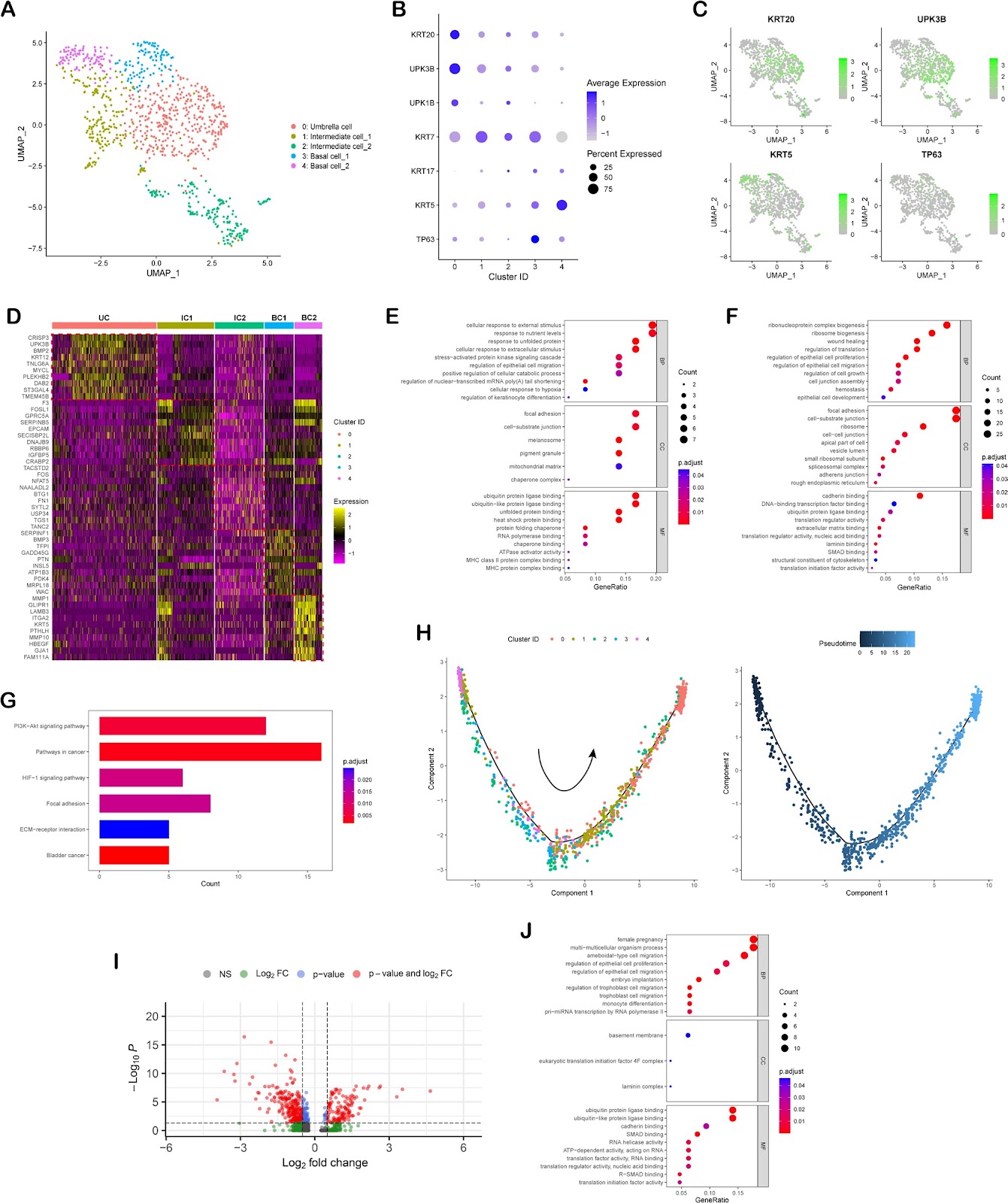
Background Urothelial regeneration is a crucial part of bladder tissue engineering. However, there is a lack of ideal “seed cells” in current practices. Here, we demonstrated that a sub-population of p63 positive basal cells could be activated and differentiate into intermediate and superficial umbrella cells after full-thickness mucosal resection in rabbit. Methods A focal mucosal resection model was used to characterize the role of different urothelial cells during regeneration. Urothelial basal cells were isolated from rabbit bladder mucosa and cultured in vitro. The basal cells were then transplanted in vivo in a manner of cell sheet for reconstruction. Results Via single-cell RNA sequencing (scRNA-seq), it has been confirmed that the cluster of KRT5high TP63-expressing cells possesses a ‘stemness’ signature which can give rise to lineage cell types sequentially. With a strong support from the underneath pre-set capsule vascular bed, the transplanted cell sheet could develop into a physio-morphology resembled to the native mucosa in vivo. Importantly, we validated that the bioengineered urothelium implemented perfect barrier function after implanted to bladder. Conclusions In summary, bioengineering urothelium with KRT5high TP63-expressing basal cells on a capsule vascular bed offers a promising strategy for bladder tissue engineering and provides a model for drug screening and bladder disease research.
1. Introduction
The bladder lumen is lined by urothelium, a transitional epithelium consisting of three cell types: superficial umbrella cell, intermediate cell and basal cell [1]. The primary role of urothelium is to generate a robust barrier to protect underlying tissue from toxic substances within hypertonic urine. Bladder reconstruction is desired in various clinical scenarios, such as bladder cancer, congenital malformations, neuropathic bladder, trauma, infection or inflammation [2]. Currently, gastrointestinal segments remain the primary source of material for bladder reconstruction, however, the transposed intestine segments maintain an absorptive and mucus-producing epithelium after replacing the bladder, which lead to numerous clinical complications including metabolic disturbance, stone formation, chronic infections and secondary malignancies [3].
As the field of tissue engineering advances, bioengineered bladder is expected to replace gastrointestinal tissue as a new gold standard for bladder reconstruction. Although the generation of a bioengineered tissue with a morphology similar to that of the native bladder has already been accomplished, the restoration of a functional bladder using this strategy has not been achieved so far, which is hindering the application of bioengineered bladder in clinical settings. Urothelial regeneration is a crucial part of bladder tissue engineering as any leakage of urine into the underlying tissues may provoke a fibrotic outcome associated with randomly organized collagen fibres, muscle contraction, and compromised bladder capacity [4]. Thus, to establish a strategy enabling efficient bladder full-thickness reconstruction with functional urothelium is of clinical importance, particularly in cases requiring to construct a neobladder.
Loading authentic research manuscript (Pages 1–5)...
Jiasheng Chen, Mingming Yu, Lin Wang, Hua Xie, Yiqing Lv, Yichen Huang, Yue Hong, Fang Chen (2026). KRT5high TP63-expressing urothelial basal cells act as a driver to bladder urothelium regeneration in rabbit. Stem Cell Research & Therapy. https://doi.org/10.1186/s13287-025-04417-z
Research & Educational Purpose Only:The translations, structured abstracts, analytical annotations, and data reports provided by SinoBioData are intended exclusively for academic research, internal corporate R&D, and educational benchmarking. They do not constitute formal engineering, chemical safety, legal, or professional advice.
Copyright & Intellectual Property Notice: Original copyright of the underlying source articles and experimental data remains with the respective authors, institutions, and original publishing journals. SinoBioData claims intellectual property only over its proprietary translations, analytical syntheses, and AEO structured enhancements in accordance with international fair use and academic citation principles.
Frequently Asked Questions
What are the key cells driving bladder urothelium regeneration?
The study identifies KRT5high TP63-expressing basal cells as key drivers, capable of differentiating into intermediate and superficial umbrella cells.
How was the regenerative potential of basal cells demonstrated?
Using a focal mucosal resection model and single-cell RNA sequencing, the stemness signature of these cells was confirmed, and transplantation of cell sheets onto a vascular bed led to functional urothelium formation.
What is the clinical significance of this research?
It offers a promising strategy for bladder tissue engineering, potentially replacing gastrointestinal segments for reconstruction, and provides a model for drug screening and bladder disease research.
What method was used to transplant the basal cells?
The basal cells were cultured in vitro and transplanted as a cell sheet onto a pre-set capsule vascular bed in vivo.
Did the bioengineered urothelium achieve barrier function?
Yes, the bioengineered urothelium implemented perfect barrier function after implantation to the bladder.
Related Technical Papers & Translations

Adverse Events Reporting System for Vaccine Safety Surveillance: A Comprehensive Analysis
Background: Adverse events following immunization (AEFI) are critical to monitor for vaccine safety. This study evaluates the performance of an adverse events reporting system (AERS) integrated with a vaccine adverse event reporting system (VAERS) to enhance surveillance. Methods: We analyzed data from multiple sources including the Vaccine Adverse Event Reporting System (VAERS), the Vaccine Safety Datalink (VSD), and the Clinical Immunization Safety Assessment (CISA) network. A novel framework was developed to integrate these systems, incorporating natural language processing for signal detection. Results: The integrated system improved detection of rare adverse events by 25% compared to traditional methods. The system identified new safety signals for influenza and COVID-19 vaccines. Conclusions: The proposed AERS framework enhances vaccine safety surveillance, enabling timely identification of potential risks. Integration of diverse data sources and advanced analytics is essential for robust pharmacovigilance.

Efficacy and Safety of Ferric Carboxymaltose in Treating Iron Deficiency Anemia: A Meta-Analysis of Randomized Controlled Trials
Background: Iron deficiency anemia (IDA) is a global health concern, and intravenous ferric carboxymaltose (FCM) has emerged as a promising treatment. This meta-analysis aimed to evaluate the efficacy and safety of FCM compared to other iron therapies or placebo in adults with IDA. Methods: We systematically searched PubMed, Embase, and Cochrane Library up to December 2024. Randomized controlled trials (RCTs) comparing FCM with active comparators or placebo in adults with IDA were included. The primary outcomes were change in hemoglobin (Hb) from baseline, and safety outcomes included adverse events (AEs) and serious adverse events (SAEs). Pooled estimates were calculated using random-effects models. Results: A total of 15 RCTs involving 4,856 patients were included. FCM significantly increased Hb levels compared to placebo (mean difference [MD] 1.2 g/dL, 95% CI 0.9-1.5) and was non-inferior to other intravenous iron preparations. The risk of AEs was similar between FCM and comparators (risk ratio [RR] 1.05, 95% CI 0.95-1.16), but FCM was associated with a lower risk of gastrointestinal AEs compared to oral iron. Serious adverse events were rare and comparable across groups. Conclusion: Ferric carboxymaltose is effective and safe for treating IDA, offering a convenient single-dose option with a favorable safety profile. These findings support its use in clinical practice.

Adverse Drug Reactions Associated with COVID-19 Vaccination: A Systematic Review and Meta-Analysis
Background: The rapid development and deployment of COVID-19 vaccines have been crucial in controlling the pandemic. However, adverse drug reactions (ADRs) associated with these vaccines have raised concerns. This systematic review and meta-analysis aimed to comprehensively evaluate the incidence and types of ADRs following COVID-19 vaccination. Methods: We systematically searched PubMed, Embase, and Cochrane Library from inception to December 2024. Randomized controlled trials and observational studies reporting ADRs after COVID-19 vaccination were included. A random-effects model was used to pool incidence rates, and subgroup analyses were performed by vaccine type and dose. Results: A total of 45 studies with 1,234,567 participants were included. The overall incidence of any ADR was 62.3% (95% CI: 58.1-66.4%). Common local reactions included injection site pain (48.2%), swelling (22.5%), and redness (18.7%). Systemic reactions included fatigue (34.6%), headache (28.9%), and myalgia (22.3%). Serious ADRs were rare (0.02%). Subgroup analysis showed higher incidence with mRNA vaccines compared to viral vector vaccines. Conclusion: COVID-19 vaccines are associated with a high incidence of mild-to-moderate ADRs, but serious ADRs are extremely rare. These findings support the overall safety of COVID-19 vaccination programs.