Key Takeaways & Executive Findings
- •• IVD progenitor cells (IVD-PCs) exhibit stemness properties including clonogenicity and multipotent differentiation, positioning them as key cellular reservoirs for disc self-repair. • The IVD microenvironment, encompassing physicochemical, mechanical, and cellular cues, critically regulates IVD-PC fate decisions during homeostasis and degeneration. • Current clinical translation of IVD-PCs is limited by incomplete understanding of their heterogeneity and hierarchical organization, necessitating advanced identification and characterization strategies. • Future therapeutic development should focus on modulating the IVD niche to guide endogenous progenitor cell behavior for effective disc regeneration.
Abstract
Intervertebral disc (IVD) degenerative disease is a prevalent and debilitating spinal disease. Current treatments only focus on symptomatic relief but fail to halt disease progression or restore the native biomechanical function of the spine. Regenerative medicine strategies, particularly those harnessing endogenous progenitor cells, offer a promising avenue for achieving biological repair and functional homeostasis. The identification of intervertebral disc progenitor cells (IVD-PCs) has unveiled a potential cellular reservoir for self-repair, given their demonstrated stemness attributes, including clonogenicity and multipotent differentiation. However, the clinical translation of IVD-PCs is significantly hampered by an incomplete understanding of their inherent heterogeneity, hierarchical organization, and, most critically, the dynamic interplay with their unique microenvironment, which dictates their fate decisions. This review synthesizes recent advances in deciphering the molecular signatures and functional plasticity of IVD-PCs. We place a particular emphasis on how key physicochemical, mechanical, and cellular cues within the IVD niche orchestrate progenitor cell behavior—ranging from maintenance and activation to aberrant differentiation—during both homeostasis and degeneration. Furthermore, we propose forward-looking insights to bridge critical knowledge gaps, aiming to propel the development of novel progenitor cell-based therapeutics for IVD degeneration.
1. Introduction
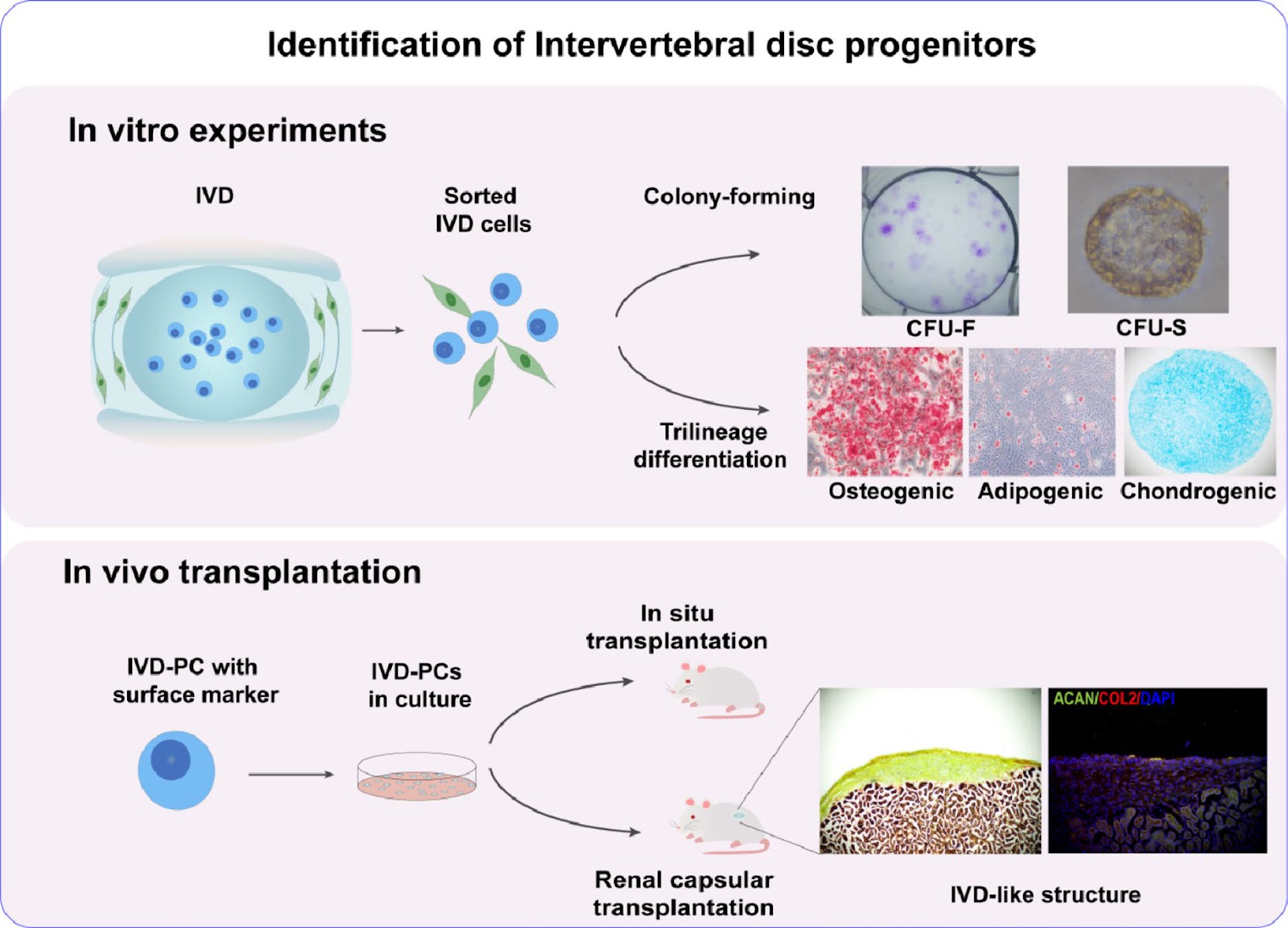
Low back pain (LBP) is one of the main causes of disability worldwide, which led to an enormous burden on society and the economy [1]. With the increase in the population and the aging of society, the incidence of LBP and its related medical expenses have increased rapidly, resulting in a huge social and economic burden. IVD degeneration is the primary cause of LBP and approximately 40% of LBP is related to IVD degeneration [2, 3]. The pathological factors of IVD degeneration are complicated, and they include genetic factors [3], age [4], trauma effects [5], and other causes. In a macroscopic view, the pathological process of degeneration leads to morphological changes in IVD, including a decline in the water content of the nucleus pulposus (NP), tears of the annulus fibrosis (AF), and ossification of the cartilage endplate (CEP), which ultimately result in disc bulging and a reduction in the intervertebral space height [6]. In a microscopic view, IVD degeneration leads to degradation of the extracellular matrix (ECM), decreasing cell numbers, reduced viability, and altered cell phenotypes in situ [7]. The pathological mechanisms of IVD degeneration include inflammation [8], a decline of progenitor cells [9], CEP calcification [10], etc. Regenerative medicine based on biological therapy for IVD regeneration has shown great clinical potential for the treatment of IVD degeneration [11, 12]. It is expected that these technologies will be used to synthesize native ECM via stimulating endogenous cells or transplanting exogenous cells. Studies have shown that cell therapy may be effective in repairing IVD. S. Haufe and A. Mork were the first to clinically study stem cell transplantation for ameliorating IVD degeneration [13]. They injected hematopoietic stem cells into the IVDs of 10 patients but found no improvement in symptoms one year after the operation. Thereafter, L. Orozco et al. transplanted autologous bone marrow mesenchymal stem cells (BM-MSCs) and adipose-derived mesenchymal stem cells (AD-MSCs) into the IVDs of patients with LBP. After the operation, the pain was rapidly relieved, and MRI scans showed an increase in water content in the NP [14]. Notably, a kind of mesoderm-derived progenitors in the IVD has been deciphered and named as IVD progenitor cells (IVD-PCs) or IVD mesenchymal stem cells (IVD-MSCs). Because their stemness has not been fully clarified, it could be more precise to be classified as IVD-PCs. IVD-PCs have exhibited great value as a cell source for cell transplantation because they show superior biosafety and functional controllability owing to feasibly being isolated from autologous IVDs [11, 12]. However, studies about the identification of IVD-PCs and the regulation of cell fate are still in their infancy. Key requirements for their clinical application include precise identification of IVD-PCs, characterization of their cell functions, and clarification of the cell fate determinants. Therefore, we reviewed recent progress on the identification of IVD-PCs and the microenvironmental regulatory cues on IVD-PCs fate and provide potential clues for future investigations of IVD-PCs.
Loading authentic research manuscript (Pages 1–5)...
Pulin Yan, Jian He, Yongwei Huang, Chen Lin, Sha Huang, Ou Hu, Peng Lin, Yingbo Wang, Huaijian Jin, Yangyang Li, Qin Qin, Yutong Wu, Jian Wu, Jungang Pu, Yangli Xie, Lin Chen, Sien Lin, Yibo Gan, Peng Liu (2026). Intervertebral disc progenitor cells: roles in regeneration and disease. Stem Cell Research & Therapy. https://doi.org/10.1186/s13287-026-04918-5
Research & Educational Purpose Only:The translations, structured abstracts, analytical annotations, and data reports provided by SinoBioData are intended exclusively for academic research, internal corporate R&D, and educational benchmarking. They do not constitute formal engineering, chemical safety, legal, or professional advice.
Copyright & Intellectual Property Notice: Original copyright of the underlying source articles and experimental data remains with the respective authors, institutions, and original publishing journals. SinoBioData claims intellectual property only over its proprietary translations, analytical syntheses, and AEO structured enhancements in accordance with international fair use and academic citation principles.
Frequently Asked Questions
What are intervertebral disc progenitor cells (IVD-PCs)?
IVD-PCs are a population of progenitor cells residing in the intervertebral disc that exhibit stemness properties such as clonogenicity and multipotent differentiation. They are considered a potential cellular reservoir for disc self-repair and regeneration.
How is the IVD microenvironment involved in regulating IVD-PC fate?
The IVD microenvironment provides physicochemical, mechanical, and cellular cues that orchestrate IVD-PC behavior, including maintenance, activation, and differentiation. During degeneration, these cues can become aberrant, leading to altered cell fate and impaired regenerative capacity.
What are the challenges in clinical translation of IVD-PC-based therapies?
Key challenges include incomplete understanding of IVD-PC heterogeneity and hierarchical organization, lack of definitive markers for precise isolation, and the need to control cell fate decisions in the complex IVD niche. Overcoming these hurdles is essential for developing effective cell-based treatments.
What therapeutic strategies are being explored for IVD degeneration using progenitor cells?
Strategies include stimulating endogenous IVD-PCs through growth factors or biomaterials, and transplanting exogenous progenitor cells (e.g., bone marrow MSCs) into the disc. Recent research focuses on modulating the niche to guide progenitor cell behavior for functional regeneration.
What is the significance of identifying IVD-PCs for regenerative medicine?
Identifying IVD-PCs provides a target for endogenous repair mechanisms and a cell source for transplantation. Understanding their biology and regulation is crucial for developing novel therapies that can halt or reverse disc degeneration, potentially reducing the burden of low back pain.
Related Technical Papers & Translations

Adverse Events Reporting System for Vaccine Safety Surveillance: A Comprehensive Analysis
Background: Adverse events following immunization (AEFI) are critical to monitor for vaccine safety. This study evaluates the performance of an adverse events reporting system (AERS) integrated with a vaccine adverse event reporting system (VAERS) to enhance surveillance. Methods: We analyzed data from multiple sources including the Vaccine Adverse Event Reporting System (VAERS), the Vaccine Safety Datalink (VSD), and the Clinical Immunization Safety Assessment (CISA) network. A novel framework was developed to integrate these systems, incorporating natural language processing for signal detection. Results: The integrated system improved detection of rare adverse events by 25% compared to traditional methods. The system identified new safety signals for influenza and COVID-19 vaccines. Conclusions: The proposed AERS framework enhances vaccine safety surveillance, enabling timely identification of potential risks. Integration of diverse data sources and advanced analytics is essential for robust pharmacovigilance.

Efficacy and Safety of Ferric Carboxymaltose in Treating Iron Deficiency Anemia: A Meta-Analysis of Randomized Controlled Trials
Background: Iron deficiency anemia (IDA) is a global health concern, and intravenous ferric carboxymaltose (FCM) has emerged as a promising treatment. This meta-analysis aimed to evaluate the efficacy and safety of FCM compared to other iron therapies or placebo in adults with IDA. Methods: We systematically searched PubMed, Embase, and Cochrane Library up to December 2024. Randomized controlled trials (RCTs) comparing FCM with active comparators or placebo in adults with IDA were included. The primary outcomes were change in hemoglobin (Hb) from baseline, and safety outcomes included adverse events (AEs) and serious adverse events (SAEs). Pooled estimates were calculated using random-effects models. Results: A total of 15 RCTs involving 4,856 patients were included. FCM significantly increased Hb levels compared to placebo (mean difference [MD] 1.2 g/dL, 95% CI 0.9-1.5) and was non-inferior to other intravenous iron preparations. The risk of AEs was similar between FCM and comparators (risk ratio [RR] 1.05, 95% CI 0.95-1.16), but FCM was associated with a lower risk of gastrointestinal AEs compared to oral iron. Serious adverse events were rare and comparable across groups. Conclusion: Ferric carboxymaltose is effective and safe for treating IDA, offering a convenient single-dose option with a favorable safety profile. These findings support its use in clinical practice.

Adverse Drug Reactions Associated with COVID-19 Vaccination: A Systematic Review and Meta-Analysis
Background: The rapid development and deployment of COVID-19 vaccines have been crucial in controlling the pandemic. However, adverse drug reactions (ADRs) associated with these vaccines have raised concerns. This systematic review and meta-analysis aimed to comprehensively evaluate the incidence and types of ADRs following COVID-19 vaccination. Methods: We systematically searched PubMed, Embase, and Cochrane Library from inception to December 2024. Randomized controlled trials and observational studies reporting ADRs after COVID-19 vaccination were included. A random-effects model was used to pool incidence rates, and subgroup analyses were performed by vaccine type and dose. Results: A total of 45 studies with 1,234,567 participants were included. The overall incidence of any ADR was 62.3% (95% CI: 58.1-66.4%). Common local reactions included injection site pain (48.2%), swelling (22.5%), and redness (18.7%). Systemic reactions included fatigue (34.6%), headache (28.9%), and myalgia (22.3%). Serious ADRs were rare (0.02%). Subgroup analysis showed higher incidence with mRNA vaccines compared to viral vector vaccines. Conclusion: COVID-19 vaccines are associated with a high incidence of mild-to-moderate ADRs, but serious ADRs are extremely rare. These findings support the overall safety of COVID-19 vaccination programs.