Key Takeaways & Executive Findings
- •• Integrins are key regulators in NAFLD progression, influencing steatosis, HSC activation, and immune infiltration. • The review highlights integrin-mediated signaling pathways as potential therapeutic targets for NAFLD and NASH. • Current clinical and preclinical integrin-targeting drugs show promise for treating steatosis, inflammation, fibrosis, and NAFLD-related HCC. • Understanding integrin functions may lead to novel diagnostic and treatment strategies for NAFLD-associated liver diseases.
Abstract
Nonalcoholic fatty liver disease (NAFLD) is a leading cause of chronic liver disease and poses a substantial health burden with increasing incidence globally. NAFLD encompasses a spectrum extending from hepatic steatosis to nonalcoholic steatohepatitis (NASH), with the possibility of progressing to cirrhosis or, in severe instances, hepatocellular carcinoma (HCC). NAFLD extends beyond simple metabolic disruption and involves multiple immune cell-mediated inflammatory processes. Integrins are a family of heterodimeric transmembrane cell adhesion receptors that regulate various aspects of NAFLD onset and progression, including hepatocellular steatosis, hepatic stellate cell (HSC) activation and immune cell infiltration. In this review, we comprehensively summarize the involvement of integrins in NAFLD, as well as the downstream signal transduction mediated by these receptors. Furthermore, we present the latest clinical and preclinical findings on drugs that target integrins for steatosis, inflammation, fibrosis and NAFLD-related HCC treatment.
1. Introduction
Liver disease is a worldwide health care concern, contributing to more than two million deaths annually and accounting for 4% of all deaths worldwide [1]. At present, nonalcoholic fatty liver disease (NAFLD) is the predominant etiology of chronic hepatitis in Western societies, with its prevalence rapidly increasing on a global scale [2]. Notably, this condition impacts a quarter of the global adult population. Over the past two decades, with rapid lifestyle changes, NAFLD has become the most common liver disease in China. The prevalence of NAFLD has increased from 23.8% to 29.0%; however, NAFLD has not received sufficient attention [3]. Over the past 30 years, the total number of deaths among NAFLD patients worldwide has doubled. The overall percentage of deaths attributed to NAFLD-related causes has increased from 0.10% to 0.17% [1]. Owing to continued high rates of adult obesity and type 2 diabetes mellitus, coupled with an aging population, the total NAFLD population is forecasted to increase by 18.3% in the U.S., whereas the prevalence of nonalcoholic steatohepatitis (NASH) cases is expected to increase by 56% by 2030 [4,5]. Currently, NAFL is defined as a catch-all term that encompasses a variety of disorders characterized by steatosis affecting a minimum of 5% of hepatocytes, combined with metabolic risk factors (such as type 2 diabetes and obesity). This definition excludes heavy alcohol usage-induced hepatitis or other chronic liver diseases. Furthermore, NASH is characterized by hepatic damage, including hepatocyte ballooning degeneration, diffuse lobular inflammation, and fibrosis [6]. Up to 15% of individuals with NAFLD progress to NASH, the more severe form of the disease. Whereas simple steatosis is often considered a “benign” condition, individuals with NASH face the potential for progression to fibrosis, cirrhosis and hepatocellular carcinoma (HCC) and have an elevated risk of liver-related mortality. In addition, HCC may develop in individuals with NAFLD without cirrhosis, termed NAFLD-HCC [7].
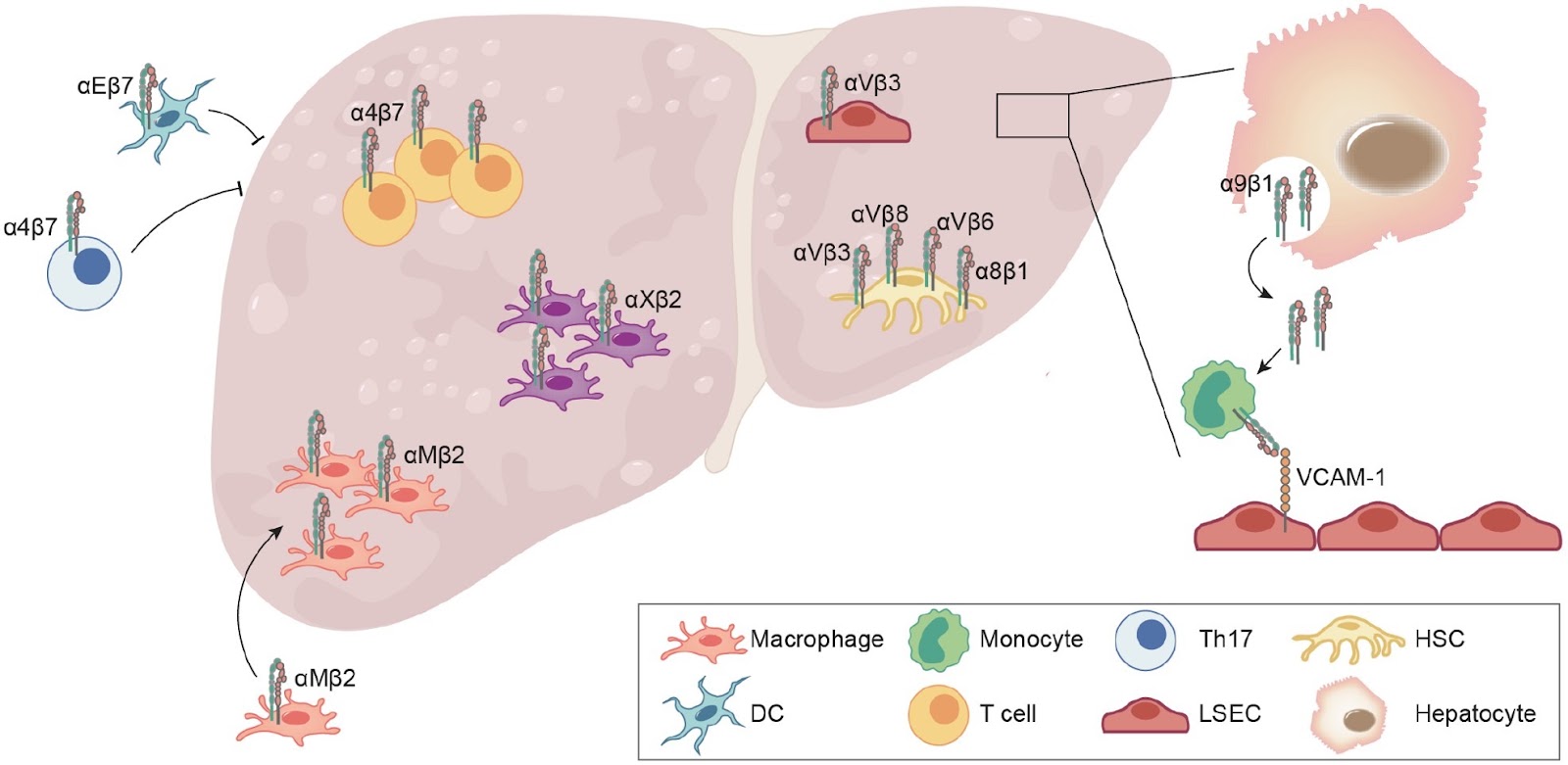
Integrins are α/β heterodimeric cell adhesion molecules, mediating cell-cell, cell-extracellular matrix (ECM) and cell-pathogen interactions and transmit signals bidirectionally across the plasma membrane [8]. In vertebrates, 18 α subunits and 8 β subunits exist, which combine into 24 types of integrins that are broadly distributed across numerous organs and tissues (Figure 1). Integrins, as type I transmembrane proteins, control cell-cell and cell-ECM adhesion, thereby impacting a variety of cellular functions, including migration, proliferation, wound repair, and other cellular activities [9]. In NAFLD, integrins serve as the primary mechanism by which cells in the liver sense their extracellular environment, such as accumulated lipids that trigger the “first hit” in NAFLD, which involves insulin resistance (IR) and hepatic steatosis [10]. Liver tissue eventually undergoes lipid peroxidation, endoplasmic reticulum (ER) stress, oxidative stress, inflammatory damage, and other pathological alterations, contributing to the development of the “multiple-hit” scenario [11]. During NAFLD-induced fibrogenesis, integrins mediate diverse cell-matrix and cell-cell interactions. In NASH-related HCC, which progresses annually [12], integrins are typically dysregulated and are involved in nearly every stage of cancer progression, including epithelial-mesenchymal transition (EMT), angiogenesis, cell proliferation, adhesion, and invasion [13]. Moreover, integrins are considered to influence multiple components within the tumor microenvironment of HCC, such as lymphocyte activation, migration, and extravasation.
Loading authentic research manuscript (Pages 1–5)...
Yangyue Ni, Mengwen Huang, Shiyang Chen, Shihui Wang, Jianfeng Chen (2026). Integrins and NAFLD-associated liver diseases: clinical associations, pathophysiological mechanisms and pharmacological implications. Acta Biochimica et Biophysica Sinica. https://doi.org/10.3724/abbs.2024149
Research & Educational Purpose Only:The translations, structured abstracts, analytical annotations, and data reports provided by SinoBioData are intended exclusively for academic research, internal corporate R&D, and educational benchmarking. They do not constitute formal engineering, chemical safety, legal, or professional advice.
Copyright & Intellectual Property Notice: Original copyright of the underlying source articles and experimental data remains with the respective authors, institutions, and original publishing journals. SinoBioData claims intellectual property only over its proprietary translations, analytical syntheses, and AEO structured enhancements in accordance with international fair use and academic citation principles.
Frequently Asked Questions
What is the role of integrins in NAFLD progression?
Integrins regulate key processes in NAFLD, including hepatocellular steatosis, hepatic stellate cell activation, and immune cell infiltration, thereby influencing disease progression from simple steatosis to NASH and fibrosis.
How do integrins contribute to NAFLD-related HCC?
In NAFLD-related HCC, integrins are dysregulated and participate in cancer progression by promoting epithelial-mesenchymal transition, angiogenesis, proliferation, adhesion, and invasion, as well as modulating the tumor microenvironment.
Are there drugs targeting integrins for NAFLD treatment?
Yes, the review discusses clinical and preclinical drugs that target integrins for treating steatosis, inflammation, fibrosis, and NAFLD-related HCC, highlighting their potential as therapeutic agents.
What is the significance of integrin-mediated signaling in NAFLD?
Integrin-mediated signaling pathways are crucial for cellular responses to extracellular matrix changes and inflammatory stimuli, making them promising targets for intervention in NAFLD and its complications.
How does NAFLD progress to more severe liver diseases?
NAFLD can progress from simple steatosis to NASH, characterized by inflammation and hepatocyte damage, and then to fibrosis, cirrhosis, and hepatocellular carcinoma, with integrins playing a role in these pathological transitions.
Related Technical Papers & Translations

Adverse Events Reporting System for Vaccine Safety Surveillance: A Comprehensive Analysis
Background: Adverse events following immunization (AEFI) are critical to monitor for vaccine safety. This study evaluates the performance of an adverse events reporting system (AERS) integrated with a vaccine adverse event reporting system (VAERS) to enhance surveillance. Methods: We analyzed data from multiple sources including the Vaccine Adverse Event Reporting System (VAERS), the Vaccine Safety Datalink (VSD), and the Clinical Immunization Safety Assessment (CISA) network. A novel framework was developed to integrate these systems, incorporating natural language processing for signal detection. Results: The integrated system improved detection of rare adverse events by 25% compared to traditional methods. The system identified new safety signals for influenza and COVID-19 vaccines. Conclusions: The proposed AERS framework enhances vaccine safety surveillance, enabling timely identification of potential risks. Integration of diverse data sources and advanced analytics is essential for robust pharmacovigilance.

Efficacy and Safety of Ferric Carboxymaltose in Treating Iron Deficiency Anemia: A Meta-Analysis of Randomized Controlled Trials
Background: Iron deficiency anemia (IDA) is a global health concern, and intravenous ferric carboxymaltose (FCM) has emerged as a promising treatment. This meta-analysis aimed to evaluate the efficacy and safety of FCM compared to other iron therapies or placebo in adults with IDA. Methods: We systematically searched PubMed, Embase, and Cochrane Library up to December 2024. Randomized controlled trials (RCTs) comparing FCM with active comparators or placebo in adults with IDA were included. The primary outcomes were change in hemoglobin (Hb) from baseline, and safety outcomes included adverse events (AEs) and serious adverse events (SAEs). Pooled estimates were calculated using random-effects models. Results: A total of 15 RCTs involving 4,856 patients were included. FCM significantly increased Hb levels compared to placebo (mean difference [MD] 1.2 g/dL, 95% CI 0.9-1.5) and was non-inferior to other intravenous iron preparations. The risk of AEs was similar between FCM and comparators (risk ratio [RR] 1.05, 95% CI 0.95-1.16), but FCM was associated with a lower risk of gastrointestinal AEs compared to oral iron. Serious adverse events were rare and comparable across groups. Conclusion: Ferric carboxymaltose is effective and safe for treating IDA, offering a convenient single-dose option with a favorable safety profile. These findings support its use in clinical practice.

Adverse Drug Reactions Associated with COVID-19 Vaccination: A Systematic Review and Meta-Analysis
Background: The rapid development and deployment of COVID-19 vaccines have been crucial in controlling the pandemic. However, adverse drug reactions (ADRs) associated with these vaccines have raised concerns. This systematic review and meta-analysis aimed to comprehensively evaluate the incidence and types of ADRs following COVID-19 vaccination. Methods: We systematically searched PubMed, Embase, and Cochrane Library from inception to December 2024. Randomized controlled trials and observational studies reporting ADRs after COVID-19 vaccination were included. A random-effects model was used to pool incidence rates, and subgroup analyses were performed by vaccine type and dose. Results: A total of 45 studies with 1,234,567 participants were included. The overall incidence of any ADR was 62.3% (95% CI: 58.1-66.4%). Common local reactions included injection site pain (48.2%), swelling (22.5%), and redness (18.7%). Systemic reactions included fatigue (34.6%), headache (28.9%), and myalgia (22.3%). Serious ADRs were rare (0.02%). Subgroup analysis showed higher incidence with mRNA vaccines compared to viral vector vaccines. Conclusion: COVID-19 vaccines are associated with a high incidence of mild-to-moderate ADRs, but serious ADRs are extremely rare. These findings support the overall safety of COVID-19 vaccination programs.