Key Takeaways & Executive Findings
- •• RAB29, NDUFS3, and MMP24OS show specific causal associations with sarcopenia, identified via CD4+ T cell dynamic eQTL Mendelian randomization. • NDUFS3 expression in CD4+ naive T cells at 16 and 40 hours post-activation is negatively associated with sarcopenia risk, suggesting a temporal protective effect. • Colocalization analysis confirms shared causal variants between eQTLs of these genes and sarcopenia GWAS signals, strengthening genetic evidence. • NDUFS3 is significantly downregulated in sarcopenia patients, highlighting it as a promising immunotherapeutic target with time-dependent regulation.
Abstract
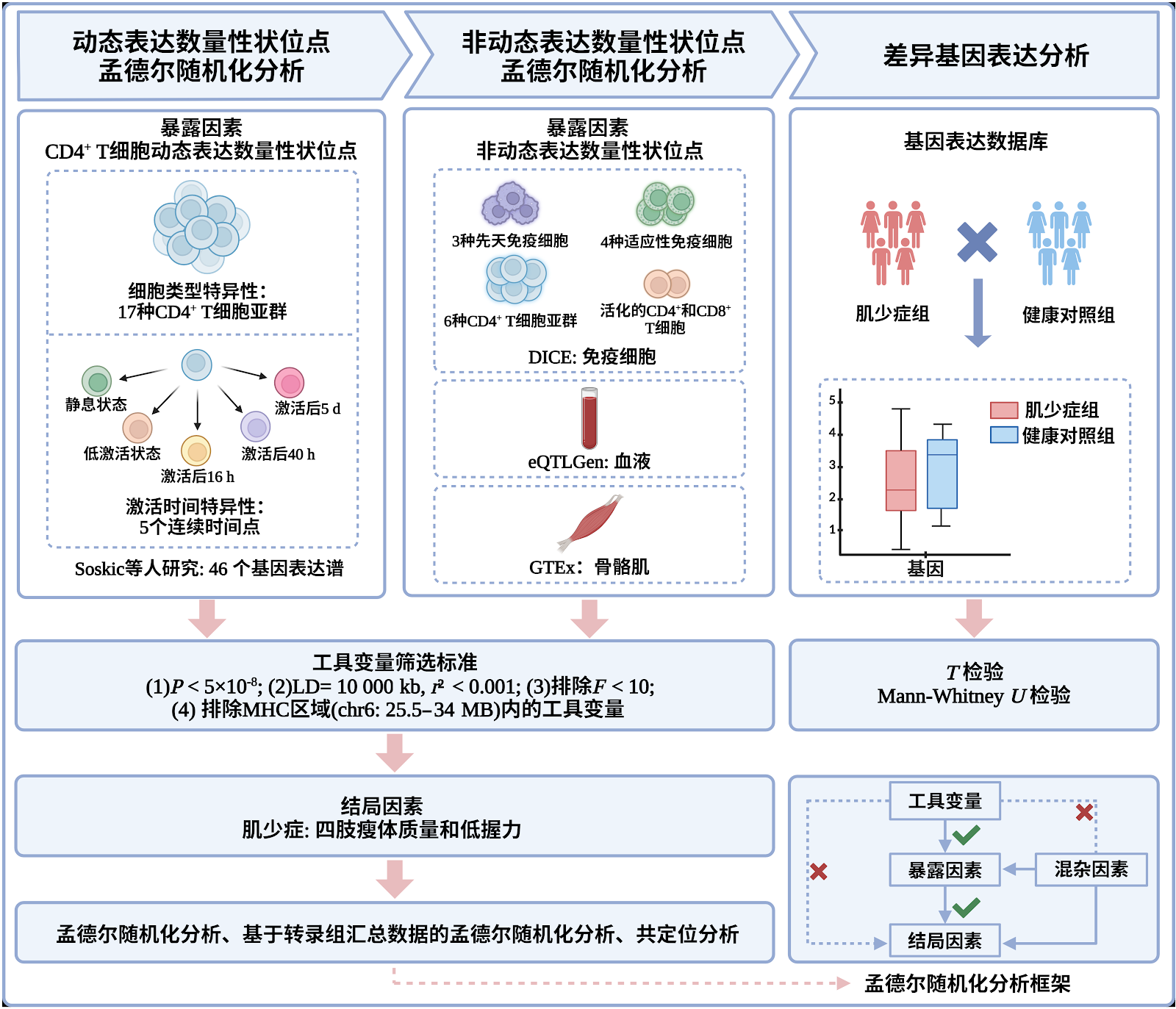
BACKGROUND: Sarcopenia is a degenerative illness in the elderly, and there is currently a dearth of particular therapeutic medications. Abnormalities in immune cells are risk factors for sarcopenia. CD4+ T lymphocytes play a vital role in skeletal muscle repair and regeneration. Previous research generally used expression quantitative trait loci data from whole tissues or blood to identify pharmacological targets, making it difficult to uncover the regulatory effects of gene expression on distinct cell subpopulations and their dynamic activation states. This study integrates dynamic expression quantitative trait locus data of CD4+ T cells to evaluate the immune cell specificity and activation time-dependent impacts of gene expression on sarcopenia, providing a platform for the development of precise immune intervention techniques. OBJECTIVE: To reveal the specific causal relationship between gene expression in different activation phases of CD4+ T cell subpopulations and sarcopenia. METHODS: Based on the dynamic eQTL data of CD4+ T cells from SOSKIC et al. (covering 46 cell-activation states in European populations), the Database of Immune Cell Expression, eQTLs and Epigenomics (DICE), eQTLGen, Genotype-Tissue Expression (GTEx), and GWAS Catalog, a two-sample Mendelian randomization analysis was systematically conducted. First, using CD4+ T cell dynamic eQTLs as exposure and sarcopenia phenotypes as outcomes, candidate genes were screened. Then, eQTL data from immune cells, whole blood, and skeletal muscle tissue were used for validation. Additionally, summary-data-based Mendelian randomization (SMR), heterogeneity tests, colocalization analysis, and differential gene expression analysis (using GEO dataset GSE111016) were performed to verify reliability. All data were publicly available summary statistics and met ethical requirements. All analyses strictly selected instrumental variables and followed the Strengthening the Reporting of Observational Studies in Epidemiology (STROBE) guidelines. RESULTS AND CONCLUSION: (1) SMR and heterogeneity tests showed that RAB29, NDUFS3, and MMP24OS had specific causal associations with sarcopenia. Specifically, expression of RAB29 in CD4+ naive T cells activated for 5 days and MMP24OS in CD4+ memory T cells activated for 5 days were positively associated with sarcopenia risk, while NDUFS3 expression in naive T cells activated for 16 and 40 hours was negatively associated with sarcopenia risk. (2) Colocalization analysis further confirmed that eQTLs for RAB29, NDUFS3, and MMP24OS shared potential causal variants with sarcopenia GWAS signals. (3) Differential expression analysis showed that NDUFS3 was significantly downregulated in sarcopenia patients compared with healthy controls, while RAB29 and MMP24OS showed no significant difference. NDUFS3 was identified as a potential gene therapy target with temporal regulatory characteristics in CD4+ T cells. This analysis was based on European population data; future studies should introduce dynamic eQTL Mendelian randomization frameworks to develop precise T-cell functional timing intervention strategies for the Chinese population.
1. Introduction
Sarcopenia is a chronic degenerative muscle disease associated with aging (ICD-10: M62.84) [1], characterized by progressive loss of muscle mass and strength. It increases the risk of neurodegenerative diseases [2], osteoarthritis, and diabetes [3-4], and leads to a higher risk of falls due to motor dysfunction [5], severely affecting patients' quality of life. Globally, approximately 50 million people suffer from sarcopenia, and with population aging, the number is expected to exceed 500 million by 2050 [6]. Exercise therapy is considered the first-line strategy for prevention and treatment [7-8]. However, for sarcopenia patients with comorbidities such as osteoarthritis or cognitive impairment, exercise intervention is difficult to implement and adherence is poor [9]. Drug therapy holds great potential when exercise is limited, yet no specific drugs are currently available [10]. Therefore, exploring novel therapeutic targets is urgent.
Target discovery based on disease pathogenesis has become a core strategy in modern drug development and precision medicine. Studies indicate that immune cells regulate the onset and progression of sarcopenia through chronic inflammation, modulation of muscle protein metabolism, and effects on skeletal muscle satellite cell function [11-13]. Among them, CD4+ T cells and their subsets, as core components of the adaptive immune system, play regulatory roles in skeletal muscle injury repair and sarcopenia development [11,14-17]. Changes in the number of CD4+ T cells and their subsets in peripheral blood are closely related to the occurrence and progression of sarcopenia [18-22]. The differentiation process involves metabolic reprogramming, which is crucial for T cell function and muscle homeostasis.
Loading authentic research manuscript (Pages 1–5)...
Jin Zicheng, Cui Kai, Li Yuzhou (2026). Integration of CD4+ T cell dynamic expression of quantitative trait loci reveals immunotherapeutic targets for sarcopenia. Chinese Journal of Tissue Engineering Research. https://doi.org/10.12307/2026.21694
Research & Educational Purpose Only:The translations, structured abstracts, analytical annotations, and data reports provided by SinoBioData are intended exclusively for academic research, internal corporate R&D, and educational benchmarking. They do not constitute formal engineering, chemical safety, legal, or professional advice.
Copyright & Intellectual Property Notice: Original copyright of the underlying source articles and experimental data remains with the respective authors, institutions, and original publishing journals. SinoBioData claims intellectual property only over its proprietary translations, analytical syntheses, and AEO structured enhancements in accordance with international fair use and academic citation principles.
Frequently Asked Questions
What is the main finding of this study?
The study identifies RAB29, NDUFS3, and MMP24OS as genes with specific causal associations with sarcopenia, with NDUFS3 showing a protective effect at specific activation time points in CD4+ T cells, suggesting it as a potential immunotherapeutic target.
How was the study conducted?
The study used two-sample Mendelian randomization integrating dynamic eQTL data from CD4+ T cells, along with validation using immune cell, whole blood, and skeletal muscle eQTL data, followed by SMR, heterogeneity tests, colocalization, and differential expression analysis.
What is the significance of using dynamic eQTL data?
Dynamic eQTL data capture the state-dependent regulatory effects of genetic variants on gene expression, allowing the identification of cell-type-specific and time-dependent causal effects, which is crucial for understanding immune-mediated diseases like sarcopenia.
What are the limitations of this study?
The analysis is based on European population data, so the findings may not be directly generalizable to other ethnicities. Future studies should incorporate dynamic eQTL MR frameworks to develop precise interventions for Chinese populations.
What are the clinical implications?
The identified targets, especially NDUFS3, could lead to the development of time-specific immunotherapies for sarcopenia, potentially improving treatment efficacy and patient outcomes.
Related Technical Papers & Translations

Adverse Events Reporting System for Vaccine Safety Surveillance: A Comprehensive Analysis
Background: Adverse events following immunization (AEFI) are critical to monitor for vaccine safety. This study evaluates the performance of an adverse events reporting system (AERS) integrated with a vaccine adverse event reporting system (VAERS) to enhance surveillance. Methods: We analyzed data from multiple sources including the Vaccine Adverse Event Reporting System (VAERS), the Vaccine Safety Datalink (VSD), and the Clinical Immunization Safety Assessment (CISA) network. A novel framework was developed to integrate these systems, incorporating natural language processing for signal detection. Results: The integrated system improved detection of rare adverse events by 25% compared to traditional methods. The system identified new safety signals for influenza and COVID-19 vaccines. Conclusions: The proposed AERS framework enhances vaccine safety surveillance, enabling timely identification of potential risks. Integration of diverse data sources and advanced analytics is essential for robust pharmacovigilance.

Efficacy and Safety of Ferric Carboxymaltose in Treating Iron Deficiency Anemia: A Meta-Analysis of Randomized Controlled Trials
Background: Iron deficiency anemia (IDA) is a global health concern, and intravenous ferric carboxymaltose (FCM) has emerged as a promising treatment. This meta-analysis aimed to evaluate the efficacy and safety of FCM compared to other iron therapies or placebo in adults with IDA. Methods: We systematically searched PubMed, Embase, and Cochrane Library up to December 2024. Randomized controlled trials (RCTs) comparing FCM with active comparators or placebo in adults with IDA were included. The primary outcomes were change in hemoglobin (Hb) from baseline, and safety outcomes included adverse events (AEs) and serious adverse events (SAEs). Pooled estimates were calculated using random-effects models. Results: A total of 15 RCTs involving 4,856 patients were included. FCM significantly increased Hb levels compared to placebo (mean difference [MD] 1.2 g/dL, 95% CI 0.9-1.5) and was non-inferior to other intravenous iron preparations. The risk of AEs was similar between FCM and comparators (risk ratio [RR] 1.05, 95% CI 0.95-1.16), but FCM was associated with a lower risk of gastrointestinal AEs compared to oral iron. Serious adverse events were rare and comparable across groups. Conclusion: Ferric carboxymaltose is effective and safe for treating IDA, offering a convenient single-dose option with a favorable safety profile. These findings support its use in clinical practice.

Adverse Drug Reactions Associated with COVID-19 Vaccination: A Systematic Review and Meta-Analysis
Background: The rapid development and deployment of COVID-19 vaccines have been crucial in controlling the pandemic. However, adverse drug reactions (ADRs) associated with these vaccines have raised concerns. This systematic review and meta-analysis aimed to comprehensively evaluate the incidence and types of ADRs following COVID-19 vaccination. Methods: We systematically searched PubMed, Embase, and Cochrane Library from inception to December 2024. Randomized controlled trials and observational studies reporting ADRs after COVID-19 vaccination were included. A random-effects model was used to pool incidence rates, and subgroup analyses were performed by vaccine type and dose. Results: A total of 45 studies with 1,234,567 participants were included. The overall incidence of any ADR was 62.3% (95% CI: 58.1-66.4%). Common local reactions included injection site pain (48.2%), swelling (22.5%), and redness (18.7%). Systemic reactions included fatigue (34.6%), headache (28.9%), and myalgia (22.3%). Serious ADRs were rare (0.02%). Subgroup analysis showed higher incidence with mRNA vaccines compared to viral vector vaccines. Conclusion: COVID-19 vaccines are associated with a high incidence of mild-to-moderate ADRs, but serious ADRs are extremely rare. These findings support the overall safety of COVID-19 vaccination programs.