Key Takeaways & Executive Findings
- •• CBX3 is highly expressed in melanoma and correlates with poor prognosis, suggesting its potential as a prognostic biomarker. • CBX3 promotes melanoma cell proliferation and migration both in vitro and in vivo, highlighting its oncogenic role. • Mechanistically, CBX3 accelerates the G1/S transition by downregulating p21 and upregulating CDK6, revealing a novel regulatory pathway. • CBX3 modulates the immune microenvironment, indicating its potential impact on immunotherapy response and as a therapeutic target.
Abstract
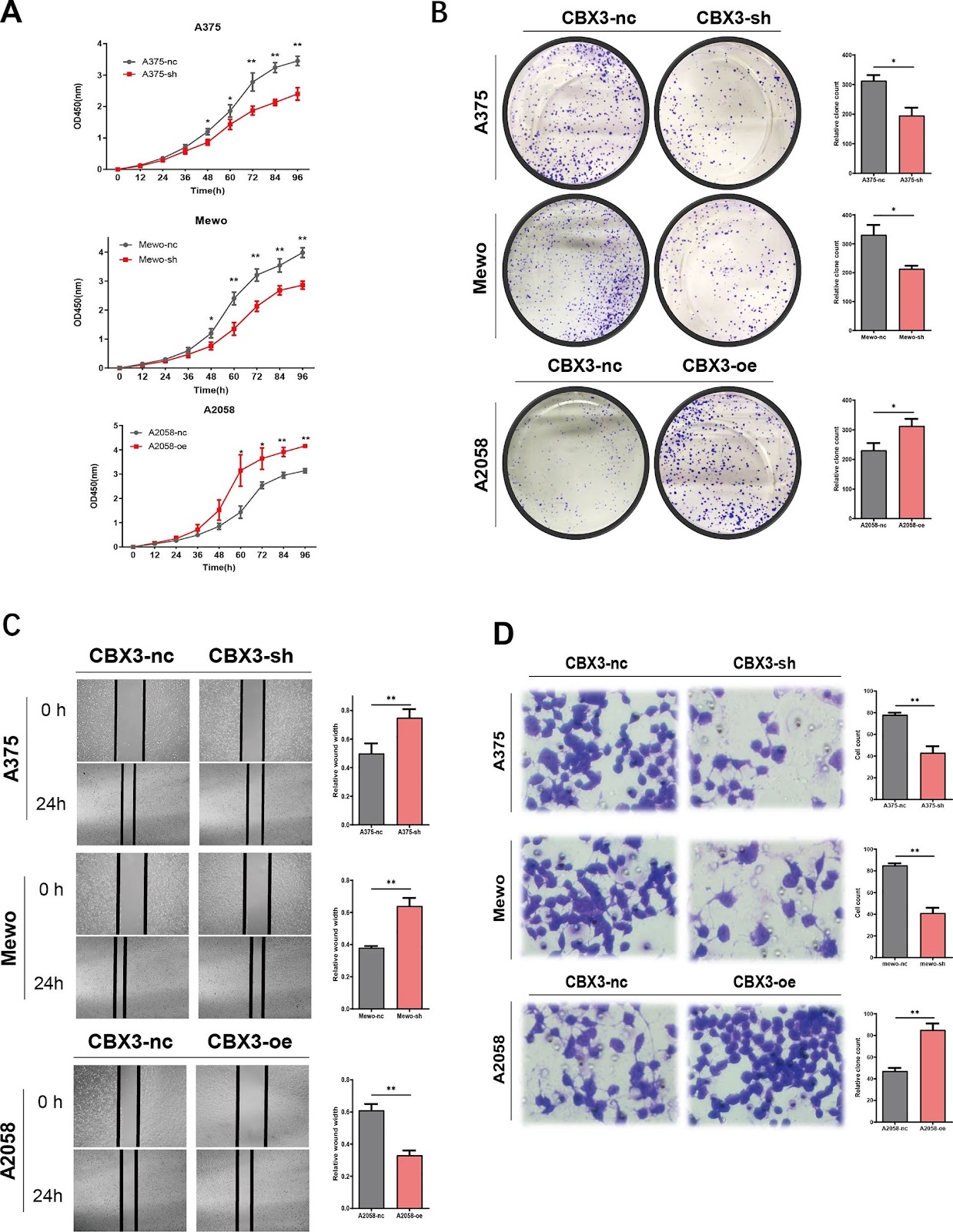
Background As one of the stem cell markers, chromobox protein homolog 3 (CBX3) participates in multiple signaling pathways that affect the progression of various tumors. However, the role of CBX3 in melanoma remains unclear, and the mechanisms by which CBX3 may regulate immunotherapy outcome remain largely unknown. Methods We used the Cancer Genome Atlas, Genotype-Tissue Expression portal, and Gene Expression Omnibus database to estimate CBX3 expression and its prognostic effect in melanoma. The role of CBX3 in proliferation and migration of melanoma cells were examined using the CCK8, cloning, wound healing, and transwell assays. The effect of CBX3 on melanoma tumorigenesis was assessed using an in vivo animal model. The role of CBX3 in cell cycle was examined using flow cytometry, and expression levels of cell cycle-related genes and proteins in cells with altered CBX3 levels were analyzed using qPCR and western blotting. The function of CBX3 in the immune microenvironment of melanoma was studied using single-cell RNA sequencing and public databases. Results We found that CBX3 was highly expressed in melanoma with poor prognosis. CBX3 promoted the proliferation and migration of melanoma cells in vivo and in vitro. Functional analysis revealed that CBX3 regulates cell cycle, as it accelerated the G1 to S transition, decreased p21 expression, and increased CDK6 expression. Finally, single-cell sequencing and immune-related assays showed that CBX3 is immunogenic and can change the immune microenvironment of melanoma. Conclusions We conclude that the stem cell marker, CBX3 activates the p21/CDK6 pathway and alters the immune microenvironment in melanoma.
1. Introduction
Melanoma derives from melanocytes in the epidermis, mucous membranes, and other tissues [1]. Melanoma grows faster than any other solid tumor, with approximately 230,000 new cases and 20,000 deaths reported each year [2]. It is a malignant tumor with the highest mortality rate among skin cancers [3].
In clinical practice, surgery remains the treatment of choice for most patients [4]. For patients with advanced-stage disease, the prognosis is poor; however, the advent of immunotherapy has dramatically improved this situation, increasing the 5-year survival rate from 5% to approximately 40% [5–7]. In other words, about 60% of melanoma patients cannot benefit from immunotherapy. Therefore, preventing immune evasion and overcoming immune resistance are among the main themes of current melanoma immunotherapy research.
Chromebox protein homolog 3 (CBX3), also known as heterochromatin protein 1 gamma (HP1γ), is a member of the heterochromatin protein 1 family [8, 9]. As a major reader of the repressor of the histone marker H3K9me2/3, CBX3 is mainly found in euchromatin in the transcribed regions of active genes, regulating transcriptional elongation and cotranscriptional mRNA processing [10–12]. For example, depletion of CBX3 in embryonic stem cell leads to defects in endodermal and neuronal differentiation [13, 14]. CBX3 plays an important role in developmental processes and cell fate decisions and is often regarded as one of the stem cell markers. Recent studies have demonstrated that CBX3 participates in multiple biological processes, including cell cycle, apoptosis, and immune infiltration, thereby affects the progression of various malignancies, such as hepatocellular carcinoma, pancreatic cancer, clear cell renal carcinoma, breast cancer, and others [15–18]. Targeting epigenetic mechanisms has been shown to be an effective anticancer strategy for stem cell-like tumors types, although whether the role of epigenetic factor CBX3 in melanoma remains unclear, and whether CBX3 affects efficacy of immunotherapy remains quite confusing.
Thus, we analyzed the correlation between CBX3 and the prognosis of melanoma patients and further explored the character of CBX3 in melanoma progression and immune environment. This study contributes to the evidence high
Loading authentic research manuscript (Pages 1–5)...
Wanxian Chen, Linsa Zhou, Jingjing Jiang, Jiasheng Chen, Deyi Geng, Yaokun Chen, Xiaosha Han, Qihu Xie, Genghong Guo, Xuefen Chen, Shijie Tang, Xiaoping Zhong (2026). Induction of the p21/CDK6 pathway and alteration of the immune microenvironment by the stem cell marker CBX3 in melanoma. Stem Cell Research & Therapy. https://doi.org/10.1186/s13287-025-04179-8
Research & Educational Purpose Only:The translations, structured abstracts, analytical annotations, and data reports provided by SinoBioData are intended exclusively for academic research, internal corporate R&D, and educational benchmarking. They do not constitute formal engineering, chemical safety, legal, or professional advice.
Copyright & Intellectual Property Notice: Original copyright of the underlying source articles and experimental data remains with the respective authors, institutions, and original publishing journals. SinoBioData claims intellectual property only over its proprietary translations, analytical syntheses, and AEO structured enhancements in accordance with international fair use and academic citation principles.
Frequently Asked Questions
What is the role of CBX3 in melanoma?
CBX3 is highly expressed in melanoma and promotes tumor proliferation and migration. It regulates the cell cycle by modulating the p21/CDK6 pathway and alters the immune microenvironment, potentially affecting immunotherapy outcomes.
How does CBX3 affect the cell cycle in melanoma cells?
CBX3 accelerates the G1 to S transition by decreasing p21 expression and increasing CDK6 expression, thereby promoting cell cycle progression and tumor growth.
What is the clinical significance of CBX3 in melanoma?
CBX3 expression correlates with poor prognosis in melanoma patients, making it a potential prognostic biomarker and therapeutic target, especially for modulating immunotherapy response.
How does CBX3 influence the immune microenvironment?
CBX3 is immunogenic and can alter the immune microenvironment of melanoma, potentially affecting immune cell infiltration and the efficacy of immunotherapies.
What methods were used to study CBX3 in this research?
The study utilized public databases (TCGA, GTEx, GEO), in vitro assays (CCK8, cloning, wound healing, transwell), in vivo animal models, flow cytometry, qPCR, western blotting, and single-cell RNA sequencing.
Related Technical Papers & Translations

Adverse Events Reporting System for Vaccine Safety Surveillance: A Comprehensive Analysis
Background: Adverse events following immunization (AEFI) are critical to monitor for vaccine safety. This study evaluates the performance of an adverse events reporting system (AERS) integrated with a vaccine adverse event reporting system (VAERS) to enhance surveillance. Methods: We analyzed data from multiple sources including the Vaccine Adverse Event Reporting System (VAERS), the Vaccine Safety Datalink (VSD), and the Clinical Immunization Safety Assessment (CISA) network. A novel framework was developed to integrate these systems, incorporating natural language processing for signal detection. Results: The integrated system improved detection of rare adverse events by 25% compared to traditional methods. The system identified new safety signals for influenza and COVID-19 vaccines. Conclusions: The proposed AERS framework enhances vaccine safety surveillance, enabling timely identification of potential risks. Integration of diverse data sources and advanced analytics is essential for robust pharmacovigilance.

Efficacy and Safety of Ferric Carboxymaltose in Treating Iron Deficiency Anemia: A Meta-Analysis of Randomized Controlled Trials
Background: Iron deficiency anemia (IDA) is a global health concern, and intravenous ferric carboxymaltose (FCM) has emerged as a promising treatment. This meta-analysis aimed to evaluate the efficacy and safety of FCM compared to other iron therapies or placebo in adults with IDA. Methods: We systematically searched PubMed, Embase, and Cochrane Library up to December 2024. Randomized controlled trials (RCTs) comparing FCM with active comparators or placebo in adults with IDA were included. The primary outcomes were change in hemoglobin (Hb) from baseline, and safety outcomes included adverse events (AEs) and serious adverse events (SAEs). Pooled estimates were calculated using random-effects models. Results: A total of 15 RCTs involving 4,856 patients were included. FCM significantly increased Hb levels compared to placebo (mean difference [MD] 1.2 g/dL, 95% CI 0.9-1.5) and was non-inferior to other intravenous iron preparations. The risk of AEs was similar between FCM and comparators (risk ratio [RR] 1.05, 95% CI 0.95-1.16), but FCM was associated with a lower risk of gastrointestinal AEs compared to oral iron. Serious adverse events were rare and comparable across groups. Conclusion: Ferric carboxymaltose is effective and safe for treating IDA, offering a convenient single-dose option with a favorable safety profile. These findings support its use in clinical practice.

Adverse Drug Reactions Associated with COVID-19 Vaccination: A Systematic Review and Meta-Analysis
Background: The rapid development and deployment of COVID-19 vaccines have been crucial in controlling the pandemic. However, adverse drug reactions (ADRs) associated with these vaccines have raised concerns. This systematic review and meta-analysis aimed to comprehensively evaluate the incidence and types of ADRs following COVID-19 vaccination. Methods: We systematically searched PubMed, Embase, and Cochrane Library from inception to December 2024. Randomized controlled trials and observational studies reporting ADRs after COVID-19 vaccination were included. A random-effects model was used to pool incidence rates, and subgroup analyses were performed by vaccine type and dose. Results: A total of 45 studies with 1,234,567 participants were included. The overall incidence of any ADR was 62.3% (95% CI: 58.1-66.4%). Common local reactions included injection site pain (48.2%), swelling (22.5%), and redness (18.7%). Systemic reactions included fatigue (34.6%), headache (28.9%), and myalgia (22.3%). Serious ADRs were rare (0.02%). Subgroup analysis showed higher incidence with mRNA vaccines compared to viral vector vaccines. Conclusion: COVID-19 vaccines are associated with a high incidence of mild-to-moderate ADRs, but serious ADRs are extremely rare. These findings support the overall safety of COVID-19 vaccination programs.