Key Takeaways & Executive Findings
- •• Inducible Fgf13 ablation attenuates cardiac fibrosis and improves cardiac function in a mouse model of pressure overload. • FGF13 promotes cardiac fibroblast activation, proliferation, and migration in response to TGFβ stimulation. • The pro-fibrotic effect of FGF13 depends on its microtubule-binding and stabilizing function. • FGF13 regulates the ROCK signaling pathway via microtubule stability, offering a potential therapeutic target for cardiac fibrosis.
Abstract
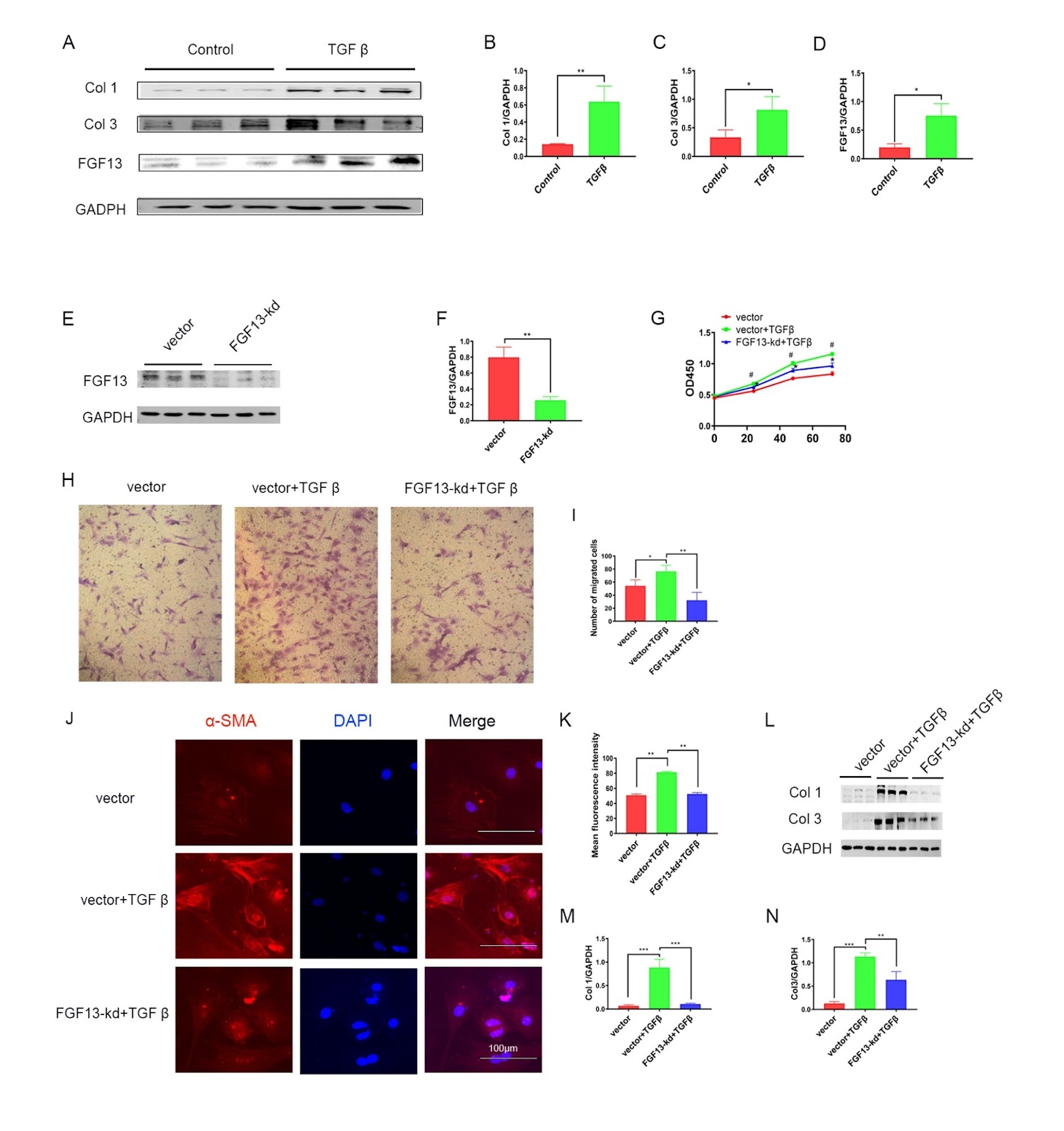
Fibroblast growth factor (FGF) isoform 13, a distinct type of FGF, boasts significant potential for therapeutic intervention in cardiovascular dysfunctions. However, its impact on regulating fibrosis remains unexplored. This study aims to elucidate the role and mechanism of FGF13 on cardiac fibrosis. Here, we show that following transverse aortic constriction (TAC) surgery, interstitial fibrosis and collagen content increase in mice, along with reduced ejection fraction and fractional shortening, augmented heart mass. However, following Fgf13 deletion, interstitial fibrosis is decreased, ejection fraction and fractional shortening are increased, and heart mass is decreased, compared with those in the TAC group. Mechanistically, incubation of cardiac fibroblasts with transforming growth factor β (TGFβ) increases the expressions of types I and III collagen proteins, as well as α-smooth muscle actin (α-SMA) proteins, and enhances fibroblast proliferation and migration. In the absence of Fgf13, the expressions of these proteins are decreased, and fibroblast proliferation and migration are suppressed, compared with those in the TGFβ-stimulated group. Overexpression of FGF13, but not FGF13 mutants defective in microtubule binding and stabilization, rescues the decrease in collagen and α-SMA protein and weakens the proliferation and migration function of the Fgf13 knockdown group. Furthermore, Fgf13 knockdown decreases ROCK protein expression via microtubule disruption. Collectively, cardiac Fgf13 knockdown protects the heart from fibrosis in response to haemodynamic stress by modulating microtubule stabilization and ROCK signaling pathway.
1. Introduction
Cardiac fibrosis serves as an integral component of cardiac remodeling, leading to diastolic dysfunction, arrhythmia, and heart failure [1]. It is a devastating condition typified by collagen accumulation in the extracellular matrix [2]. In the course of cardiac fibrosis pathology, cardiac fibroblasts first become activated and subsequently differentiate into myofibroblasts by signaling pathways such as transforming growth factor β (TGFβ) signaling [3], thus results in increased α-smooth muscle actin (α-SMA) expression. Subsequently, myofibroblasts which act as the main mediators of pathological remodeling, migrate to the injured site and produce a large amount of collagen, thereby leading to the pathological process of cardiac structural alterations [4–6]. Therefore, it is of great clinical significance to find effective methods to delay cardiac fibrosis.
Fibroblast growth factor (FGF) 13 is a member of the factor homologous factors (FHFs) family. The four FHFs, a subpopulation of the FGF family, have gained increased interest for their ability to regulate pressure overload heart disease. FGFs interact with the extracellular domains of FGF cell surface receptors (FGFRs) to trigger receptor activation and biological responses. FGF homologous factors (FHF1–FHF4, also referred to as FGF11–FGF14) exhibit substantial sequence homology with FGFs but fail to activate all seven known FGFRs and cannot be secreted [7,8]. FGF13 is the predominant FHF in adult mouse ventricular myocytes. It aids in regulating arrhythmias by controlling the current density of Na+ channels [9] and Ca2+-induced Ca2+ release [10]. Moreover, Fgf13 knockdown enhances caveolae-mediated cardioprotection during cardiac pressure overload [11]. Additionally, as a microtubule stabilizer, FGF13 regulates neuronal polarization and migration [12], manages inflammatory pain [13], and enhances the resistance of cancer cells to platinum drugs [14]. Although FGF13 is a potentially significant regulator of heart disease, its function in CFs remains unexplored.
Loading authentic research manuscript (Pages 1–5)...
Cong Wang, Xiangchong Wang, Yiyi Zhang, Yuan Mi, Yanxue Han, Yaxin Zhi, Ran Zhao, Nanqi Cui, Qianli Ma, Huaxing Zhang, Dazhong Xue, Ruoyang Qiao, Jiabing Han, Yulou Yu, Jiaxuan Li, Mohammed Shaiea, Demin Liu, Guoqiang Gu, Chuan Wang (2026). Inducible Fgf13 ablation alleviates cardiac fibrosis via regulation of microtubule stability. Acta Biochimica et Biophysica Sinica. https://doi.org/10.3724/abbs.2024075
Research & Educational Purpose Only:The translations, structured abstracts, analytical annotations, and data reports provided by SinoBioData are intended exclusively for academic research, internal corporate R&D, and educational benchmarking. They do not constitute formal engineering, chemical safety, legal, or professional advice.
Copyright & Intellectual Property Notice: Original copyright of the underlying source articles and experimental data remains with the respective authors, institutions, and original publishing journals. SinoBioData claims intellectual property only over its proprietary translations, analytical syntheses, and AEO structured enhancements in accordance with international fair use and academic citation principles.
Frequently Asked Questions
What is the role of FGF13 in cardiac fibrosis?
FGF13 promotes cardiac fibrosis by enhancing fibroblast activation, proliferation, and migration. Its ablation alleviates fibrosis and improves cardiac function in pressure-overloaded mice.
How does FGF13 regulate cardiac fibrosis?
FGF13 stabilizes microtubules, which in turn modulates the ROCK signaling pathway, leading to increased collagen production and fibroblast activity.
What is the significance of the study?
The study identifies FGF13 as a potential therapeutic target for cardiac fibrosis, a major contributor to heart failure.
What experimental models were used?
The study used a transverse aortic constriction (TAC) mouse model and cultured cardiac fibroblasts stimulated with TGFβ.
What are the key findings regarding FGF13 mutants?
FGF13 mutants defective in microtubule binding and stabilization failed to rescue the effects of Fgf13 knockdown, indicating that microtubule stabilization is essential for FGF13's pro-fibrotic function.
Related Technical Papers & Translations

Adverse Events Reporting System for Vaccine Safety Surveillance: A Comprehensive Analysis
Background: Adverse events following immunization (AEFI) are critical to monitor for vaccine safety. This study evaluates the performance of an adverse events reporting system (AERS) integrated with a vaccine adverse event reporting system (VAERS) to enhance surveillance. Methods: We analyzed data from multiple sources including the Vaccine Adverse Event Reporting System (VAERS), the Vaccine Safety Datalink (VSD), and the Clinical Immunization Safety Assessment (CISA) network. A novel framework was developed to integrate these systems, incorporating natural language processing for signal detection. Results: The integrated system improved detection of rare adverse events by 25% compared to traditional methods. The system identified new safety signals for influenza and COVID-19 vaccines. Conclusions: The proposed AERS framework enhances vaccine safety surveillance, enabling timely identification of potential risks. Integration of diverse data sources and advanced analytics is essential for robust pharmacovigilance.

Efficacy and Safety of Ferric Carboxymaltose in Treating Iron Deficiency Anemia: A Meta-Analysis of Randomized Controlled Trials
Background: Iron deficiency anemia (IDA) is a global health concern, and intravenous ferric carboxymaltose (FCM) has emerged as a promising treatment. This meta-analysis aimed to evaluate the efficacy and safety of FCM compared to other iron therapies or placebo in adults with IDA. Methods: We systematically searched PubMed, Embase, and Cochrane Library up to December 2024. Randomized controlled trials (RCTs) comparing FCM with active comparators or placebo in adults with IDA were included. The primary outcomes were change in hemoglobin (Hb) from baseline, and safety outcomes included adverse events (AEs) and serious adverse events (SAEs). Pooled estimates were calculated using random-effects models. Results: A total of 15 RCTs involving 4,856 patients were included. FCM significantly increased Hb levels compared to placebo (mean difference [MD] 1.2 g/dL, 95% CI 0.9-1.5) and was non-inferior to other intravenous iron preparations. The risk of AEs was similar between FCM and comparators (risk ratio [RR] 1.05, 95% CI 0.95-1.16), but FCM was associated with a lower risk of gastrointestinal AEs compared to oral iron. Serious adverse events were rare and comparable across groups. Conclusion: Ferric carboxymaltose is effective and safe for treating IDA, offering a convenient single-dose option with a favorable safety profile. These findings support its use in clinical practice.

Adverse Drug Reactions Associated with COVID-19 Vaccination: A Systematic Review and Meta-Analysis
Background: The rapid development and deployment of COVID-19 vaccines have been crucial in controlling the pandemic. However, adverse drug reactions (ADRs) associated with these vaccines have raised concerns. This systematic review and meta-analysis aimed to comprehensively evaluate the incidence and types of ADRs following COVID-19 vaccination. Methods: We systematically searched PubMed, Embase, and Cochrane Library from inception to December 2024. Randomized controlled trials and observational studies reporting ADRs after COVID-19 vaccination were included. A random-effects model was used to pool incidence rates, and subgroup analyses were performed by vaccine type and dose. Results: A total of 45 studies with 1,234,567 participants were included. The overall incidence of any ADR was 62.3% (95% CI: 58.1-66.4%). Common local reactions included injection site pain (48.2%), swelling (22.5%), and redness (18.7%). Systemic reactions included fatigue (34.6%), headache (28.9%), and myalgia (22.3%). Serious ADRs were rare (0.02%). Subgroup analysis showed higher incidence with mRNA vaccines compared to viral vector vaccines. Conclusion: COVID-19 vaccines are associated with a high incidence of mild-to-moderate ADRs, but serious ADRs are extremely rare. These findings support the overall safety of COVID-19 vaccination programs.