Key Takeaways & Executive Findings
- •• HA-primed iMSC-derived EVs (HA–iMSC–EVs) significantly improve androgenic alopecia by blocking testosterone-induced upregulation of AR, TGF-β, and IL-6 in dermal papilla cells. • HA–iMSC–EVs reactivate the Wnt/β-catenin pathway via β-catenin stabilization and increased phosphorylated GSK3β, promoting hair regrowth. • In a testosterone-induced AGA mouse model, HA–iMSC–EVs restored hair growth more effectively than unprimed iMSC–EVs, comparable to finasteride. • Scalable production of iMSCs combined with HA priming offers a promising cell-free therapeutic strategy for AGA with enhanced efficacy.
Abstract
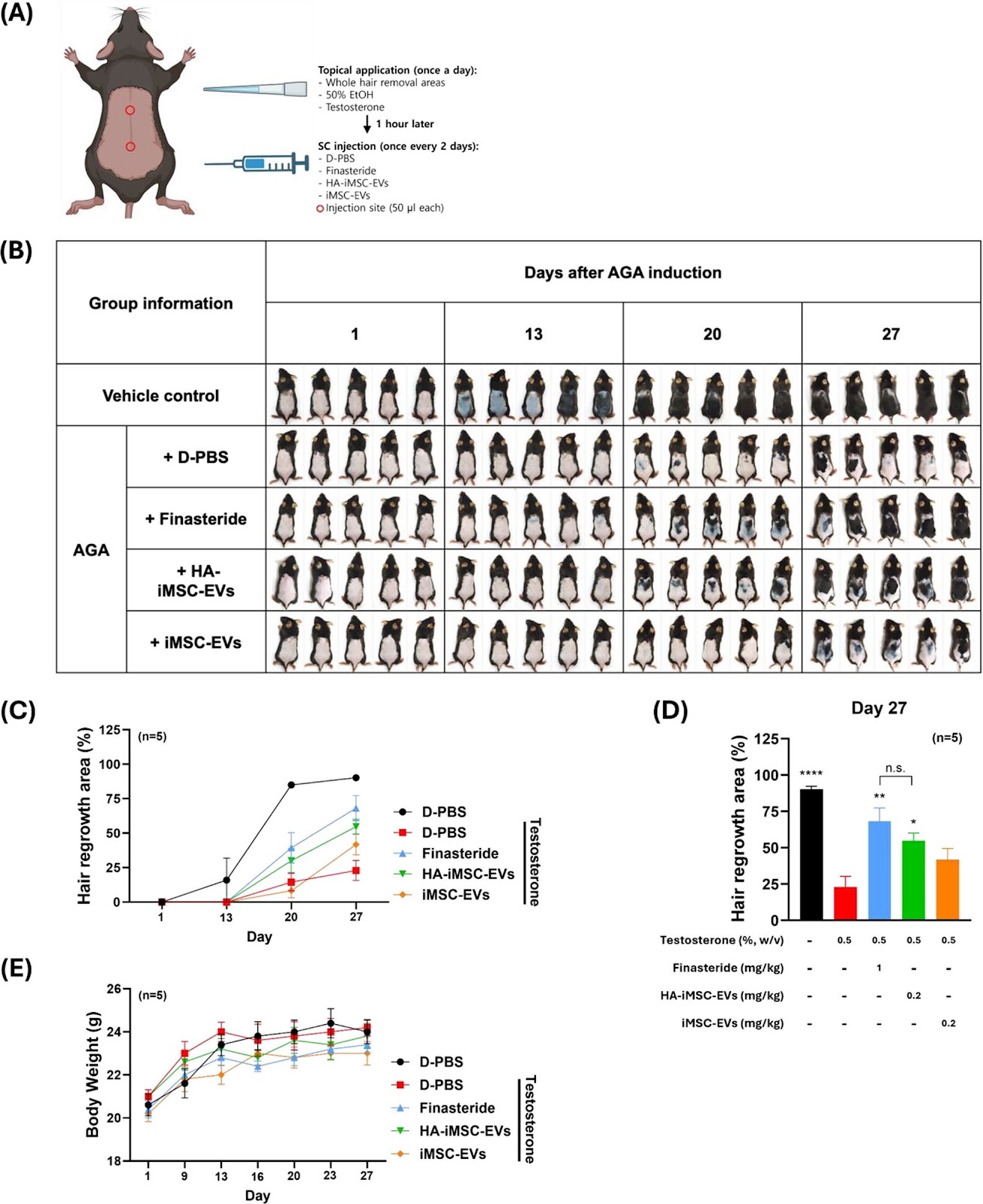
Background: Androgenetic alopecia (AGA) is a common form of hair loss. Androgens, such as testosterone and dihydrotestosterone, are the main causes of AGA. Extracellular vesicles (EVs) derived from mesenchymal stem cells (MSCs) can reduce AGA. However, preparing therapeutic doses of MSCs for clinical use is challenging. Induced pluripotent stem cell-derived MSCs (iMSCs) are homogenous and easily expandable, enabling scalable production of EVs. Hyaluronic acid (HA) can exert various functions including free radical scavenging, immune regulation, and cell migration. Herein, we examined whether hyaluronic acid (HA) stimulation of iMSCs could produce EVs with enhanced therapeutic outcomes for AGA. Methods: EVs were collected from iMSCs primed with HA (HA–iMSC–EVs) or without HA (iMSC–EVs). The characteristics of EVs were examined using dynamic light scattering, cryo-transmission electron microscopy, immunoblotting, flow cytometry, and proteomic analysis. In vitro, we compared the potential of EVs in stimulating the survival of hair follicle dermal papilla cells undergoing testosterone-mediated AGA. Additionally, the expression of androgen receptor (AR) and relevant growth factors as well as key proteins of Wnt/β-catenin signaling pathway (β-catenin and phosphorylated GSK3β) was analyzed. Subsequently, AGA was induced in male C57/BL6 mice by testosterone administration, followed by repeated injections of iMSC–EVs, HA–iMSC–EVs, finasteride, or vehicle. Several parameters including hair growth, anagen phase ratio, reactivation of Wnt/β-catenin pathway, and AR expression was examined using qPCR, immunoblotting, and immunofluorescence analysis. Results: Both types of EVs showed typical characteristics for EVs, such as size distribution, markers, and surface protein expression. In hair follicle dermal papilla cells, the mRNA levels of AR, TGF-β, and IL-6 increased by testosterone was blocked by HA–iMSC–EVs, which also contributed to the augmented expression of trophic genes related to hair regrowth. However, no notable changes were observed in the iMSC–EVs. Re-activation of Wnt/β-catenin was observed in HA–iMSC–EVs but not in iMSC–EVs, as shown by β-catenin stabilization and an increase in phosphorylated GSK3β. Restoration of hair growth was more significant in HA–iMSC–EVs than in iMSC–EVs.
1. Introduction
Androgenetic alopecia (AGA) is a common form of hair loss which is affected by genetic, hormonal, and environmental factors, as well as aging [1, 2]. Notably, the hair follicles of patients with AGA has a higher sensitivity to androgens such as dihydrotestosterone (DHT). In hair follicles, testosterone is converted to DHT by 5α-reductase and prolonged exposure to DHT makes hair follicles shrink, eventually leading to hair loss [3]. Several strategies for AGA are available, but only finasteride and minoxidil are approved by the US Food and Drug Administration [4]. However, prolonged use of finasteride can cause sexual dysfunction, while minoxidil has side effects such as irritation, swelling, and lightheadedness [5–7].
The Wnt/β-catenin pathway plays an essential role in the hair follicle development from dermal papilla cells (DPCs) [8–10]. In the presence of Wnt ligands, the phosphorylation of β-catenin by glycogen synthase kinase 3β (GSK3β) is inhibited, stabilizing β-catenin. Without the Wnt ligand, GSK3β phosphorylates β-catenin leading to the degradation and ubiquitination of β-catenin [11]. In patients with AGA, DHT inhibits the Wnt/β-catenin pathway by activating GSK3β, contributing to the inhibition of hair follicular stem cell differentiation in DPCs [12]. Consistently, the inhibition of GSK3β via phosphorylation (at Ser9) by human placental extract caused β-catenin stabilization and promoted the hair-inductive capacity of DPCs [13]. Collectively, activation of the Wnt/β-catenin pathway by blocking GSK3β activity is required to block AGA progression.
Extracellular vesicles (EVs), which are nano-sized particles released from almost all cell types, play an essential role in cell-to-cell communication [14]. In addition, the content of EVs in body fluids can provide biological information about the original tissues, making EVs invaluable tools as non-invasive diagnostic markers [15]. Importantly, stem cell-derived EVs have potential for therapeutic purposes i
Loading authentic research manuscript (Pages 1–5)...
Hyun Geun Oh, Minyoung Jung, Seon-Yeong Jeong, Jimin Kim, Sang-Deok Han, Hongduk Kim, Seulki Lee, Yejin Lee, Haedeun You, Somi Park, Eun A. Kim, Tae Min Kim, Soo Kim (2026). Improvement of androgenic alopecia by extracellular vesicles secreted from hyaluronic acid-stimulated induced mesenchymal stem cells. Stem Cell Research & Therapy. https://doi.org/10.1186/s13287-024-03906-x
Research & Educational Purpose Only:The translations, structured abstracts, analytical annotations, and data reports provided by SinoBioData are intended exclusively for academic research, internal corporate R&D, and educational benchmarking. They do not constitute formal engineering, chemical safety, legal, or professional advice.
Copyright & Intellectual Property Notice: Original copyright of the underlying source articles and experimental data remains with the respective authors, institutions, and original publishing journals. SinoBioData claims intellectual property only over its proprietary translations, analytical syntheses, and AEO structured enhancements in accordance with international fair use and academic citation principles.
Frequently Asked Questions
What is the main finding of this study?
The study demonstrates that extracellular vesicles derived from hyaluronic acid-stimulated induced mesenchymal stem cells (HA–iMSC–EVs) significantly improve androgenic alopecia by reactivating the Wnt/β-catenin pathway and blocking androgen-induced inflammatory signals, leading to enhanced hair regrowth compared to unprimed iMSC–EVs.
How does hyaluronic acid enhance the therapeutic potential of iMSC-derived EVs?
Hyaluronic acid priming of iMSCs alters the EV cargo, enhancing their ability to suppress androgen receptor (AR) and pro-inflammatory cytokines (TGF-β, IL-6) while promoting trophic factors and Wnt/β-catenin signaling, thereby improving hair follicle survival and regeneration.
What is the significance of using induced mesenchymal stem cells (iMSCs) for EV production?
iMSCs are homogenous and easily expandable, allowing scalable production of EVs for clinical use, overcoming the limitations of primary MSCs in terms of availability and consistency.
What are the potential clinical implications of this research?
HA–iMSC–EVs offer a promising cell-free therapeutic strategy for androgenetic alopecia, potentially providing a safer and more effective alternative to current treatments like finasteride and minoxidil, with fewer side effects.
How was the efficacy of HA–iMSC–EVs evaluated in this study?
Efficacy was evaluated in vitro using testosterone-treated hair follicle dermal papilla cells and in vivo using a testosterone-induced AGA mouse model, assessing hair growth, anagen phase ratio, Wnt/β-catenin pathway activation, and AR expression.
Related Technical Papers & Translations

Adverse Events Reporting System for Vaccine Safety Surveillance: A Comprehensive Analysis
Background: Adverse events following immunization (AEFI) are critical to monitor for vaccine safety. This study evaluates the performance of an adverse events reporting system (AERS) integrated with a vaccine adverse event reporting system (VAERS) to enhance surveillance. Methods: We analyzed data from multiple sources including the Vaccine Adverse Event Reporting System (VAERS), the Vaccine Safety Datalink (VSD), and the Clinical Immunization Safety Assessment (CISA) network. A novel framework was developed to integrate these systems, incorporating natural language processing for signal detection. Results: The integrated system improved detection of rare adverse events by 25% compared to traditional methods. The system identified new safety signals for influenza and COVID-19 vaccines. Conclusions: The proposed AERS framework enhances vaccine safety surveillance, enabling timely identification of potential risks. Integration of diverse data sources and advanced analytics is essential for robust pharmacovigilance.

Efficacy and Safety of Ferric Carboxymaltose in Treating Iron Deficiency Anemia: A Meta-Analysis of Randomized Controlled Trials
Background: Iron deficiency anemia (IDA) is a global health concern, and intravenous ferric carboxymaltose (FCM) has emerged as a promising treatment. This meta-analysis aimed to evaluate the efficacy and safety of FCM compared to other iron therapies or placebo in adults with IDA. Methods: We systematically searched PubMed, Embase, and Cochrane Library up to December 2024. Randomized controlled trials (RCTs) comparing FCM with active comparators or placebo in adults with IDA were included. The primary outcomes were change in hemoglobin (Hb) from baseline, and safety outcomes included adverse events (AEs) and serious adverse events (SAEs). Pooled estimates were calculated using random-effects models. Results: A total of 15 RCTs involving 4,856 patients were included. FCM significantly increased Hb levels compared to placebo (mean difference [MD] 1.2 g/dL, 95% CI 0.9-1.5) and was non-inferior to other intravenous iron preparations. The risk of AEs was similar between FCM and comparators (risk ratio [RR] 1.05, 95% CI 0.95-1.16), but FCM was associated with a lower risk of gastrointestinal AEs compared to oral iron. Serious adverse events were rare and comparable across groups. Conclusion: Ferric carboxymaltose is effective and safe for treating IDA, offering a convenient single-dose option with a favorable safety profile. These findings support its use in clinical practice.

Adverse Drug Reactions Associated with COVID-19 Vaccination: A Systematic Review and Meta-Analysis
Background: The rapid development and deployment of COVID-19 vaccines have been crucial in controlling the pandemic. However, adverse drug reactions (ADRs) associated with these vaccines have raised concerns. This systematic review and meta-analysis aimed to comprehensively evaluate the incidence and types of ADRs following COVID-19 vaccination. Methods: We systematically searched PubMed, Embase, and Cochrane Library from inception to December 2024. Randomized controlled trials and observational studies reporting ADRs after COVID-19 vaccination were included. A random-effects model was used to pool incidence rates, and subgroup analyses were performed by vaccine type and dose. Results: A total of 45 studies with 1,234,567 participants were included. The overall incidence of any ADR was 62.3% (95% CI: 58.1-66.4%). Common local reactions included injection site pain (48.2%), swelling (22.5%), and redness (18.7%). Systemic reactions included fatigue (34.6%), headache (28.9%), and myalgia (22.3%). Serious ADRs were rare (0.02%). Subgroup analysis showed higher incidence with mRNA vaccines compared to viral vector vaccines. Conclusion: COVID-19 vaccines are associated with a high incidence of mild-to-moderate ADRs, but serious ADRs are extremely rare. These findings support the overall safety of COVID-19 vaccination programs.