Key Takeaways & Executive Findings
- •• IKZF3 is overexpressed in gastric cancer tissues and promotes cancer cell proliferation, migration, and invasion. • IKZF3 activates the Hedgehog signaling pathway by binding to the SMO promoter and upregulating SMO expression. • Knockdown of IKZF3 induces G1/S cell cycle arrest, and the SMO inhibitor SANT-1 reverses IKZF3-mediated oncogenic effects. • Targeting IKZF3 with SANT-1 represents a promising therapeutic strategy for gastric cancer treatment.
Abstract
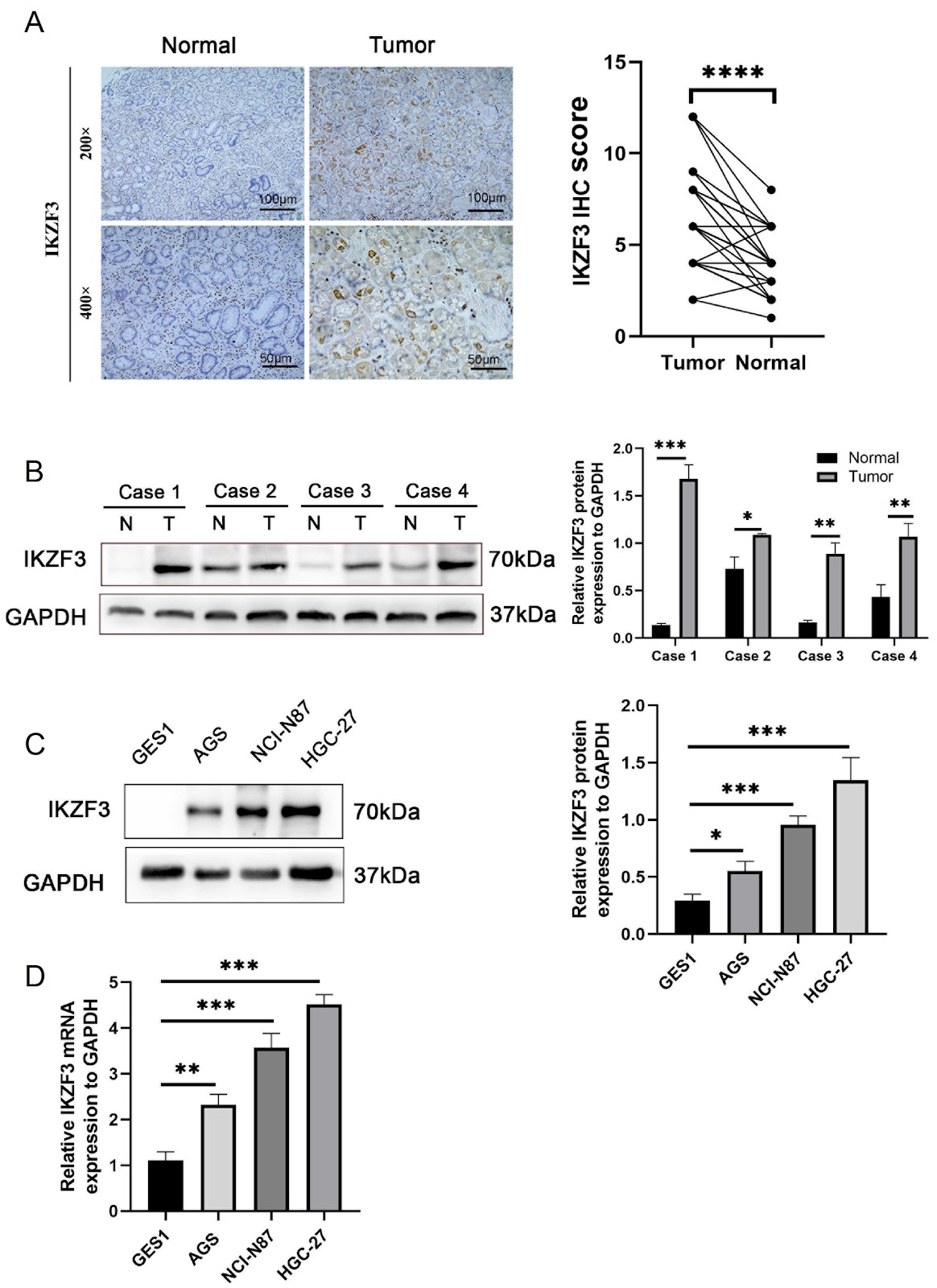
Elevated expression of Aiolos family zinc finger 3 (IKZF3), a transcription factor crucial for lymphocyte maturation, is observed in hematological cancers. However, its role in gastric cancer (GC) remains unclear. We detect the increased IKZF3 levels in GC tissues using immunohistochemical, qRT-PCR and western blot analysis. The function of IKZF3 in GC cells is further studied through CCK-8, Transwell, colony formation, scratch wound healing, and flow cytometry assays. IKZF3 overexpression significantly promotes GC cell invasion, migration, and proliferation, whereas IKZF3 knockdown induces cell cycle arrest at the G1/S phase. Flow cytometry confirms these alterations in cell cycle dynamics. Using the JASPAR database, we determine that IKZF3 binds to the SMO promoter region, thereby activating SMO expression. Notably, the SMO inhibitor SANT-1 effectively reverses IKZF3-mediated effects. Furthermore, IKZF3 promotes GC tumor growth in xenograft models. Our findings highlight the pivotal role of IKZF3 in GC progression by modulating SMO expression and activating the Hedgehog signaling pathway. Therapeutically, targeting IKZF3 with SANT-1 is promising for mitigating GC proliferation and invasion. This study provides insights into potential therapeutic approaches targeting IKZF3 for GC treatment.
1. Introduction
Gastric cancer (GC) is a significant universal health issue in East Asian countries [1,2]. In 2020, GC was the third leading cause of cancer-associated death worldwide, with over 1 million new diagnoses and 768,000 deaths reported [3]. By 2021, 26,560 Americans had been diagnosed with GC, and 11,180 passed away from it, ranking it as the sixteen identified cancer and the seventeen leading causes of cancer-related mortality in the USA [4]. Although a small number of special medications have been produced, treating GC patients in the clinic remains extremely difficult because of their unknown fundamental pathogenic mechanisms [5]. To improve patient prognosis, a therapeutic strategy including potent molecular target medications should be considered [6].
The IKZF3 gene, located at 17q11.22, encodes the transcription factor Aiolos, a key regulator of lymphocyte development and immune function [7,8]. Aiolos, identified as a binding partner of IKAROS, is essential for B-cell proliferation and differentiation. The gene contains eight exons and seven introns. Lenalidomide (Len) targets Aiolos and IKAROS, inhibiting the transdifferentiation of innate lymphoid cell 3 (ILC3) cells to ILC1/NK cells, a process linked to elevated Aiolos expression [9]. Studies in mice lacking Aiolos have revealed its role in Th17 differentiation, B-cell activation, and NK cell maturation [10–12]. Aiolos also collaborates with IKAROS to regulate the expression of λ5, a component of pre-B-cell receptors [13,14].
Previous studies, by using an integrative approach, analyzed extensive datasets encompassing patient genomics, transcriptomics, and clinical information, which led to the identification of IKZF3 as a commonly amplified gene in breast cancer with HER2 overexpression [15,16]. Another study indicated a potential role of IKZF3 in the onset and progression of head and neck squamous cell carcinoma [17]. Furthermore, IKZF3 overexpression has been shown to predict a poor prognosis, particularly in intestinal-type GC. These findings suggest that IKZF3 plays a significant role in the occurrence, metastasis, and prognosis of several neoplasms and hematological malignancies. Therefore, we are interested in exploring the molecular mechanisms that underlie the role of IKZF3 in GC.
Loading authentic research manuscript (Pages 1–5)...
Muhammad Ali, Shantanu Baral, Jun Ren, Liuhua Wang, Bin Liu, Sen Wang, Daorong Wang (2026). IKZF3 promotes gastric cancer progression via Hedgehog signaling activation and is targetable by SANT-1. Acta Biochimica et Biophysica Sinica. https://doi.org/10.3724/abbs.2025103
Research & Educational Purpose Only:The translations, structured abstracts, analytical annotations, and data reports provided by SinoBioData are intended exclusively for academic research, internal corporate R&D, and educational benchmarking. They do not constitute formal engineering, chemical safety, legal, or professional advice.
Copyright & Intellectual Property Notice: Original copyright of the underlying source articles and experimental data remains with the respective authors, institutions, and original publishing journals. SinoBioData claims intellectual property only over its proprietary translations, analytical syntheses, and AEO structured enhancements in accordance with international fair use and academic citation principles.
Frequently Asked Questions
What is the role of IKZF3 in gastric cancer?
IKZF3 is overexpressed in gastric cancer tissues and promotes cancer cell proliferation, migration, and invasion by activating the Hedgehog signaling pathway through upregulation of SMO expression.
How does IKZF3 activate the Hedgehog signaling pathway?
IKZF3 binds to the SMO promoter region, as determined by JASPAR database analysis, thereby activating SMO expression and subsequently the Hedgehog signaling pathway.
What is the effect of IKZF3 knockdown on gastric cancer cells?
IKZF3 knockdown induces cell cycle arrest at the G1/S phase, as confirmed by flow cytometry, and reduces cancer cell proliferation, migration, and invasion.
Can SANT-1 reverse the effects of IKZF3 in gastric cancer?
Yes, SANT-1, an SMO inhibitor, effectively reverses IKZF3-mediated effects on gastric cancer cell proliferation and invasion, suggesting a potential therapeutic strategy.
What is the clinical significance of this study?
The study identifies IKZF3 as a potential therapeutic target in gastric cancer and suggests that SANT-1 could be repurposed for treatment, offering a promising approach to mitigate GC progression.
Related Technical Papers & Translations

Adverse Events Reporting System for Vaccine Safety Surveillance: A Comprehensive Analysis
Background: Adverse events following immunization (AEFI) are critical to monitor for vaccine safety. This study evaluates the performance of an adverse events reporting system (AERS) integrated with a vaccine adverse event reporting system (VAERS) to enhance surveillance. Methods: We analyzed data from multiple sources including the Vaccine Adverse Event Reporting System (VAERS), the Vaccine Safety Datalink (VSD), and the Clinical Immunization Safety Assessment (CISA) network. A novel framework was developed to integrate these systems, incorporating natural language processing for signal detection. Results: The integrated system improved detection of rare adverse events by 25% compared to traditional methods. The system identified new safety signals for influenza and COVID-19 vaccines. Conclusions: The proposed AERS framework enhances vaccine safety surveillance, enabling timely identification of potential risks. Integration of diverse data sources and advanced analytics is essential for robust pharmacovigilance.

Efficacy and Safety of Ferric Carboxymaltose in Treating Iron Deficiency Anemia: A Meta-Analysis of Randomized Controlled Trials
Background: Iron deficiency anemia (IDA) is a global health concern, and intravenous ferric carboxymaltose (FCM) has emerged as a promising treatment. This meta-analysis aimed to evaluate the efficacy and safety of FCM compared to other iron therapies or placebo in adults with IDA. Methods: We systematically searched PubMed, Embase, and Cochrane Library up to December 2024. Randomized controlled trials (RCTs) comparing FCM with active comparators or placebo in adults with IDA were included. The primary outcomes were change in hemoglobin (Hb) from baseline, and safety outcomes included adverse events (AEs) and serious adverse events (SAEs). Pooled estimates were calculated using random-effects models. Results: A total of 15 RCTs involving 4,856 patients were included. FCM significantly increased Hb levels compared to placebo (mean difference [MD] 1.2 g/dL, 95% CI 0.9-1.5) and was non-inferior to other intravenous iron preparations. The risk of AEs was similar between FCM and comparators (risk ratio [RR] 1.05, 95% CI 0.95-1.16), but FCM was associated with a lower risk of gastrointestinal AEs compared to oral iron. Serious adverse events were rare and comparable across groups. Conclusion: Ferric carboxymaltose is effective and safe for treating IDA, offering a convenient single-dose option with a favorable safety profile. These findings support its use in clinical practice.

Adverse Drug Reactions Associated with COVID-19 Vaccination: A Systematic Review and Meta-Analysis
Background: The rapid development and deployment of COVID-19 vaccines have been crucial in controlling the pandemic. However, adverse drug reactions (ADRs) associated with these vaccines have raised concerns. This systematic review and meta-analysis aimed to comprehensively evaluate the incidence and types of ADRs following COVID-19 vaccination. Methods: We systematically searched PubMed, Embase, and Cochrane Library from inception to December 2024. Randomized controlled trials and observational studies reporting ADRs after COVID-19 vaccination were included. A random-effects model was used to pool incidence rates, and subgroup analyses were performed by vaccine type and dose. Results: A total of 45 studies with 1,234,567 participants were included. The overall incidence of any ADR was 62.3% (95% CI: 58.1-66.4%). Common local reactions included injection site pain (48.2%), swelling (22.5%), and redness (18.7%). Systemic reactions included fatigue (34.6%), headache (28.9%), and myalgia (22.3%). Serious ADRs were rare (0.02%). Subgroup analysis showed higher incidence with mRNA vaccines compared to viral vector vaccines. Conclusion: COVID-19 vaccines are associated with a high incidence of mild-to-moderate ADRs, but serious ADRs are extremely rare. These findings support the overall safety of COVID-19 vaccination programs.