Key Takeaways & Executive Findings
- •• Tumor-derived IFN-γ induces a persistent myeloid-biased differentiation of hematopoietic stem cells (HSCs) in colorectal and lung cancer models. • Meis1 is identified as a critical transcription factor mediating IFN-γ-induced HSC myelopoiesis, and its ablation prevents myeloid differentiation. • HSC-derived myeloid-derived suppressor cells (MDSCs) suppress T cell function and promote tumor progression. • Combining anti-PD-1 with the anti-IFN-γ antibody Emapalumab inhibits HSC-derived MDSC production and enhances antitumor immunity, improving ICB efficacy.
Abstract
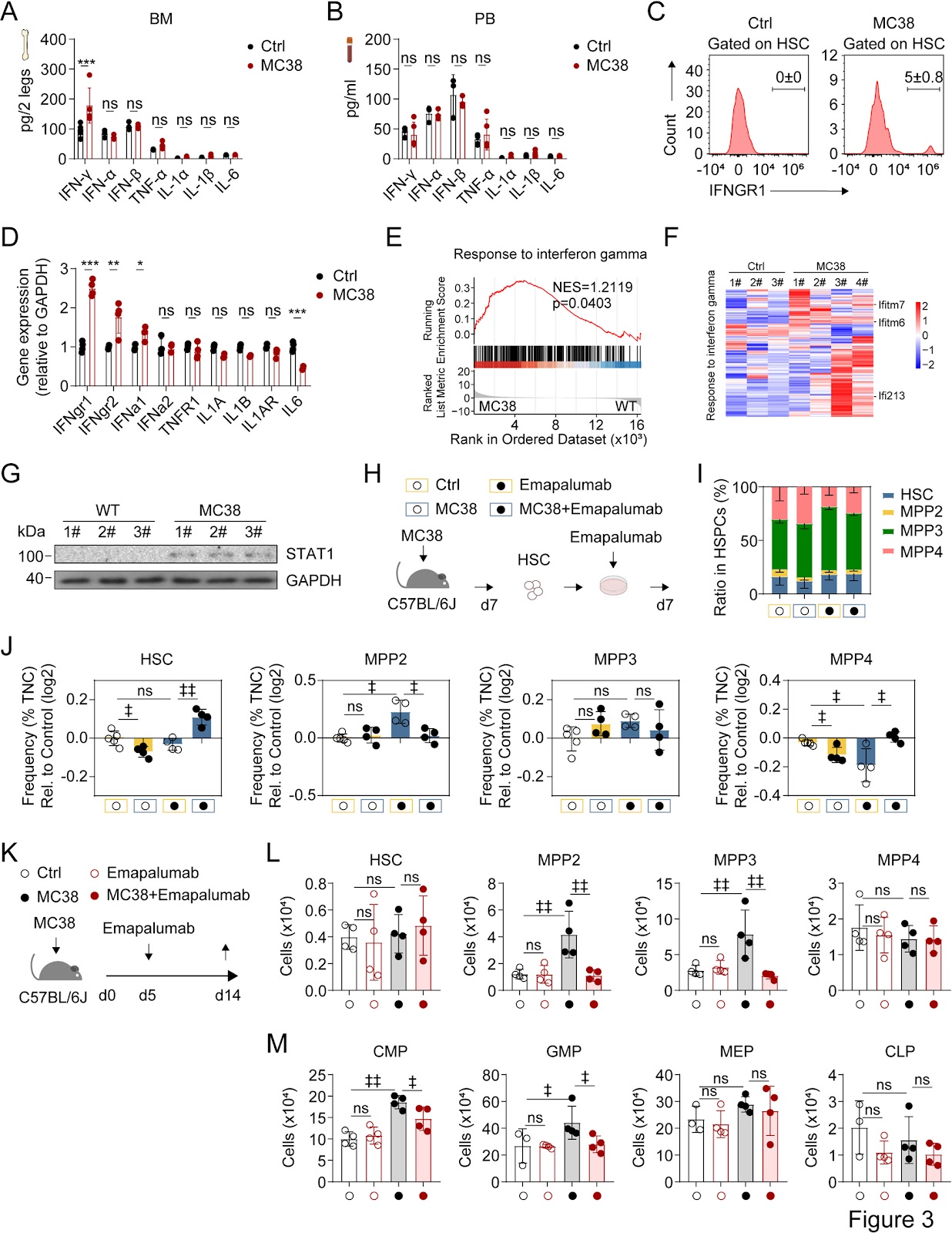
Background: The role of inflammation-induced myeloid-biased hematopoiesis in driving resistance to immune checkpoint blockade (ICB) is recognized, yet the intricate mechanisms through which tumors orchestrate it are not fully defined. Methods: MC38 tumor and Lewis lung cancer models were performed to evaluate hematopoietic stem cells (HSCs) differentiation biased. Key pro-inflammatory cytokines implicated in this process were screened through ELISA assay and bioinformatic analysis. Subsequent mechanistic investigations identified the central transcription factor governing tumor-induced myeloid-biased differentiation of HSCs. To demonstrate the functional impact on antitumor immunity, we quantified HSC-derived myeloid-derived suppressor cells (MDSCs) and assessed their suppressive effects on T cell function. Furthermore, the therapeutic potential of targeting this axis was evaluated using Emapalumab, an anti-IFN-γ antibody, to determine whether suppressing myeloid-biased HSCs could enhance the antitumor effects of ICB. Results: Here, we found HSCs exhibit a persistent myeloid-biased differentiation phenotype in MC38 tumor and Lewis lung cancer models, which was induced by the pro-inflammatory cytokines IFN-γ. Transcriptional profiling indicated Meis homeobox 1 (Meis1) was enriched in tumor primed HSCs, and ablation of Meis1 in HSCs prevented HSCs-associated myeloid cell differentiation. The resulting HSC-derived MDSCs were identified as key factors of tumor progression. Therapeutic targeting of the myeloid differentiation axis with a combination of anti-PD-1 antibody and Emapalumab, an anti-IFN-γ antibody inhibited HSC-derived MDSCs production and enhanced T cells-mediated adaptive immunity to suppress tumor progression. Conclusions: Our results highlight HSC-directed therapy as a novel approach for cancer treatment. Combining anti-PD-1 with Emapalumab potently enhances the response to ICB, offering a promising strategy to achieve superior and durable anticancer efficacy.
1. Introduction
The hematopoietic stem cells (HSCs) represent a rare population of quiescent and multi-lineage producing stem cells that persist throughout an individual's lifespan [1]. The presence of external stimuli can rapidly induce partial HSCs to enhance immune cell production, which consequently leads to function attenuation and eventual exhaustion of stem cell [2, 3]. Both acute insults—hemorrhage, infection—and chronic inflammatory states trigger this emergency myelopoiesis, with mature myeloid cells being the dominant product [4–7]. This emergency hematopoiesis is triggered by injuries through both direct and indirect mechanisms [8]. Further investigations have demonstrated that pro-inflammatory cytokines, including interferon (IFN)-α, IFN-γ, granulocyte colony-stimulating factor (G-CSF), thrombopoietin (TPO), interleukin-1 (IL-1) and tumor necrosis factor alpha (TNF-α), play important roles in inducing inflammatory response of HSCs [9–15].
Systematic inflammatory stimuli can train HSCs to a long-term myelopoiesis to initiate trained innate immunity [16–18]. In response to pro-inflammatory cytokines, HSCs become active to facilitate rapid myelopoiesis, leading to increased levels of lineage-biased multipotent progenitors (MPPs) and lineage-committed myeloid progenitor cells [19–22]. The MPP compartments indicate an overproduction of megakaryocytic/erythroid-biased MPP2s and granulocyte/macrophage-biased MPP3s, as well as limited presence of lymphoid-biased MPP4s [23, 24]. Although inflammation has been established as a critical inducer of cancer, its impact on HSC function and lineage commitment during tumorigenesis remains unclear.
Loading authentic research manuscript (Pages 1–5)...
Xue Han, Minyi Zhao, Kexin Wang, Weiwei Ma, Songqi Zhu, Ruiqing Zhou, Uet Yu, Bangxue Jiang, Xiaoqing Bai, Peng Lei, Shunqing Wang (2026). IFN-γ Induces Hematopoietic Stem Cell Myelopoiesis through Meis1 in Tumor. Stem Cell Research & Therapy. https://doi.org/10.1186/s13287-026-04968-9
Research & Educational Purpose Only:The translations, structured abstracts, analytical annotations, and data reports provided by SinoBioData are intended exclusively for academic research, internal corporate R&D, and educational benchmarking. They do not constitute formal engineering, chemical safety, legal, or professional advice.
Copyright & Intellectual Property Notice: Original copyright of the underlying source articles and experimental data remains with the respective authors, institutions, and original publishing journals. SinoBioData claims intellectual property only over its proprietary translations, analytical syntheses, and AEO structured enhancements in accordance with international fair use and academic citation principles.
Frequently Asked Questions
What is the role of IFN-γ in tumor-induced hematopoiesis?
IFN-γ is a pro-inflammatory cytokine that induces a persistent myeloid-biased differentiation of hematopoietic stem cells (HSCs) in tumor models, leading to the production of immunosuppressive myeloid-derived suppressor cells (MDSCs) that promote tumor progression.
How does Meis1 contribute to myeloid-biased differentiation?
Meis1 is a transcription factor enriched in tumor-primed HSCs. Its expression is induced by IFN-γ and is essential for driving HSC differentiation toward the myeloid lineage. Ablation of Meis1 in HSCs prevents myeloid cell differentiation and reduces MDSC production.
What is the therapeutic potential of combining anti-PD-1 with Emapalumab?
Combining anti-PD-1 (an immune checkpoint inhibitor) with Emapalumab (an anti-IFN-γ antibody) inhibits HSC-derived MDSC production and enhances T cell-mediated adaptive immunity, thereby improving the antitumor efficacy of immune checkpoint blockade in colorectal and lung cancer models.
What are the key findings of this study?
The study reveals that tumor-derived IFN-γ drives myeloid-biased hematopoiesis via Meis1, leading to MDSC accumulation and immunosuppression. Targeting this axis with Emapalumab in combination with anti-PD-1 enhances ICB response, offering a novel therapeutic strategy.
What is the significance of HSC-directed therapy in cancer treatment?
HSC-directed therapy represents a novel approach that targets the upstream hematopoietic stem cell compartment to modulate the immune microenvironment. By preventing the generation of immunosuppressive myeloid cells, it can enhance the efficacy of immunotherapies like immune checkpoint blockade.
Related Technical Papers & Translations

Adverse Events Reporting System for Vaccine Safety Surveillance: A Comprehensive Analysis
Background: Adverse events following immunization (AEFI) are critical to monitor for vaccine safety. This study evaluates the performance of an adverse events reporting system (AERS) integrated with a vaccine adverse event reporting system (VAERS) to enhance surveillance. Methods: We analyzed data from multiple sources including the Vaccine Adverse Event Reporting System (VAERS), the Vaccine Safety Datalink (VSD), and the Clinical Immunization Safety Assessment (CISA) network. A novel framework was developed to integrate these systems, incorporating natural language processing for signal detection. Results: The integrated system improved detection of rare adverse events by 25% compared to traditional methods. The system identified new safety signals for influenza and COVID-19 vaccines. Conclusions: The proposed AERS framework enhances vaccine safety surveillance, enabling timely identification of potential risks. Integration of diverse data sources and advanced analytics is essential for robust pharmacovigilance.

Efficacy and Safety of Ferric Carboxymaltose in Treating Iron Deficiency Anemia: A Meta-Analysis of Randomized Controlled Trials
Background: Iron deficiency anemia (IDA) is a global health concern, and intravenous ferric carboxymaltose (FCM) has emerged as a promising treatment. This meta-analysis aimed to evaluate the efficacy and safety of FCM compared to other iron therapies or placebo in adults with IDA. Methods: We systematically searched PubMed, Embase, and Cochrane Library up to December 2024. Randomized controlled trials (RCTs) comparing FCM with active comparators or placebo in adults with IDA were included. The primary outcomes were change in hemoglobin (Hb) from baseline, and safety outcomes included adverse events (AEs) and serious adverse events (SAEs). Pooled estimates were calculated using random-effects models. Results: A total of 15 RCTs involving 4,856 patients were included. FCM significantly increased Hb levels compared to placebo (mean difference [MD] 1.2 g/dL, 95% CI 0.9-1.5) and was non-inferior to other intravenous iron preparations. The risk of AEs was similar between FCM and comparators (risk ratio [RR] 1.05, 95% CI 0.95-1.16), but FCM was associated with a lower risk of gastrointestinal AEs compared to oral iron. Serious adverse events were rare and comparable across groups. Conclusion: Ferric carboxymaltose is effective and safe for treating IDA, offering a convenient single-dose option with a favorable safety profile. These findings support its use in clinical practice.

Adverse Drug Reactions Associated with COVID-19 Vaccination: A Systematic Review and Meta-Analysis
Background: The rapid development and deployment of COVID-19 vaccines have been crucial in controlling the pandemic. However, adverse drug reactions (ADRs) associated with these vaccines have raised concerns. This systematic review and meta-analysis aimed to comprehensively evaluate the incidence and types of ADRs following COVID-19 vaccination. Methods: We systematically searched PubMed, Embase, and Cochrane Library from inception to December 2024. Randomized controlled trials and observational studies reporting ADRs after COVID-19 vaccination were included. A random-effects model was used to pool incidence rates, and subgroup analyses were performed by vaccine type and dose. Results: A total of 45 studies with 1,234,567 participants were included. The overall incidence of any ADR was 62.3% (95% CI: 58.1-66.4%). Common local reactions included injection site pain (48.2%), swelling (22.5%), and redness (18.7%). Systemic reactions included fatigue (34.6%), headache (28.9%), and myalgia (22.3%). Serious ADRs were rare (0.02%). Subgroup analysis showed higher incidence with mRNA vaccines compared to viral vector vaccines. Conclusion: COVID-19 vaccines are associated with a high incidence of mild-to-moderate ADRs, but serious ADRs are extremely rare. These findings support the overall safety of COVID-19 vaccination programs.