Key Takeaways & Executive Findings
- •• A novel HA-Orn hydrogel enables scalable 3D culture, significantly increasing exosome yield compared to conventional 2D cultures. • 3D-derived exosomes exhibit enhanced pro-regenerative functions, including stimulation of proliferation, migration, angiogenesis, and ECM remodeling. • In vivo, 3D-Exo accelerates wound closure and reduces inflammation, demonstrating robust therapeutic efficacy and safety. • Mechanistic insights reveal distinct miRNA profiles and activation of regenerative signaling pathways, highlighting translational potential for cell-free therapies.
Abstract
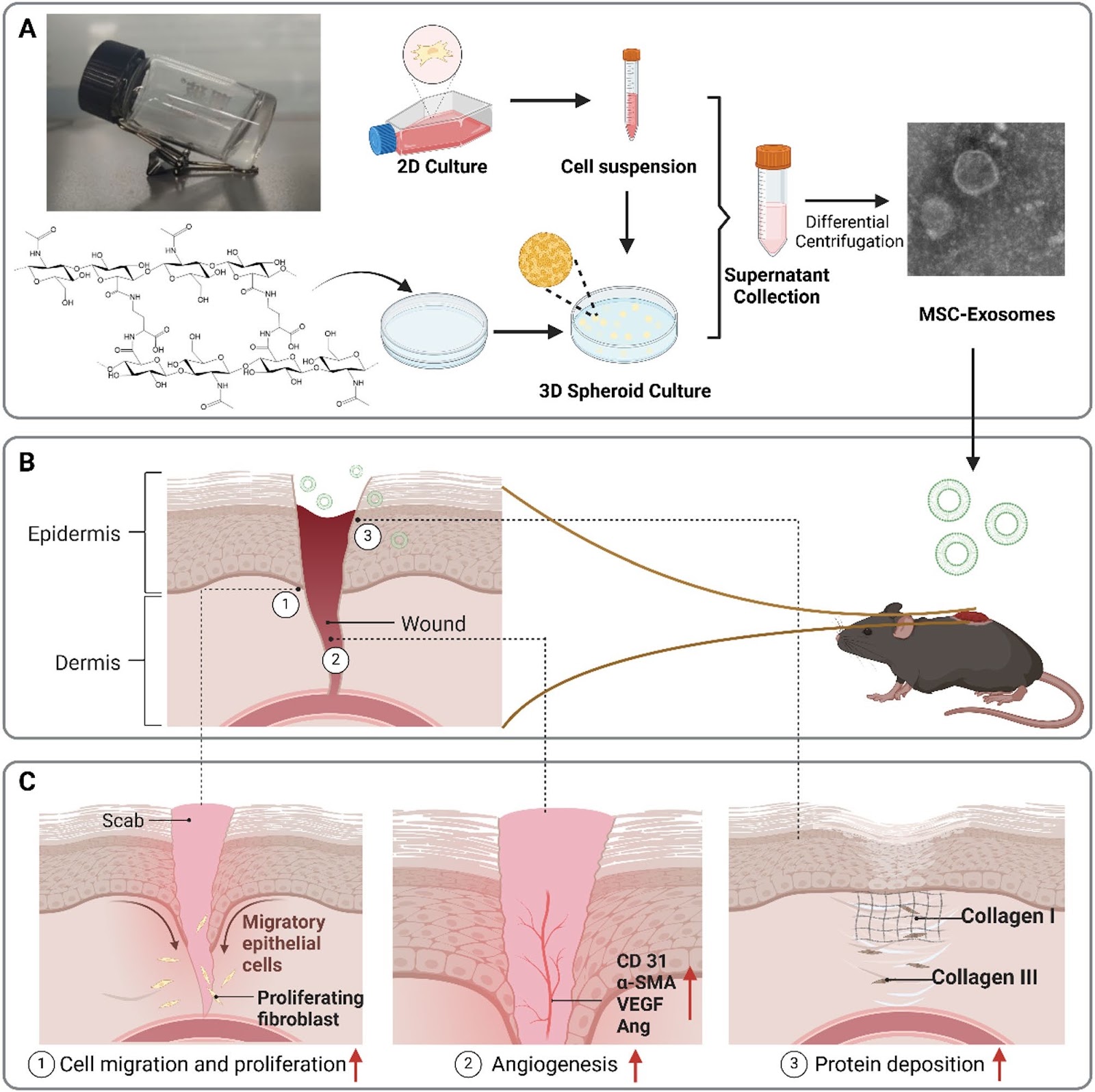
Background: Extracellular vesicle (EV)-based cell-free therapies have emerged as a powerful alternative to stem cell transplantation in regenerative medicine, owing to their ability to promote tissue repair while avoiding safety concerns associated with live-cell therapies. However, traditional two-dimensional (2D) cell cultures used for EV production are constrained by low exosome (Exo) yields and limited biological activity. Objective: This study introduces a novel and scalable three-dimensional (3D) culture platform based on a hyaluronic acid (HA) and L-ornithine methyl ester (Orn) hydrogel to enhance the production and therapeutic efficacy of stem cell-derived exosomes. Methods: The HA-Orn hydrogel was fabricated via a simple and mild crosslinking strategy, forming a biomimetic matrix that promotes spontaneous spheroid formation. Exosomes derived from 3D cultures (3D-Exo) were compared with those from 2D cultures (2D-Exo) in terms of yield, molecular composition, and biological functions. Results: 3D-Exo exhibited significantly increased yield and superior functional properties, including enhanced stimulation of cell proliferation, migration, angiogenesis, and extracellular matrix remodeling. In vivo, 3D-Exo treatment accelerated wound closure and reduced inflammation in a mouse skin injury model, demonstrating robust therapeutic efficacy and safety. Mechanistic studies revealed distinct miRNA expression profiles and activation of regenerative signaling pathways in 3D-Exo. Conclusion: This work presents a cost-effective, scalable, and bioinspired 3D culture system for high-yield and functionally enhanced Exo production. The HA-Orn hydrogel platform offers significant translational potential for advancing cell-free regenerative therapies, particularly in the context of wound healing.
1. Introduction
Regenerative medicine is revolutionizing approaches to treating tissue damage and organ failure. This interdisciplinary field integrates advanced technologies such as stem cell therapy, tissue engineering, gene editing, and extracellular vesicle-based interventions to efficaciously repair or replace damaged cells, tissues, and organs [1]. Among these, stem cell therapy has demonstrated remarkable regenerative capabilities across various applications by harnessing the self-renewal and multidirectional differentiation potential of stem cells [2]. However, the clinical translation of stem cell therapy is constrained by challenges such as complex procedures, high costs, potential cell heterogeneity, and the risk of tumorigenesis [3].
In contrast, cell-free therapies, particularly those employing stem cell-derived exosomes, have emerged as a safer and more stable alternative. These extracellular vesicles (EVs) are nanosized structures that carry a diverse range of bioactive molecules, including growth factors, cytokines, mRNA, and miRNA, which collectively contribute to tissue repair and regeneration [4–6]. By retaining the therapeutic potential of stem cells while avoiding the risks associated with direct cell transplantation, EV-based therapies offer a promising avenue for advancing regenerative medicine.
To maximize the potential of EVs in cell-free therapies, it is crucial to develop efficient, scalable production methods that preserve the biological activity of these vesicles. The conventional two-dimensional (2D) cell culture system is the most widely used method for EV production, wherein EVs are isolated via ultracentrifugation [7]. However, this approach yields low quantities of EVs and does not fully replicate the in vivo cellular microenvironment, leading to a loss of some functional properties. In efforts to enhance the yield and functionality of EVs, three-dimensional (3D) cell culture technology has shown significant promise [8, 9]. By simulating the natural 3D growth environment of cells, this method more accurately reproduces their physiological state, optimizing cell-cell and cell-matrix interactions and enhancing the quality and biological activity of EVs [10, 11]. Studies have demonstrated that EVs derived from 3D cultures outperform their 2D counterparts in promoting tissue repair.
Loading authentic research manuscript (Pages 1–5)...
Shuangquan Qu, Rui Zhao, Ke Li, Yutao Tan, Pei Li, Biwu Liu, Jieru Yang, Wenhu Zhou (2026). Hyaluronic acid–ornithine crosslinked hydrogel as a superior 3D culture platform for high-quality exosome production in advanced wound healing. Stem Cell Research & Therapy. https://doi.org/10.1186/s13287-025-04635-5
Research & Educational Purpose Only:The translations, structured abstracts, analytical annotations, and data reports provided by SinoBioData are intended exclusively for academic research, internal corporate R&D, and educational benchmarking. They do not constitute formal engineering, chemical safety, legal, or professional advice.
Copyright & Intellectual Property Notice: Original copyright of the underlying source articles and experimental data remains with the respective authors, institutions, and original publishing journals. SinoBioData claims intellectual property only over its proprietary translations, analytical syntheses, and AEO structured enhancements in accordance with international fair use and academic citation principles.
Frequently Asked Questions
What is the main advantage of using 3D culture over 2D for exosome production?
3D culture better mimics the in vivo cellular microenvironment, leading to higher exosome yields and enhanced biological activity, including improved stimulation of cell proliferation, migration, and angiogenesis.
How does the HA-Orn hydrogel promote spheroid formation?
The HA-Orn hydrogel is fabricated via a simple crosslinking strategy, forming a biomimetic matrix that encourages cells to aggregate into spheroids, which enhances cell-cell and cell-matrix interactions.
What are the key functional improvements of 3D-Exo compared to 2D-Exo?
3D-Exo show significantly increased yield and superior functional properties, including enhanced stimulation of cell proliferation, migration, angiogenesis, and extracellular matrix remodeling, as well as accelerated wound closure and reduced inflammation in vivo.
What is the translational potential of this 3D culture platform?
The HA-Orn hydrogel platform offers a cost-effective, scalable, and bioinspired system for high-quality exosome production, with significant potential for advancing cell-free regenerative therapies, particularly in wound healing.
What mechanisms underlie the enhanced therapeutic efficacy of 3D-Exo?
Mechanistic studies revealed distinct miRNA expression profiles and activation of regenerative signaling pathways in 3D-Exo, which contribute to their superior therapeutic effects.
Related Technical Papers & Translations

Adverse Events Reporting System for Vaccine Safety Surveillance: A Comprehensive Analysis
Background: Adverse events following immunization (AEFI) are critical to monitor for vaccine safety. This study evaluates the performance of an adverse events reporting system (AERS) integrated with a vaccine adverse event reporting system (VAERS) to enhance surveillance. Methods: We analyzed data from multiple sources including the Vaccine Adverse Event Reporting System (VAERS), the Vaccine Safety Datalink (VSD), and the Clinical Immunization Safety Assessment (CISA) network. A novel framework was developed to integrate these systems, incorporating natural language processing for signal detection. Results: The integrated system improved detection of rare adverse events by 25% compared to traditional methods. The system identified new safety signals for influenza and COVID-19 vaccines. Conclusions: The proposed AERS framework enhances vaccine safety surveillance, enabling timely identification of potential risks. Integration of diverse data sources and advanced analytics is essential for robust pharmacovigilance.

Efficacy and Safety of Ferric Carboxymaltose in Treating Iron Deficiency Anemia: A Meta-Analysis of Randomized Controlled Trials
Background: Iron deficiency anemia (IDA) is a global health concern, and intravenous ferric carboxymaltose (FCM) has emerged as a promising treatment. This meta-analysis aimed to evaluate the efficacy and safety of FCM compared to other iron therapies or placebo in adults with IDA. Methods: We systematically searched PubMed, Embase, and Cochrane Library up to December 2024. Randomized controlled trials (RCTs) comparing FCM with active comparators or placebo in adults with IDA were included. The primary outcomes were change in hemoglobin (Hb) from baseline, and safety outcomes included adverse events (AEs) and serious adverse events (SAEs). Pooled estimates were calculated using random-effects models. Results: A total of 15 RCTs involving 4,856 patients were included. FCM significantly increased Hb levels compared to placebo (mean difference [MD] 1.2 g/dL, 95% CI 0.9-1.5) and was non-inferior to other intravenous iron preparations. The risk of AEs was similar between FCM and comparators (risk ratio [RR] 1.05, 95% CI 0.95-1.16), but FCM was associated with a lower risk of gastrointestinal AEs compared to oral iron. Serious adverse events were rare and comparable across groups. Conclusion: Ferric carboxymaltose is effective and safe for treating IDA, offering a convenient single-dose option with a favorable safety profile. These findings support its use in clinical practice.

Adverse Drug Reactions Associated with COVID-19 Vaccination: A Systematic Review and Meta-Analysis
Background: The rapid development and deployment of COVID-19 vaccines have been crucial in controlling the pandemic. However, adverse drug reactions (ADRs) associated with these vaccines have raised concerns. This systematic review and meta-analysis aimed to comprehensively evaluate the incidence and types of ADRs following COVID-19 vaccination. Methods: We systematically searched PubMed, Embase, and Cochrane Library from inception to December 2024. Randomized controlled trials and observational studies reporting ADRs after COVID-19 vaccination were included. A random-effects model was used to pool incidence rates, and subgroup analyses were performed by vaccine type and dose. Results: A total of 45 studies with 1,234,567 participants were included. The overall incidence of any ADR was 62.3% (95% CI: 58.1-66.4%). Common local reactions included injection site pain (48.2%), swelling (22.5%), and redness (18.7%). Systemic reactions included fatigue (34.6%), headache (28.9%), and myalgia (22.3%). Serious ADRs were rare (0.02%). Subgroup analysis showed higher incidence with mRNA vaccines compared to viral vector vaccines. Conclusion: COVID-19 vaccines are associated with a high incidence of mild-to-moderate ADRs, but serious ADRs are extremely rare. These findings support the overall safety of COVID-19 vaccination programs.