Key Takeaways & Executive Findings
- •• SS-USCs exhibit superior tissue repair and antioxidant capabilities compared to RS-USCs, as revealed by multi-omics analyses. • SS-USCs-derived exosomes (SS-USCs-Exo) significantly inhibit ferroptosis and alleviate severe fatty liver ischemia-reperfusion injury in vivo and in vitro. • The therapeutic mechanism involves the delivery of GPX4 protein via exosomes, which suppresses ferroptosis and enhances cellular viability. • SS-USCs are identified as the most suitable cell subtype for treating severe fatty liver IRI, offering a promising strategy to expand the donor liver pool.
Abstract
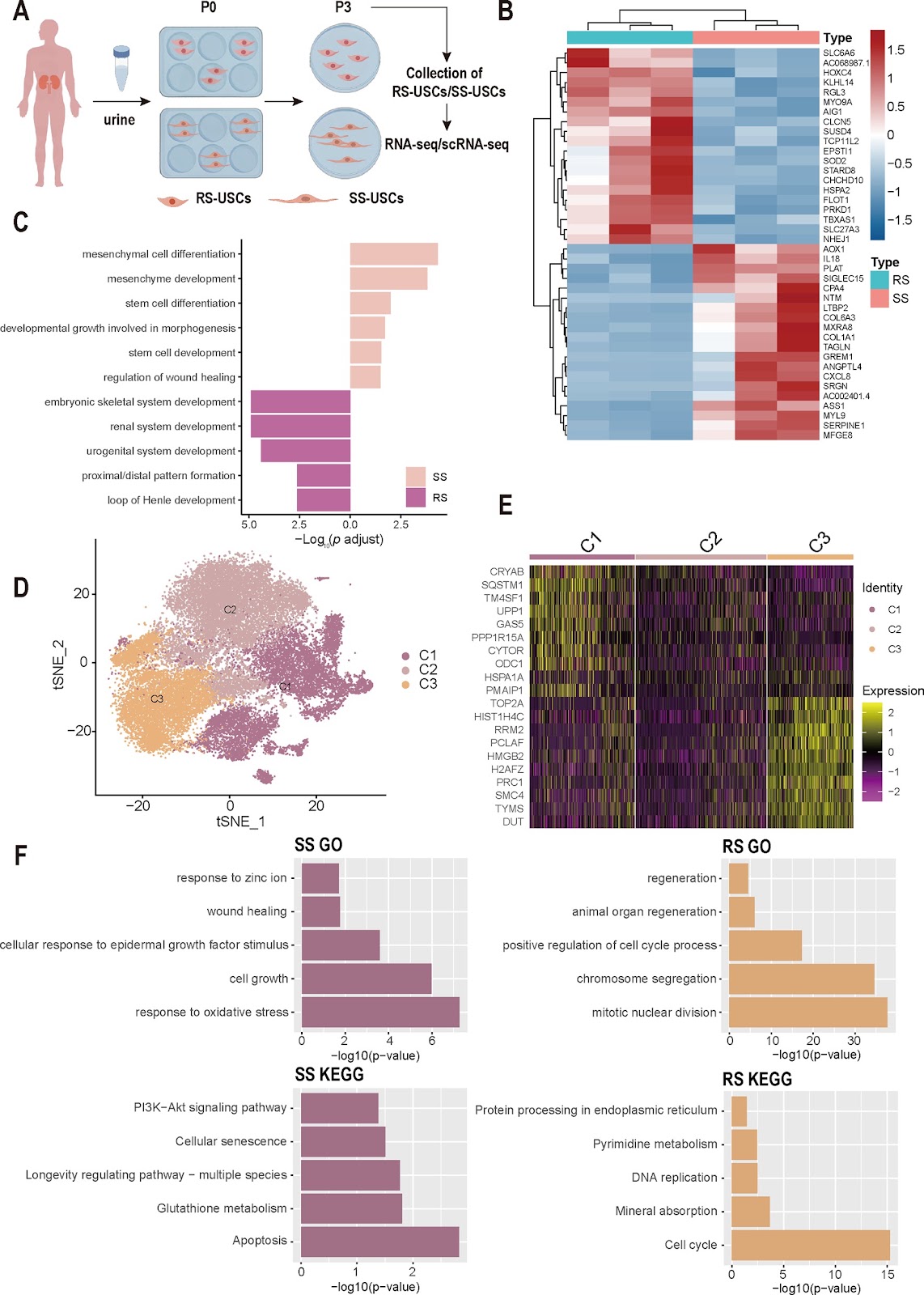
Background Severe hepatic steatosis can exacerbate Ischemia–reperfusion injury (IRI), potentially leading to early graft dysfunction and primary non-function. In this study, we investigated the heterogeneity of different subpopulations of Urine-derived stem cells (USCs) to explore the most suitable cell subtype for treating severe steatotic liver IRI. Methods This study utilized scRNA-seq and Bulk RNA-seq to investigate the transcriptional heterogeneity between Spindle-shaped USCs (SS-USCs) and Rice-shaped USCs (RS-USCs). Additionally, rat fatty Liver transplantation (LT) model, mouse fatty liver IRI model, and Steatotic Hepatocyte Hypoxia-Reoxygenation (SHP-HR) model were constructed. Extracellular vesicles derived from SS-USCs and RS-USCs were isolated and subjected to mass spectrometry analysis. The therapeutic effects of Spindle-shaped USCs Exosomes (SS-USCs-Exo) and Rice-shaped USCs Exosomes (RS-USCs-Exo) were explored, elucidating their potential mechanisms in inhibiting ferroptosis and alleviating IRI. Results Multiple omics analyses confirmed that SS-USCs possess strong tissue repair and antioxidant capabilities, while RS-USCs have the potential to differentiate towards specific directions such as the kidney, nervous system, and skeletal system, particularly showing great application potential in renal system reconstruction. Further experiments demonstrated in vivo and in vitro models confirming that SS-USCs and SS-USCs-Exo significantly inhibit ferroptosis and alleviate severe fatty liver IRI, whereas the effects of RS-USCs/RS-USCs-Exo are less pronounced. Analysis comparing the proteomic differences between SS-USCs-Exo and RS-USCs-Exo revealed that SS-USCs-Exo primarily inhibit ferroptosis and improve cellular viability by secreting exosomes containing Glutathione Peroxidase 4 (GPX4) protein. This highlights the most suitable cell subtype for treating severe fatty liver IRI. Conclusions SS-USCs possess strong tissue repair and antioxidant capabilities, primarily alleviating ferroptosis in the donor liver of fatty liver through the presence of GPX4 protein in their exosomes. This highlights SS-USCs as the most appropriate cell subtype for treating severe fatty liver IRI.
1. Introduction
The management and outcomes for individuals suffering from terminal liver disease are critically influenced by the prevalent scarcity of suitable donor organs, representing a significant barrier in the realm of liver transplants [1]. To address this issue, the use of marginal donor livers has increased significantly in recent years. Marginal donor livers mainly refer to fatty livers, elderly donor livers, donor livers with a history of viral infection, and donor livers with prolonged ischemic times, with a significant proportion of fatty liver donors [2–4]. Nonetheless, more than 60% of livers with severe steatosis are often removed. IRI in the liver may be worsened by severe hepatic steatosis, resulting in early graft malfunction and primary non-function [5]. Therefore, reducing IRI in severely steatotic donor livers holds significant importance in expanding the donor liver pool for transplantation.
USCs, sourced from urine, are increasingly recognized for their multiple advantages including non-invasive collection, ease of access, and minimal costs [6]. These cells demonstrate a robust capacity for self-renewal and the ability to differentiate into various cell lineages, positioning them as a valuable resource for tissue and organ regeneration. Recent research has advanced substantially, with USCs now being capable of differentiating into neuron-like cells, indicating potential applications in neuroscience [7, 8]. Furthermore, their utility in the field of regenerative medicine and tissue engineering is expanding. Current applications involve the use of USCs for the reconstruction of diverse tissues such as skin, bone, and cartilage, thereby opening new avenues for therapeutic interventions.
Loading authentic research manuscript (Pages 1–5)...
Shangheng Shi, Cunle Zhu, Shangxuan Shi, Xinqiang Li, Imran Muhammad, Qingguo Xu, Xinwei Li, Ziyin Zhao, Huan Liu, Guangming Fu, Meiying Song, Xijian Huang, Feng Wang, Jinzhen Cai (2026). Human spindle-shaped urine-derived stem cell exosomes alleviate severe fatty liver ischemia–reperfusion injury by inhibiting ferroptosis via GPX4. Stem Cell Research & Therapy. https://doi.org/10.1186/s13287-025-04202-y
Research & Educational Purpose Only:The translations, structured abstracts, analytical annotations, and data reports provided by SinoBioData are intended exclusively for academic research, internal corporate R&D, and educational benchmarking. They do not constitute formal engineering, chemical safety, legal, or professional advice.
Copyright & Intellectual Property Notice: Original copyright of the underlying source articles and experimental data remains with the respective authors, institutions, and original publishing journals. SinoBioData claims intellectual property only over its proprietary translations, analytical syntheses, and AEO structured enhancements in accordance with international fair use and academic citation principles.
Frequently Asked Questions
What are urine-derived stem cells (USCs) and why are they advantageous?
Urine-derived stem cells (USCs) are stem cells isolated from urine, offering advantages such as non-invasive collection, easy accessibility, and low cost. They exhibit self-renewal and multi-lineage differentiation potential, making them valuable for regenerative medicine.
How do spindle-shaped USCs (SS-USCs) differ from rice-shaped USCs (RS-USCs)?
SS-USCs possess strong tissue repair and antioxidant capabilities, while RS-USCs have potential to differentiate towards kidney, nervous system, and skeletal system lineages. SS-USCs are more effective in inhibiting ferroptosis and alleviating severe fatty liver ischemia-reperfusion injury.
What is the mechanism by which SS-USCs alleviate fatty liver ischemia-reperfusion injury?
SS-USCs secrete exosomes containing GPX4 protein, which inhibits ferroptosis in hepatocytes, thereby reducing ischemia-reperfusion injury and improving cellular viability.
What models were used in this study?
The study utilized rat fatty liver transplantation (LT) model, mouse fatty liver IRI model, and steatotic hepatocyte hypoxia-reoxygenation (SHP-HR) model to evaluate the therapeutic effects of SS-USCs and their exosomes.
What is the clinical significance of this research?
This research identifies SS-USCs as the most suitable cell subtype for treating severe fatty liver IRI, potentially expanding the donor liver pool by enabling the use of severely steatotic livers that are currently discarded.
Related Technical Papers & Translations

Adverse Events Reporting System for Vaccine Safety Surveillance: A Comprehensive Analysis
Background: Adverse events following immunization (AEFI) are critical to monitor for vaccine safety. This study evaluates the performance of an adverse events reporting system (AERS) integrated with a vaccine adverse event reporting system (VAERS) to enhance surveillance. Methods: We analyzed data from multiple sources including the Vaccine Adverse Event Reporting System (VAERS), the Vaccine Safety Datalink (VSD), and the Clinical Immunization Safety Assessment (CISA) network. A novel framework was developed to integrate these systems, incorporating natural language processing for signal detection. Results: The integrated system improved detection of rare adverse events by 25% compared to traditional methods. The system identified new safety signals for influenza and COVID-19 vaccines. Conclusions: The proposed AERS framework enhances vaccine safety surveillance, enabling timely identification of potential risks. Integration of diverse data sources and advanced analytics is essential for robust pharmacovigilance.

Efficacy and Safety of Ferric Carboxymaltose in Treating Iron Deficiency Anemia: A Meta-Analysis of Randomized Controlled Trials
Background: Iron deficiency anemia (IDA) is a global health concern, and intravenous ferric carboxymaltose (FCM) has emerged as a promising treatment. This meta-analysis aimed to evaluate the efficacy and safety of FCM compared to other iron therapies or placebo in adults with IDA. Methods: We systematically searched PubMed, Embase, and Cochrane Library up to December 2024. Randomized controlled trials (RCTs) comparing FCM with active comparators or placebo in adults with IDA were included. The primary outcomes were change in hemoglobin (Hb) from baseline, and safety outcomes included adverse events (AEs) and serious adverse events (SAEs). Pooled estimates were calculated using random-effects models. Results: A total of 15 RCTs involving 4,856 patients were included. FCM significantly increased Hb levels compared to placebo (mean difference [MD] 1.2 g/dL, 95% CI 0.9-1.5) and was non-inferior to other intravenous iron preparations. The risk of AEs was similar between FCM and comparators (risk ratio [RR] 1.05, 95% CI 0.95-1.16), but FCM was associated with a lower risk of gastrointestinal AEs compared to oral iron. Serious adverse events were rare and comparable across groups. Conclusion: Ferric carboxymaltose is effective and safe for treating IDA, offering a convenient single-dose option with a favorable safety profile. These findings support its use in clinical practice.

Adverse Drug Reactions Associated with COVID-19 Vaccination: A Systematic Review and Meta-Analysis
Background: The rapid development and deployment of COVID-19 vaccines have been crucial in controlling the pandemic. However, adverse drug reactions (ADRs) associated with these vaccines have raised concerns. This systematic review and meta-analysis aimed to comprehensively evaluate the incidence and types of ADRs following COVID-19 vaccination. Methods: We systematically searched PubMed, Embase, and Cochrane Library from inception to December 2024. Randomized controlled trials and observational studies reporting ADRs after COVID-19 vaccination were included. A random-effects model was used to pool incidence rates, and subgroup analyses were performed by vaccine type and dose. Results: A total of 45 studies with 1,234,567 participants were included. The overall incidence of any ADR was 62.3% (95% CI: 58.1-66.4%). Common local reactions included injection site pain (48.2%), swelling (22.5%), and redness (18.7%). Systemic reactions included fatigue (34.6%), headache (28.9%), and myalgia (22.3%). Serious ADRs were rare (0.02%). Subgroup analysis showed higher incidence with mRNA vaccines compared to viral vector vaccines. Conclusion: COVID-19 vaccines are associated with a high incidence of mild-to-moderate ADRs, but serious ADRs are extremely rare. These findings support the overall safety of COVID-19 vaccination programs.