Key Takeaways & Executive Findings
- •• Leukoreduction filters, typically discarded after blood manufacturing, can yield sufficient platelets and plasma to produce human platelet lysate (f-hPL) for MSC expansion. • f-hPL at 10% supplementation significantly enhances MSC proliferation compared to commercial hPL (20% higher) and FBS (300% higher), while maintaining MSC quality. • The optimal protein concentration for f-hPL lysate is >27 mg/mL, and a single filter can provide ~3.5×10^10 platelets with 37.1% collection efficiency. • This approach offers a sustainable, cost-effective, and ethical alternative to FBS and commercial hPL for clinical-scale stem cell therapy.
Abstract
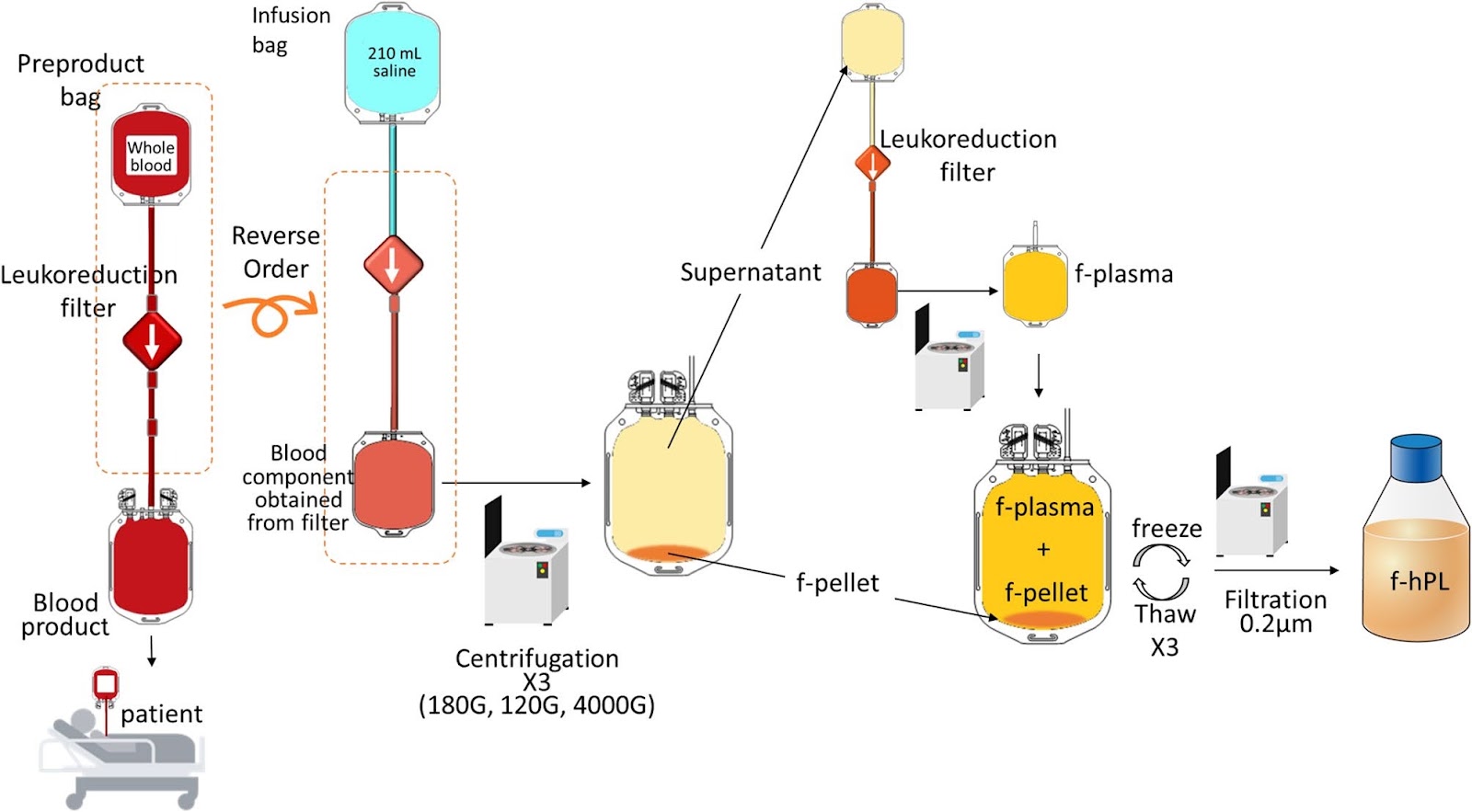
Background Stem cell therapy holds significant potential for promoting recovery, with numerous products currently under development. Blood-derived supplements are often essential for successful stem cell expansion, with fetal bovine serum (FBS) being the most commonly used supplement. However, FBS has drawbacks, including the risk of immune responses, ethical concerns about animal welfare, and potential zoonotic infections. Human platelet lysate (hPL), derived from lysed platelets, contains various growth factors and has been proposed as an alternative to FBS. However, obtaining sufficient human platelets for clinical use remains challenging. Leukoreduction filters, used during blood transfusion manufacturing to remove leukocytes, also retain significant amounts of platelets and plasma. This study investigates the feasibility and efficacy of filter-derived hPL (f-hPL) for mesenchymal stem cell (MSC) expansion. Methods Leukoreduction filters were collected after their use in the manufacturing of whole blood transfusion products. Each filter was reverse-perfused with saline to extract residual blood contents. Platelets (f-platelet) and supernatant were separated by multiple centrifugation steps. f-Platelet were lysed with varying concentrations of fresh frozen plasma (FFP) to determine the optimal protein concentration for the lysate solution. Then, plasma left in the leukoreduction filters were used to generate lysate solution (f-plasma) at optimal protein concentration. f-Platelet (1.1 × 10^9/mL) and f-plasma (27 mg/mL protein) were combined in a freezing bag and subjected to three freeze-thaw cycles to produce f-hPL. Both small- and large-scale f-hPL were manufactured, and MSCs expansion and quality assessments were perfomed to evaluate the efficacy of f-hPL. Results A total of 3.5 ± 0.6 × 10^10 f-platelets were obtained from a single leukoreduction filter, yielding a collection efficiency of 37.1 ± 5.3%. The optimal protein concentration of lysate solution for cell expansion was > 27 mg/mL. Subsequently, six leukoreduction filters used to produce enough f-platelet and p-plasma for 100 mL of f-hPL. MSCs cultured in medium supplemented with 10% f-hPL demonstrated superior expansion, with cell proliferation rates 20% higher than those observed with commercial hPL and 300% higher than those cultured with FBS. The expanded MSCs met the International Society for Cell & Gene Therapy criteria for cell surface markers and differentiation potential.
1. Introduction
Cell transplantation therapy holds promise for promoting recovery in various diseases. To date, several cell types have been investigated, including embryonic stem cells, induced pluripotent stem cells, and mesenchymal stem cells (MSC). In most cases, blood-derived supplements are required to be added in the culture medium to successfully expand stem cells, with fetal bovine serum (FBS) being the most commonly used supplement [1]. However, FBS poses potential risks, including zoonotic contamination, immunological reactions to xenogeneic serum antigens, and ethical concerns regarding animal welfare [2–4].
An alternative candidate is human AB serum, which offers the advantage of non-zoonotic contamination, and many clinical trials are currently utilizing human AB serum for cell expansion [5, 6]. However, due to its reliance on human resources, the cost of this supplement is relatively high, and its supply may be insufficient to meet the growing demand for industrial-scale stem cell products. Recent reports have demonstrated that human platelet lysate (hPL) is a promising substitute for cell supplement [7, 8], and several clinical trials have incorporated hPL as a supplement in stem cell culture media [9–15]. Similar to human AB serum, the preparation of a sufficient quantity of hPL is crucial for clinical applications. However, human platelets are primarily collected at blood banks for transfusion purposes, rather than for hPL production. Consequently, outdated platelet concentrates, which account for 2–4% of the total platelet concentrates, are frequently utilized for hPL production. Due to ongoing efforts to minimize outdated blood products, the availability of such platelet concentrates is expected to decrease, potentially limiting their use as a source for hPL.
Loading authentic research manuscript (Pages 1–5)...
Shinobu Wakamoto, Tomoko Furukawa, Masahito Kawabori, Mitsuaki Akino, Shiho Kato, Hisae Fuse, Sumio Ohtsuki, Yoshihiro Torimoto, Miki Fujimura, Shuichi Kino (2026). Human platelet lysate produced from leukoreduction filter contents enables sufficient MSC growth. Stem Cell Research & Therapy. https://doi.org/10.1186/s13287-025-04329-y
Research & Educational Purpose Only:The translations, structured abstracts, analytical annotations, and data reports provided by SinoBioData are intended exclusively for academic research, internal corporate R&D, and educational benchmarking. They do not constitute formal engineering, chemical safety, legal, or professional advice.
Copyright & Intellectual Property Notice: Original copyright of the underlying source articles and experimental data remains with the respective authors, institutions, and original publishing journals. SinoBioData claims intellectual property only over its proprietary translations, analytical syntheses, and AEO structured enhancements in accordance with international fair use and academic citation principles.
Frequently Asked Questions
What is the main advantage of using leukoreduction filter-derived human platelet lysate (f-hPL) over fetal bovine serum (FBS) for stem cell culture?
f-hPL provides a human-derived, xeno-free alternative to FBS, eliminating risks of zoonotic infections and immune reactions, while also addressing ethical concerns. It supports superior MSC proliferation (300% higher than FBS) and meets quality criteria for clinical use.
How is f-hPL produced from leukoreduction filters?
Leukoreduction filters are reverse-perfused with saline to extract residual blood. Platelets and plasma are separated via centrifugation, then platelets are lysed with plasma at an optimal protein concentration (>27 mg/mL) and subjected to three freeze-thaw cycles to produce f-hPL.
What is the yield of platelets from a single leukoreduction filter?
A single leukoreduction filter yields approximately 3.5 ± 0.6 × 10^10 platelets, with a collection efficiency of 37.1 ± 5.3%.
Does f-hPL affect the quality of expanded mesenchymal stem cells?
No, MSCs expanded with f-hPL maintain their characteristic cell surface markers and differentiation potential, meeting the International Society for Cell & Gene Therapy criteria.
Why is f-hPL considered a sustainable source for stem cell therapy?
Leukoreduction filters are routinely discarded after blood manufacturing, providing a readily available and low-cost source of platelets and plasma. This reduces reliance on outdated platelet concentrates and addresses supply limitations for large-scale stem cell production.
Related Technical Papers & Translations

Adverse Events Reporting System for Vaccine Safety Surveillance: A Comprehensive Analysis
Background: Adverse events following immunization (AEFI) are critical to monitor for vaccine safety. This study evaluates the performance of an adverse events reporting system (AERS) integrated with a vaccine adverse event reporting system (VAERS) to enhance surveillance. Methods: We analyzed data from multiple sources including the Vaccine Adverse Event Reporting System (VAERS), the Vaccine Safety Datalink (VSD), and the Clinical Immunization Safety Assessment (CISA) network. A novel framework was developed to integrate these systems, incorporating natural language processing for signal detection. Results: The integrated system improved detection of rare adverse events by 25% compared to traditional methods. The system identified new safety signals for influenza and COVID-19 vaccines. Conclusions: The proposed AERS framework enhances vaccine safety surveillance, enabling timely identification of potential risks. Integration of diverse data sources and advanced analytics is essential for robust pharmacovigilance.

Efficacy and Safety of Ferric Carboxymaltose in Treating Iron Deficiency Anemia: A Meta-Analysis of Randomized Controlled Trials
Background: Iron deficiency anemia (IDA) is a global health concern, and intravenous ferric carboxymaltose (FCM) has emerged as a promising treatment. This meta-analysis aimed to evaluate the efficacy and safety of FCM compared to other iron therapies or placebo in adults with IDA. Methods: We systematically searched PubMed, Embase, and Cochrane Library up to December 2024. Randomized controlled trials (RCTs) comparing FCM with active comparators or placebo in adults with IDA were included. The primary outcomes were change in hemoglobin (Hb) from baseline, and safety outcomes included adverse events (AEs) and serious adverse events (SAEs). Pooled estimates were calculated using random-effects models. Results: A total of 15 RCTs involving 4,856 patients were included. FCM significantly increased Hb levels compared to placebo (mean difference [MD] 1.2 g/dL, 95% CI 0.9-1.5) and was non-inferior to other intravenous iron preparations. The risk of AEs was similar between FCM and comparators (risk ratio [RR] 1.05, 95% CI 0.95-1.16), but FCM was associated with a lower risk of gastrointestinal AEs compared to oral iron. Serious adverse events were rare and comparable across groups. Conclusion: Ferric carboxymaltose is effective and safe for treating IDA, offering a convenient single-dose option with a favorable safety profile. These findings support its use in clinical practice.

Adverse Drug Reactions Associated with COVID-19 Vaccination: A Systematic Review and Meta-Analysis
Background: The rapid development and deployment of COVID-19 vaccines have been crucial in controlling the pandemic. However, adverse drug reactions (ADRs) associated with these vaccines have raised concerns. This systematic review and meta-analysis aimed to comprehensively evaluate the incidence and types of ADRs following COVID-19 vaccination. Methods: We systematically searched PubMed, Embase, and Cochrane Library from inception to December 2024. Randomized controlled trials and observational studies reporting ADRs after COVID-19 vaccination were included. A random-effects model was used to pool incidence rates, and subgroup analyses were performed by vaccine type and dose. Results: A total of 45 studies with 1,234,567 participants were included. The overall incidence of any ADR was 62.3% (95% CI: 58.1-66.4%). Common local reactions included injection site pain (48.2%), swelling (22.5%), and redness (18.7%). Systemic reactions included fatigue (34.6%), headache (28.9%), and myalgia (22.3%). Serious ADRs were rare (0.02%). Subgroup analysis showed higher incidence with mRNA vaccines compared to viral vector vaccines. Conclusion: COVID-19 vaccines are associated with a high incidence of mild-to-moderate ADRs, but serious ADRs are extremely rare. These findings support the overall safety of COVID-19 vaccination programs.