Key Takeaways & Executive Findings
- •• Identified a novel population of human intermediate prostate cancer stem cells (CriPCSCs) that express both luminal and basal markers and exhibit stem cell properties. • Developed a customized culture medium enabling long-term expansion of primary intermediate prostate cells without genetic modification. • Demonstrated that CriPCSCs are highly tumorigenic in vivo, forming tumors in immunodeficient mice within one month, and resist castration by upregulating AR and proliferation markers. • Established a patient primary cell-derived xenograft (PrDX) model that faithfully recapitulates human prostate adenocarcinoma, providing a valuable tool for studying prostate cancer initiation and therapy resistance.
Abstract
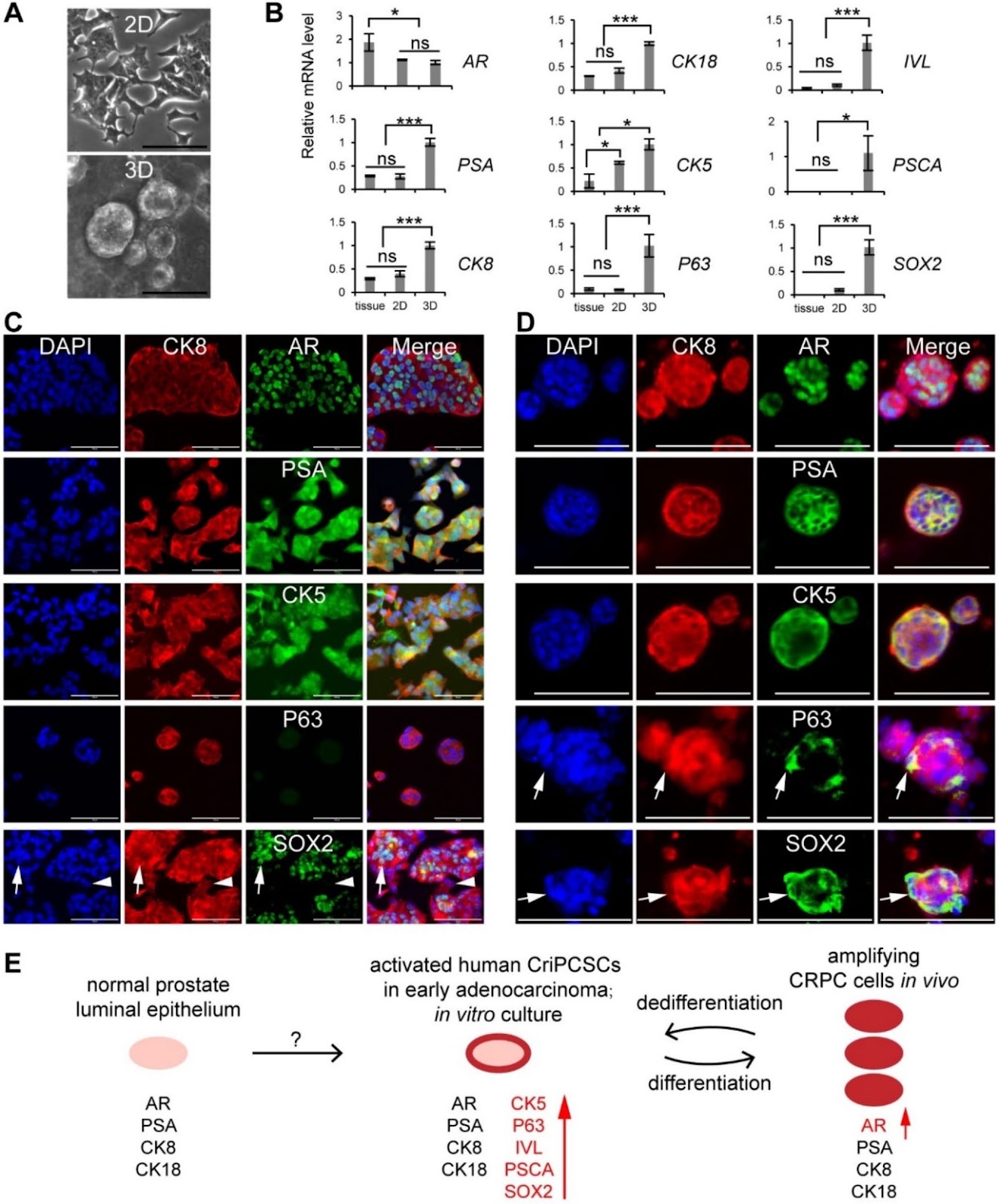
Background Intermediate cells are present in the early stages of human prostate development and adenocarcinoma. While primary cells isolated from benign human prostate tissues or tumors exhibit an intermediate phenotype in vitro, they cannot form tumors in vivo unless genetically modified. It is unclear about the stem cell properties and tumorigenicity of intermediate cells. Methods We developed a customized medium to culture primary human intermediate prostate cells, which were transplanted into male immunodeficient NCG mice to examine tumorigenicity in vivo. We treated the cells with different concentrations of dihydrotestosterone (DHT) and enzalutamide in vitro and surgically castrated the mice after cell transplantation in vivo. Immunostaining, qRT-PCR, RNA sequencing, and western blotting were performed to characterize the cells in tissues and 2D and 3D cultures. Results We found intermediate cells expressing AR+PSA+CK8+CK5+ in the luminal compartment of human prostate adenocarcinoma by immunostaining. We cultured the primary intermediate cells in vitro, which expressed luminal (AR+PSA+CK8+CK18+), basal (CK5+P63+), intermediate (IVL+), and stem cell (CK4+CK13+PSCA+SOX2+) markers. These cells resisted castration in vitro by upregulating the expression of AR, PSA, and proliferation markers KI67 and PCNA. The intermediate cells had high tumorigenicity in vivo, forming tumors in immunodeficient NCG mice in a month without any genetic modification or co-transplantation with embryonic urogenital sinus mesenchyme (UGSM) cells. We named these cells human castration-resistant intermediate prostate cancer stem cells or CriPCSCs and defined the xenograft model as patient primary cell-derived xenograft (PrDX). Human CriPCSCs resisted castration in vitro and
1. Introduction
Prostate cancer is the most commonly diagnosed cancer in men in the US, and it is also the fastest-growing cancer in men in China [1–3]. The majority of prostate cancers are initially diagnosed as adenocarcinomas, which have a luminal phenotype and express androgen receptor (AR), prostate-specific antigen (PSA), keratin 8 (CK8), and CK18 [4]. The androgen signaling pathway is a key regulator in prostate development and adenocarcinoma [5]. Androgen deprivation therapy, also known as castration, has been the standard treatment for advanced and metastatic prostate adenocarcinomas [5]. However, most patients will eventually develop into castration-resistant prostate cancer (CRPC) [5–8]. Prostate stem cells (PSCs) are crucial in the development of prostate cancer and resistance to castration [9, 10]. Studies using lineage-tracing and pulse-chase transgenic mouse models have identified rare castration-resistant PSCs in luminal and basal cell populations that can give rise to prostate cancers upon genetic manipulations [9, 11–15]. Research on human prostate stem cells has significant implications in translational medicine. This is due to the differences between human and mouse prostates in terms of anatomy, histology, and cell biology [16]. Dean Tang’s group identified a subpopulation of cancer stem cells within the LAPC9 prostate cancer cell line, which exhibited a high tumor-initiating capacity [17]. Recent single-cell sequencing studies have identified potential stem cell populations in human prostate normal tissues and tumors [18–22].
The in vitro culture of prostate stem cells or cancer stem cells offers valuable tools for prostate cancer research and precision medicine. Dihydrotestosterone (DHT), a potent endogenous androgen, was typically added to the culture media to support luminal PSC growth [23, 24]. However, primary human prostate stem cells cultured in previous studies exhibited low tumorigenicity. These cells were often genetically engineered to overexpress oncogenes or knock out tumor suppressor genes to promote prostate cancer development [25–29]. Co-transplantation with embryonic urogenital sinus mesenchyme (UGSM) cells was required for these engineered cells to effectively form tumors in vivo [25–29]. However, genetic modifications might hinder the accurate replication of original tumors in vitro, which is cruci
Loading authentic research manuscript (Pages 1–5)...
Jie Mu, Ruizhi Li, Yu Zheng, Yi Lu, Lei Ma, Lin Yin, Miao Zhang, Wenyu Ma, Mengjia Chang, Aihua Liu, Jing Li, Hai Zhu, Dong Wang (2026). Human intermediate prostate cancer stem cells contribute to the initiation and development of prostate adenocarcinoma. Stem Cell Research & Therapy. https://doi.org/10.1186/s13287-024-03917-8
Research & Educational Purpose Only:The translations, structured abstracts, analytical annotations, and data reports provided by SinoBioData are intended exclusively for academic research, internal corporate R&D, and educational benchmarking. They do not constitute formal engineering, chemical safety, legal, or professional advice.
Copyright & Intellectual Property Notice: Original copyright of the underlying source articles and experimental data remains with the respective authors, institutions, and original publishing journals. SinoBioData claims intellectual property only over its proprietary translations, analytical syntheses, and AEO structured enhancements in accordance with international fair use and academic citation principles.
Frequently Asked Questions
What are intermediate prostate cancer stem cells (CriPCSCs)?
CriPCSCs are a newly identified population of human prostate cancer cells that express both luminal and basal markers, along with stem cell markers. They are castration-resistant and highly tumorigenic, capable of initiating prostate adenocarcinoma in vivo without genetic modification.
How were CriPCSCs isolated and cultured?
The researchers developed a customized medium to culture primary human intermediate prostate cells from benign and tumor tissues. These cells were characterized by immunostaining, qRT-PCR, RNA sequencing, and western blotting, and were found to express a unique combination of markers.
What is the significance of the PrDX model?
The patient primary cell-derived xenograft (PrDX) model established in this study allows for the growth of human prostate cancer cells in immunodeficient mice without genetic engineering or co-transplantation with UGSM cells. This model more accurately replicates the original tumor and provides a valuable tool for studying prostate cancer biology and testing therapies.
How do CriPCSCs resist castration?
CriPCSCs resist castration by upregulating the expression of androgen receptor (AR), prostate-specific antigen (PSA), and proliferation markers such as KI67 and PCNA, both in vitro and in vivo. This allows them to survive and proliferate in low-androgen environments, contributing to castration-resistant prostate cancer.
What are the potential clinical implications of this research?
The identification of CriPCSCs and the PrDX model could lead to better understanding of prostate cancer initiation and progression, as well as the development of targeted therapies against these stem cells. It also provides a platform for personalized medicine by testing patient-specific drug responses.
Related Technical Papers & Translations

Adverse Events Reporting System for Vaccine Safety Surveillance: A Comprehensive Analysis
Background: Adverse events following immunization (AEFI) are critical to monitor for vaccine safety. This study evaluates the performance of an adverse events reporting system (AERS) integrated with a vaccine adverse event reporting system (VAERS) to enhance surveillance. Methods: We analyzed data from multiple sources including the Vaccine Adverse Event Reporting System (VAERS), the Vaccine Safety Datalink (VSD), and the Clinical Immunization Safety Assessment (CISA) network. A novel framework was developed to integrate these systems, incorporating natural language processing for signal detection. Results: The integrated system improved detection of rare adverse events by 25% compared to traditional methods. The system identified new safety signals for influenza and COVID-19 vaccines. Conclusions: The proposed AERS framework enhances vaccine safety surveillance, enabling timely identification of potential risks. Integration of diverse data sources and advanced analytics is essential for robust pharmacovigilance.

Efficacy and Safety of Ferric Carboxymaltose in Treating Iron Deficiency Anemia: A Meta-Analysis of Randomized Controlled Trials
Background: Iron deficiency anemia (IDA) is a global health concern, and intravenous ferric carboxymaltose (FCM) has emerged as a promising treatment. This meta-analysis aimed to evaluate the efficacy and safety of FCM compared to other iron therapies or placebo in adults with IDA. Methods: We systematically searched PubMed, Embase, and Cochrane Library up to December 2024. Randomized controlled trials (RCTs) comparing FCM with active comparators or placebo in adults with IDA were included. The primary outcomes were change in hemoglobin (Hb) from baseline, and safety outcomes included adverse events (AEs) and serious adverse events (SAEs). Pooled estimates were calculated using random-effects models. Results: A total of 15 RCTs involving 4,856 patients were included. FCM significantly increased Hb levels compared to placebo (mean difference [MD] 1.2 g/dL, 95% CI 0.9-1.5) and was non-inferior to other intravenous iron preparations. The risk of AEs was similar between FCM and comparators (risk ratio [RR] 1.05, 95% CI 0.95-1.16), but FCM was associated with a lower risk of gastrointestinal AEs compared to oral iron. Serious adverse events were rare and comparable across groups. Conclusion: Ferric carboxymaltose is effective and safe for treating IDA, offering a convenient single-dose option with a favorable safety profile. These findings support its use in clinical practice.

Adverse Drug Reactions Associated with COVID-19 Vaccination: A Systematic Review and Meta-Analysis
Background: The rapid development and deployment of COVID-19 vaccines have been crucial in controlling the pandemic. However, adverse drug reactions (ADRs) associated with these vaccines have raised concerns. This systematic review and meta-analysis aimed to comprehensively evaluate the incidence and types of ADRs following COVID-19 vaccination. Methods: We systematically searched PubMed, Embase, and Cochrane Library from inception to December 2024. Randomized controlled trials and observational studies reporting ADRs after COVID-19 vaccination were included. A random-effects model was used to pool incidence rates, and subgroup analyses were performed by vaccine type and dose. Results: A total of 45 studies with 1,234,567 participants were included. The overall incidence of any ADR was 62.3% (95% CI: 58.1-66.4%). Common local reactions included injection site pain (48.2%), swelling (22.5%), and redness (18.7%). Systemic reactions included fatigue (34.6%), headache (28.9%), and myalgia (22.3%). Serious ADRs were rare (0.02%). Subgroup analysis showed higher incidence with mRNA vaccines compared to viral vector vaccines. Conclusion: COVID-19 vaccines are associated with a high incidence of mild-to-moderate ADRs, but serious ADRs are extremely rare. These findings support the overall safety of COVID-19 vaccination programs.