Key Takeaways & Executive Findings
- •• Dual inhibition of TP53 and DNA methylation maintenance during Cas9-mediated NHEJ significantly enhances XIST reactivation efficiency in female hPSCs, increasing from ~5% to ~43.7%. • This strategy provides a robust method for stabilizing X-chromosome inactivation, addressing a critical barrier in disease modeling and clinical applications of female hPSCs. • The approach avoids the use of exogenous sequences, mitigating concerns about unintended effects on XIST expression compared to HDR-based methods. • The findings have implications for improving the safety and reliability of female hPSCs in regenerative medicine and X-linked disorder research.
Abstract
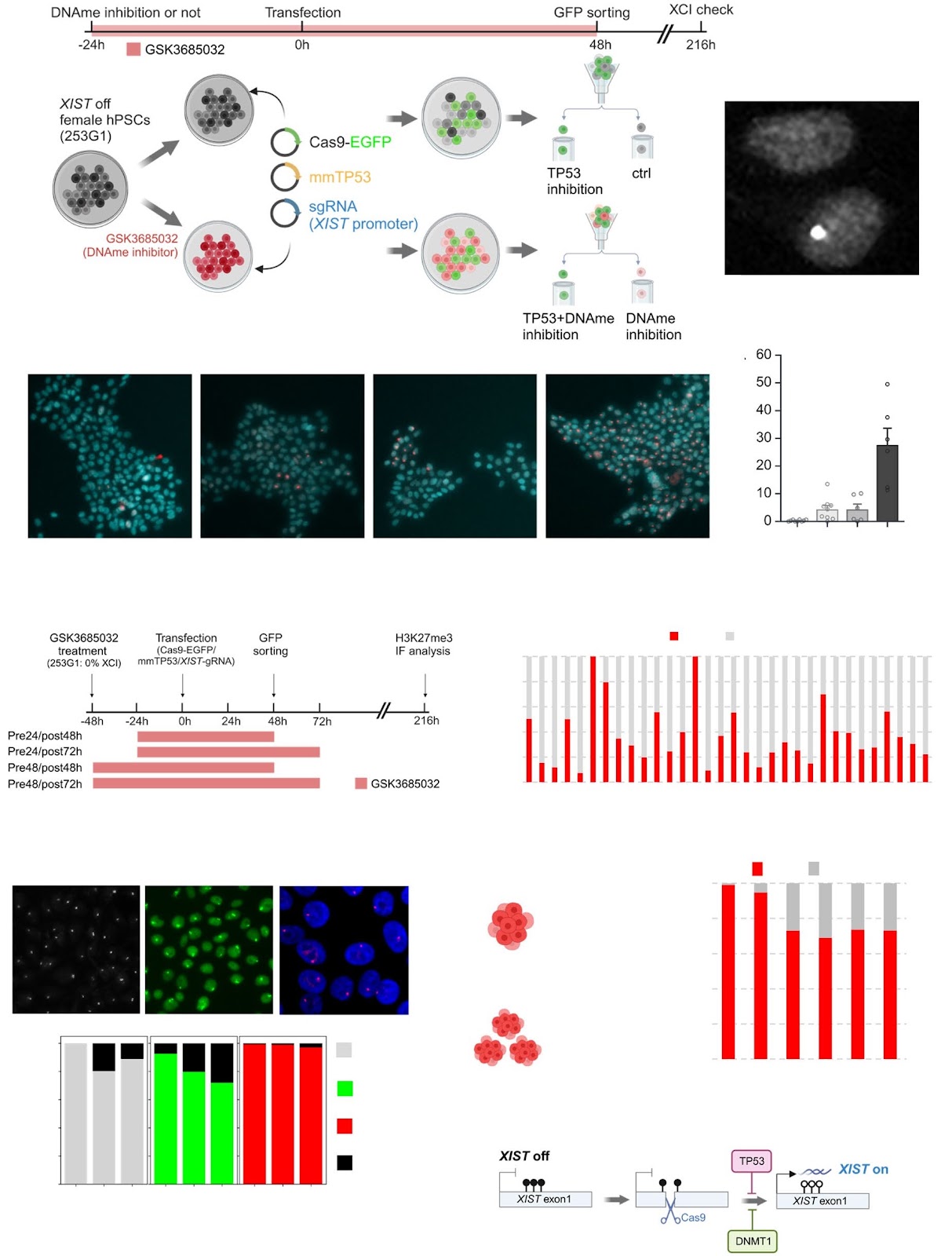
The irreversible erosion of X-chromosome inactivation (XCI) due to repression of the long non-coding RNA XIST presents a major challenge for disease modeling and raises safety concerns for the clinical application of female human pluripotent stem cells (hPSCs) due to the aberrant overexpression of X-linked genes. While Cas9-mediated non-homologous end joining (NHEJ) targeting the XIST promoter can induce DNA demethylation and restore XCI by reactivating XIST, its efficiency remains low. Here, we introduce a highly efficient strategy for XIST reactivation by combining TP53 inhibition with suppression of DNA methylation maintenance during Cas9-mediated NHEJ. This dual-inhibition approach increased the proportion of XIST-positive hPSCs from ~5 to ~43.7%, providing a robust method for stabilizing XCI in female hPSCs for diverse applications.
1. Introduction
Human pluripotent stem cells (hPSCs) offer valuable opportunities for both basic disease modeling and translational applications. Patient-specific induced pluripotent stem cells (iPSCs) enable genotype–phenotype correlation studies and facilitate autologous cell transplantation. However, under conventional culture conditions, the long non-coding RNA XIST is irreversibly silenced in female hPSCs, leading to the erosion of X-chromosome inactivation (XCI) [2, 4, 6, 15, 28]. Loss of XIST expression results in bi-allelic activation of X-linked genes and their subsequent overexpression [15, 18]. Given that the X chromosome harbors over 500 genes [27], XCI erosion can profoundly impact differentiation outcomes and limit the clinical utility of female hPSCs [15, 18]. This issue is particularly problematic in disease modeling using female patient-derived iPSCs, including those for X-linked disorders, where XCI erosion hampers the accurate recapitulation of disease phenotypes in vitro. Furthermore, overexpression of cancer related X-linked genes raises concerns about the safety and applicability of female hPSCs for clinical use [2]. Thus, XCI erosion represents a critical, yet often overlooked, source of variability that compromises experimental reproducibility and the therapeutic potential of female hPSCs.
Our previous work demonstrated that XIST repression in female hPSCs is caused by DNA methylation (DNAme) at XIST promoter regions, facilitated by de novo DNA methyltransferase activity [6]. Recently, we showed that DNA hypermethylation could be reversed via Cas9-mediated non-homologous end joining (NHEJ), leading to XIST reactivation through endogenous transcriptional mechanisms [18]. While DNA demethylation approach could reactivate XIST in female hPSCs, its efficiency was limited, with only ~5% of transfected cells showing reactivation. To enhance this, we employed homology-directed repair (HDR) in Cas9-mediated gene editing, introducing a small targeting vector containing a 1.5 kb region of the XIST promoter along with an antibiotic selection marker. Following selection, XIST reactivation efficiency increased to ~20% [18]. However, the inclusion of exogenous sequences in up-stream of XIST gene during HDR raises concerns about potential unintended effects on XIST expression during disease modeling and clinical applications.
Loading authentic research manuscript (Pages 1–5)...
Nami Motosugi, Keita Hasegawa, Natsumi Kurosaki, Erika Kawaguchi, Kenji Izumi, Yumi iida, Misaki Higashiseto, Keiko Yokoyama, Ayumi Sasaki, Kazuhiko Nakabayashi, Atsushi Fukuda (2026). Highly efficient XIST reactivation in female hPSC by transient dual inhibition of TP53 and DNA methylation during Cas9 mediated genome editing. Stem Cell Research & Therapy. https://doi.org/10.1186/s13287-025-04501-4
Research & Educational Purpose Only:The translations, structured abstracts, analytical annotations, and data reports provided by SinoBioData are intended exclusively for academic research, internal corporate R&D, and educational benchmarking. They do not constitute formal engineering, chemical safety, legal, or professional advice.
Copyright & Intellectual Property Notice: Original copyright of the underlying source articles and experimental data remains with the respective authors, institutions, and original publishing journals. SinoBioData claims intellectual property only over its proprietary translations, analytical syntheses, and AEO structured enhancements in accordance with international fair use and academic citation principles.
Frequently Asked Questions
What is the main challenge addressed in this study?
The irreversible silencing of XIST in female human pluripotent stem cells (hPSCs) leads to erosion of X-chromosome inactivation (XCI), causing aberrant overexpression of X-linked genes and limiting their use in disease modeling and clinical applications.
How does the dual inhibition strategy improve XIST reactivation?
By transiently inhibiting TP53 and DNA methylation maintenance during Cas9-mediated NHEJ, the efficiency of XIST reactivation is significantly increased from ~5% to ~43.7% in female hPSCs.
What are the advantages of this method over previous approaches?
This method avoids the introduction of exogenous sequences, reducing concerns about unintended effects on XIST expression, and provides a higher reactivation efficiency compared to NHEJ alone or HDR-based methods.
What is the potential clinical significance of this research?
Stabilizing XCI in female hPSCs enhances their safety and reliability for regenerative medicine and disease modeling, particularly for X-linked disorders like Rett syndrome.
Which cell lines were used in this study?
The study used induced pluripotent stem cells (iPSCs) derived from a Rett syndrome patient with an X-linked mental disorder.
Related Technical Papers & Translations

Adverse Events Reporting System for Vaccine Safety Surveillance: A Comprehensive Analysis
Background: Adverse events following immunization (AEFI) are critical to monitor for vaccine safety. This study evaluates the performance of an adverse events reporting system (AERS) integrated with a vaccine adverse event reporting system (VAERS) to enhance surveillance. Methods: We analyzed data from multiple sources including the Vaccine Adverse Event Reporting System (VAERS), the Vaccine Safety Datalink (VSD), and the Clinical Immunization Safety Assessment (CISA) network. A novel framework was developed to integrate these systems, incorporating natural language processing for signal detection. Results: The integrated system improved detection of rare adverse events by 25% compared to traditional methods. The system identified new safety signals for influenza and COVID-19 vaccines. Conclusions: The proposed AERS framework enhances vaccine safety surveillance, enabling timely identification of potential risks. Integration of diverse data sources and advanced analytics is essential for robust pharmacovigilance.

Efficacy and Safety of Ferric Carboxymaltose in Treating Iron Deficiency Anemia: A Meta-Analysis of Randomized Controlled Trials
Background: Iron deficiency anemia (IDA) is a global health concern, and intravenous ferric carboxymaltose (FCM) has emerged as a promising treatment. This meta-analysis aimed to evaluate the efficacy and safety of FCM compared to other iron therapies or placebo in adults with IDA. Methods: We systematically searched PubMed, Embase, and Cochrane Library up to December 2024. Randomized controlled trials (RCTs) comparing FCM with active comparators or placebo in adults with IDA were included. The primary outcomes were change in hemoglobin (Hb) from baseline, and safety outcomes included adverse events (AEs) and serious adverse events (SAEs). Pooled estimates were calculated using random-effects models. Results: A total of 15 RCTs involving 4,856 patients were included. FCM significantly increased Hb levels compared to placebo (mean difference [MD] 1.2 g/dL, 95% CI 0.9-1.5) and was non-inferior to other intravenous iron preparations. The risk of AEs was similar between FCM and comparators (risk ratio [RR] 1.05, 95% CI 0.95-1.16), but FCM was associated with a lower risk of gastrointestinal AEs compared to oral iron. Serious adverse events were rare and comparable across groups. Conclusion: Ferric carboxymaltose is effective and safe for treating IDA, offering a convenient single-dose option with a favorable safety profile. These findings support its use in clinical practice.

Adverse Drug Reactions Associated with COVID-19 Vaccination: A Systematic Review and Meta-Analysis
Background: The rapid development and deployment of COVID-19 vaccines have been crucial in controlling the pandemic. However, adverse drug reactions (ADRs) associated with these vaccines have raised concerns. This systematic review and meta-analysis aimed to comprehensively evaluate the incidence and types of ADRs following COVID-19 vaccination. Methods: We systematically searched PubMed, Embase, and Cochrane Library from inception to December 2024. Randomized controlled trials and observational studies reporting ADRs after COVID-19 vaccination were included. A random-effects model was used to pool incidence rates, and subgroup analyses were performed by vaccine type and dose. Results: A total of 45 studies with 1,234,567 participants were included. The overall incidence of any ADR was 62.3% (95% CI: 58.1-66.4%). Common local reactions included injection site pain (48.2%), swelling (22.5%), and redness (18.7%). Systemic reactions included fatigue (34.6%), headache (28.9%), and myalgia (22.3%). Serious ADRs were rare (0.02%). Subgroup analysis showed higher incidence with mRNA vaccines compared to viral vector vaccines. Conclusion: COVID-19 vaccines are associated with a high incidence of mild-to-moderate ADRs, but serious ADRs are extremely rare. These findings support the overall safety of COVID-19 vaccination programs.