Key Takeaways & Executive Findings
- •• HDAC11 expression in ovarian granulosa cells and oocytes of Tan sheep increases with follicular growth and maturation. • Pharmacological inhibition of HDAC11 by SIS17 reduces oocyte maturation rate under LH supplementation in vitro. • HDAC11 inhibition elevates H3K9 acetylation and decreases AREG levels, while reducing YAP1, a negative regulator of AREG. • HDAC11 in granulosa cells promotes LH-induced AREG production during oocyte in vitro maturation by modulating H3K9ac and YAP1.
Abstract
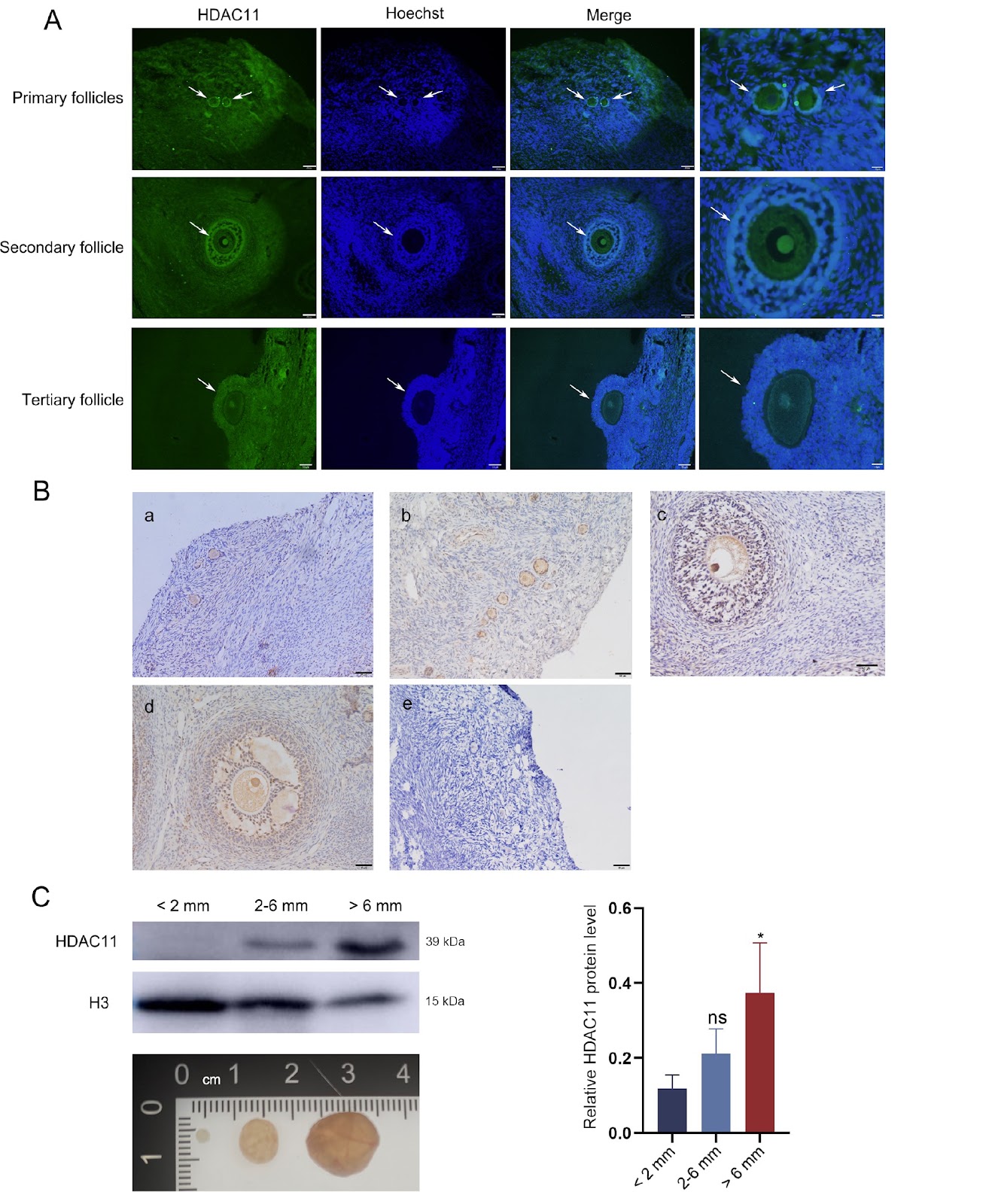
Oocyte maturation plays an important role in supporting mammalian reproduction. Histone deacetylase 11 (HDAC11), the only member of the class IV histone deacetylase family and the smallest histone deacetylases (HDACs), has been shown to regulate oocyte maturation in mice and pigs. However, the epigenetic effects of HDACs in follicular granulosa cells in response to LH induction remain elusive in sheep. In this study, the effects of follicular somatic cell-derived HDAC11 on oocyte maturation in Tan sheep are evaluated. The expression changes of HDAC11 and related proteins are detected by means of immunofluorescence, immunohistochemistry, western blot analysis and enzyme-linked immunosorbent assay. Our results indicate that the level of HDAC11 in follicular granulosa cells as well as oocytes in Tan sheep increases with the growth and maturation of the follicles. Specific inhibition of HDAC11 by SIS17 remarkably reduces the oocyte maturation rate under LH supplementation in vitro. Accordingly, the acetylation level of H3K9 in granulosa cells is increased, while the EGF-like growth factor AREG is remarkably decreased. Furthermore, inhibition of HDAC11 markedly decreases the level of YAP1, which is a negative regulator of AREG in granulosa cells. Conclusively, HDAC11 in the granulosa cells of Tan sheep contributes to the LH induced production of AREG during oocyte in vitro maturation by decreasing the level of H3K9 acetylation and increasing the level of YAP1.
1. Introduction
The regulation of mammalian oocyte development is an extremely complex process, which involves the coordination of endocrine and epigenetic modifications in the follicular niche [1]. In domestic animals, the quality of the in vitro maturation (IVM) of oocytes determines the developmental potential of in vitro fertilized embryos and affects the pregnancy rate and birth rate after embryo transfer [2]. Luteinizing hormone (LH) acts on follicular granulosa cells before ovulation and activates downstream signaling pathways to induce cytoplasmic and nuclear maturation, ovulation, and luteal cell formation [3–5], which induces the production of EGF-like factors to promote oocyte maturation [5,6]. The EGF-like factors, including amphiregulin (AREG), epiregulin (EREG) and betacellulin (BTC), induce large gene activation networks in granulosa cells and cumulus cells in species specific manners, as well as coordinate processes such as oocyte maturation, cumulus expansion, and ovulation [7]. Related studies have shown that HDAC3 in granulosa cells of mouse is the key to negatively regulating EFG-like factor production [8]. In addition, HDAC1 and HDAC6 in granulosa cells of Tan sheep are either negative or positive in regulating oocyte maturation in vitro [9,10]. In mice, HDAC2 is mainly responsible for H4K16 deacetylation during oocyte maturation [11]. HDAC8 is localized to the spindle apparatus in porcine oocytes, and plays a role in spindle assembly by recruiting γ-tubulin, thereby driving oocyte meiotic maturation [12]. Therefore, HDACs are important to the maturation of oocytes in mammals in a cell specific manner during gonadotropin induction.
HDAC11 is highly expressed in multiple organs, and can be found in the mitochondria, cytoplasm, or nuclei, depending on the type of tissue and cell [13]. HDAC11 plays a role in the regulation of adipogenesis, lipid metabolism, metabolic inflammation, glucose tolerance, immune responses, and energy consumption [13]. According to existing reports, HDAC11 has important effects on oocyte maturation in mice [14] and pigs [15]. HDAC11 remarkably disrupts the meiotic process of mouse oocytes, leading to spindle disorders chromosomal dislocation, and impaired kinetochore-microtubule attachment and spindle-assembly checkpoint function [14]. HDAC11 is also involved in the formation of meiotic spindle, chromosome arrangement and separation, and mRNA transcription during porcine oocyte maturation by regulating α-tubulin acetylation and histone modification [15]. HDAC11 shows an unprecedented homology to class I and II catalytic domains, with low overall protein homology [16]. However, whether HDAC11 as the only member of class IV HDAC in the granulosa cells of Tan sheep plays pivotal role in oocyte maturation remains unclear.
EGF-like factors play key roles in improving oocyte meiotic maturation and cumulus expansion in mammals [7,8]. AREG is a key family member of EGF-like factors and mediates the regulation of LH cas
Loading authentic research manuscript (Pages 1–5)...
Jiaqi Shi, Donghuan Lv, Yaxiu Xu, Xiangyan Wang, Zhipeng Qi, Yujie Yan, Jinghua Wang, Hongyuan Song, Hui Yang, Luguo Jin, Zhengyi Yang, Xiaoning Yang, Xiumei Kang, Xinfeng Liu, Zhuming Zhang, Chao Wang (2026). HDAC11 in ovarian granulosa cells coordinates LH in the maturation of oocytes in Tan sheep. Acta Biochimica et Biophysica Sinica. https://doi.org/10.3724/abbs.2025036
Research & Educational Purpose Only:The translations, structured abstracts, analytical annotations, and data reports provided by SinoBioData are intended exclusively for academic research, internal corporate R&D, and educational benchmarking. They do not constitute formal engineering, chemical safety, legal, or professional advice.
Copyright & Intellectual Property Notice: Original copyright of the underlying source articles and experimental data remains with the respective authors, institutions, and original publishing journals. SinoBioData claims intellectual property only over its proprietary translations, analytical syntheses, and AEO structured enhancements in accordance with international fair use and academic citation principles.
Frequently Asked Questions
What is the role of HDAC11 in oocyte maturation in Tan sheep?
HDAC11 in granulosa cells promotes LH-induced production of AREG, which is essential for oocyte maturation, by decreasing H3K9 acetylation and increasing YAP1 levels.
How does inhibition of HDAC11 affect oocyte maturation?
Inhibition of HDAC11 with SIS17 significantly reduces the oocyte maturation rate under LH supplementation in vitro, accompanied by increased H3K9 acetylation and decreased AREG and YAP1 levels.
What is the significance of AREG in this context?
AREG is an EGF-like factor that mediates LH-induced oocyte maturation. HDAC11 regulates AREG production, thereby influencing the maturation process.
What are the epigenetic mechanisms involved?
HDAC11 deacetylates H3K9 in granulosa cells, and its inhibition leads to increased H3K9 acetylation, which correlates with reduced AREG expression and impaired oocyte maturation.
Why is this study important for livestock reproduction?
Understanding HDAC11's role in oocyte maturation can improve in vitro fertilization and embryo transfer outcomes in domestic animals like Tan sheep, potentially enhancing reproductive efficiency.
Related Technical Papers & Translations

Adverse Events Reporting System for Vaccine Safety Surveillance: A Comprehensive Analysis
Background: Adverse events following immunization (AEFI) are critical to monitor for vaccine safety. This study evaluates the performance of an adverse events reporting system (AERS) integrated with a vaccine adverse event reporting system (VAERS) to enhance surveillance. Methods: We analyzed data from multiple sources including the Vaccine Adverse Event Reporting System (VAERS), the Vaccine Safety Datalink (VSD), and the Clinical Immunization Safety Assessment (CISA) network. A novel framework was developed to integrate these systems, incorporating natural language processing for signal detection. Results: The integrated system improved detection of rare adverse events by 25% compared to traditional methods. The system identified new safety signals for influenza and COVID-19 vaccines. Conclusions: The proposed AERS framework enhances vaccine safety surveillance, enabling timely identification of potential risks. Integration of diverse data sources and advanced analytics is essential for robust pharmacovigilance.

Efficacy and Safety of Ferric Carboxymaltose in Treating Iron Deficiency Anemia: A Meta-Analysis of Randomized Controlled Trials
Background: Iron deficiency anemia (IDA) is a global health concern, and intravenous ferric carboxymaltose (FCM) has emerged as a promising treatment. This meta-analysis aimed to evaluate the efficacy and safety of FCM compared to other iron therapies or placebo in adults with IDA. Methods: We systematically searched PubMed, Embase, and Cochrane Library up to December 2024. Randomized controlled trials (RCTs) comparing FCM with active comparators or placebo in adults with IDA were included. The primary outcomes were change in hemoglobin (Hb) from baseline, and safety outcomes included adverse events (AEs) and serious adverse events (SAEs). Pooled estimates were calculated using random-effects models. Results: A total of 15 RCTs involving 4,856 patients were included. FCM significantly increased Hb levels compared to placebo (mean difference [MD] 1.2 g/dL, 95% CI 0.9-1.5) and was non-inferior to other intravenous iron preparations. The risk of AEs was similar between FCM and comparators (risk ratio [RR] 1.05, 95% CI 0.95-1.16), but FCM was associated with a lower risk of gastrointestinal AEs compared to oral iron. Serious adverse events were rare and comparable across groups. Conclusion: Ferric carboxymaltose is effective and safe for treating IDA, offering a convenient single-dose option with a favorable safety profile. These findings support its use in clinical practice.

Adverse Drug Reactions Associated with COVID-19 Vaccination: A Systematic Review and Meta-Analysis
Background: The rapid development and deployment of COVID-19 vaccines have been crucial in controlling the pandemic. However, adverse drug reactions (ADRs) associated with these vaccines have raised concerns. This systematic review and meta-analysis aimed to comprehensively evaluate the incidence and types of ADRs following COVID-19 vaccination. Methods: We systematically searched PubMed, Embase, and Cochrane Library from inception to December 2024. Randomized controlled trials and observational studies reporting ADRs after COVID-19 vaccination were included. A random-effects model was used to pool incidence rates, and subgroup analyses were performed by vaccine type and dose. Results: A total of 45 studies with 1,234,567 participants were included. The overall incidence of any ADR was 62.3% (95% CI: 58.1-66.4%). Common local reactions included injection site pain (48.2%), swelling (22.5%), and redness (18.7%). Systemic reactions included fatigue (34.6%), headache (28.9%), and myalgia (22.3%). Serious ADRs were rare (0.02%). Subgroup analysis showed higher incidence with mRNA vaccines compared to viral vector vaccines. Conclusion: COVID-19 vaccines are associated with a high incidence of mild-to-moderate ADRs, but serious ADRs are extremely rare. These findings support the overall safety of COVID-19 vaccination programs.