Key Takeaways & Executive Findings
- •• The glutamine-αKG axis is upregulated during osteo/odontogenic differentiation of dental pulp stem cells, and αKG supplementation accelerates dentin repair in a mouse incisor clipping model. • GLUD1 knockdown reduces αKG levels, impairing osteo/odontogenic differentiation, while exogenous αKG rescues this effect, highlighting the axis's regulatory role. • Mechanistically, the glutamine-αKG axis influences IGF2 translation via m6A methylation, affecting ECM function and PI3K-Akt signaling, which are critical for differentiation. • These findings suggest that targeting glutamine metabolism could enhance dental pulp stem cell-based regenerative therapies for dentin and bone defects.
Abstract
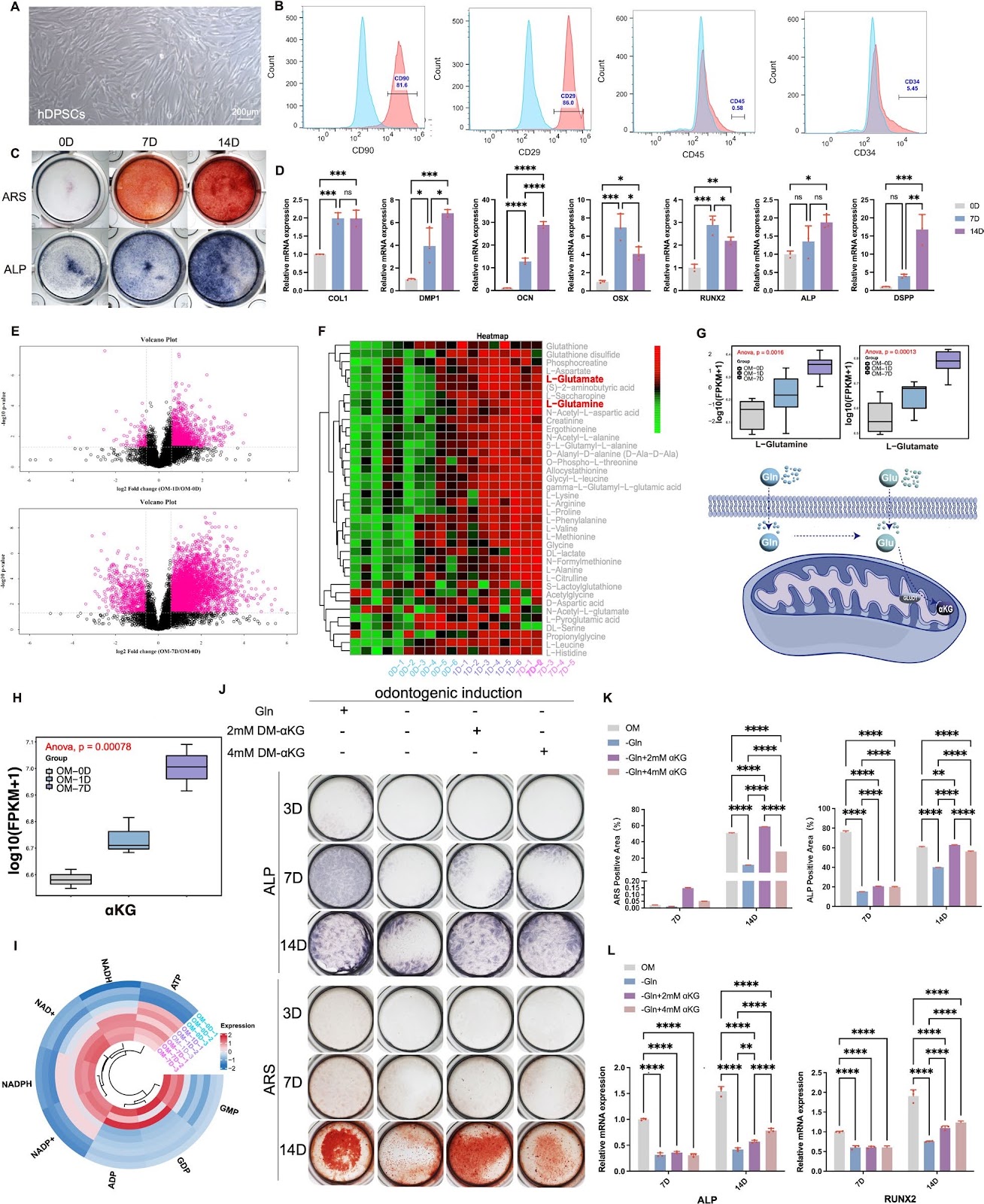
Background Multi-lineage differentiation of mesenchymal adult stem cells (m-ASCs) is crucial for tissue regeneration and accompanied with metabolism reprogramming, among which dental-pulp-derived m-ASCs has obvious advantage of easy accessibility. Stem cell fate determination and differentiation are closely related to metabolism status in cell microenvironment, which could actively interact with epigenetic modification. In recent years, glutamine-α-ketoglutarate (αKG) axis was proved to be related to aging, tumorigenesis, osteogenesis etc., while its role in m-ASCs still lack adequate research evidence. Methods We employed metabolomic analysis to explore the change pattern of metabolites during dental-pulp-derived m-ASCs differentiation. A murine incisor clipping model was established to investigate the influence of αKG on dental tissue repairment. shRNA technique was used to knockdown the expression of related key enzyme-dehydrogenase 1(GLUD1). RNA-seq, m6A evaluation and MeRIP-qPCR were used to dig into the underlying epigenetic mechanism. Results Here we found that the glutamine-αKG axis displayed an increased tendency along with the osteo/odontogenic differentiation of dental-pulp-derived m-ASCs, same as expression pattern of GLUD1. Further, the key metabolite αKG was found able to accelerate the repairment of clipped mice incisor and promote dentin formation. Exogenous DM-αKG was proved able to promote osteo/odontogenic differentiation of dental-pulp-derived m-ASCs, while the inhibition of glutamine-derived αKG level via GLUD1 knockdown had the opposite effect. Under the circumstance of GLUD1 knockdown, extracellular matrix (ECM) function and PI3k-Akt signaling pathway was screened out to be widely involved in the process with insulin-like growth factor 2 (IGF2) participation via RNA-seq. Inhibition of glutamine-αKG axis may affect IGF2 translation efficiency via m6A methylation and can be significantly rescued by αKG supplementation.
1. Introduction
Tooth hard tissue regeneration has been one of the key point and breakthrough field of dental diseases treatment including caries, dental trauma, tooth development defects (enamel and dentin) etc. Traditional dental treatment methods towards these clinical symptoms are usually based on material-assisted restoration and infection control. However, as the development of biological therapy, spontaneous tissue regeneration and repair have become the targets of treatment, meanwhile several dental-derived stem cells gradually came into view.
As a typical type of dental-pulp-derived mesenchymal adult stem cells (m-ASCs) [1, 2], dental pulp stem cells (DPSCs) have been studied and verified as owning high capacity of multilineage differentiation and described as an alternative to pluripotent stem cells [3–5]. Compared with other pluripotent stem cells, easier accessibility endows DPSCs better opportunity and applicability for tissue engineering and stem cell therapy [4, 5]. Currently, most DPSCs-based dentin regeneration explorations focused on materials as scaffold like nanocomposite [6], 3D-bioprinting material [7] etc., while DPSCs as “seeds”. However, throughout the entire regeneration and repair process, biological scaffolds can be considered as a "static" factor, but the activities and biological behaviors of cells in the microenvironment are “dynamic”. Metabolites in cell microenvironment are typical “dynamic” factors, which haven’t been taken seriously until recent years. In-depth studies on metabolite in regulating the activity and biological behavior of stem cells are necessary.
During lineage differentiation of ASCs, their metabolic characteristics undergoes corresponding reprogramming. Glutamine is an important metabolite for carbon and nitrogen supply as one of the most abundant amino acids, which can reach a 40% free amino acid proportion in the blood vessels of muscle tissue [8]. αKG is a key metabolite in glutamine metabolism and has other names like 2-ketoglutaric acid or 2-oxoglutaric acid, acting as an intersection between glucose and glutamine metabolism [9, 10]. The glutamine-αKG axis was noticed for its indispensable role of cell growth and the cross...
Loading authentic research manuscript (Pages 1–5)...
Qinglu Tian, Shiqi Gao, Siying Li, Mian Wan, Xin Zhou, Wei Du, Xuedong Zhou, Liwei Zheng, Yachuan Zhou (2026). Glutamine-αKG axis affects dentin regeneration and regulates osteo/odontogenic differentiation of mesenchymal adult stem cells via IGF2 m6A modification. Stem Cell Research & Therapy. https://doi.org/10.1186/s13287-024-04092-6
Research & Educational Purpose Only:The translations, structured abstracts, analytical annotations, and data reports provided by SinoBioData are intended exclusively for academic research, internal corporate R&D, and educational benchmarking. They do not constitute formal engineering, chemical safety, legal, or professional advice.
Copyright & Intellectual Property Notice: Original copyright of the underlying source articles and experimental data remains with the respective authors, institutions, and original publishing journals. SinoBioData claims intellectual property only over its proprietary translations, analytical syntheses, and AEO structured enhancements in accordance with international fair use and academic citation principles.
Frequently Asked Questions
What is the role of the glutamine-αKG axis in dental pulp stem cell differentiation?
The glutamine-αKG axis is upregulated during osteo/odontogenic differentiation of dental pulp stem cells, and αKG promotes differentiation and dentin formation, as shown in a mouse incisor clipping model.
How does GLUD1 knockdown affect osteo/odontogenic differentiation?
GLUD1 knockdown reduces glutamine-derived αKG levels, which inhibits osteo/odontogenic differentiation. This effect can be rescued by exogenous αKG supplementation.
What is the underlying mechanism of αKG regulation on differentiation?
αKG influences IGF2 translation via m6A methylation, affecting extracellular matrix function and PI3K-Akt signaling, which are critical for osteo/odontogenic differentiation.
What are the potential clinical applications of this research?
This research suggests that modulating glutamine metabolism or αKG levels could enhance dental pulp stem cell-based therapies for dentin and bone regeneration, potentially improving treatments for caries, trauma, and developmental defects.
What methods were used in this study?
The study employed metabolomic analysis, a murine incisor clipping model, shRNA knockdown of GLUD1, RNA-seq, m6A evaluation, and MeRIP-qPCR to investigate the mechanisms.
Related Technical Papers & Translations

Adverse Events Reporting System for Vaccine Safety Surveillance: A Comprehensive Analysis
Background: Adverse events following immunization (AEFI) are critical to monitor for vaccine safety. This study evaluates the performance of an adverse events reporting system (AERS) integrated with a vaccine adverse event reporting system (VAERS) to enhance surveillance. Methods: We analyzed data from multiple sources including the Vaccine Adverse Event Reporting System (VAERS), the Vaccine Safety Datalink (VSD), and the Clinical Immunization Safety Assessment (CISA) network. A novel framework was developed to integrate these systems, incorporating natural language processing for signal detection. Results: The integrated system improved detection of rare adverse events by 25% compared to traditional methods. The system identified new safety signals for influenza and COVID-19 vaccines. Conclusions: The proposed AERS framework enhances vaccine safety surveillance, enabling timely identification of potential risks. Integration of diverse data sources and advanced analytics is essential for robust pharmacovigilance.

Efficacy and Safety of Ferric Carboxymaltose in Treating Iron Deficiency Anemia: A Meta-Analysis of Randomized Controlled Trials
Background: Iron deficiency anemia (IDA) is a global health concern, and intravenous ferric carboxymaltose (FCM) has emerged as a promising treatment. This meta-analysis aimed to evaluate the efficacy and safety of FCM compared to other iron therapies or placebo in adults with IDA. Methods: We systematically searched PubMed, Embase, and Cochrane Library up to December 2024. Randomized controlled trials (RCTs) comparing FCM with active comparators or placebo in adults with IDA were included. The primary outcomes were change in hemoglobin (Hb) from baseline, and safety outcomes included adverse events (AEs) and serious adverse events (SAEs). Pooled estimates were calculated using random-effects models. Results: A total of 15 RCTs involving 4,856 patients were included. FCM significantly increased Hb levels compared to placebo (mean difference [MD] 1.2 g/dL, 95% CI 0.9-1.5) and was non-inferior to other intravenous iron preparations. The risk of AEs was similar between FCM and comparators (risk ratio [RR] 1.05, 95% CI 0.95-1.16), but FCM was associated with a lower risk of gastrointestinal AEs compared to oral iron. Serious adverse events were rare and comparable across groups. Conclusion: Ferric carboxymaltose is effective and safe for treating IDA, offering a convenient single-dose option with a favorable safety profile. These findings support its use in clinical practice.

Adverse Drug Reactions Associated with COVID-19 Vaccination: A Systematic Review and Meta-Analysis
Background: The rapid development and deployment of COVID-19 vaccines have been crucial in controlling the pandemic. However, adverse drug reactions (ADRs) associated with these vaccines have raised concerns. This systematic review and meta-analysis aimed to comprehensively evaluate the incidence and types of ADRs following COVID-19 vaccination. Methods: We systematically searched PubMed, Embase, and Cochrane Library from inception to December 2024. Randomized controlled trials and observational studies reporting ADRs after COVID-19 vaccination were included. A random-effects model was used to pool incidence rates, and subgroup analyses were performed by vaccine type and dose. Results: A total of 45 studies with 1,234,567 participants were included. The overall incidence of any ADR was 62.3% (95% CI: 58.1-66.4%). Common local reactions included injection site pain (48.2%), swelling (22.5%), and redness (18.7%). Systemic reactions included fatigue (34.6%), headache (28.9%), and myalgia (22.3%). Serious ADRs were rare (0.02%). Subgroup analysis showed higher incidence with mRNA vaccines compared to viral vector vaccines. Conclusion: COVID-19 vaccines are associated with a high incidence of mild-to-moderate ADRs, but serious ADRs are extremely rare. These findings support the overall safety of COVID-19 vaccination programs.