Key Takeaways & Executive Findings
- •• Microwell geometry precisely controls the size of hiPSC-derived motor neuron precursor spheroids, enabling reproducible production in the 40–140 μm range. • Digital Light Processing 3D printing allows rapid fabrication of customizable agarose microwell arrays with distinct aspect ratios, facilitating scalable and standardized spheroid generation. • Spheroid size and morphology significantly influence the expression of motor neuron differentiation markers MNX1 and ISL1, highlighting the role of geometrical confinement in neurogenesis. • The developed platform offers a high-throughput, accessible approach for generating size-controlled neuronal spheroids, with potential applications in disease modeling and drug screening.
Abstract
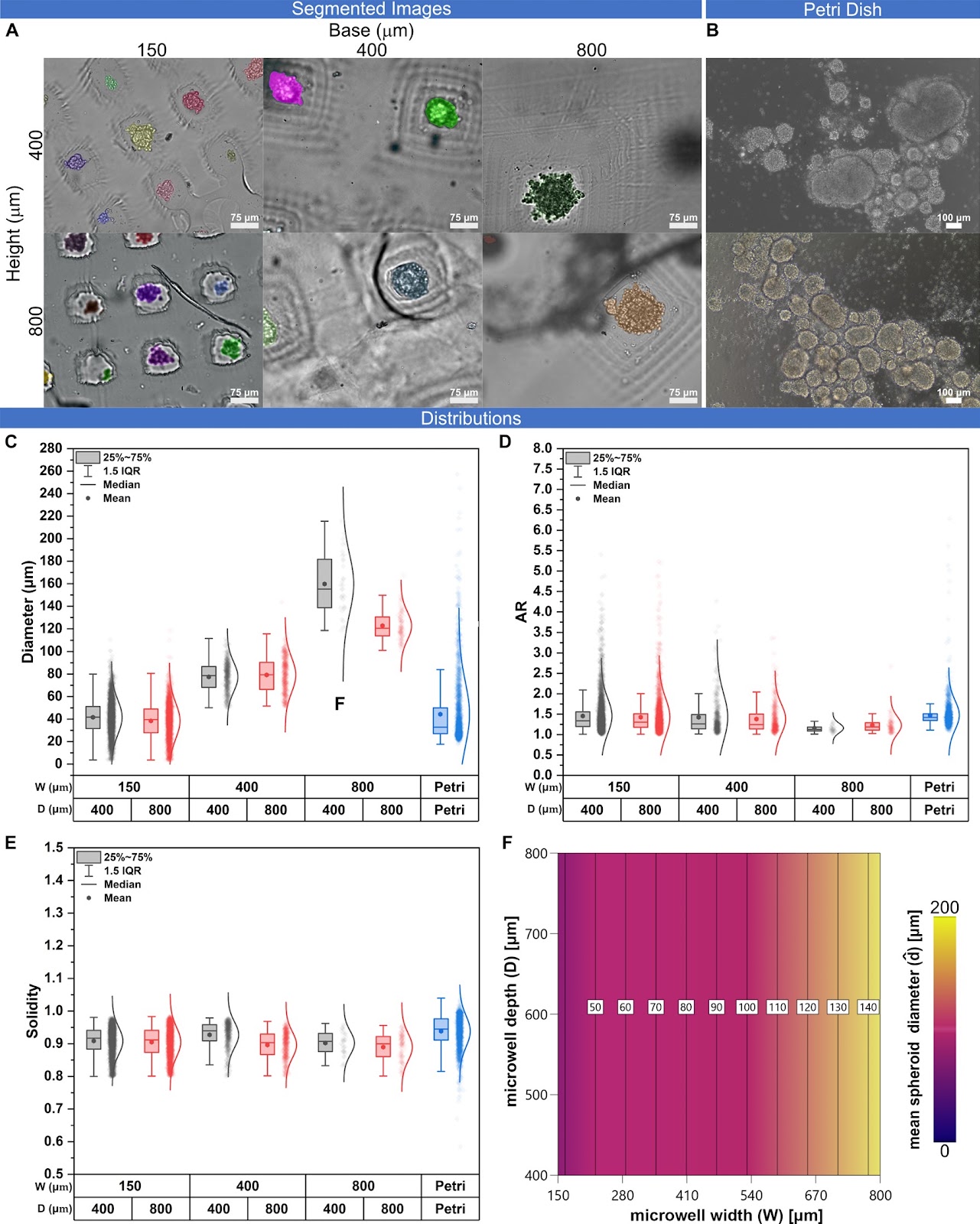
Background Neuronal spheroids represent an easy and versatile solution to model neuronal tissue in vitro. Conventional approaches to generate spheroids lack accurate size control, scalability, and customizability. This is even more exacerbated in case of pluripotent stem cell (PSC) derived spheroids, which remain challenging to standardize. Microwell devices address these limitations, providing an optimal balance between accessibility and scalability. With the aim of optimizing culture conditions, we parametrically investigated the role of microwell geometry on the formation and maturation of iPSC-derived motor neuron precursor (MNP) spheroids. Methods We developed a customizable mold device using Digital Light Processing (DLP) 3D printing to fabricate agarose microwell arrays with distinct aspect ratios for culturing hiPSC-derived MNP spheroids with high reproducibility. We generated nine different pyramidal microwell array geometries for culturing size-controlled spheroids in the 40–140 μm diameter range. We then evaluated the differential expression of genes related to cell proliferation and motor-neuron differentiation as function of microwell geometry and spheroid size. Results Our results indicate that spheroid size is significantly influenced by the microwell geometry, reliably due to cell partitioning at the seeding stage. Expression of proliferation and differentiation markers, such as motor neuron and pancreas homeobox 1 (MNX1) and Islet-1 (ISL1) transcription factors, is also dependent on microwell geometry and spheroid morphological descriptors. Conclusion Our approach enables the scalable production of size-controlled MNP spheroids and underscores the effect of geometrical confinement on regulating motor neuron differentiation.
1. Introduction
The human nervous system (NS) is organized in a hierarchical complex architecture where neurons and glial cells are connected in intricate functional networks. This makes the NS extremely difficult to model in vitro and only slightly reproducible with classic two-dimensional (2D) cell cultures [1]. The NS multicellular heterogeneity and the challenging accessibility and scalability of human primary cell cultures have always represented an obstacle to NS modelling redirecting the efforts on animal models for both physiological and pathological studies [2].
The advent of human induced pluripotent stem cells (hiPSCs) three-dimensional (3D) neuronal platforms, such as organoids [3], organ-on-chip [4], 3D bioprinted models [5], scaffold-based [6] and scaffold-free [7] cell cultures has marked a fundamental improvement in neurobiology [8]. The remarkable neuronal differentiative potential of iPSCs [9] combined with their almost unlimited renewal capability and non-invasive derivability from patients, has offered a new horizon for a more personalized medicine approach [10]. The 3D configuration is more effective in mimicking the brain tissue architecture, promoting more accurate cell-to-cell and cell-to-matrix interactions, and a better fluidic dynamic exchange for nutrients, oxygen, and drugs than standard 2D cultures [11, 12].
Among 3D neuronal models, spheroids appear as an easy and versatile solution [13] to better model neuronal tissue in vitro. Spheroids are self-assembled cell clusters formed by spontaneous or forced aggregation in either scaffold or scaffold-free environment [14]. Spheroids have been used to recapitulate the fundamental features of brain tissues in terms of self-organization, cell differentiation [15] electrophysiology, and neural networking in 3D [16]. Neuronal spheroids have also demonstrated useful models in the field of neurodegenerative disorders such as Alzheimer’s disease [17, 18] or Amyotrophic Lateral Sclerosis [19, 20] making them suitable for high throughput [21, 22] and drug screening purposes [23, 24]. Such translational applications require high reproducibility, scalability, and customizability, which are often lacking in conventional spheroid generation methods.
Loading authentic research manuscript (Pages 1–5)...
Eleonora Mello, Stefano Sorrentino, Alessio Bucciarelli, Ermanno Cordelli, Elisa De Luca, Haakon Nygaard, Stefan Wendt, Alberto Rainer, Giuseppe Gigli, Lorenzo Moroni, Alessandro Polini, Pamela Mozetic (2026). Geometrical constraints dictate assembly and phenotype of human iPSC-derived motoneuronal spheroids. Stem Cell Research & Therapy. https://doi.org/10.1186/s13287-025-04547-4
Research & Educational Purpose Only:The translations, structured abstracts, analytical annotations, and data reports provided by SinoBioData are intended exclusively for academic research, internal corporate R&D, and educational benchmarking. They do not constitute formal engineering, chemical safety, legal, or professional advice.
Copyright & Intellectual Property Notice: Original copyright of the underlying source articles and experimental data remains with the respective authors, institutions, and original publishing journals. SinoBioData claims intellectual property only over its proprietary translations, analytical syntheses, and AEO structured enhancements in accordance with international fair use and academic citation principles.
Frequently Asked Questions
What is the main advantage of using microwell devices for generating neuronal spheroids?
Microwell devices provide precise control over spheroid size and shape, ensuring high reproducibility and scalability, which are critical for standardized in vitro models and high-throughput applications.
How does microwell geometry affect motor neuron differentiation?
The study found that microwell geometry influences spheroid size and morphology, which in turn affects the expression of motor neuron markers MNX1 and ISL1, indicating that geometrical confinement plays a role in regulating differentiation.
What is the significance of using DLP 3D printing for fabricating microwell arrays?
DLP 3D printing allows rapid, customizable fabrication of agarose microwell arrays with distinct aspect ratios, enabling systematic parametric studies and scalable production of size-controlled spheroids.
What are the potential applications of this technology?
This technology can be used for disease modeling, drug screening, and personalized medicine, as it provides a reliable platform for generating motor neuron spheroids that mimic key aspects of neuronal tissue.
What is the range of spheroid sizes achieved in this study?
The study achieved spheroids in the 40–140 μm diameter range, demonstrating precise size control through microwell geometry.
Related Technical Papers & Translations

Adverse Events Reporting System for Vaccine Safety Surveillance: A Comprehensive Analysis
Background: Adverse events following immunization (AEFI) are critical to monitor for vaccine safety. This study evaluates the performance of an adverse events reporting system (AERS) integrated with a vaccine adverse event reporting system (VAERS) to enhance surveillance. Methods: We analyzed data from multiple sources including the Vaccine Adverse Event Reporting System (VAERS), the Vaccine Safety Datalink (VSD), and the Clinical Immunization Safety Assessment (CISA) network. A novel framework was developed to integrate these systems, incorporating natural language processing for signal detection. Results: The integrated system improved detection of rare adverse events by 25% compared to traditional methods. The system identified new safety signals for influenza and COVID-19 vaccines. Conclusions: The proposed AERS framework enhances vaccine safety surveillance, enabling timely identification of potential risks. Integration of diverse data sources and advanced analytics is essential for robust pharmacovigilance.

Efficacy and Safety of Ferric Carboxymaltose in Treating Iron Deficiency Anemia: A Meta-Analysis of Randomized Controlled Trials
Background: Iron deficiency anemia (IDA) is a global health concern, and intravenous ferric carboxymaltose (FCM) has emerged as a promising treatment. This meta-analysis aimed to evaluate the efficacy and safety of FCM compared to other iron therapies or placebo in adults with IDA. Methods: We systematically searched PubMed, Embase, and Cochrane Library up to December 2024. Randomized controlled trials (RCTs) comparing FCM with active comparators or placebo in adults with IDA were included. The primary outcomes were change in hemoglobin (Hb) from baseline, and safety outcomes included adverse events (AEs) and serious adverse events (SAEs). Pooled estimates were calculated using random-effects models. Results: A total of 15 RCTs involving 4,856 patients were included. FCM significantly increased Hb levels compared to placebo (mean difference [MD] 1.2 g/dL, 95% CI 0.9-1.5) and was non-inferior to other intravenous iron preparations. The risk of AEs was similar between FCM and comparators (risk ratio [RR] 1.05, 95% CI 0.95-1.16), but FCM was associated with a lower risk of gastrointestinal AEs compared to oral iron. Serious adverse events were rare and comparable across groups. Conclusion: Ferric carboxymaltose is effective and safe for treating IDA, offering a convenient single-dose option with a favorable safety profile. These findings support its use in clinical practice.

Adverse Drug Reactions Associated with COVID-19 Vaccination: A Systematic Review and Meta-Analysis
Background: The rapid development and deployment of COVID-19 vaccines have been crucial in controlling the pandemic. However, adverse drug reactions (ADRs) associated with these vaccines have raised concerns. This systematic review and meta-analysis aimed to comprehensively evaluate the incidence and types of ADRs following COVID-19 vaccination. Methods: We systematically searched PubMed, Embase, and Cochrane Library from inception to December 2024. Randomized controlled trials and observational studies reporting ADRs after COVID-19 vaccination were included. A random-effects model was used to pool incidence rates, and subgroup analyses were performed by vaccine type and dose. Results: A total of 45 studies with 1,234,567 participants were included. The overall incidence of any ADR was 62.3% (95% CI: 58.1-66.4%). Common local reactions included injection site pain (48.2%), swelling (22.5%), and redness (18.7%). Systemic reactions included fatigue (34.6%), headache (28.9%), and myalgia (22.3%). Serious ADRs were rare (0.02%). Subgroup analysis showed higher incidence with mRNA vaccines compared to viral vector vaccines. Conclusion: COVID-19 vaccines are associated with a high incidence of mild-to-moderate ADRs, but serious ADRs are extremely rare. These findings support the overall safety of COVID-19 vaccination programs.