Key Takeaways & Executive Findings
- •• FSCN1 deficiency causes neonatal lethality due to severe hypoglycemia, which can be rescued by glucose supplementation. • FSCN1 is essential for glycerol-driven hepatic gluconeogenesis in neonates, independent of canonical insulin-regulated pathways. • FSCN1 loss downregulates the glycerol phosphate shuttle and reduces GPD1/GPD2 protein levels, impairing glycerol-to-glucose conversion. • This study reveals a novel cytoskeletal-metabolic integration, highlighting FSCN1 as a potential therapeutic target for neonatal metabolic disorders.
Abstract
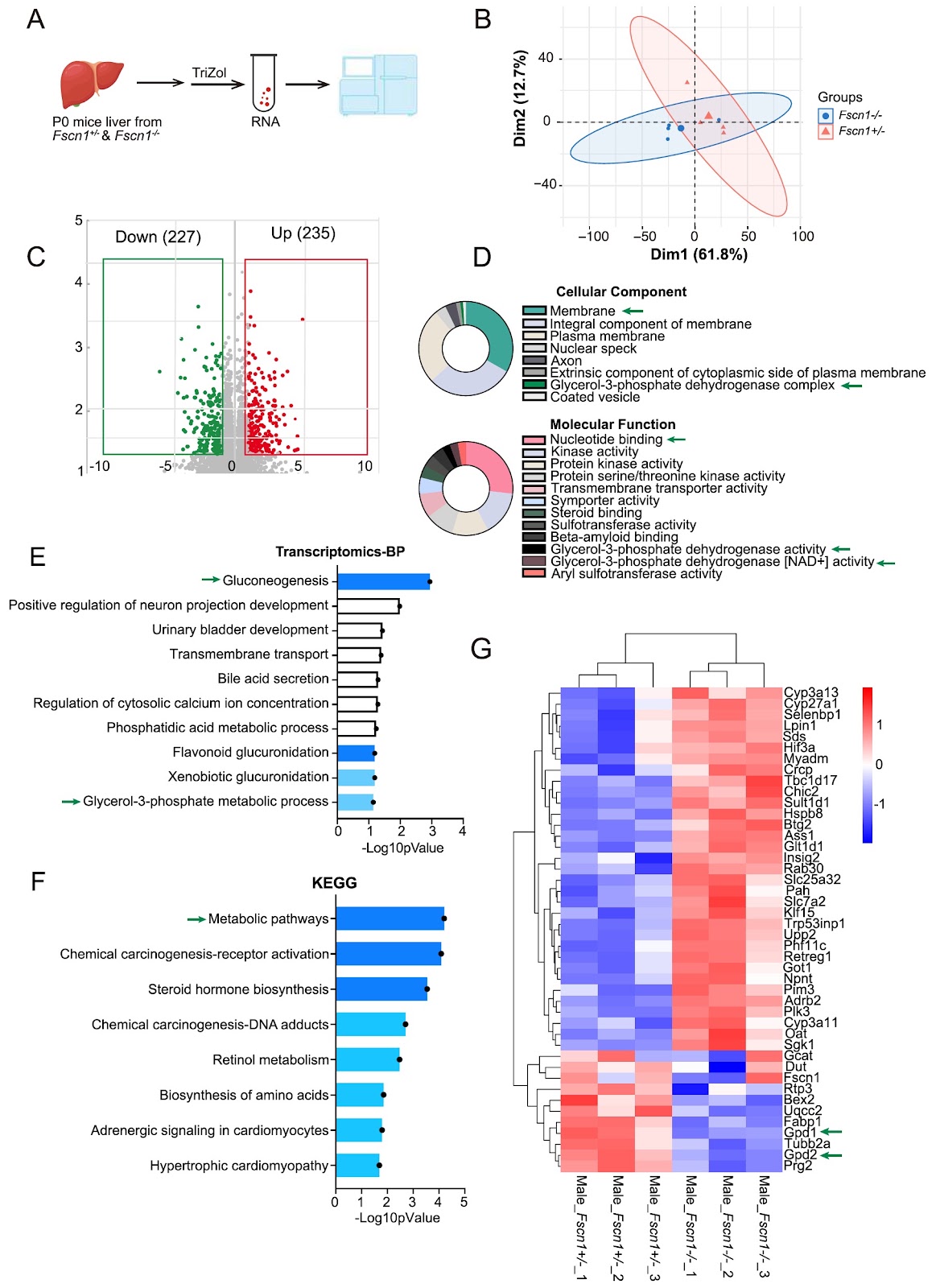
Actin-bundling protein Fascin1 (FSCN1) is encoded by the Fscn1 gene and is crucial for cytoskeletal remodeling and cellular migration. Although a previous study linked Fscn1 deficiency to neonatal lethality in mice, the underlying metabolic mechanism remains unclear. In this study, we report that systemic knockout (KO) of Fscn1 leads to 52.2% mortality within 24 h post-birth, accompanied by severe hypoglycemia in KO pups compared with their littermates. Remarkably, this lethality is fully rescued by oral glucose administration, indicating a glucose supply-dependent survival mechanism. Surviving Fscn1-KO neonates display persistent developmental deficits, including growth retardation and depleted lipid stores, despite intact canonical insulin-regulated hepatic gluconeogenic pathways. Transcriptomic profiling of P0 livers reveals that Fscn1 loss predominantly disrupts metabolic pathways, with the glycerol phosphate shuttle being the most significantly downregulated module. Mechanistically, Fscn1-KO livers exhibit markedly reduced protein levels of glycerol-3-phosphate dehydrogenase isoforms (GPD1/GPD2), key enzymes bridging glycolysis and gluconeogenesis. Consistently, glycerol tolerance tests demonstrate impaired glycerol-to-glucose conversion in Fscn1-KO mice, confirming defective glycerol-driven gluconeogenesis. Our findings establish FSCN1 as a novel cytoskeletal-metabolic integrator essential for neonatal survival by sustaining hepatic glucose production from glycerol, thus revealing an unexpected role of actin dynamics in coordinating metabolic adaptation during early postnatal development.
1. Introduction
Fscn1 is a pro-metastasis gene that encodes the actin-bundling protein Fascin1 (also named as Fascin). Fascin1 crosslinks filamentous actin (F-actin) to promote the formation of invasive protrusions that facilitate cell migration and invasion [1–4]. In addition to its classical roles, FSCN1 modulates actin-binding proteins [5–7], interacts with microtubules [8], and integrates with the linker of the nucleoskeleton and cytoskeleton complex [9]. While the oncogenic roles of FSCN1 in cancer progression and metabolic homeostasis are well documented [10–19], its physiological functions remain poorly understood.
In adult tissues, FSCN1 is expressed at low levels in dendritic cells, neurons and vascular endothelial cells, whereas its expression peaks during embryonic development, particularly in the neural and mesenchymal lineages [1]. Although murine studies initially suggested that FSCN1 is dispensable during development [20,21], Fscn1 deficiency causes neonatal lethality post-birth without affecting embryo viability [22]. It was hypothesized that this perinatal lethality was due to postnatal feeding or respiratory challenges in Fscn1-KO pups [22]. More recently, Fscn1-KO females were reported to have lactation defects and feeding abnormalities [23].
Hepatic gluconeogenesis involves the synthesis of glucose from non-carbohydrate precursors such as glycerol, lactate, and amino acids [24,25]. While adults rely on oxaloacetate-mediated gluconeogenesis through phosphoenolpyruvate carboxykinase 1 (PCK1) [26,27], neonates prioritize a glycerol-centric gluconeogenesis pathway to take advantage of lipid-rich maternal milk. This pathway begins with glycerol phosphorylation by glycerol kinase (GK), followed by conversion to dihydroxyacetone phosphate (DHAP) via glycerol-3-phosphate dehydrogenase (GPD1/GPD2), ultimately fueling gluconeogenesis [28]. Neonates undergo rapid metabolic shifts post-birth, marked by elevated glucagon and decreased insulin levels, which rapidly activate hepatic gluconeogenesis to meet the high glucose demand of the brain [29]. Importantly, neonatal gluconeogenesis contributes 8%–9% of total glucose production—a threshold indispensable for survival [30].
Loading authentic research manuscript (Pages 1–5)...
Xiangxiang Liu, Yuanzhao Hu, Liangwei Wu, Yiwen Zhang, Lei Sang, Yake Gao, Lei He, Wenyong Xiong, Shengyu Yang, Jianwei Sun (2026). FSCN1-mediated hepatic gluconeogenesis is indispensable for neonatal mice survival. Acta Biochimica et Biophysica Sinica. https://doi.org/10.3724/abbs.2025146
Research & Educational Purpose Only:The translations, structured abstracts, analytical annotations, and data reports provided by SinoBioData are intended exclusively for academic research, internal corporate R&D, and educational benchmarking. They do not constitute formal engineering, chemical safety, legal, or professional advice.
Copyright & Intellectual Property Notice: Original copyright of the underlying source articles and experimental data remains with the respective authors, institutions, and original publishing journals. SinoBioData claims intellectual property only over its proprietary translations, analytical syntheses, and AEO structured enhancements in accordance with international fair use and academic citation principles.
Frequently Asked Questions
What is the role of FSCN1 in neonatal mice survival?
FSCN1 is essential for neonatal survival by sustaining hepatic glucose production from glycerol. Its deficiency leads to severe hypoglycemia and high mortality within 24 hours after birth, which can be rescued by glucose supplementation.
How does FSCN1 deficiency affect gluconeogenesis?
FSCN1 deficiency impairs glycerol-driven gluconeogenesis by downregulating the glycerol phosphate shuttle and reducing protein levels of GPD1/GPD2, key enzymes that convert glycerol to glucose precursors.
What are the key metabolic pathways disrupted in Fscn1 knockout neonates?
Transcriptomic profiling of P0 livers shows that Fscn1 loss predominantly disrupts metabolic pathways, with the glycerol phosphate shuttle being the most significantly downregulated module.
Can the lethality of Fscn1 knockout mice be rescued?
Yes, oral glucose administration fully rescues the lethality of Fscn1 knockout neonates, indicating a glucose supply-dependent survival mechanism.
What is the significance of this study for understanding metabolic adaptation?
This study reveals an unexpected role of actin dynamics in coordinating metabolic adaptation during early postnatal development, establishing FSCN1 as a novel cytoskeletal-metabolic integrator.
Related Technical Papers & Translations

Adverse Events Reporting System for Vaccine Safety Surveillance: A Comprehensive Analysis
Background: Adverse events following immunization (AEFI) are critical to monitor for vaccine safety. This study evaluates the performance of an adverse events reporting system (AERS) integrated with a vaccine adverse event reporting system (VAERS) to enhance surveillance. Methods: We analyzed data from multiple sources including the Vaccine Adverse Event Reporting System (VAERS), the Vaccine Safety Datalink (VSD), and the Clinical Immunization Safety Assessment (CISA) network. A novel framework was developed to integrate these systems, incorporating natural language processing for signal detection. Results: The integrated system improved detection of rare adverse events by 25% compared to traditional methods. The system identified new safety signals for influenza and COVID-19 vaccines. Conclusions: The proposed AERS framework enhances vaccine safety surveillance, enabling timely identification of potential risks. Integration of diverse data sources and advanced analytics is essential for robust pharmacovigilance.

Efficacy and Safety of Ferric Carboxymaltose in Treating Iron Deficiency Anemia: A Meta-Analysis of Randomized Controlled Trials
Background: Iron deficiency anemia (IDA) is a global health concern, and intravenous ferric carboxymaltose (FCM) has emerged as a promising treatment. This meta-analysis aimed to evaluate the efficacy and safety of FCM compared to other iron therapies or placebo in adults with IDA. Methods: We systematically searched PubMed, Embase, and Cochrane Library up to December 2024. Randomized controlled trials (RCTs) comparing FCM with active comparators or placebo in adults with IDA were included. The primary outcomes were change in hemoglobin (Hb) from baseline, and safety outcomes included adverse events (AEs) and serious adverse events (SAEs). Pooled estimates were calculated using random-effects models. Results: A total of 15 RCTs involving 4,856 patients were included. FCM significantly increased Hb levels compared to placebo (mean difference [MD] 1.2 g/dL, 95% CI 0.9-1.5) and was non-inferior to other intravenous iron preparations. The risk of AEs was similar between FCM and comparators (risk ratio [RR] 1.05, 95% CI 0.95-1.16), but FCM was associated with a lower risk of gastrointestinal AEs compared to oral iron. Serious adverse events were rare and comparable across groups. Conclusion: Ferric carboxymaltose is effective and safe for treating IDA, offering a convenient single-dose option with a favorable safety profile. These findings support its use in clinical practice.

Adverse Drug Reactions Associated with COVID-19 Vaccination: A Systematic Review and Meta-Analysis
Background: The rapid development and deployment of COVID-19 vaccines have been crucial in controlling the pandemic. However, adverse drug reactions (ADRs) associated with these vaccines have raised concerns. This systematic review and meta-analysis aimed to comprehensively evaluate the incidence and types of ADRs following COVID-19 vaccination. Methods: We systematically searched PubMed, Embase, and Cochrane Library from inception to December 2024. Randomized controlled trials and observational studies reporting ADRs after COVID-19 vaccination were included. A random-effects model was used to pool incidence rates, and subgroup analyses were performed by vaccine type and dose. Results: A total of 45 studies with 1,234,567 participants were included. The overall incidence of any ADR was 62.3% (95% CI: 58.1-66.4%). Common local reactions included injection site pain (48.2%), swelling (22.5%), and redness (18.7%). Systemic reactions included fatigue (34.6%), headache (28.9%), and myalgia (22.3%). Serious ADRs were rare (0.02%). Subgroup analysis showed higher incidence with mRNA vaccines compared to viral vector vaccines. Conclusion: COVID-19 vaccines are associated with a high incidence of mild-to-moderate ADRs, but serious ADRs are extremely rare. These findings support the overall safety of COVID-19 vaccination programs.