Key Takeaways & Executive Findings
- •• Celsr3 knockout in Purkinje cells causes ataxia-like behavior and synaptic deficits, including impaired mEPSCs and LTP. • Forskolin, a cAMP activator, ameliorates ataxia-like behavior and restores synaptic function in Celsr3 cKO mice. • The therapeutic effects of forskolin are mediated via the cAMP/Epac pathway, not PKA, as shown by antagonist studies. • Forskolin represents a potential therapeutic agent for inherited cerebellar ataxias involving synaptic dysfunction.
Abstract
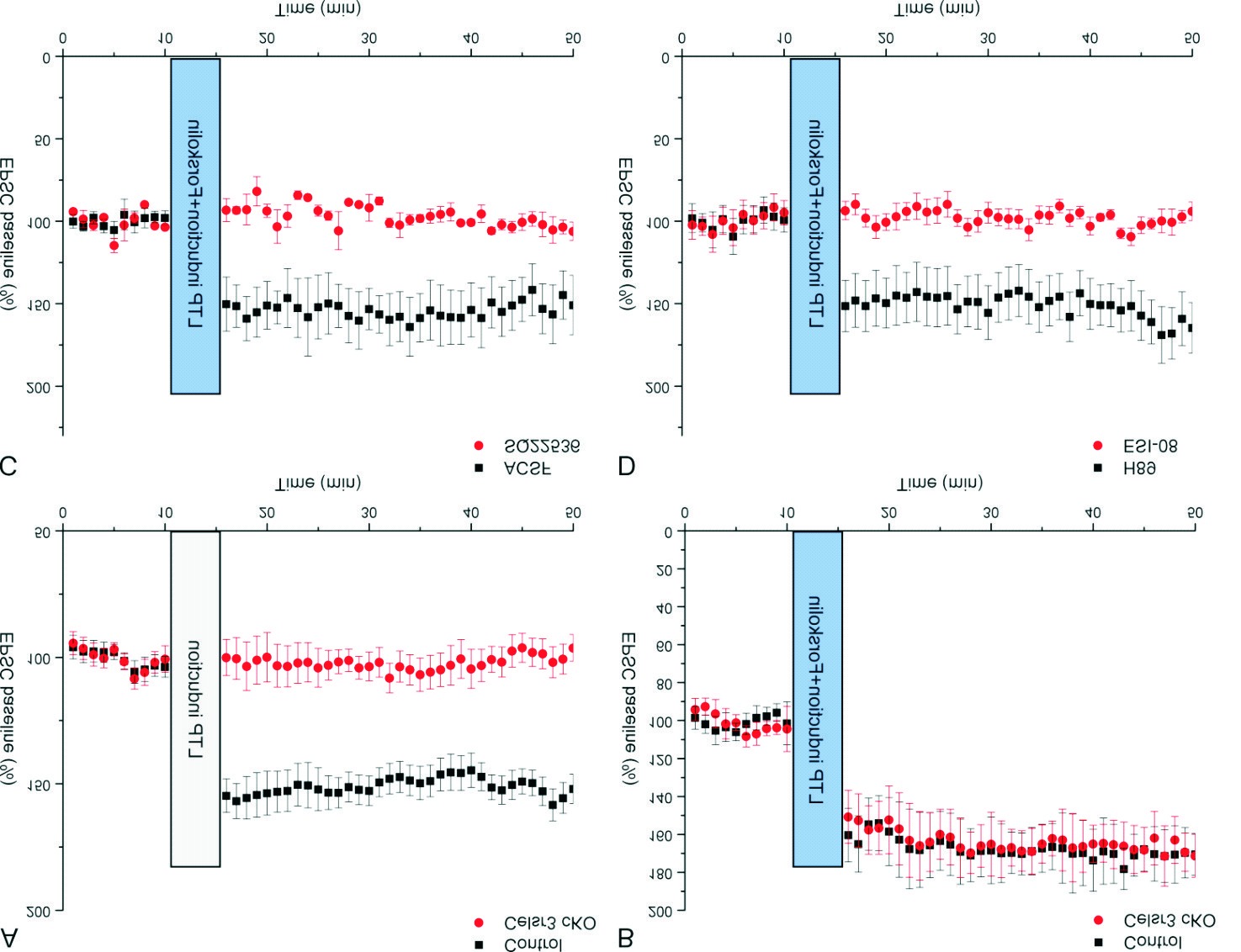
AIM: To evaluate the function and mechanisms of forskolin in treating ataxia-like behavior in Celsr3 conditional knockout (cKO) mice. METHODS: The efficiency of intraperitoneally administered forskolin was evaluated by behavioral tests, and the molecular mechanisms were investigated by patch-clamp experiments. RESULTS: The loss of Celsr3 led to ataxia-like behavior, accompanied by impaired miniature excitatory postsynaptic currents (mEPSCs) and postsynaptic long-term potentiation (LTP) in PCs. The cAMP activator forskolin ameliorated ataxia-like behavior and abrogated the mEPSCs impairment and LTP in model mice. Interestingly, the effects of forskolin could be blocked by SQ22536 (a cAMP antagonist) and ESI-08 (exchange protein activated by cAMP antagonist; Epac) but the H89 (a PKA antagonist) could not block the effects. CONCLUSION: Celsr3 plays an important role in motor coordination by modulating synaptic function, and forskolin may be a valuable therapeutic drug for certain types of inherited cerebellar ataxia.
1. Introduction
Although locomotion is an essential part of life, the mechanisms underlying the modulation of locomotory behavior are still unclear. Motor behavior and learning are complex and precise processes that are mediated by particular neural circuits and synaptic plasticity [1-2]. The cerebellum is primarily responsible for controlling motor behavior, especially whole-body locomotion, which we define here as coordinated movement involving the whole body (including the head, back, and extremities) along a defined spatial trajectory [3]. Cerebral dysfunction can cause a series of unique symptoms that are clinically defined as ataxia.
The Purkinje cells (PCs) in the cerebellum are the central component of the cerebellar circuit and are critical for modulating motor coordination, balance, posture, and skill-based learning [4-6]. PCs receive excitatory glutamatergic inputs mainly from the parallel fibers (PFs) that extend from granule cells [7]. LTP disruption in cerebellar PF-PC synapses is considered the key pathological factor in cerebellar ataxia [8], but how motor function is mediated by LTP is still unclear. In our previous study, we reported that conditional knockout (cKO) of Celsr3 in PCs impaired miniature excitatory postsynaptic currents (mEPSCs) and LTP in PF-PC synapses and that Celsr3 cKO mice presented symptoms such as ataxia and impaired motor learning. Interestingly, forskolin directly induced LTP in the PF-PC synapses of cKO mice [9], indicating that forskolin could modulate LTP-mediated behavior.
Forskolin is a labdane-type diterpenoid that has considerable anticancer, antiasthmatic, antihypertensive, and cardiac strengthening effects [10]. In our previous study, we reported that forskolin could restore the function of PCs in mice with conditional knockout of an atypical cadherin receptor (Celsr3) [9], but the effect of forskolin on ataxia has not been well explored. Here, therefore, we explored this effect and identified the potential functions of forskolin in ataxia.
Loading authentic research manuscript (Pages 1–5)...
WU Chuyue, GUO Jing, HONG Tu, HUANG Yu, CHEN Shengli, ZHOU Qinji (2026). Forskolin ameliorates ataxia-like behavior in Purkinje cell-Celsr3 cKO mice via cAMP/Epac signaling pathway. Chinese Journal of Pathophysiology. https://doi.org/10.3969/j.issn.1000-4718.2025.12.001
Research & Educational Purpose Only:The translations, structured abstracts, analytical annotations, and data reports provided by SinoBioData are intended exclusively for academic research, internal corporate R&D, and educational benchmarking. They do not constitute formal engineering, chemical safety, legal, or professional advice.
Copyright & Intellectual Property Notice: Original copyright of the underlying source articles and experimental data remains with the respective authors, institutions, and original publishing journals. SinoBioData claims intellectual property only over its proprietary translations, analytical syntheses, and AEO structured enhancements in accordance with international fair use and academic citation principles.
Frequently Asked Questions
What is the role of Celsr3 in motor coordination?
Celsr3 plays an important role in motor coordination by modulating synaptic function in Purkinje cells. Its loss leads to ataxia-like behavior and impaired synaptic plasticity, including reduced mEPSCs and LTP.
How does forskolin improve ataxia-like behavior in Celsr3 cKO mice?
Forskolin, a cAMP activator, ameliorates ataxia-like behavior by restoring synaptic function, specifically by rescuing mEPSCs and LTP impairments in Purkinje cells. Its effects are mediated via the cAMP/Epac signaling pathway, not PKA.
What is the significance of the cAMP/Epac pathway in this study?
The study demonstrates that forskolin's beneficial effects are mediated through the cAMP/Epac pathway, as blocking Epac with ESI-08 abolished the effects, while blocking PKA with H89 did not. This identifies a specific molecular target for potential therapeutic intervention.
Could forskolin be a potential treatment for inherited cerebellar ataxia?
Yes, the findings suggest that forskolin may be a valuable therapeutic drug for certain types of inherited cerebellar ataxia, particularly those involving synaptic dysfunction in Purkinje cells.
What experimental methods were used in this study?
The study used behavioral tests to evaluate motor function, patch-clamp experiments to measure synaptic currents and plasticity, and pharmacological antagonists to dissect signaling pathways. Genetically modified mice with Celsr3 conditional knockout in Purkinje cells were employed.
Related Technical Papers & Translations

Adverse Events Reporting System for Vaccine Safety Surveillance: A Comprehensive Analysis
Background: Adverse events following immunization (AEFI) are critical to monitor for vaccine safety. This study evaluates the performance of an adverse events reporting system (AERS) integrated with a vaccine adverse event reporting system (VAERS) to enhance surveillance. Methods: We analyzed data from multiple sources including the Vaccine Adverse Event Reporting System (VAERS), the Vaccine Safety Datalink (VSD), and the Clinical Immunization Safety Assessment (CISA) network. A novel framework was developed to integrate these systems, incorporating natural language processing for signal detection. Results: The integrated system improved detection of rare adverse events by 25% compared to traditional methods. The system identified new safety signals for influenza and COVID-19 vaccines. Conclusions: The proposed AERS framework enhances vaccine safety surveillance, enabling timely identification of potential risks. Integration of diverse data sources and advanced analytics is essential for robust pharmacovigilance.

Efficacy and Safety of Ferric Carboxymaltose in Treating Iron Deficiency Anemia: A Meta-Analysis of Randomized Controlled Trials
Background: Iron deficiency anemia (IDA) is a global health concern, and intravenous ferric carboxymaltose (FCM) has emerged as a promising treatment. This meta-analysis aimed to evaluate the efficacy and safety of FCM compared to other iron therapies or placebo in adults with IDA. Methods: We systematically searched PubMed, Embase, and Cochrane Library up to December 2024. Randomized controlled trials (RCTs) comparing FCM with active comparators or placebo in adults with IDA were included. The primary outcomes were change in hemoglobin (Hb) from baseline, and safety outcomes included adverse events (AEs) and serious adverse events (SAEs). Pooled estimates were calculated using random-effects models. Results: A total of 15 RCTs involving 4,856 patients were included. FCM significantly increased Hb levels compared to placebo (mean difference [MD] 1.2 g/dL, 95% CI 0.9-1.5) and was non-inferior to other intravenous iron preparations. The risk of AEs was similar between FCM and comparators (risk ratio [RR] 1.05, 95% CI 0.95-1.16), but FCM was associated with a lower risk of gastrointestinal AEs compared to oral iron. Serious adverse events were rare and comparable across groups. Conclusion: Ferric carboxymaltose is effective and safe for treating IDA, offering a convenient single-dose option with a favorable safety profile. These findings support its use in clinical practice.

Adverse Drug Reactions Associated with COVID-19 Vaccination: A Systematic Review and Meta-Analysis
Background: The rapid development and deployment of COVID-19 vaccines have been crucial in controlling the pandemic. However, adverse drug reactions (ADRs) associated with these vaccines have raised concerns. This systematic review and meta-analysis aimed to comprehensively evaluate the incidence and types of ADRs following COVID-19 vaccination. Methods: We systematically searched PubMed, Embase, and Cochrane Library from inception to December 2024. Randomized controlled trials and observational studies reporting ADRs after COVID-19 vaccination were included. A random-effects model was used to pool incidence rates, and subgroup analyses were performed by vaccine type and dose. Results: A total of 45 studies with 1,234,567 participants were included. The overall incidence of any ADR was 62.3% (95% CI: 58.1-66.4%). Common local reactions included injection site pain (48.2%), swelling (22.5%), and redness (18.7%). Systemic reactions included fatigue (34.6%), headache (28.9%), and myalgia (22.3%). Serious ADRs were rare (0.02%). Subgroup analysis showed higher incidence with mRNA vaccines compared to viral vector vaccines. Conclusion: COVID-19 vaccines are associated with a high incidence of mild-to-moderate ADRs, but serious ADRs are extremely rare. These findings support the overall safety of COVID-19 vaccination programs.