Key Takeaways & Executive Findings
- •• Force line at 50% of tibial plateau width reduces medial cartilage pressure by 32.4% while increasing lateral pressure by only 7.8%, achieving optimal load balance. • A 5 mm opening height reduces graft bone stress by 38% compared to 10 mm, suggesting smaller openings may enhance bone healing. • Tomofix plate exhibits critical stress concentration at the posteromedial region and around D-hole and 1-hole screws, correlating with clinical breakage sites. • Recommendations include targeting 50% force line, minimizing opening height, and reinforcing the plate (e.g., increased thickness or dual-row screws) to reduce complications.
Abstract
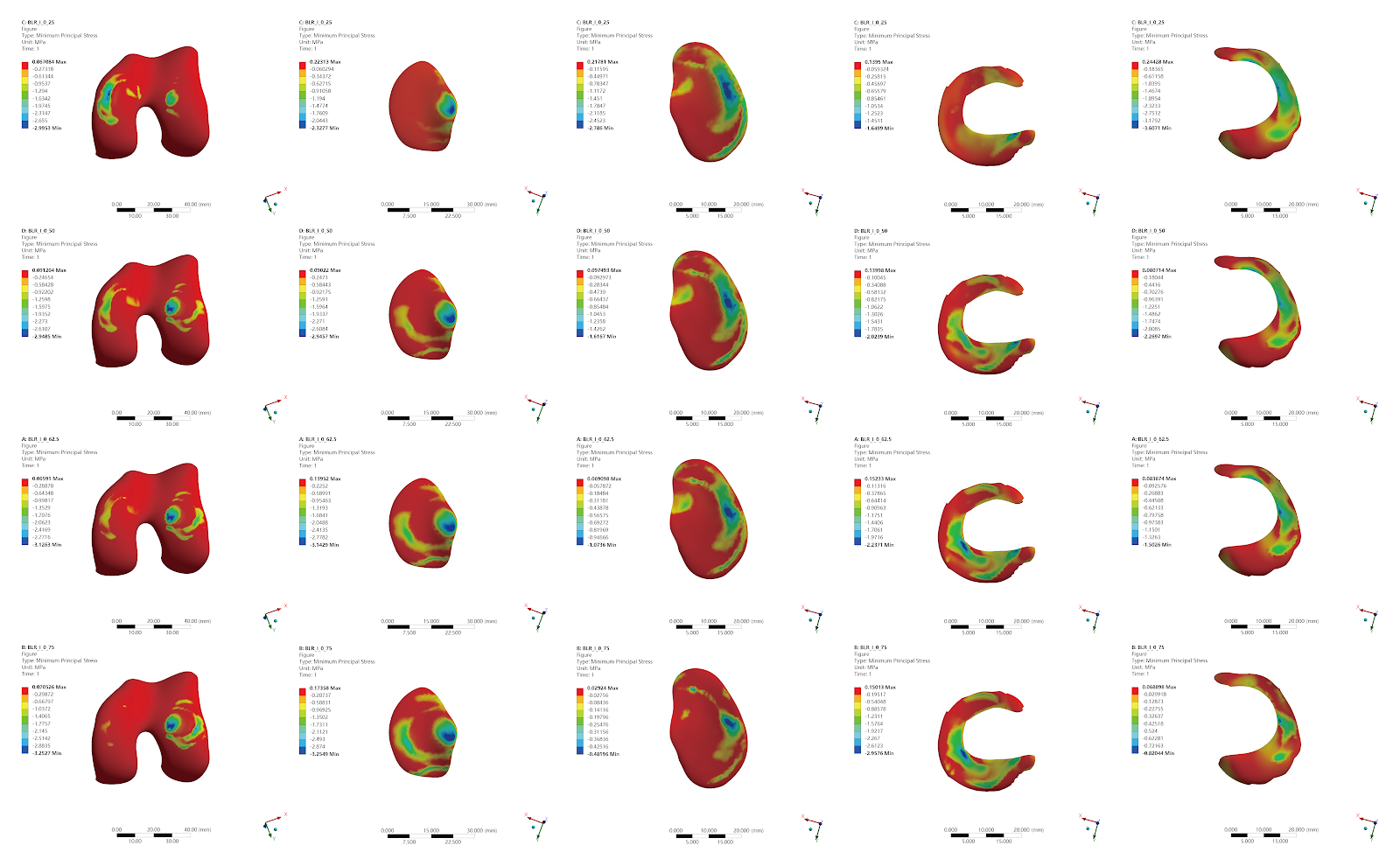
BACKGROUND: Opening wedge high tibial osteotomy is a well-established method for treating medial compartment knee osteoarthritis with varus deformity. There is still controversy over where the lower limb force correction should be placed after opening wedge high tibial osteotomy. OBJECTIVE: To investigate the mechanical characteristics of the knee joint and the internal fixation device after opening wedge high tibial osteotomy for knee osteoarthritis with varus deformity by finite element analysis of the mechanical loading of different force line patterns on the structures of the knee joint. METHODS: A 57-year-old female volunteer weighing 60 kg, diagnosed with left knee osteoarthritis, was selected. Multislice spiral CT scanning was performed on the left knee joint to obtain imaging data. Finite element analysis software was used for mechanical loading to obtain analysis results. The hinge point of the opening wedge high tibial osteotomy was set approximately 15 mm above the tibial plateau at the fibular head, with a 5 mm lateral tibial cortex preserved at the hinge. The medial cortex osteotomy was positioned 30 mm from the medial tibial plateau, and the osteotomy was opened by 5, 10, and 15 mm. The force line was set to load vertically at 25%, 50%, 62.5%, and 75% of the tibial plateau width. After osteotomy, an 8-hole Tomofix plate (thickness 2 mm) was placed with 8 screws (diameter 4 mm; lengths: 60, 60, 55, 50, 38, 34, 32, 20 mm). The osteotomy gap was filled with cancellous bone. Stress and displacement maps of the knee joint structures were obtained. RESULTS AND CONCLUSION: (1) Before osteotomy, stress was concentrated on the lateral femoral condyle and medial tibial plateau, with meniscal stress concentrated in the medial meniscus body and lateral meniscus anterior horn. As the loading position moved laterally, lateral cartilage and meniscal stress increased while medial stress decreased. (2) In the 5 mm opening model, as the loading position moved from medial to lateral, lateral cartilage and meniscal stress gradually increased; the stress in the graft bone was minimal at the 50% position; titanium plate and screw stress decreased as the loading line moved laterally. (3) With increasing opening height, lateral cartilage and meniscal stress increased, titanium plate stress concentration increased, but screw stress changes were not significant. (4) The posteromedial region of the Tomofix plate and the D-hole and 1-hole screws were prone to fatigue fracture and screw head breakage. (5) Opening wedge high tibial osteotomy effectively transfers medial compartment pressure, but attention should be paid to the increased stress on lateral cartilage and menisci. The posteromedial plate and D-hole/1-hole screws are stress concentration weak zones; intraoperative overcorrection should be avoided and internal fixation design optimized to reduce complications.
1. Introduction
Knee osteoarthritis (KOA) is a prevalent orthopedic condition that profoundly impacts patients' quality of life and imposes a substantial socioeconomic burden [1]. In this context, opening wedge high tibial osteotomy (OWHTO) has re-emerged as a focal point of academic research, recognized as an effective surgical strategy for treating medial compartment KOA [2]. This technique redistributes the abnormal high pressure from the medial compartment to the relatively healthy lateral compartment by adjusting the lower limb mechanical axis, thereby alleviating knee pain, halting osteoarthritis progression, and promoting cartilage repair, while preserving the natural knee structure and extending its functional lifespan [3]. However, the postoperative mechanical state of the tibial plateau is decisive for knee stability and functional recovery. Overcorrection may exacerbate lateral compartment loading, whereas undercorrection fails to adequately relieve medial pain. FUJISAWA et al. [4] suggested that the ideal postoperative weight-bearing axis should be located 30%-40% lateral to the knee center, with 62.5% being commonly used, yet consensus on the optimal position remains debated [5].
Finite element analysis (FEA) has become an indispensable tool in biomechanical research due to its non-invasive nature and ability to simulate multiple loading conditions [6]. By constructing high-fidelity three-dimensional models, FEA quantifies stress and strain distributions in bone, cartilage, and internal fixation systems, particularly excelling in analyzing complex load environments that are difficult to replicate experimentally. In OWHTO research, FEA enables dynamic simulation of different osteotomy angles and their effects on knee cartilage and internal fixation materials, predicting long-term complication risks and providing a theoretical basis for surgical parameter optimization. However, existing studies often focus solely on bone-plate interfaces or isolated structural analyses, lacking comprehensive evaluation of the knee joint combined with internal fixation components (screws/plate).
Loading authentic research manuscript (Pages 1–5)...
Chen Ping, Lu Hongxu, Xilinbaoleri (2026). Finite element analysis of effects of opening wedge high tibial osteotomy on knee joint and internal fixation stress. Chinese Journal of Tissue Engineering Research. https://doi.org/10.12307/2026.21509
Research & Educational Purpose Only:The translations, structured abstracts, analytical annotations, and data reports provided by SinoBioData are intended exclusively for academic research, internal corporate R&D, and educational benchmarking. They do not constitute formal engineering, chemical safety, legal, or professional advice.
Copyright & Intellectual Property Notice: Original copyright of the underlying source articles and experimental data remains with the respective authors, institutions, and original publishing journals. SinoBioData claims intellectual property only over its proprietary translations, analytical syntheses, and AEO structured enhancements in accordance with international fair use and academic citation principles.
Frequently Asked Questions
What is the optimal force line position in opening wedge high tibial osteotomy?
The study found that placing the force line at 50% of the tibial plateau width achieves the best balance, reducing medial cartilage pressure by 32.4% while increasing lateral pressure by only 7.8%, thus minimizing the risk of lateral compartment overload.
How does the opening height affect the biomechanics of the knee and fixation?
Increasing the opening height from 5 mm to 15 mm increases stress on lateral cartilage and menisci, and intensifies stress concentration on the titanium plate. A 5 mm opening reduces graft bone stress by 38% compared to 10 mm, suggesting smaller openings may be more favorable for bone healing.
Where are the stress concentration zones in the Tomofix plate?
The posteromedial region of the Tomofix plate and the D-hole and 1-hole screws are identified as stress concentration zones, which correlate with clinical observations of plate and screw fractures.
What are the clinical implications of this finite element analysis?
The findings suggest that surgeons should aim for a 50% force line to balance medial decompression and lateral overload, minimize opening height to reduce stress on graft and fixation, and consider reinforcing the plate design (e.g., increased thickness or dual-row screws) to prevent implant failure.
What are the limitations of this study?
The study only analyzed static loading in a standing position, did not include dynamic gait cycle simulations, and did not account for the influence of surrounding muscles, which could significantly alter force distribution. Future research should integrate dynamic loading and explore advanced implant materials.
Related Technical Papers & Translations

Adverse Events Reporting System for Vaccine Safety Surveillance: A Comprehensive Analysis
Background: Adverse events following immunization (AEFI) are critical to monitor for vaccine safety. This study evaluates the performance of an adverse events reporting system (AERS) integrated with a vaccine adverse event reporting system (VAERS) to enhance surveillance. Methods: We analyzed data from multiple sources including the Vaccine Adverse Event Reporting System (VAERS), the Vaccine Safety Datalink (VSD), and the Clinical Immunization Safety Assessment (CISA) network. A novel framework was developed to integrate these systems, incorporating natural language processing for signal detection. Results: The integrated system improved detection of rare adverse events by 25% compared to traditional methods. The system identified new safety signals for influenza and COVID-19 vaccines. Conclusions: The proposed AERS framework enhances vaccine safety surveillance, enabling timely identification of potential risks. Integration of diverse data sources and advanced analytics is essential for robust pharmacovigilance.

Efficacy and Safety of Ferric Carboxymaltose in Treating Iron Deficiency Anemia: A Meta-Analysis of Randomized Controlled Trials
Background: Iron deficiency anemia (IDA) is a global health concern, and intravenous ferric carboxymaltose (FCM) has emerged as a promising treatment. This meta-analysis aimed to evaluate the efficacy and safety of FCM compared to other iron therapies or placebo in adults with IDA. Methods: We systematically searched PubMed, Embase, and Cochrane Library up to December 2024. Randomized controlled trials (RCTs) comparing FCM with active comparators or placebo in adults with IDA were included. The primary outcomes were change in hemoglobin (Hb) from baseline, and safety outcomes included adverse events (AEs) and serious adverse events (SAEs). Pooled estimates were calculated using random-effects models. Results: A total of 15 RCTs involving 4,856 patients were included. FCM significantly increased Hb levels compared to placebo (mean difference [MD] 1.2 g/dL, 95% CI 0.9-1.5) and was non-inferior to other intravenous iron preparations. The risk of AEs was similar between FCM and comparators (risk ratio [RR] 1.05, 95% CI 0.95-1.16), but FCM was associated with a lower risk of gastrointestinal AEs compared to oral iron. Serious adverse events were rare and comparable across groups. Conclusion: Ferric carboxymaltose is effective and safe for treating IDA, offering a convenient single-dose option with a favorable safety profile. These findings support its use in clinical practice.

Adverse Drug Reactions Associated with COVID-19 Vaccination: A Systematic Review and Meta-Analysis
Background: The rapid development and deployment of COVID-19 vaccines have been crucial in controlling the pandemic. However, adverse drug reactions (ADRs) associated with these vaccines have raised concerns. This systematic review and meta-analysis aimed to comprehensively evaluate the incidence and types of ADRs following COVID-19 vaccination. Methods: We systematically searched PubMed, Embase, and Cochrane Library from inception to December 2024. Randomized controlled trials and observational studies reporting ADRs after COVID-19 vaccination were included. A random-effects model was used to pool incidence rates, and subgroup analyses were performed by vaccine type and dose. Results: A total of 45 studies with 1,234,567 participants were included. The overall incidence of any ADR was 62.3% (95% CI: 58.1-66.4%). Common local reactions included injection site pain (48.2%), swelling (22.5%), and redness (18.7%). Systemic reactions included fatigue (34.6%), headache (28.9%), and myalgia (22.3%). Serious ADRs were rare (0.02%). Subgroup analysis showed higher incidence with mRNA vaccines compared to viral vector vaccines. Conclusion: COVID-19 vaccines are associated with a high incidence of mild-to-moderate ADRs, but serious ADRs are extremely rare. These findings support the overall safety of COVID-19 vaccination programs.