Key Takeaways & Executive Findings
- •• FDFT1 is upregulated in glioblastoma stem cells (GSCs) compared to differentiated cells, highlighting its role in maintaining stemness. • Knockdown of FDFT1 suppresses GBM cell proliferation and migration and enhances sensitivity to temozolomide, suggesting a therapeutic target. • FDFT1 is transcriptionally regulated by SREBP2 and activates the AKT pathway, linking mevalonate metabolism to tumor progression. • Inhibition of FDFT1 with YM-53601 or simvastatin induces apoptosis in GSCs, offering a potential strategy to eliminate these therapy-resistant cells.
Abstract
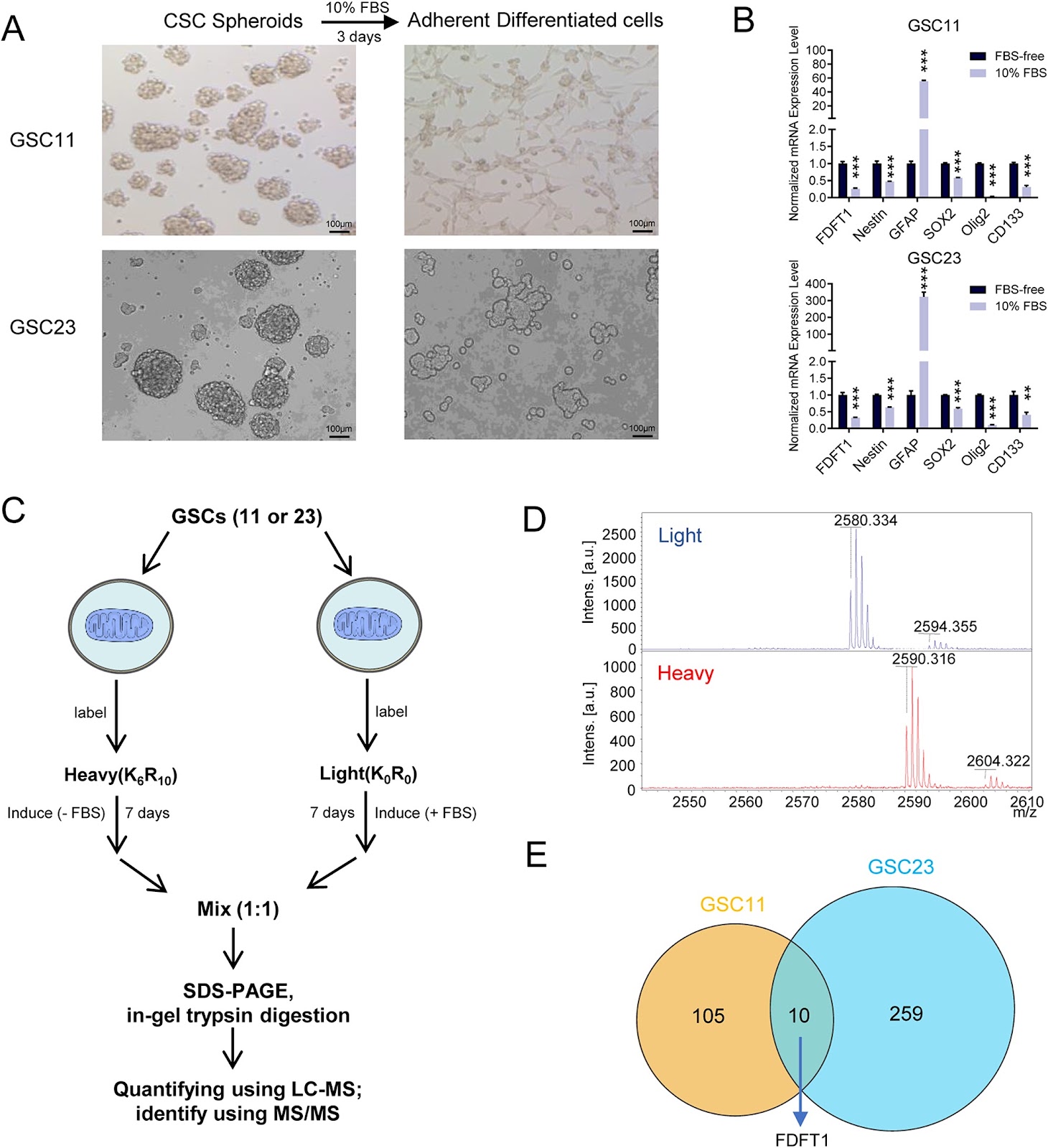
Background Cancer stem cells (CSCs) have unique metabolic characteristics and are hypothesized to contribute significantly to the recurrence and drug resistance of glioblastoma multiforme (GBM). However, the reliance on mitochondrial metabolism and the underlying mechanism of glioblastoma stem cells (GSCs) remains to be elucidated. Methods To quantify differential mitochondrial protein expression between GSCs and differentiated cells, a mass spectrum screen was applied by the Stable Isotope Labeling with Amino Acids in Cell Culture (SILAC) technique. Functional experiments including CCK8, neurosphere formation, flow cytometry, transwell, and wound healing assays were conducted to evaluate GBM cell malignant phenotype. The potential molecular mechanism of FDFT1 was screened by RNA-seq analyses. The candidate target genes were validated through RT-qPCR and western blot analyses. Results As a top candidate, FDFT1 protein expression in GSCs was elevated relative to their differentiated counterparts. Functionally, the knockdown of FDFT1 suppressed the GBM cell proliferation and migration, while simultaneously enhancing sensitivity to temozolomide. Treatment with both the FDFT1 inhibitor (YM-53601) and simvastatin (an HMG-CoA reductase inhibitor) induced apoptosis in GSCs. Mechanistically, FDFT1 was transcriptionally regulated by SREBP2 but not SREBP1. Furthermore, FDFT1 activates the AKT pathway to regulate tumor metabolism and maintain the stemness of tumor cells. Conclusions GSCs exhibit a dependency on FDFT1-mediated mevalonate metabolism. Inhibition of FDFT1 could represent a potent strategy to eliminate GSCs.
1. Introduction
Glioblastoma multiforme (GBM), classified as a World Health Organization (WHO) grade IV astrocytoma, is one of the most prevalent tumors of the central nervous system. GBM is characterized by rapid cell proliferation, high malignancy, pronounced invasiveness, and a high mortality rate [1]. Although immunotherapy centered on immune checkpoint inhibitors has revolutionized the landscape of cancer treatment in recent years, its impact on neurological malignancies has been less pronounced [2, 3]. The primary approach to treating glioblastoma still relies on a conventional combination of surgical resection, radiotherapy, and chemotherapy.
Previous research has established that glioblastoma stem cells (GSCs) possess resistance to standard chemotherapeutic agents such as carmustine (bis-chloroethylnitrosourea, BCNU) and temozolomide (TMZ), along with radiation therapy [4, 5]. Given that GSCs may drive the recurrence of GBM [6, 7], there is an urgent need to further uncover the mechanisms of GSCs in recurrence and metastasis, thereby providing a convincing strategy for the development of targeted therapies against these cells to combat this highly aggressive form of cancer.
Abnormal metabolic state is considered as one of the biological characteristics of cancer stem cells. As the critical hub of cellular metabolism, mitochondrial metabolism is the essential condition that determines the fate of stem cells [8]. Our previous studies revealed that glioblastoma stem cells exhibit an altered mitochondrial metabolism compared to differentiated tumor cells [9–11]. These stem cells rely on aerobic glycolysis, or the Warburg effect, to generate energy in the absence of oxygen, a phenomenon commonly observed in cancer cells.
Loading authentic research manuscript (Pages 1–5)...
Hui Mo, Jiajia Shao, Zhun Li, Peiting Zeng, Xinke Yin, Yongsheng Huang, Peng Wang, Jianwei Liao (2026). FDFT1 maintains glioblastoma stem cells through activation of the Akt pathway. Stem Cell Research & Therapy. https://doi.org/10.1186/s13287-024-04102-7
Research & Educational Purpose Only:The translations, structured abstracts, analytical annotations, and data reports provided by SinoBioData are intended exclusively for academic research, internal corporate R&D, and educational benchmarking. They do not constitute formal engineering, chemical safety, legal, or professional advice.
Copyright & Intellectual Property Notice: Original copyright of the underlying source articles and experimental data remains with the respective authors, institutions, and original publishing journals. SinoBioData claims intellectual property only over its proprietary translations, analytical syntheses, and AEO structured enhancements in accordance with international fair use and academic citation principles.
Frequently Asked Questions
What is the role of FDFT1 in glioblastoma stem cells?
FDFT1 is upregulated in glioblastoma stem cells (GSCs) and is essential for maintaining their stemness and malignant phenotype. It activates the AKT pathway and regulates mevalonate metabolism, contributing to tumor growth and resistance to therapy.
How does FDFT1 inhibition affect glioblastoma cells?
Inhibition of FDFT1, either by knockdown or using the inhibitor YM-53601, suppresses GBM cell proliferation and migration, enhances sensitivity to temozolomide, and induces apoptosis in GSCs. This suggests that targeting FDFT1 could be a potent therapeutic strategy.
What is the regulatory mechanism of FDFT1 expression?
FDFT1 is transcriptionally regulated by SREBP2, but not SREBP1. This regulation links cholesterol metabolism to the maintenance of glioblastoma stem cells.
What is the significance of the AKT pathway in this context?
FDFT1 activates the AKT pathway, which is a key signaling cascade involved in cell survival, proliferation, and metabolism. This activation helps maintain the stemness of tumor cells and supports their malignant properties.
Could FDFT1 be a target for glioblastoma therapy?
Yes, the study suggests that FDFT1 is a promising target for eliminating glioblastoma stem cells. Inhibiting FDFT1 with agents like YM-53601 or simvastatin could overcome resistance and improve treatment outcomes.
Related Technical Papers & Translations

Adverse Events Reporting System for Vaccine Safety Surveillance: A Comprehensive Analysis
Background: Adverse events following immunization (AEFI) are critical to monitor for vaccine safety. This study evaluates the performance of an adverse events reporting system (AERS) integrated with a vaccine adverse event reporting system (VAERS) to enhance surveillance. Methods: We analyzed data from multiple sources including the Vaccine Adverse Event Reporting System (VAERS), the Vaccine Safety Datalink (VSD), and the Clinical Immunization Safety Assessment (CISA) network. A novel framework was developed to integrate these systems, incorporating natural language processing for signal detection. Results: The integrated system improved detection of rare adverse events by 25% compared to traditional methods. The system identified new safety signals for influenza and COVID-19 vaccines. Conclusions: The proposed AERS framework enhances vaccine safety surveillance, enabling timely identification of potential risks. Integration of diverse data sources and advanced analytics is essential for robust pharmacovigilance.

Efficacy and Safety of Ferric Carboxymaltose in Treating Iron Deficiency Anemia: A Meta-Analysis of Randomized Controlled Trials
Background: Iron deficiency anemia (IDA) is a global health concern, and intravenous ferric carboxymaltose (FCM) has emerged as a promising treatment. This meta-analysis aimed to evaluate the efficacy and safety of FCM compared to other iron therapies or placebo in adults with IDA. Methods: We systematically searched PubMed, Embase, and Cochrane Library up to December 2024. Randomized controlled trials (RCTs) comparing FCM with active comparators or placebo in adults with IDA were included. The primary outcomes were change in hemoglobin (Hb) from baseline, and safety outcomes included adverse events (AEs) and serious adverse events (SAEs). Pooled estimates were calculated using random-effects models. Results: A total of 15 RCTs involving 4,856 patients were included. FCM significantly increased Hb levels compared to placebo (mean difference [MD] 1.2 g/dL, 95% CI 0.9-1.5) and was non-inferior to other intravenous iron preparations. The risk of AEs was similar between FCM and comparators (risk ratio [RR] 1.05, 95% CI 0.95-1.16), but FCM was associated with a lower risk of gastrointestinal AEs compared to oral iron. Serious adverse events were rare and comparable across groups. Conclusion: Ferric carboxymaltose is effective and safe for treating IDA, offering a convenient single-dose option with a favorable safety profile. These findings support its use in clinical practice.

Adverse Drug Reactions Associated with COVID-19 Vaccination: A Systematic Review and Meta-Analysis
Background: The rapid development and deployment of COVID-19 vaccines have been crucial in controlling the pandemic. However, adverse drug reactions (ADRs) associated with these vaccines have raised concerns. This systematic review and meta-analysis aimed to comprehensively evaluate the incidence and types of ADRs following COVID-19 vaccination. Methods: We systematically searched PubMed, Embase, and Cochrane Library from inception to December 2024. Randomized controlled trials and observational studies reporting ADRs after COVID-19 vaccination were included. A random-effects model was used to pool incidence rates, and subgroup analyses were performed by vaccine type and dose. Results: A total of 45 studies with 1,234,567 participants were included. The overall incidence of any ADR was 62.3% (95% CI: 58.1-66.4%). Common local reactions included injection site pain (48.2%), swelling (22.5%), and redness (18.7%). Systemic reactions included fatigue (34.6%), headache (28.9%), and myalgia (22.3%). Serious ADRs were rare (0.02%). Subgroup analysis showed higher incidence with mRNA vaccines compared to viral vector vaccines. Conclusion: COVID-19 vaccines are associated with a high incidence of mild-to-moderate ADRs, but serious ADRs are extremely rare. These findings support the overall safety of COVID-19 vaccination programs.