Key Takeaways & Executive Findings
- •• FANCA is overexpressed in gastric cancer cell lines and correlates with advanced pathologic stage and lymphatic metastasis. • Knockdown of FANCA suppresses proliferation, migration, invasion, and induces G1/S cell cycle arrest, while overexpression promotes these malignant behaviors. • In vivo xenograft experiments confirm that FANCA promotes gastric tumor progression. • FANCA exerts its oncogenic effects via the cell cycle pathway, suggesting it as a potential therapeutic target for gastric cancer.
Abstract
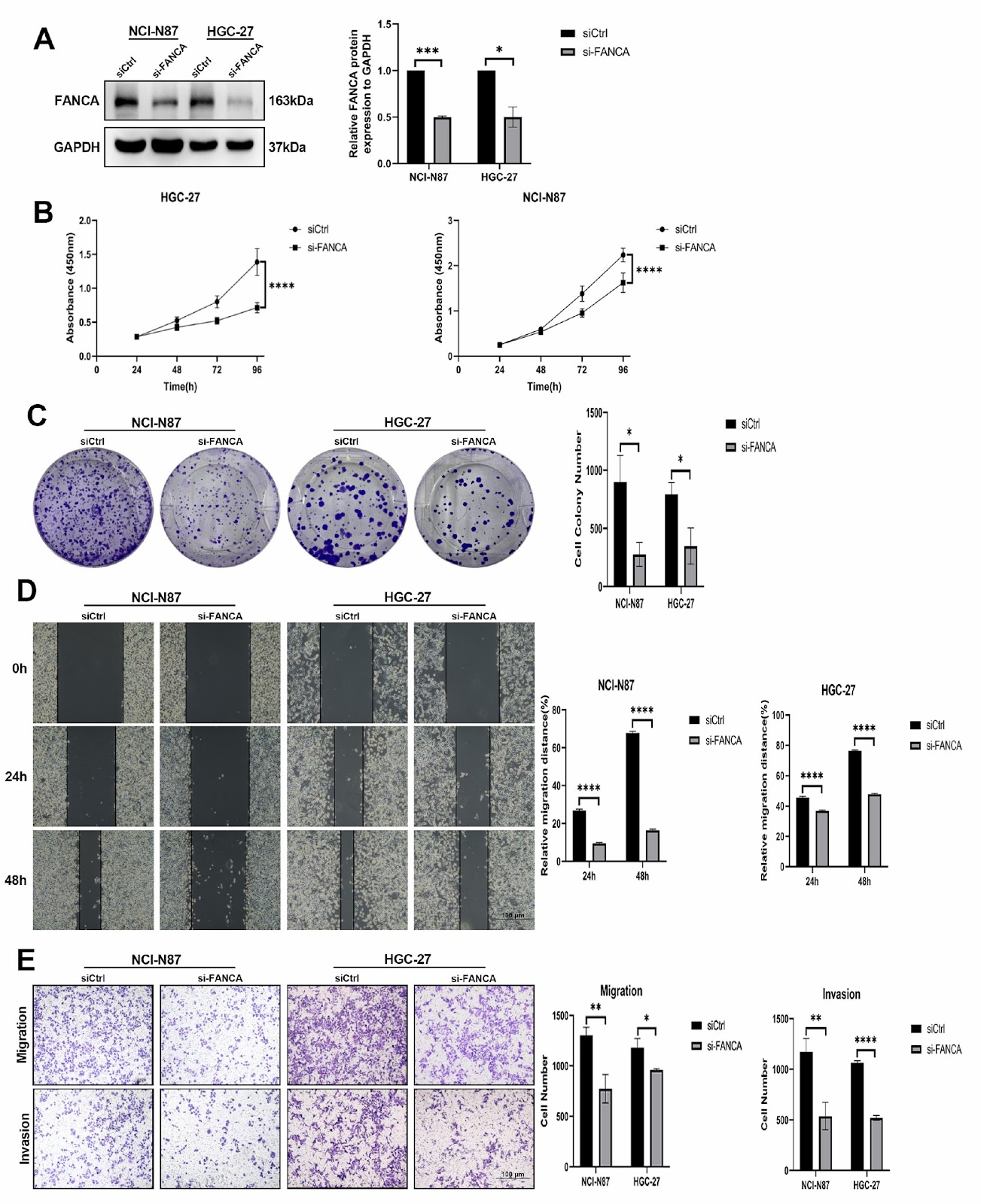
The present study explores the function of FANCA gene, a pivotal member of the Fanconi anaemia (FA) pathway crucial for preserving genomic stability and preventing cancer, particularly in the context of gastric cancer (GC). Using immunohistochemistry, quantitative real-time PCR, and western blot analysis, we evaluate FANCA mRNA and protein expressions in GC cell lines. The relationship between FANCA expression and clinicopathological characteristics is also explored. Various assays, including CCK8, colony formation, wound healing, and Transwell assays, are used to assess functional changes in cells associated with FANCA. Flow cytometry is utilized to evaluate alterations in the cell cycle resulted from FANCA knockdown and overexpression. Our findings show elevated FANCA expression in GC cell lines, with levels correlated with pathologic stage and lymphatic metastasis. FANCA knockdown impedes cell proliferation, migration, and invasion and induces G1/S phase cell cycle arrest. Conversely, FANCA overexpression stimulates cell proliferation, migration, and invasion. In vivo xenograft experiments confirm the promotional role of FANCA in GC tumor progression. Moreover, FANCA overexpression is associated with the activation of cell cycle. Collectively, our results suggest that FANCA drives malignant cell behaviors in GC through the cell cycle pathway, highlighting its potential as a therapeutic target for the treatment of GC.
1. Introduction
Gastric cancer (GC), or stomach cancer, remains a challenging global health concern, demanding continued research and innovation for prevention, early detection, and treatment. This malignancy is associated with significant morbidity and mortality and ranks as the fifth most common cancer worldwide, with substantial regional variations in its incidence and outcomes [1,2]. Emerging research is shedding light on the complexities of GC, including its genetic and molecular underpinnings, paving the way for novel approaches to deal with this formidable disease. The global distribution of GC is marked by notable disparities, with a disproportionately higher burden in specific regions, such as Eastern Asia and parts of South America, and a lower incidence in North America and Western Europe [3]. These geographic differences reflect a convergence of genetic, environmental, and lifestyle factors that contribute to disease initiation and progression. The role of Helicobacter pylori infection, a well-established risk factor, continues to be a focal point in GC research, as does the impact of dietary habits, tobacco use, and familial predisposition [4]. Recent advances in molecular biology have illuminated the heterogeneity of gastric cancer, leading to the recognition of distinct subtypes that have different prognoses and therapeutic implications. The integration of genomics and precision medicine is shaping the development of targeted therapies and personalized treatment strategies for patients [5,6].
The FANCA gene is a vital component of the Fanconi anaemia (FA) pathway, a complex network of proteins responsible for mending DNA interstrand crosslinks (ICLs). These crosslinks arise when both strands of the DNA double helix are covalently linked, posing a significant threat to genomic stability. If left unrepaired, these crosslinks can lead to chromosomal abnormalities, cell death, and increased susceptibility to cancers [7]. Positioned on the long arm of chromosome 16 (16q24.3), the FANCA gene extends across a genomic region comprising multiple exons and introns. This gene encodes the FANCA protein, a large protein crucial to the FA core complex. This complex, consisting of various FA proteins, such as FANCB, FANCC, FANCE, FANCF, FANCG, FANCL, and others, is central to activating the FA pathway [8,9]. The role of FANCA involves the assembly and stability of this core complex. The core complex is essential for the monoubiquitination of the FANCD2 and FANCI proteins, a critical step in FA pathway activation. The activated FANCD2-FANCI complex plays a central role in coordinating the repair of DNA interstrand crosslinks [10]. Mutations in the FANCA gene can lead to FA, resulting in a non-functional or less stable FANCA protein. This disruption affects the formation of the FA core complex, impairing the repair of DNA interstrand crosslinks and contributing to the phenotypic manifestations of FA. [11]. Individuals with biallelic mutations in FANCA may exhibit various clinical features, including bone marrow failure, congenital anomalies (such as skeletal abnormalities), and an elevated risk of cancer.
Loading authentic research manuscript (Pages 1–5)...
Wei Wang, Shantanu Baral, Bin Liu, Qiannan Sun, Liuhua Wang, Jun Ren, Dong Tang, Daorong Wang (2026). FANCA facilitates G1/S cell cycle advancement, proliferation, migration and invasion in gastric cancer. Acta Biochimica et Biophysica Sinica. https://doi.org/10.3724/abbs.2024045
Research & Educational Purpose Only:The translations, structured abstracts, analytical annotations, and data reports provided by SinoBioData are intended exclusively for academic research, internal corporate R&D, and educational benchmarking. They do not constitute formal engineering, chemical safety, legal, or professional advice.
Copyright & Intellectual Property Notice: Original copyright of the underlying source articles and experimental data remains with the respective authors, institutions, and original publishing journals. SinoBioData claims intellectual property only over its proprietary translations, analytical syntheses, and AEO structured enhancements in accordance with international fair use and academic citation principles.
Frequently Asked Questions
What is the role of FANCA in gastric cancer?
FANCA is overexpressed in gastric cancer and promotes cell proliferation, migration, invasion, and G1/S cell cycle progression, thereby driving tumor progression.
How does FANCA affect the cell cycle in gastric cancer cells?
FANCA overexpression activates the cell cycle, particularly promoting the G1/S transition, while knockdown induces G1/S arrest, indicating its critical role in cell cycle regulation.
What methods were used to study FANCA in this study?
The study employed immunohistochemistry, qRT-PCR, western blotting, CCK8, colony formation, wound healing, Transwell assays, flow cytometry, and in vivo xenograft experiments.
Is FANCA a potential therapeutic target for gastric cancer?
Yes, the findings suggest that targeting FANCA could be a promising therapeutic strategy for gastric cancer, as its inhibition suppresses malignant behaviors.
What is the clinical significance of FANCA expression in gastric cancer patients?
Elevated FANCA expression correlates with advanced pathologic stage and lymphatic metastasis, indicating its potential as a prognostic biomarker.
Related Technical Papers & Translations

Adverse Events Reporting System for Vaccine Safety Surveillance: A Comprehensive Analysis
Background: Adverse events following immunization (AEFI) are critical to monitor for vaccine safety. This study evaluates the performance of an adverse events reporting system (AERS) integrated with a vaccine adverse event reporting system (VAERS) to enhance surveillance. Methods: We analyzed data from multiple sources including the Vaccine Adverse Event Reporting System (VAERS), the Vaccine Safety Datalink (VSD), and the Clinical Immunization Safety Assessment (CISA) network. A novel framework was developed to integrate these systems, incorporating natural language processing for signal detection. Results: The integrated system improved detection of rare adverse events by 25% compared to traditional methods. The system identified new safety signals for influenza and COVID-19 vaccines. Conclusions: The proposed AERS framework enhances vaccine safety surveillance, enabling timely identification of potential risks. Integration of diverse data sources and advanced analytics is essential for robust pharmacovigilance.

Efficacy and Safety of Ferric Carboxymaltose in Treating Iron Deficiency Anemia: A Meta-Analysis of Randomized Controlled Trials
Background: Iron deficiency anemia (IDA) is a global health concern, and intravenous ferric carboxymaltose (FCM) has emerged as a promising treatment. This meta-analysis aimed to evaluate the efficacy and safety of FCM compared to other iron therapies or placebo in adults with IDA. Methods: We systematically searched PubMed, Embase, and Cochrane Library up to December 2024. Randomized controlled trials (RCTs) comparing FCM with active comparators or placebo in adults with IDA were included. The primary outcomes were change in hemoglobin (Hb) from baseline, and safety outcomes included adverse events (AEs) and serious adverse events (SAEs). Pooled estimates were calculated using random-effects models. Results: A total of 15 RCTs involving 4,856 patients were included. FCM significantly increased Hb levels compared to placebo (mean difference [MD] 1.2 g/dL, 95% CI 0.9-1.5) and was non-inferior to other intravenous iron preparations. The risk of AEs was similar between FCM and comparators (risk ratio [RR] 1.05, 95% CI 0.95-1.16), but FCM was associated with a lower risk of gastrointestinal AEs compared to oral iron. Serious adverse events were rare and comparable across groups. Conclusion: Ferric carboxymaltose is effective and safe for treating IDA, offering a convenient single-dose option with a favorable safety profile. These findings support its use in clinical practice.

Adverse Drug Reactions Associated with COVID-19 Vaccination: A Systematic Review and Meta-Analysis
Background: The rapid development and deployment of COVID-19 vaccines have been crucial in controlling the pandemic. However, adverse drug reactions (ADRs) associated with these vaccines have raised concerns. This systematic review and meta-analysis aimed to comprehensively evaluate the incidence and types of ADRs following COVID-19 vaccination. Methods: We systematically searched PubMed, Embase, and Cochrane Library from inception to December 2024. Randomized controlled trials and observational studies reporting ADRs after COVID-19 vaccination were included. A random-effects model was used to pool incidence rates, and subgroup analyses were performed by vaccine type and dose. Results: A total of 45 studies with 1,234,567 participants were included. The overall incidence of any ADR was 62.3% (95% CI: 58.1-66.4%). Common local reactions included injection site pain (48.2%), swelling (22.5%), and redness (18.7%). Systemic reactions included fatigue (34.6%), headache (28.9%), and myalgia (22.3%). Serious ADRs were rare (0.02%). Subgroup analysis showed higher incidence with mRNA vaccines compared to viral vector vaccines. Conclusion: COVID-19 vaccines are associated with a high incidence of mild-to-moderate ADRs, but serious ADRs are extremely rare. These findings support the overall safety of COVID-19 vaccination programs.