Key Takeaways & Executive Findings
- •• ECSW preconditioning enhances ECFC function via PI3K/AKT pathway activation, improving migration, tube formation, proliferation, and VEGF-A secretion while reducing apoptosis. • Intravenous delivery of SW-ECFCs significantly improves cardiac function and reduces infarct size in a rat MI model, outperforming non-preconditioned ECFCs. • The therapeutic benefits of SW-ECFCs are mediated by PI3K/AKT signaling, as inhibition with LY294002 abolishes the enhanced effects. • This study provides a novel preconditioning strategy to overcome the low engraftment and poor survival of transplanted ECFCs, offering a promising approach for stem cell-based cardiac repair.
Abstract
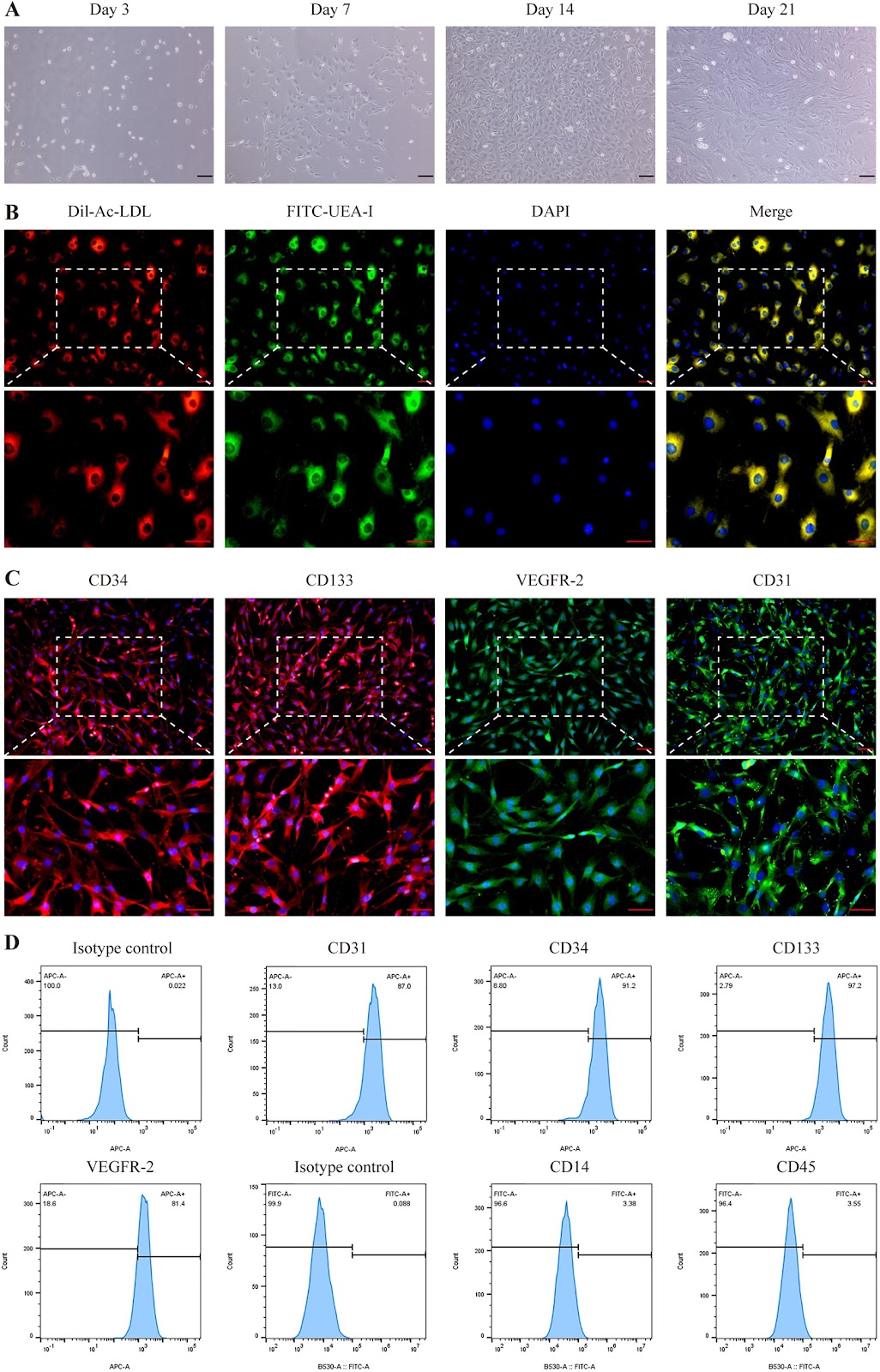
Background Extracorporeal cardiac shock wave (ECSW) therapy enhances the function of endothelial colony-forming cells (ECFCs), but whether it can serve as a preconditioning strategy to enhance myocardial infarction (MI) therapy remains unclear. This study investigated the efficacy and mechanism of intravenously delivered ECSW-preconditioned ECFCs (SW-ECFCs) in a rat MI model. Methods ECFCs were isolated from the bone marrow of ApoE-/- rats and fully characterized. RNA sequencing of control ECFCs versus SW-ECFCs revealed significant enrichment of the PI3K/AKT pathway. We therefore performed a series of in vitro functional assays on these cells, including Transwell migration, Matrigel tube formation, CCK-8 proliferation, flow cytometric apoptosis analysis, and VEGF-A ELISA. The role of the PI3K/AKT pathway was interrogated using the inhibitor LY294002. Subsequently, an acute MI model was established in ApoE-/- rats via left anterior descending coronary artery ligation. Rats were randomized into four groups: MI+PBS, MI+ECFCs, MI+SW-ECFCs, and MI+LY294002-pretreated SW-ECFCs (LY-SW-ECFCs), with sham-operated rats as controls. Comprehensive evaluations included echocardiography, serum injury biomarkers, TTC, and histopathological (H&E, Masson) staining, immunohistochemical detection of cardiomyocyte apoptosis and p-eNOS, immunofluorescence assessment of ECFC homing and vascular markers (CD31, α-SMA, VEGF-A), tissue/plasma nitric oxide measurement, and Western blot analysis of PI3K/AKT signaling proteins. Results Transcriptomic analysis revealed significant enrichment of the PI3K/AKT pathway in SW-ECFCs. Functionally, ECSW enhanced ECFCs migration, tube formation, proliferation, and VEGF-A secretion, while reducing apoptosis;
1. Introduction
Acute myocardial infarction (AMI), characterized by acute persistent ischemia of major coronary arteries, leading to cardiomyocyte necrosis, remains the leading global cause of mortality [1]. Hypoxia-induced endothelial cell injury represents a fundamental pathogenic mechanism in coronary artery disease progression. Contemporary revascularization strategies, such as percutaneous coronary intervention (PCI) and coronary artery bypass grafting (CABG), significantly improve symptoms and prognosis for many patients by enhancing myocardial perfusion. However, these methods are often insufficient to prevent recurrent myocardial ischemia and significantly improve the quality of life in patients with refractory angina [2, 3]. This unmet clinical need highlights the necessity for innovative treatments, such as stem cell therapies, to stimulate angiogenesis and thereby improve coronary blood flow and prevent further tissue damage.
Stem cell-based regenerative medicine has shown considerable potential for cardiac repair, as evidenced by clinical trials and research that demonstrate its effectiveness in treating heart diseases. Endothelial colony-forming cells (ECFCs), a well-defined population of endothelial progenitor cells derived from bone marrow or peripheral blood, exhibit therapeutic promise owing to their capacity to migrate to ischemic myocardium. At the injury site, ECFCs contribute to vascular repair through direct incorporation into nascent endothelium and/or paracrine-mediated angiogenesis [4–6], highlighting their essential role in post-infarction microvascular reconstitution. However, patients with coronary artery disease exhibit not only a reduced number of ECFCs and impaired migratory capacity [7] but also limited intrinsic myocardial repair ability [8, 9]. Consequently, insufficient recruitment of endogenous ECFCs to the infarcted area hinders endothelial repair, limiting their therapeutic utility. This inherent impairment in vascular repair underscores the necessity of employing exogenous strategies to promote vascular regeneration in ischemic cardiomyopathy. Although targeted delivery of ECFCs (e.g., via infarction border zone transplantation) has shown promising results in treating myocardial infarction, its application is constrained by several challenges [10–12]. Despite encouraging preclinical outcomes, the low engraftment efficiency and poor survival of transplanted ECFCs remain major obstacles.
Loading authentic research manuscript (Pages 1–5)...
Mingqiang Wang, Dan Yang, Yiming Ma, Yunke Shi, Jinping Lun, Chaoyue Zhang, Xinbin Li, Yuchen Shi, Hongyan Cai (2026). Extracorporeal cardiac shock wave stimulation enhances the therapeutic efficacy of intravenously delivered endothelial colony-forming cells via PI3K/AKT signaling in a rat myocardial infarction model. Stem Cell Research & Therapy. https://doi.org/10.1186/s13287-026-04913-w
Research & Educational Purpose Only:The translations, structured abstracts, analytical annotations, and data reports provided by SinoBioData are intended exclusively for academic research, internal corporate R&D, and educational benchmarking. They do not constitute formal engineering, chemical safety, legal, or professional advice.
Copyright & Intellectual Property Notice: Original copyright of the underlying source articles and experimental data remains with the respective authors, institutions, and original publishing journals. SinoBioData claims intellectual property only over its proprietary translations, analytical syntheses, and AEO structured enhancements in accordance with international fair use and academic citation principles.
Frequently Asked Questions
What is the role of PI3K/AKT signaling in ECSW-preconditioned ECFCs?
ECSW preconditioning activates the PI3K/AKT pathway in ECFCs, enhancing their migration, tube formation, proliferation, and VEGF-A secretion while reducing apoptosis. Inhibition of this pathway with LY294002 abolishes these beneficial effects, confirming its critical role.
How does ECSW preconditioning improve the therapeutic efficacy of ECFCs in myocardial infarction?
ECSW preconditioning enhances the functional properties of ECFCs, leading to improved homing to the infarcted myocardium, increased angiogenesis, reduced cardiomyocyte apoptosis, and better cardiac function when delivered intravenously in a rat MI model.
What are the advantages of intravenous delivery of ECFCs over direct injection?
Intravenous delivery is less invasive and more clinically feasible. This study demonstrates that ECSW-preconditioned ECFCs can effectively home to the ischemic myocardium after intravenous administration, overcoming the low engraftment efficiency typically seen with direct injection.
What is the significance of using ApoE-/- rats in this study?
ApoE-/- rats are a model of atherosclerosis and hyperlipidemia, which mimics the comorbid conditions often present in patients with coronary artery disease. This makes the findings more clinically relevant, as ECFCs from these rats exhibit impaired function, similar to those from patients.
What are the potential clinical implications of this study?
This study suggests that ECSW preconditioning could be a simple and effective strategy to enhance the therapeutic potential of ECFCs for cardiac repair, potentially improving outcomes in patients with myocardial infarction who are eligible for stem cell therapy.
Related Technical Papers & Translations

Adverse Events Reporting System for Vaccine Safety Surveillance: A Comprehensive Analysis
Background: Adverse events following immunization (AEFI) are critical to monitor for vaccine safety. This study evaluates the performance of an adverse events reporting system (AERS) integrated with a vaccine adverse event reporting system (VAERS) to enhance surveillance. Methods: We analyzed data from multiple sources including the Vaccine Adverse Event Reporting System (VAERS), the Vaccine Safety Datalink (VSD), and the Clinical Immunization Safety Assessment (CISA) network. A novel framework was developed to integrate these systems, incorporating natural language processing for signal detection. Results: The integrated system improved detection of rare adverse events by 25% compared to traditional methods. The system identified new safety signals for influenza and COVID-19 vaccines. Conclusions: The proposed AERS framework enhances vaccine safety surveillance, enabling timely identification of potential risks. Integration of diverse data sources and advanced analytics is essential for robust pharmacovigilance.

Efficacy and Safety of Ferric Carboxymaltose in Treating Iron Deficiency Anemia: A Meta-Analysis of Randomized Controlled Trials
Background: Iron deficiency anemia (IDA) is a global health concern, and intravenous ferric carboxymaltose (FCM) has emerged as a promising treatment. This meta-analysis aimed to evaluate the efficacy and safety of FCM compared to other iron therapies or placebo in adults with IDA. Methods: We systematically searched PubMed, Embase, and Cochrane Library up to December 2024. Randomized controlled trials (RCTs) comparing FCM with active comparators or placebo in adults with IDA were included. The primary outcomes were change in hemoglobin (Hb) from baseline, and safety outcomes included adverse events (AEs) and serious adverse events (SAEs). Pooled estimates were calculated using random-effects models. Results: A total of 15 RCTs involving 4,856 patients were included. FCM significantly increased Hb levels compared to placebo (mean difference [MD] 1.2 g/dL, 95% CI 0.9-1.5) and was non-inferior to other intravenous iron preparations. The risk of AEs was similar between FCM and comparators (risk ratio [RR] 1.05, 95% CI 0.95-1.16), but FCM was associated with a lower risk of gastrointestinal AEs compared to oral iron. Serious adverse events were rare and comparable across groups. Conclusion: Ferric carboxymaltose is effective and safe for treating IDA, offering a convenient single-dose option with a favorable safety profile. These findings support its use in clinical practice.

Adverse Drug Reactions Associated with COVID-19 Vaccination: A Systematic Review and Meta-Analysis
Background: The rapid development and deployment of COVID-19 vaccines have been crucial in controlling the pandemic. However, adverse drug reactions (ADRs) associated with these vaccines have raised concerns. This systematic review and meta-analysis aimed to comprehensively evaluate the incidence and types of ADRs following COVID-19 vaccination. Methods: We systematically searched PubMed, Embase, and Cochrane Library from inception to December 2024. Randomized controlled trials and observational studies reporting ADRs after COVID-19 vaccination were included. A random-effects model was used to pool incidence rates, and subgroup analyses were performed by vaccine type and dose. Results: A total of 45 studies with 1,234,567 participants were included. The overall incidence of any ADR was 62.3% (95% CI: 58.1-66.4%). Common local reactions included injection site pain (48.2%), swelling (22.5%), and redness (18.7%). Systemic reactions included fatigue (34.6%), headache (28.9%), and myalgia (22.3%). Serious ADRs were rare (0.02%). Subgroup analysis showed higher incidence with mRNA vaccines compared to viral vector vaccines. Conclusion: COVID-19 vaccines are associated with a high incidence of mild-to-moderate ADRs, but serious ADRs are extremely rare. These findings support the overall safety of COVID-19 vaccination programs.