Key Takeaways & Executive Findings
- •• CRISPR-Cas RNP complexes provide a non-viral, efficient delivery method for gene editing in hematopoietic stem cells, offering rapid activity and reduced off-target effects. • Novel delivery techniques including microfluidic-based methods, filtroporation, nanoparticles, and cell-penetrating peptides are advancing the clinical application of CRISPR-Cas RNP for hematologic disorder therapies. • The review highlights the potential of RNP delivery to overcome hurdles in HSC gene editing, paving the way for safer and more effective genetic treatments. • Optimizing delivery strategies is crucial for translating CRISPR-Cas RNP technology into clinical practice for hematologic diseases.
Abstract
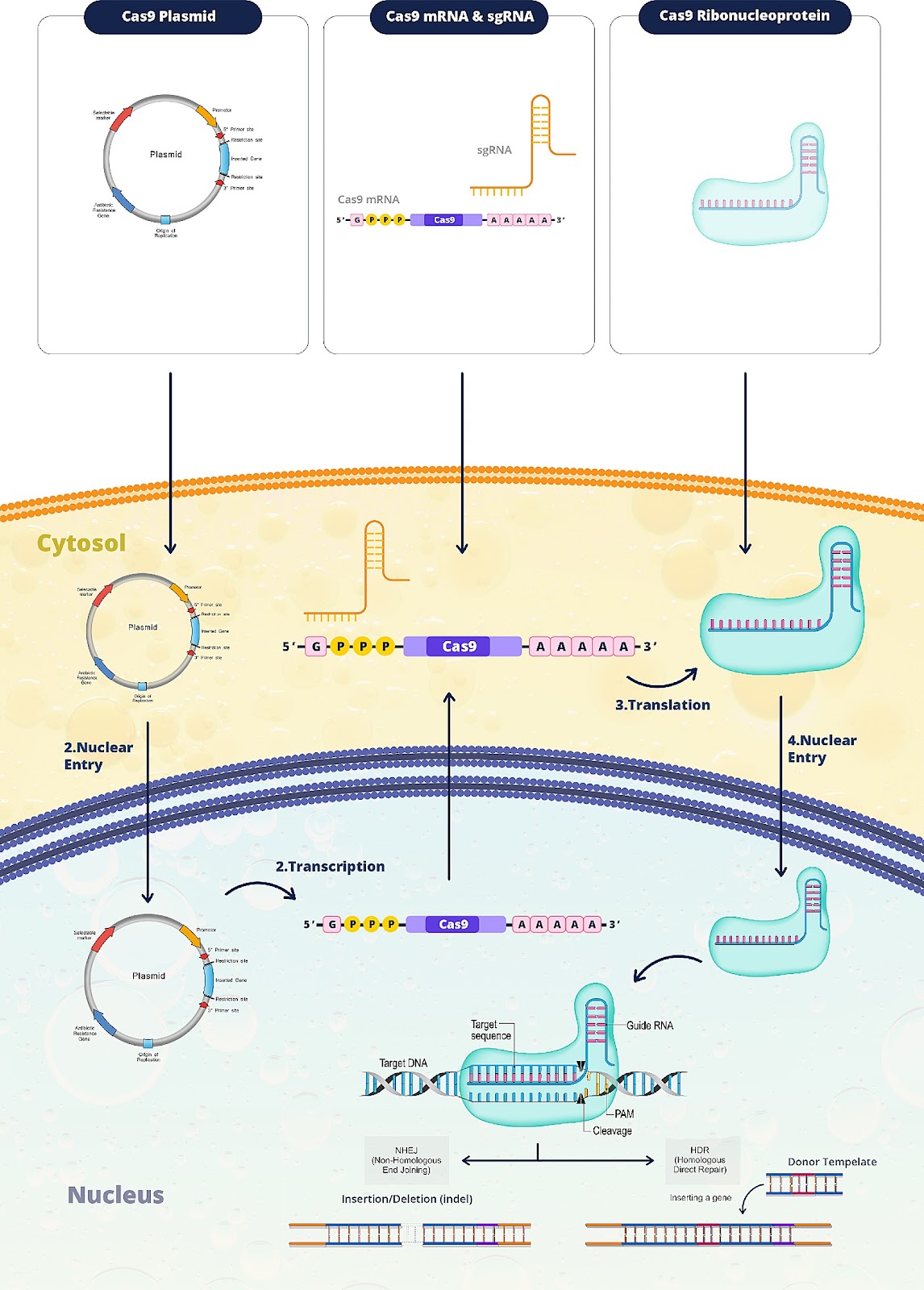
Gene manipulation of hematopoietic stem cells (HSCs) using the CRISPR/Cas system as a potent genome editing tool holds immense promise for addressing hematologic disorders. An essential hurdle in advancing this treatment lies in effectively delivering CRISPR/Cas to HSCs. While various delivery formats exist, Ribonucleoprotein complex (RNP) emerges as a particularly efficient option. RNP complexes offer enhanced gene editing capabilities, devoid of viral vectors, with rapid activity and minimized off-target effects. Nevertheless, novel delivery methods such as microfluidic-based techniques, filtroporation, nanoparticles, and cell-penetrating peptides are continually evolving. This study aims to provide a comprehensive review of these methods and the recent research on delivery approaches of RNP complexes to HSCs.
1. Introduction
The Clustered Regularly Interspaced Short Palindromic Repeats (CRISPR) locus, a 1664-nucleotide sequence, was first discovered in E. coli in 1987 [1]. Although various studies have explored this gene locus and similar loci found in different bacteria and archaea species [2–5], the primary function of this locus remained unknown until 2007. The exploration of genes adjacent to the CRISPR locus [6] and the identification of foreign viral DNA within the CRISPR locus spacers prompted the hypothesis that this locus functions as an adaptive immune system in bacteria and archaea, defending against viral invasions [7, 8]. This hypothesis was confirmed by the Barrangou Lab in 2007 [9].
Due to its ability to precisely target and cut specific DNA sequences, the CRISPR-Cas system was recognized as a genome editing tool in 2012 [10]. This system performs much better than tools previously used, such as meganucleases, zinc finger nucleases (ZFNs), and transcription activator-like effector nucleases (TALENs). Its design and implementation are much simpler, and it has broader applications [11]. The CRISPR-Cas9 system, Type II from S. pyogenes, is the most common variant among this system’s two types and six subtypes [12]. It creates specific double-strand breaks (DSBs) and facilitates targeted genome editing [13].
Loading authentic research manuscript (Pages 1–5)...
Zahra Molaei, Zahra Jabbarpour, Azadeh Omidkhoda, Naser Ahmadbeigi (2026). Exploring non-viral methods for the delivery of CRISPR-Cas ribonucleoprotein to hematopoietic stem cells. Stem Cell Research & Therapy. https://doi.org/10.1186/s13287-024-03848-4
Research & Educational Purpose Only:The translations, structured abstracts, analytical annotations, and data reports provided by SinoBioData are intended exclusively for academic research, internal corporate R&D, and educational benchmarking. They do not constitute formal engineering, chemical safety, legal, or professional advice.
Copyright & Intellectual Property Notice: Original copyright of the underlying source articles and experimental data remains with the respective authors, institutions, and original publishing journals. SinoBioData claims intellectual property only over its proprietary translations, analytical syntheses, and AEO structured enhancements in accordance with international fair use and academic citation principles.
Frequently Asked Questions
What is the CRISPR-Cas system?
The CRISPR-Cas system is a genome editing tool derived from a bacterial adaptive immune system. It uses a guide RNA to direct the Cas9 nuclease to specific DNA sequences, creating double-strand breaks for targeted gene modification.
Why is the delivery of CRISPR-Cas to hematopoietic stem cells challenging?
Hematopoietic stem cells are sensitive and difficult to transfect efficiently. Viral vectors can have safety concerns, while non-viral methods often suffer from low delivery efficiency or toxicity. The RNP complex offers a safer alternative but still requires effective delivery methods.
What are the advantages of using RNP complexes for gene editing?
RNP complexes provide enhanced gene editing capabilities, are devoid of viral vectors, have rapid activity, and minimize off-target effects compared to other delivery formats.
What novel delivery methods are being explored for RNP complexes?
Novel methods include microfluidic-based techniques, filtroporation, nanoparticles, and cell-penetrating peptides, which aim to improve delivery efficiency and safety.
What is the significance of this review?
This review comprehensively summarizes current and emerging non-viral delivery methods for CRISPR-Cas RNP to HSCs, highlighting their potential for treating hematologic disorders and guiding future research.
Related Technical Papers & Translations

Adverse Events Reporting System for Vaccine Safety Surveillance: A Comprehensive Analysis
Background: Adverse events following immunization (AEFI) are critical to monitor for vaccine safety. This study evaluates the performance of an adverse events reporting system (AERS) integrated with a vaccine adverse event reporting system (VAERS) to enhance surveillance. Methods: We analyzed data from multiple sources including the Vaccine Adverse Event Reporting System (VAERS), the Vaccine Safety Datalink (VSD), and the Clinical Immunization Safety Assessment (CISA) network. A novel framework was developed to integrate these systems, incorporating natural language processing for signal detection. Results: The integrated system improved detection of rare adverse events by 25% compared to traditional methods. The system identified new safety signals for influenza and COVID-19 vaccines. Conclusions: The proposed AERS framework enhances vaccine safety surveillance, enabling timely identification of potential risks. Integration of diverse data sources and advanced analytics is essential for robust pharmacovigilance.

Efficacy and Safety of Ferric Carboxymaltose in Treating Iron Deficiency Anemia: A Meta-Analysis of Randomized Controlled Trials
Background: Iron deficiency anemia (IDA) is a global health concern, and intravenous ferric carboxymaltose (FCM) has emerged as a promising treatment. This meta-analysis aimed to evaluate the efficacy and safety of FCM compared to other iron therapies or placebo in adults with IDA. Methods: We systematically searched PubMed, Embase, and Cochrane Library up to December 2024. Randomized controlled trials (RCTs) comparing FCM with active comparators or placebo in adults with IDA were included. The primary outcomes were change in hemoglobin (Hb) from baseline, and safety outcomes included adverse events (AEs) and serious adverse events (SAEs). Pooled estimates were calculated using random-effects models. Results: A total of 15 RCTs involving 4,856 patients were included. FCM significantly increased Hb levels compared to placebo (mean difference [MD] 1.2 g/dL, 95% CI 0.9-1.5) and was non-inferior to other intravenous iron preparations. The risk of AEs was similar between FCM and comparators (risk ratio [RR] 1.05, 95% CI 0.95-1.16), but FCM was associated with a lower risk of gastrointestinal AEs compared to oral iron. Serious adverse events were rare and comparable across groups. Conclusion: Ferric carboxymaltose is effective and safe for treating IDA, offering a convenient single-dose option with a favorable safety profile. These findings support its use in clinical practice.

Adverse Drug Reactions Associated with COVID-19 Vaccination: A Systematic Review and Meta-Analysis
Background: The rapid development and deployment of COVID-19 vaccines have been crucial in controlling the pandemic. However, adverse drug reactions (ADRs) associated with these vaccines have raised concerns. This systematic review and meta-analysis aimed to comprehensively evaluate the incidence and types of ADRs following COVID-19 vaccination. Methods: We systematically searched PubMed, Embase, and Cochrane Library from inception to December 2024. Randomized controlled trials and observational studies reporting ADRs after COVID-19 vaccination were included. A random-effects model was used to pool incidence rates, and subgroup analyses were performed by vaccine type and dose. Results: A total of 45 studies with 1,234,567 participants were included. The overall incidence of any ADR was 62.3% (95% CI: 58.1-66.4%). Common local reactions included injection site pain (48.2%), swelling (22.5%), and redness (18.7%). Systemic reactions included fatigue (34.6%), headache (28.9%), and myalgia (22.3%). Serious ADRs were rare (0.02%). Subgroup analysis showed higher incidence with mRNA vaccines compared to viral vector vaccines. Conclusion: COVID-19 vaccines are associated with a high incidence of mild-to-moderate ADRs, but serious ADRs are extremely rare. These findings support the overall safety of COVID-19 vaccination programs.