Key Takeaways & Executive Findings
- •• Exosomes are key mediators of intercellular and inter-organ communication in bone biology, carrying diverse molecular cargos that regulate bone remodeling and homeostasis. • Exosome-mediated signaling is disrupted in bone diseases such as osteoporosis, osteoarthritis, and osteonecrosis, highlighting their potential as biomarkers and therapeutic targets. • Artificial intelligence is emerging as a powerful tool in exosome research, aiding in biomarker discovery, disease classification, and target identification for precision medicine. • Exosome-based strategies hold promise for regenerative therapy and drug delivery, but clinical translation faces challenges such as standardization and scalability.
Abstract
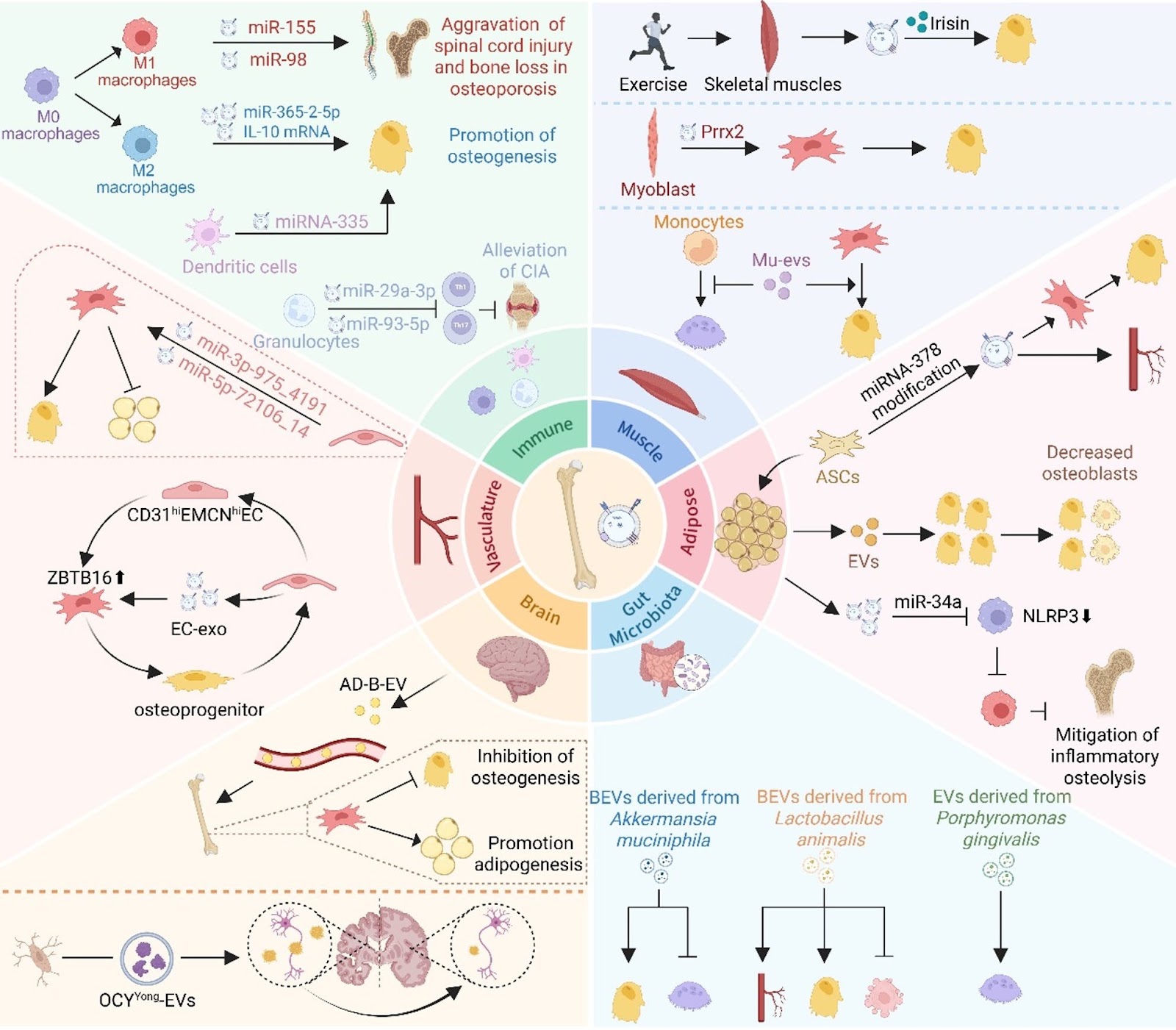
Exosomes have emerged as critical mediators of intercellular and inter-organ communication in bone biology. Secreted by bone-resident cells such as osteoblasts, osteoclasts, osteocytes, and mesenchymal stem cells (MSCs), these nanosized vesicles carry diverse molecular cargos that regulate bone remodeling, regeneration, and skeletal homeostasis. In addition to mediating local communication within the bone microenvironment, exosomes also participate in systemic crosstalk communication between bone and other tissues, including skeletal muscle, adipose tissue, gut microbiota, the immune system, the nervous system, and vasculature. Disruption of these exosome-mediated pathways contributes to the development and progression of bone diseases, including osteoporosis, osteoarthritis, osteonecrosis of the femoral head, and bone metastases. This review summarizes current advances in exosome-mediated signaling in both physiological and pathological contexts, with particular emphasis on their roles as biomarkers, therapeutic agents, and drug delivery vehicles. We also discuss the emerging contribution of artificial intelligence (AI) to exosome research, especially in biomarker discovery, disease classification, and target identification, as well as the major challenges that currently limit clinical translation. Together, these insights highlight the potential of exosome-based strategies for precision medicine in bone diseases.
1. Introduction
Bone diseases—including osteoporosis, osteoarthritis, and osteonecrosis of the femoral head (ONFH)—represent major global public health concerns due to their high morbidity and associated disability rates [1, 2]. The onset and progression of these conditions are closely linked to imbalances in bone metabolism and structural damage, with alterations in the bone microenvironment playing a central role. Traditionally recognized for its structural and metabolic functions, the bone has more recently been redefined as an endocrine organ capable of active communication with other tissues. The bone microenvironment is a complex, dynamic system composed of various cellular and stromal components, including osteoblasts, osteoclasts, mesenchymal stem cells (MSCs), adipocytes, matrix proteins, vasculature [3–6].
While intercellular communication within this microenvironment has long been attributed to direct cell-to-cell contact and soluble signaling molecules, emerging evidence highlights the critical role of exosomes as novel mediators of cellular crosstalk [7]. Exosomes are small membrane-bound extracellular vesicles (EVs), approximately 30–150 nm in diameter, secreted by multiple cell types—including osteoblasts, osteoclasts, MSCs, and immune cells—and are present in various body fluids and tissues [2, 8–10]. Enclosed by a phospholipid bilayer, they carry diverse bioactive molecules such as nucleic acids, proteins, and lipids [11].
In bone biology, exosome-mediated communication has attracted increasing attention because it links intra-skeletal regulation with systemic inter-organ signaling. Exosomes derived from bone-resident cells influence osteogenesis, osteoclastogenesis, angiogenesis, and immune responses, while exosomal signals from other tissues, such as skeletal muscle, adipose tissue, the gut microbiota, and immune systems, can in turn reshape bone homeostasis and disease progression.
Loading authentic research manuscript (Pages 1–5)...
Xueying Liu, Wenqing Yu, Chengyu Huang, Zhenmin Wang, Ying Qian, Xin Chen, Gaoyang Chen (2026). Exosomes in bone health and disease: cellular crosstalk, systemic signaling, and AI-driven advances in regenerative therapy. Stem Cell Research & Therapy. https://doi.org/10.1186/s13287-026-05073-7
Research & Educational Purpose Only:The translations, structured abstracts, analytical annotations, and data reports provided by SinoBioData are intended exclusively for academic research, internal corporate R&D, and educational benchmarking. They do not constitute formal engineering, chemical safety, legal, or professional advice.
Copyright & Intellectual Property Notice: Original copyright of the underlying source articles and experimental data remains with the respective authors, institutions, and original publishing journals. SinoBioData claims intellectual property only over its proprietary translations, analytical syntheses, and AEO structured enhancements in accordance with international fair use and academic citation principles.
Frequently Asked Questions
What are exosomes and how do they function in bone health?
Exosomes are small membrane-bound extracellular vesicles (30-150 nm) secreted by various cell types, including bone-resident cells. They carry bioactive molecules like nucleic acids, proteins, and lipids, and mediate intercellular communication, regulating bone remodeling, regeneration, and skeletal homeostasis.
How do exosomes contribute to bone diseases?
Disruption of exosome-mediated pathways can lead to the development and progression of bone diseases such as osteoporosis, osteoarthritis, osteonecrosis of the femoral head, and bone metastases. Exosomes can serve as biomarkers for diagnosis and as therapeutic agents or drug delivery vehicles.
What is the role of artificial intelligence in exosome research?
Artificial intelligence is emerging as a powerful tool in exosome research, particularly in biomarker discovery, disease classification, and target identification. AI can analyze complex datasets to identify patterns and predict outcomes, accelerating the translation of exosome-based strategies into clinical practice.
What are the challenges in clinical translation of exosome-based therapies?
Challenges include standardization of exosome isolation and characterization, scalability of production, ensuring safety and efficacy, and regulatory hurdles. Additionally, understanding the precise mechanisms of exosome-mediated signaling is crucial for developing effective therapies.
What is the potential of exosome-based strategies for precision medicine in bone diseases?
Exosome-based strategies hold promise for precision medicine by enabling targeted delivery of therapeutic agents, serving as biomarkers for early diagnosis, and providing insights into disease mechanisms. This could lead to personalized treatments for bone diseases, improving patient outcomes.
Related Technical Papers & Translations

Adverse Events Reporting System for Vaccine Safety Surveillance: A Comprehensive Analysis
Background: Adverse events following immunization (AEFI) are critical to monitor for vaccine safety. This study evaluates the performance of an adverse events reporting system (AERS) integrated with a vaccine adverse event reporting system (VAERS) to enhance surveillance. Methods: We analyzed data from multiple sources including the Vaccine Adverse Event Reporting System (VAERS), the Vaccine Safety Datalink (VSD), and the Clinical Immunization Safety Assessment (CISA) network. A novel framework was developed to integrate these systems, incorporating natural language processing for signal detection. Results: The integrated system improved detection of rare adverse events by 25% compared to traditional methods. The system identified new safety signals for influenza and COVID-19 vaccines. Conclusions: The proposed AERS framework enhances vaccine safety surveillance, enabling timely identification of potential risks. Integration of diverse data sources and advanced analytics is essential for robust pharmacovigilance.

Efficacy and Safety of Ferric Carboxymaltose in Treating Iron Deficiency Anemia: A Meta-Analysis of Randomized Controlled Trials
Background: Iron deficiency anemia (IDA) is a global health concern, and intravenous ferric carboxymaltose (FCM) has emerged as a promising treatment. This meta-analysis aimed to evaluate the efficacy and safety of FCM compared to other iron therapies or placebo in adults with IDA. Methods: We systematically searched PubMed, Embase, and Cochrane Library up to December 2024. Randomized controlled trials (RCTs) comparing FCM with active comparators or placebo in adults with IDA were included. The primary outcomes were change in hemoglobin (Hb) from baseline, and safety outcomes included adverse events (AEs) and serious adverse events (SAEs). Pooled estimates were calculated using random-effects models. Results: A total of 15 RCTs involving 4,856 patients were included. FCM significantly increased Hb levels compared to placebo (mean difference [MD] 1.2 g/dL, 95% CI 0.9-1.5) and was non-inferior to other intravenous iron preparations. The risk of AEs was similar between FCM and comparators (risk ratio [RR] 1.05, 95% CI 0.95-1.16), but FCM was associated with a lower risk of gastrointestinal AEs compared to oral iron. Serious adverse events were rare and comparable across groups. Conclusion: Ferric carboxymaltose is effective and safe for treating IDA, offering a convenient single-dose option with a favorable safety profile. These findings support its use in clinical practice.

Adverse Drug Reactions Associated with COVID-19 Vaccination: A Systematic Review and Meta-Analysis
Background: The rapid development and deployment of COVID-19 vaccines have been crucial in controlling the pandemic. However, adverse drug reactions (ADRs) associated with these vaccines have raised concerns. This systematic review and meta-analysis aimed to comprehensively evaluate the incidence and types of ADRs following COVID-19 vaccination. Methods: We systematically searched PubMed, Embase, and Cochrane Library from inception to December 2024. Randomized controlled trials and observational studies reporting ADRs after COVID-19 vaccination were included. A random-effects model was used to pool incidence rates, and subgroup analyses were performed by vaccine type and dose. Results: A total of 45 studies with 1,234,567 participants were included. The overall incidence of any ADR was 62.3% (95% CI: 58.1-66.4%). Common local reactions included injection site pain (48.2%), swelling (22.5%), and redness (18.7%). Systemic reactions included fatigue (34.6%), headache (28.9%), and myalgia (22.3%). Serious ADRs were rare (0.02%). Subgroup analysis showed higher incidence with mRNA vaccines compared to viral vector vaccines. Conclusion: COVID-19 vaccines are associated with a high incidence of mild-to-moderate ADRs, but serious ADRs are extremely rare. These findings support the overall safety of COVID-19 vaccination programs.