Key Takeaways & Executive Findings
- •• Hypoxic preconditioning enhances the angiogenic potential of hucMSC-derived exosomes, promoting endothelial cell proliferation, migration, and tube formation in vitro. • In a rat model of premature ovarian failure (POF), hypoxia-pretreated exosomes significantly restore ovarian function by enhancing angiogenesis in vivo. • The therapeutic effect is mediated by exosomal miR-205-5p, which targets the PTEN/PI3K/AKT/mTOR signaling pathway to stimulate angiogenesis. • This study provides a novel cell-free therapeutic approach using stem cell-derived exosomes for the treatment of POF, offering a theoretical basis for clinical translation.
Abstract
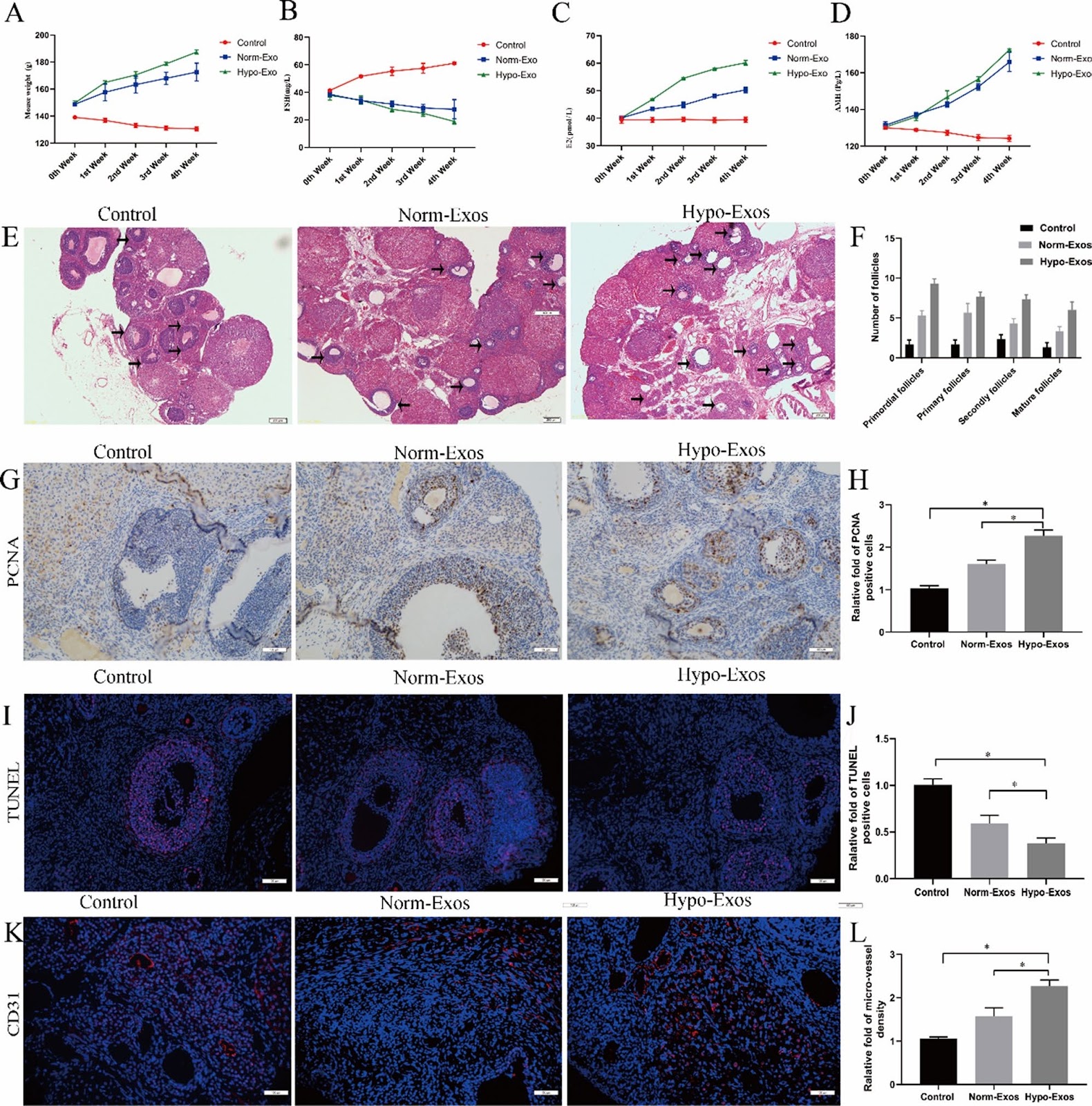
Background hucMSC-exosomes can be engineered to strengthen their therapeutic potential, and the present study aimed to explore whether hypoxic preconditioning can enhance the angiogenic potential of hucMSC-exosomes in an experimental model of POF. Methods Primary hucMSCs and ROMECs were isolated from fresh tissue samples and assessed through a series of experiments. Exosomes were isolated from hucMSCs under normoxic or hypoxic conditions (norm-Exos and hypo-Exos, respectively) and then characterized using classic experimental methods. Based on a series of angiogenesis-related assays, we found that hypo-Exos significantly promoted ROMEC proliferation, migration, and tube formation and increased angiogenesis-promoting molecules in vitro. Histology, immunohistochemistry, and immunofluorescence experiments in a rat model of POF demonstrated that hypoxia pretreatment strengthens the therapeutic angiogenic effect of hucMSC-exosomes in vivo. Subsequently, high-throughput miRNA sequencing, qRT-PCR analysis, and western blotting were employed to identify the potential molecular mechanism. Results We found that hypo-Exos enhance endothelial function and angiogenesis via the transfer of miR-205-5p in vitro and in vivo. Finally, based on the results of bioinformatics analysis, dual luciferase reporter assays, and gain- and loss-of-function studies, we found evidence indicating that exosomal miR-205-5p enhances angiogenesis by targeting the PTEN/PI3K/AKT/mTOR signalling pathway. These results indicated for the first time that exosomes derived from hypoxia-conditioned hucMSCs strongly enhance angiogenesis via the transfer of miR-205-5p by targeting the PTEN/PI3K/AKT/mTOR signalling pathway. Conclusions Our findings provide a theoretical basis and demonstrate the potential application of a novel cell-free approach with stem cell-derived products in the treatment of POF.
1. Introduction
Premature ovarian failure (POF) is a common endocrine disease clinically defined as loss of ovarian function in women less than 40 years of age. POF is characterized by abnormal menstruation, abnormally increased follicle stimulating hormone (FSH), decreased anti-Müllerian hormone (AMH), oestradiol (E2) fluctuations, and long-term amenorrhea, which lead to an increased risk of a variety of diseases, such as female infertility, cardiovascular diseases, sexual dysfunction, diabetes mellitus type 2, and even early mortality [1]. POF is caused by factors, such as genetics, immunity, psychological factors, and chemotherapy injury, and the incidence of POF has increased in recent years. It was reported that chemotherapy agents are the most common causes of POF, and approximately 5% of cancer survivors who receive chemotherapy are young women [2]. Given the limitations of conventional hormone replacement therapy, it is necessary and urgent to develop effective therapeutic strategies, such as stem cell-derived therapies, to restore ovarian function in young women who suffer damage to chemotherapy [3].
Mesenchymal stem cells (MSCs) have been identified as a new frontier of therapeutic strategies to treat various disorders and damage, including POF [4]. MSCs are considered a promising source for cell therapies in regeneration medicine owing to their paracrine functions and directional differentiation [5]. A growing body of preclinical studies have noted that MSCs derived from human umbilical cord (hucMSC) and other adult tissues (adipose, skin, amniotic membrane, menstrual blood, placenta, and bone marrow) improve ovarian function and structure in POF models [4]. However, despite their exploration in preclinical studies, problems such as immunological rejection, cellular transplantation-related risks, and limited cell survival remain significant hurdles. Therefore, cell-free approaches using MSC-derived exosomes have emerged as a safer and more practical alternative, and this study investigates the potential of hypoxic preconditioning to enhance the therapeutic efficacy of hucMSC-exosomes in POF.
Loading authentic research manuscript (Pages 1–5)...
Qingxi Qu, Linghong Liu, Limei Wang, Yuqian Cui, Chunxiao Liu, Xuanxuan Jing, Xiaoxuan Xu (2026). Exosomes derived from hypoxic mesenchymal stem cells restore ovarian function by enhancing angiogenesis. Stem Cell Research & Therapy. https://doi.org/10.1186/s13287-024-04111-6
Research & Educational Purpose Only:The translations, structured abstracts, analytical annotations, and data reports provided by SinoBioData are intended exclusively for academic research, internal corporate R&D, and educational benchmarking. They do not constitute formal engineering, chemical safety, legal, or professional advice.
Copyright & Intellectual Property Notice: Original copyright of the underlying source articles and experimental data remains with the respective authors, institutions, and original publishing journals. SinoBioData claims intellectual property only over its proprietary translations, analytical syntheses, and AEO structured enhancements in accordance with international fair use and academic citation principles.
Frequently Asked Questions
What is premature ovarian failure (POF)?
Premature ovarian failure (POF) is a condition where ovarian function is lost in women under 40 years of age, characterized by abnormal menstruation, elevated FSH, decreased AMH, and long-term amenorrhea, leading to infertility and other health risks.
How do hypoxic preconditioned exosomes enhance angiogenesis?
Hypoxic preconditioning of hucMSCs enhances the angiogenic potential of their exosomes by enriching them with miR-205-5p, which targets the PTEN/PI3K/AKT/mTOR signaling pathway, promoting endothelial cell proliferation, migration, and tube formation.
What is the significance of using exosomes over whole-cell therapy?
Exosome-based therapy offers a cell-free approach that reduces risks of immunological rejection and tumorigenicity, provides easier storage and handling, and can be engineered for enhanced therapeutic efficacy, making it a promising alternative to whole-cell transplantation.
What are the key findings of this study?
The study demonstrates that exosomes derived from hypoxia-conditioned hucMSCs significantly improve ovarian function in a rat model of POF by enhancing angiogenesis via miR-205-5p targeting the PTEN/PI3K/AKT/mTOR pathway, providing a novel cell-free therapeutic strategy.
What is the potential clinical application of this research?
This research provides a theoretical basis for developing a novel cell-free therapy using hypoxia-preconditioned hucMSC-derived exosomes to treat POF, potentially offering a safer and more effective alternative to conventional hormone replacement therapy.
Related Technical Papers & Translations

Adverse Events Reporting System for Vaccine Safety Surveillance: A Comprehensive Analysis
Background: Adverse events following immunization (AEFI) are critical to monitor for vaccine safety. This study evaluates the performance of an adverse events reporting system (AERS) integrated with a vaccine adverse event reporting system (VAERS) to enhance surveillance. Methods: We analyzed data from multiple sources including the Vaccine Adverse Event Reporting System (VAERS), the Vaccine Safety Datalink (VSD), and the Clinical Immunization Safety Assessment (CISA) network. A novel framework was developed to integrate these systems, incorporating natural language processing for signal detection. Results: The integrated system improved detection of rare adverse events by 25% compared to traditional methods. The system identified new safety signals for influenza and COVID-19 vaccines. Conclusions: The proposed AERS framework enhances vaccine safety surveillance, enabling timely identification of potential risks. Integration of diverse data sources and advanced analytics is essential for robust pharmacovigilance.

Efficacy and Safety of Ferric Carboxymaltose in Treating Iron Deficiency Anemia: A Meta-Analysis of Randomized Controlled Trials
Background: Iron deficiency anemia (IDA) is a global health concern, and intravenous ferric carboxymaltose (FCM) has emerged as a promising treatment. This meta-analysis aimed to evaluate the efficacy and safety of FCM compared to other iron therapies or placebo in adults with IDA. Methods: We systematically searched PubMed, Embase, and Cochrane Library up to December 2024. Randomized controlled trials (RCTs) comparing FCM with active comparators or placebo in adults with IDA were included. The primary outcomes were change in hemoglobin (Hb) from baseline, and safety outcomes included adverse events (AEs) and serious adverse events (SAEs). Pooled estimates were calculated using random-effects models. Results: A total of 15 RCTs involving 4,856 patients were included. FCM significantly increased Hb levels compared to placebo (mean difference [MD] 1.2 g/dL, 95% CI 0.9-1.5) and was non-inferior to other intravenous iron preparations. The risk of AEs was similar between FCM and comparators (risk ratio [RR] 1.05, 95% CI 0.95-1.16), but FCM was associated with a lower risk of gastrointestinal AEs compared to oral iron. Serious adverse events were rare and comparable across groups. Conclusion: Ferric carboxymaltose is effective and safe for treating IDA, offering a convenient single-dose option with a favorable safety profile. These findings support its use in clinical practice.

Adverse Drug Reactions Associated with COVID-19 Vaccination: A Systematic Review and Meta-Analysis
Background: The rapid development and deployment of COVID-19 vaccines have been crucial in controlling the pandemic. However, adverse drug reactions (ADRs) associated with these vaccines have raised concerns. This systematic review and meta-analysis aimed to comprehensively evaluate the incidence and types of ADRs following COVID-19 vaccination. Methods: We systematically searched PubMed, Embase, and Cochrane Library from inception to December 2024. Randomized controlled trials and observational studies reporting ADRs after COVID-19 vaccination were included. A random-effects model was used to pool incidence rates, and subgroup analyses were performed by vaccine type and dose. Results: A total of 45 studies with 1,234,567 participants were included. The overall incidence of any ADR was 62.3% (95% CI: 58.1-66.4%). Common local reactions included injection site pain (48.2%), swelling (22.5%), and redness (18.7%). Systemic reactions included fatigue (34.6%), headache (28.9%), and myalgia (22.3%). Serious ADRs were rare (0.02%). Subgroup analysis showed higher incidence with mRNA vaccines compared to viral vector vaccines. Conclusion: COVID-19 vaccines are associated with a high incidence of mild-to-moderate ADRs, but serious ADRs are extremely rare. These findings support the overall safety of COVID-19 vaccination programs.