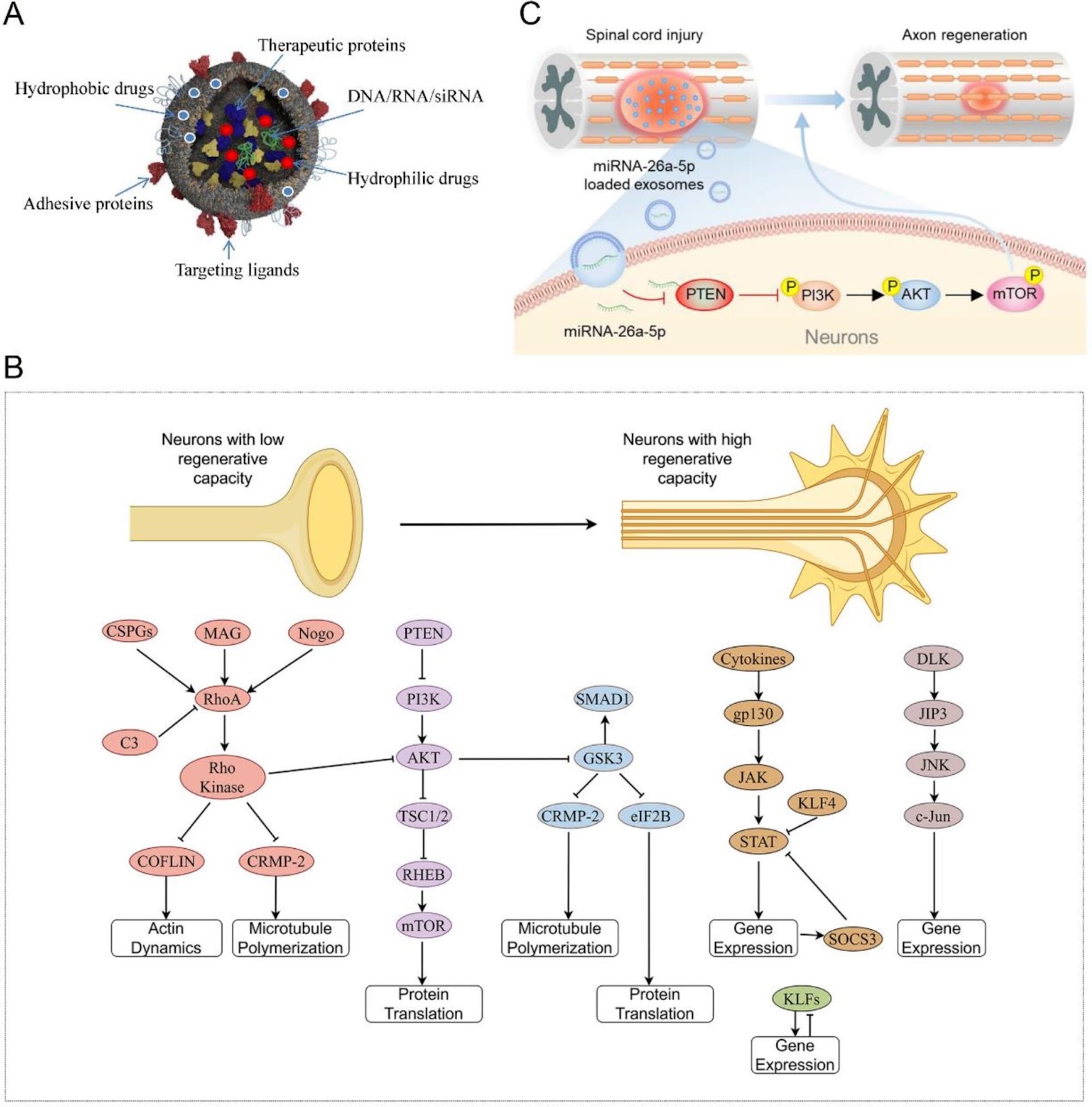
Key Takeaways & Executive Findings
- •• Exosomes derived from various cell types exhibit potent neuroprotective effects in preclinical SCI models, promoting functional recovery. • The mechanisms of exosome action include neurogenesis, angiogenesis, preservation of the blood-spinal cord barrier, anti-apoptosis, and anti-inflammatory modulation. • Exosome cargo, including miRNAs and proteins, modulates key signaling pathways involved in secondary injury cascade. • Despite challenges, exosome-based therapies hold promise for translational application in SCI, offering targeted delivery and reduced side effects.
Abstract
Patients with spinal cord injury (SCI) have permanent devastating motor and sensory disabilities. Secondary SCI is known for its complex progression and presents with sophisticated aberrant inflammation, vascular changes, and secondary cellular dysfunction, which aggravate the primary damage. Since their initial discovery, the potent neuroprotective effects and powerful delivery abilities of exosomes (Exos) have been reported in different research fields, including SCI. In this study, we summarize therapeutic advances related to the application of Exos in preclinical animal studies. Subsequently, we discuss the mechanisms of action of Exos derived from diverse cell types, including neurogenesis, angiogenesis, blood–spinal cord barrier preservation, anti-apoptosis, and anti-inflammatory potential. We also evaluate the relationship between the Exo delivery cargo and signaling pathways. Finally, we discuss the challenges and advantages of using Exos to offer innovative insights regarding the development of efficient clinical strategies for SCI.
1. Introduction
Spinal cord injury (SCI) is one of the most serious neurological disorders, with a global incidence of 1.2–5.8 and 0.2–13.0 cases per 100 000 population in developed and developing countries, respectively [1–6]. Approximately 90% of SCIs are caused by traumatic events, such as traffic accidents, falls, or acts of violence [6]. SCI results in enduring impairments, including paralysis, sensory loss, and long-term complications, including muscle atrophy, joint deformities, infections, atelectasis, pneumonia, venous thromboembolism, dysphagia, chronic pain, pressure ulcer, and psychological distress such as depression [7, 8], thereby accounting for a substantial proportion of the worldwide injury burden of lost productivity and high healthcare costs [5].
Currently, no effective treatment is available to mitigate long-term functional impairments attributed to SCI. Available therapies, such as anti-inflammatory medications, have limited efficacy since they are rapidly eliminated by cerebrospinal fluid, and their bioactivity is diminished [9, 10]. This is partly due to a limited understanding of the intricate pathophysiological processes that occur after SCI and a lack of safe and efficient instruments to regulate the already known therapeutic targets [11].
Loading authentic research manuscript (Pages 1–5)...
Yueying Li, Wenqi Luo, Chuikai Meng, Kaiyuan Shi, Rui Gu, Shusen Cui (2026). Exosomes as promising bioactive materials in the treatment of spinal cord injury. Stem Cell Research & Therapy. https://doi.org/10.1186/s13287-024-03952-5
Research & Educational Purpose Only:The translations, structured abstracts, analytical annotations, and data reports provided by SinoBioData are intended exclusively for academic research, internal corporate R&D, and educational benchmarking. They do not constitute formal engineering, chemical safety, legal, or professional advice.
Copyright & Intellectual Property Notice: Original copyright of the underlying source articles and experimental data remains with the respective authors, institutions, and original publishing journals. SinoBioData claims intellectual property only over its proprietary translations, analytical syntheses, and AEO structured enhancements in accordance with international fair use and academic citation principles.
Frequently Asked Questions
What are exosomes and how are they relevant to spinal cord injury treatment?
Exosomes are small extracellular vesicles that mediate intercellular communication by transferring bioactive molecules. In SCI, they have shown neuroprotective effects, promoting functional recovery by modulating inflammation, apoptosis, and promoting regeneration.
What are the main mechanisms by which exosomes exert therapeutic effects in SCI?
Exosomes derived from various cell types exert effects through promoting neurogenesis, angiogenesis, preserving the blood-spinal cord barrier, inhibiting apoptosis, and modulating inflammatory responses.
What are the challenges in translating exosome-based therapies for SCI to clinical use?
Challenges include standardization of exosome isolation and characterization, ensuring targeted delivery to the injured spinal cord, potential immunogenicity, and scalability of production under good manufacturing practices.
What is the significance of exosome cargo in SCI treatment?
Exosome cargo, including microRNAs, proteins, and lipids, can modulate key signaling pathways involved in secondary injury, offering a multifaceted approach to counteract the complex pathophysiology of SCI.
What is the future outlook for exosome-based therapies in SCI?
With ongoing research, exosome-based therapies hold promise as a novel strategy for SCI, potentially offering targeted, efficient, and safer alternatives to current treatments, but further preclinical and clinical studies are needed.
Related Technical Papers & Translations

Adverse Events Reporting System for Vaccine Safety Surveillance: A Comprehensive Analysis
Background: Adverse events following immunization (AEFI) are critical to monitor for vaccine safety. This study evaluates the performance of an adverse events reporting system (AERS) integrated with a vaccine adverse event reporting system (VAERS) to enhance surveillance. Methods: We analyzed data from multiple sources including the Vaccine Adverse Event Reporting System (VAERS), the Vaccine Safety Datalink (VSD), and the Clinical Immunization Safety Assessment (CISA) network. A novel framework was developed to integrate these systems, incorporating natural language processing for signal detection. Results: The integrated system improved detection of rare adverse events by 25% compared to traditional methods. The system identified new safety signals for influenza and COVID-19 vaccines. Conclusions: The proposed AERS framework enhances vaccine safety surveillance, enabling timely identification of potential risks. Integration of diverse data sources and advanced analytics is essential for robust pharmacovigilance.

Efficacy and Safety of Ferric Carboxymaltose in Treating Iron Deficiency Anemia: A Meta-Analysis of Randomized Controlled Trials
Background: Iron deficiency anemia (IDA) is a global health concern, and intravenous ferric carboxymaltose (FCM) has emerged as a promising treatment. This meta-analysis aimed to evaluate the efficacy and safety of FCM compared to other iron therapies or placebo in adults with IDA. Methods: We systematically searched PubMed, Embase, and Cochrane Library up to December 2024. Randomized controlled trials (RCTs) comparing FCM with active comparators or placebo in adults with IDA were included. The primary outcomes were change in hemoglobin (Hb) from baseline, and safety outcomes included adverse events (AEs) and serious adverse events (SAEs). Pooled estimates were calculated using random-effects models. Results: A total of 15 RCTs involving 4,856 patients were included. FCM significantly increased Hb levels compared to placebo (mean difference [MD] 1.2 g/dL, 95% CI 0.9-1.5) and was non-inferior to other intravenous iron preparations. The risk of AEs was similar between FCM and comparators (risk ratio [RR] 1.05, 95% CI 0.95-1.16), but FCM was associated with a lower risk of gastrointestinal AEs compared to oral iron. Serious adverse events were rare and comparable across groups. Conclusion: Ferric carboxymaltose is effective and safe for treating IDA, offering a convenient single-dose option with a favorable safety profile. These findings support its use in clinical practice.

Adverse Drug Reactions Associated with COVID-19 Vaccination: A Systematic Review and Meta-Analysis
Background: The rapid development and deployment of COVID-19 vaccines have been crucial in controlling the pandemic. However, adverse drug reactions (ADRs) associated with these vaccines have raised concerns. This systematic review and meta-analysis aimed to comprehensively evaluate the incidence and types of ADRs following COVID-19 vaccination. Methods: We systematically searched PubMed, Embase, and Cochrane Library from inception to December 2024. Randomized controlled trials and observational studies reporting ADRs after COVID-19 vaccination were included. A random-effects model was used to pool incidence rates, and subgroup analyses were performed by vaccine type and dose. Results: A total of 45 studies with 1,234,567 participants were included. The overall incidence of any ADR was 62.3% (95% CI: 58.1-66.4%). Common local reactions included injection site pain (48.2%), swelling (22.5%), and redness (18.7%). Systemic reactions included fatigue (34.6%), headache (28.9%), and myalgia (22.3%). Serious ADRs were rare (0.02%). Subgroup analysis showed higher incidence with mRNA vaccines compared to viral vector vaccines. Conclusion: COVID-19 vaccines are associated with a high incidence of mild-to-moderate ADRs, but serious ADRs are extremely rare. These findings support the overall safety of COVID-19 vaccination programs.