Key Takeaways & Executive Findings
- •• Customized serum-free media (SFM) enhance hUC-MSC proliferation, activity, and stability compared to serum-containing media (SCM), while maintaining consistent morphology and surface markers. • Different SFM formulations yield distinct cellular behaviors (activity, proliferation, senescence, cell cycle), underscoring the need for tailored media design for specific clinical applications. • SFM-cultured hUC-MSCs retain normal karyotype after long-term culture, supporting their biosafety for clinical-grade production. • The study provides critical insights for industrial-scale production of clinical-grade MSCs, emphasizing cost-effectiveness, inter-batch consistency, and regulatory compliance.
Abstract
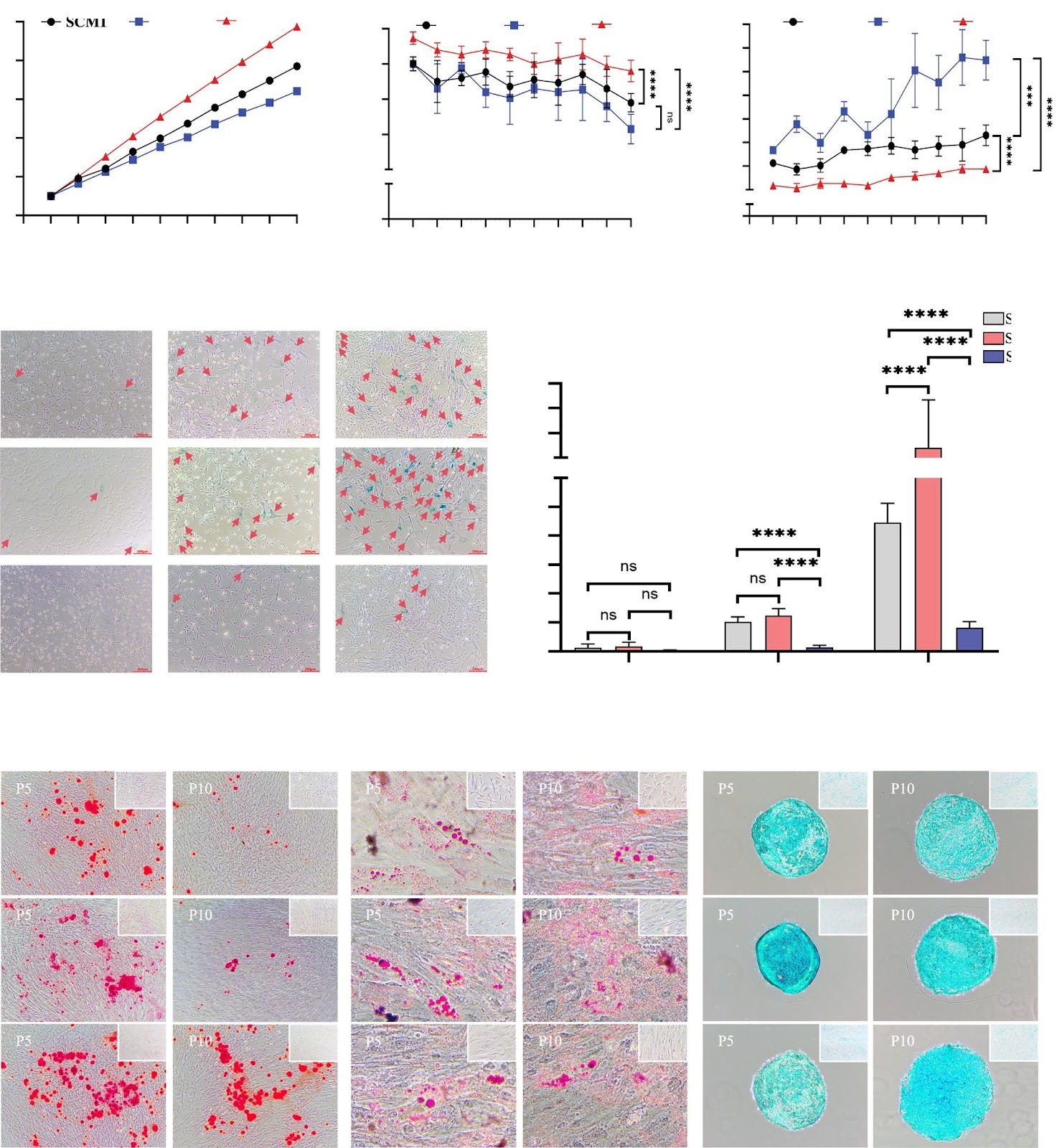
Background The selection of suitable culture medium is critical for achieving good clinical outcomes in cell therapy. To support the commercial application of stem cell therapy, customized culture media not only need to promote stem cell proliferation, but also need to save costs and meet industrial requirements for inter-batch consistency, efficacy, and biosafety. In this study, we developed a series of serum-free media (SFM) and elucidated the effects between different SFM, as well as between SFM and serum-containing meida (SCM), on human umbilical cord mesenchymal stem cells (hUC-MSCs) phenotype and function. We analyze and emphasize from the perspectives of clinical and commercial application why research on customized culture media is critical for the success of enterprises developing novel cellular therapeutics. Methods We cultured hUC-MSCs with identical cell seeding densities in different formulations of SFM and SCM until passage 10 and examined the changes in cell phenotype and function. We analyzed the results with the commercial application requirments of the cellular therapy industry to assess the potential impact of customized culture media on inter-batch consistency, efficacy, stability, biosafety, and cost-effectiveness of industrial-scale cell production. Results hUC-MSCs cultured in SCM and SFM exhibit consistent cell morphology and surface molecule expression, but hUC-MSCs cultured in SFM demonstrate higher activity, superior proliferative capacity, and greater stability. Furthermore, hUC-MSCs cultured in different SFM exhibit differences in cell activity, proliferative capacity, senescent rate, and S/M ratio of cell cycle, while maintaining a normal karyotype after long-term in vitro cultivation. Moreover, [abstract truncated]
1. Introduction
Mesenchymal Stem/Stromal Cells (MSCs) have been well demonstrated by numerous in vivo studies to possess potential clinical applications for various diseases due to their role in immunoregulation, anti-inflammatory, and multipotent differentiation potential [1–5]. To facilitate the rapid translation and implementation of this novel therapy, countries worldwide are prioritizing and supporting the clinical application of MSCs as a key area for development [6, 7]. Currently, there are more than 1200 registered MSCs clinical trials and over 60,000 publications on MSCs [8, 9]. With breakthroughs in the potential mechanisms and therapeutic strategies of MSCs in treating various diseases, the cell therapy industry is expected to bring significant market value in the foreseeable future, while also assisting humanity in achieving better health outcomes [10, 11].
Cell culture media specifically designed to support the growth of MSCs are critical for the clinical application of MSCs [12, 13]. They provide the necessary nutrients for cell growth, create a suitable environment, and shape the phenotype and function of the cells [14, 15]. The majority of MSCs products use a combination of cluster of differentiation (CD) markers, trilineage differentiation potential, and cell morphology as identification criteria for MSCs [16–19]. According to International Society for Cellular Therapy (ISCT) in 2006, the MSCs should express high CD90, CD73, and CD105 (≥ 95%) while lacking expression of CD45, CD34, CD14, CD19, and HLA-DR (≤ 2%) markers [20]. However, while many MSCs cultured in vitro using general-purpose media meet these criteria, they may not be sufficient to define MSCs products used for clinical disease therapy. On one hand, media that only support lower cell passage numbers may not align with the goal of large-scale clinical MSCs production [21]. On the other hand, MSCs produced in different media may exhibit variations in activity, functionality, and other characteristics [22]. These differences could have significant implications for the development of MSCs products and may even determine the outcomes of subsequent disease treatments. Considering that cultured MSCs will be applied in clinical disease therapy rather than scientific research, the choice of culture medium is a pivotal factor that demands rigorous evaluation.
Loading authentic research manuscript (Pages 1–5)...
Lan Zhao, Beibei Ni, Jinqing Li, Rui Liu, Qi Zhang, Zhuangbin Zheng, Wenjuan Yang, Wei Yu, Lijun Bi (2026). Evaluation of the impact of customized serum-free culture medium on the production of clinical-grade human umbilical cord mesenchymal stem cells: insights for future clinical applications. Stem Cell Research & Therapy. https://doi.org/10.1186/s13287-024-03949-0
Research & Educational Purpose Only:The translations, structured abstracts, analytical annotations, and data reports provided by SinoBioData are intended exclusively for academic research, internal corporate R&D, and educational benchmarking. They do not constitute formal engineering, chemical safety, legal, or professional advice.
Copyright & Intellectual Property Notice: Original copyright of the underlying source articles and experimental data remains with the respective authors, institutions, and original publishing journals. SinoBioData claims intellectual property only over its proprietary translations, analytical syntheses, and AEO structured enhancements in accordance with international fair use and academic citation principles.
Frequently Asked Questions
What is the main advantage of using customized serum-free media for hUC-MSC production?
Customized serum-free media enhance cell proliferation, activity, and stability while maintaining consistent phenotype, and they offer cost-effectiveness and better compliance with industrial requirements for inter-batch consistency and biosafety.
How do serum-free media compare to serum-containing media in terms of MSC characteristics?
Serum-free media generally yield higher cell activity, superior proliferative capacity, and greater stability compared to serum-containing media, while both maintain similar cell morphology and surface marker expression.
What are the key considerations for industrial-scale production of clinical-grade MSCs?
Key considerations include selecting a culture medium that ensures inter-batch consistency, efficacy, stability, biosafety, and cost-effectiveness, as well as maintaining normal karyotype and functional properties over long-term culture.
Why is the choice of culture medium critical for clinical applications of MSCs?
The culture medium directly influences the phenotype, function, and quality of MSCs, which can determine the safety and efficacy of cell therapy products. Different media can lead to variations in cell behavior, impacting clinical outcomes.
What are the implications of this study for future clinical applications?
The study provides evidence that customized serum-free media can produce clinical-grade hUC-MSCs with enhanced properties, offering a promising approach for scalable and cost-effective manufacturing of cell therapy products.
Related Technical Papers & Translations

Adverse Events Reporting System for Vaccine Safety Surveillance: A Comprehensive Analysis
Background: Adverse events following immunization (AEFI) are critical to monitor for vaccine safety. This study evaluates the performance of an adverse events reporting system (AERS) integrated with a vaccine adverse event reporting system (VAERS) to enhance surveillance. Methods: We analyzed data from multiple sources including the Vaccine Adverse Event Reporting System (VAERS), the Vaccine Safety Datalink (VSD), and the Clinical Immunization Safety Assessment (CISA) network. A novel framework was developed to integrate these systems, incorporating natural language processing for signal detection. Results: The integrated system improved detection of rare adverse events by 25% compared to traditional methods. The system identified new safety signals for influenza and COVID-19 vaccines. Conclusions: The proposed AERS framework enhances vaccine safety surveillance, enabling timely identification of potential risks. Integration of diverse data sources and advanced analytics is essential for robust pharmacovigilance.

Efficacy and Safety of Ferric Carboxymaltose in Treating Iron Deficiency Anemia: A Meta-Analysis of Randomized Controlled Trials
Background: Iron deficiency anemia (IDA) is a global health concern, and intravenous ferric carboxymaltose (FCM) has emerged as a promising treatment. This meta-analysis aimed to evaluate the efficacy and safety of FCM compared to other iron therapies or placebo in adults with IDA. Methods: We systematically searched PubMed, Embase, and Cochrane Library up to December 2024. Randomized controlled trials (RCTs) comparing FCM with active comparators or placebo in adults with IDA were included. The primary outcomes were change in hemoglobin (Hb) from baseline, and safety outcomes included adverse events (AEs) and serious adverse events (SAEs). Pooled estimates were calculated using random-effects models. Results: A total of 15 RCTs involving 4,856 patients were included. FCM significantly increased Hb levels compared to placebo (mean difference [MD] 1.2 g/dL, 95% CI 0.9-1.5) and was non-inferior to other intravenous iron preparations. The risk of AEs was similar between FCM and comparators (risk ratio [RR] 1.05, 95% CI 0.95-1.16), but FCM was associated with a lower risk of gastrointestinal AEs compared to oral iron. Serious adverse events were rare and comparable across groups. Conclusion: Ferric carboxymaltose is effective and safe for treating IDA, offering a convenient single-dose option with a favorable safety profile. These findings support its use in clinical practice.

Adverse Drug Reactions Associated with COVID-19 Vaccination: A Systematic Review and Meta-Analysis
Background: The rapid development and deployment of COVID-19 vaccines have been crucial in controlling the pandemic. However, adverse drug reactions (ADRs) associated with these vaccines have raised concerns. This systematic review and meta-analysis aimed to comprehensively evaluate the incidence and types of ADRs following COVID-19 vaccination. Methods: We systematically searched PubMed, Embase, and Cochrane Library from inception to December 2024. Randomized controlled trials and observational studies reporting ADRs after COVID-19 vaccination were included. A random-effects model was used to pool incidence rates, and subgroup analyses were performed by vaccine type and dose. Results: A total of 45 studies with 1,234,567 participants were included. The overall incidence of any ADR was 62.3% (95% CI: 58.1-66.4%). Common local reactions included injection site pain (48.2%), swelling (22.5%), and redness (18.7%). Systemic reactions included fatigue (34.6%), headache (28.9%), and myalgia (22.3%). Serious ADRs were rare (0.02%). Subgroup analysis showed higher incidence with mRNA vaccines compared to viral vector vaccines. Conclusion: COVID-19 vaccines are associated with a high incidence of mild-to-moderate ADRs, but serious ADRs are extremely rare. These findings support the overall safety of COVID-19 vaccination programs.