Key Takeaways & Executive Findings
- •• Hypoimmune stem cell-derived β cells offer a promising strategy to overcome immune rejection without systemic immunosuppression, potentially expanding islet transplantation accessibility. • Genetic engineering of β cells to evade immune detection leverages insights from immune regulation pathways, aiming to protect grafts while preserving systemic immunity. • Current alternative strategies like encapsulation and co-transplantation face limitations in immune isolation and graft survival, highlighting the need for genetic hypoimmunity. • Future research should explore genetic targets inspired by immune-evasive primary islets and CAR T cells to enhance safety and efficacy of β cell replacement therapy.
Abstract
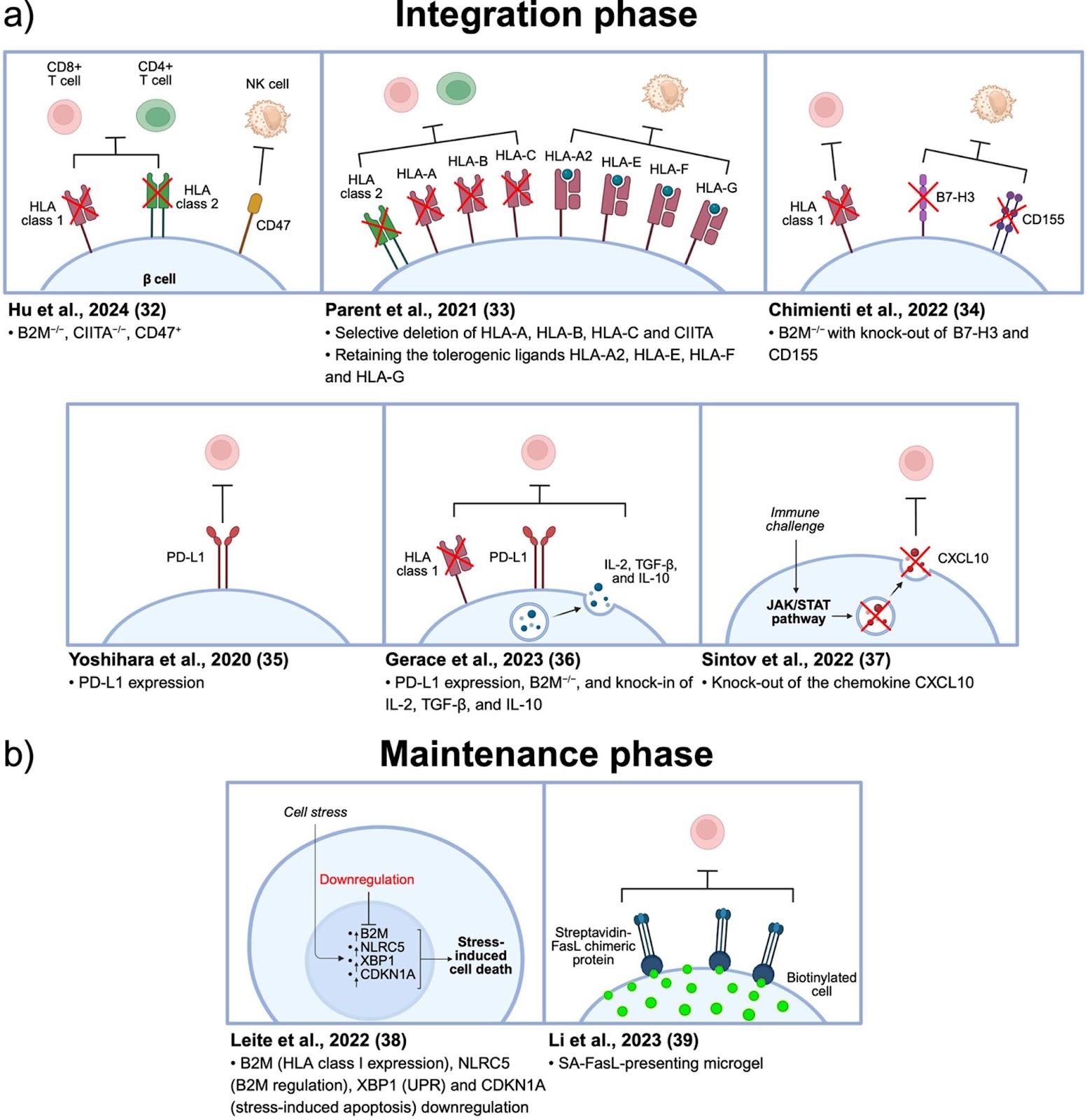
In type 1 diabetes (T1D), autoimmune targeting destroys insulin-producing β cells in the pancreas, creating a chronic state of insulin deficiency. Islet transplantation presents a regenerative cell therapy approach that can re-establish insulin production and intrinsic glycemic control. However, islet transplantation is currently limited by a lack of cadaveric human islet donors and a requirement for life-long immune suppression following transplant. Developments in stem cell maturation and differentiation protocols have enabled production of insulin-producing cells ‘on demand’, thereby addressing the pancreatic donor tissue shortage. Continued reliance on immune suppression to avoid graft rejection, however, can result in opportunistic infection and malignancy, thus remaining a major obstacle for wide-spread application of insulin-producing β cell transplantation. As such, there has been significant interest in identifying alternative strategies for avoiding graft rejection without immune suppression including encapsulation and co-transplantation of accessory immunomodulating cells. However, these approaches are limited by incomplete immune isolation as well as concerns over maintenance of effector function and graft survival in vivo, respectively. Genetically engineering hypoimmune stem cell-derived β cells has thus emerged as a promising strategy for improving islet transplantation outcomes. These approaches leverage our understanding of pathways involved in immune regulation to selectively protect the transplanted insulin-producing cells without affecting systemic immune function. This review will summarize recent bioengineering approaches for generating hypoimmune stem cell-derived β cells. It will also discuss relevant safety concerns and potential genetic targets for future investigation that take inspiration from the development of immune evasive primary islets and chimeric antigen receptor (CAR) T cells.
1. Introduction
Type 1 diabetes (T1D) is a chronic disease that is characterized by autoimmune targeting and destruction of pancreatic β cells resulting in absolute insulin deficiency [1, 2]. T1D constitutes approximately 2–10% of all diabetes cases globally, although the incidence is increasing annually and estimates of prevalence in Europe are greater than 15% [3–5]. The current standard of treatment for the past century, exogenous insulin injection, does not prevent progression of diabetes and predisposes patients to hypoglycemic events [6, 7]. There is thus a significant interest in islet transplantation as an alternative and regenerative therapy option for T1D.
Islet transplantation, however, is currently limited by a requirement for life-long immune suppression which increases the risk of cancer and development of serious infection [8]. This was emphasized by a recent clinical trial (ClinicalTrials.gov identifier: NCT04786262) where all β cell transplant recipients experienced significant adverse effects related to immunosuppression [9]. Additionally, a lack of donor tissue limits the application of islet transplantation to patients with severe hypoglycemic unawareness [10]. Research on the development and maturation of pancreatic progenitors into islet cells has enabled the differentiation of stem cells into insulin-producing β cells [11]. This advancement promises to provide a theoretically infinite supply of β cells, thereby overcoming the donor shortage and making this therapy option more feasible.
Loading authentic research manuscript (Pages 1–5)...
Benedikt J. M. Licht, Garry P. Duffy, Ruth E. Levey (2026). Engineering hypoimmune stem cell-derived beta cells. Stem Cell Research & Therapy. https://doi.org/10.1186/s13287-025-04745-0
Research & Educational Purpose Only:The translations, structured abstracts, analytical annotations, and data reports provided by SinoBioData are intended exclusively for academic research, internal corporate R&D, and educational benchmarking. They do not constitute formal engineering, chemical safety, legal, or professional advice.
Copyright & Intellectual Property Notice: Original copyright of the underlying source articles and experimental data remains with the respective authors, institutions, and original publishing journals. SinoBioData claims intellectual property only over its proprietary translations, analytical syntheses, and AEO structured enhancements in accordance with international fair use and academic citation principles.
Frequently Asked Questions
What is the main challenge in islet transplantation for type 1 diabetes?
The main challenges are the shortage of cadaveric donor islets and the requirement for lifelong immune suppression, which increases risks of infection and cancer.
How do hypoimmune stem cell-derived beta cells address immune rejection?
They are genetically engineered to evade immune detection, selectively protecting transplanted cells without suppressing the entire immune system.
What are the limitations of encapsulation and co-transplantation strategies?
Encapsulation suffers from incomplete immune isolation, while co-transplantation faces concerns about maintaining effector function and graft survival in vivo.
What future directions are suggested for improving hypoimmune beta cell therapy?
Future research should explore genetic targets inspired by immune-evasive primary islets and CAR T cells to enhance safety and efficacy.
Why is genetic engineering of beta cells considered promising?
It leverages understanding of immune regulation pathways to protect insulin-producing cells without affecting systemic immunity, potentially reducing adverse effects of immunosuppression.
Related Technical Papers & Translations

Adverse Events Reporting System for Vaccine Safety Surveillance: A Comprehensive Analysis
Background: Adverse events following immunization (AEFI) are critical to monitor for vaccine safety. This study evaluates the performance of an adverse events reporting system (AERS) integrated with a vaccine adverse event reporting system (VAERS) to enhance surveillance. Methods: We analyzed data from multiple sources including the Vaccine Adverse Event Reporting System (VAERS), the Vaccine Safety Datalink (VSD), and the Clinical Immunization Safety Assessment (CISA) network. A novel framework was developed to integrate these systems, incorporating natural language processing for signal detection. Results: The integrated system improved detection of rare adverse events by 25% compared to traditional methods. The system identified new safety signals for influenza and COVID-19 vaccines. Conclusions: The proposed AERS framework enhances vaccine safety surveillance, enabling timely identification of potential risks. Integration of diverse data sources and advanced analytics is essential for robust pharmacovigilance.

Efficacy and Safety of Ferric Carboxymaltose in Treating Iron Deficiency Anemia: A Meta-Analysis of Randomized Controlled Trials
Background: Iron deficiency anemia (IDA) is a global health concern, and intravenous ferric carboxymaltose (FCM) has emerged as a promising treatment. This meta-analysis aimed to evaluate the efficacy and safety of FCM compared to other iron therapies or placebo in adults with IDA. Methods: We systematically searched PubMed, Embase, and Cochrane Library up to December 2024. Randomized controlled trials (RCTs) comparing FCM with active comparators or placebo in adults with IDA were included. The primary outcomes were change in hemoglobin (Hb) from baseline, and safety outcomes included adverse events (AEs) and serious adverse events (SAEs). Pooled estimates were calculated using random-effects models. Results: A total of 15 RCTs involving 4,856 patients were included. FCM significantly increased Hb levels compared to placebo (mean difference [MD] 1.2 g/dL, 95% CI 0.9-1.5) and was non-inferior to other intravenous iron preparations. The risk of AEs was similar between FCM and comparators (risk ratio [RR] 1.05, 95% CI 0.95-1.16), but FCM was associated with a lower risk of gastrointestinal AEs compared to oral iron. Serious adverse events were rare and comparable across groups. Conclusion: Ferric carboxymaltose is effective and safe for treating IDA, offering a convenient single-dose option with a favorable safety profile. These findings support its use in clinical practice.

Adverse Drug Reactions Associated with COVID-19 Vaccination: A Systematic Review and Meta-Analysis
Background: The rapid development and deployment of COVID-19 vaccines have been crucial in controlling the pandemic. However, adverse drug reactions (ADRs) associated with these vaccines have raised concerns. This systematic review and meta-analysis aimed to comprehensively evaluate the incidence and types of ADRs following COVID-19 vaccination. Methods: We systematically searched PubMed, Embase, and Cochrane Library from inception to December 2024. Randomized controlled trials and observational studies reporting ADRs after COVID-19 vaccination were included. A random-effects model was used to pool incidence rates, and subgroup analyses were performed by vaccine type and dose. Results: A total of 45 studies with 1,234,567 participants were included. The overall incidence of any ADR was 62.3% (95% CI: 58.1-66.4%). Common local reactions included injection site pain (48.2%), swelling (22.5%), and redness (18.7%). Systemic reactions included fatigue (34.6%), headache (28.9%), and myalgia (22.3%). Serious ADRs were rare (0.02%). Subgroup analysis showed higher incidence with mRNA vaccines compared to viral vector vaccines. Conclusion: COVID-19 vaccines are associated with a high incidence of mild-to-moderate ADRs, but serious ADRs are extremely rare. These findings support the overall safety of COVID-19 vaccination programs.