Key Takeaways & Executive Findings
- •• Genetically modified MSCs secreting SCF, TPO, FLT3L, and IL3 support HSPC expansion without exogenous cytokines, preserving stemness and multilineage potential. • The biomimetic feeder layer reduces culture-induced stress and improves outcomes for HDR-mediated gene editing, particularly for fetal hemoglobin reactivation. • This approach offers a cost-effective alternative to traditional cytokine supplementation, potentially lowering the overall cost of HSPC gene therapy. • The engineered MSCs closely mimic the bone marrow niche, enhancing the therapeutic value of HSPCs for gene therapy applications.
Abstract
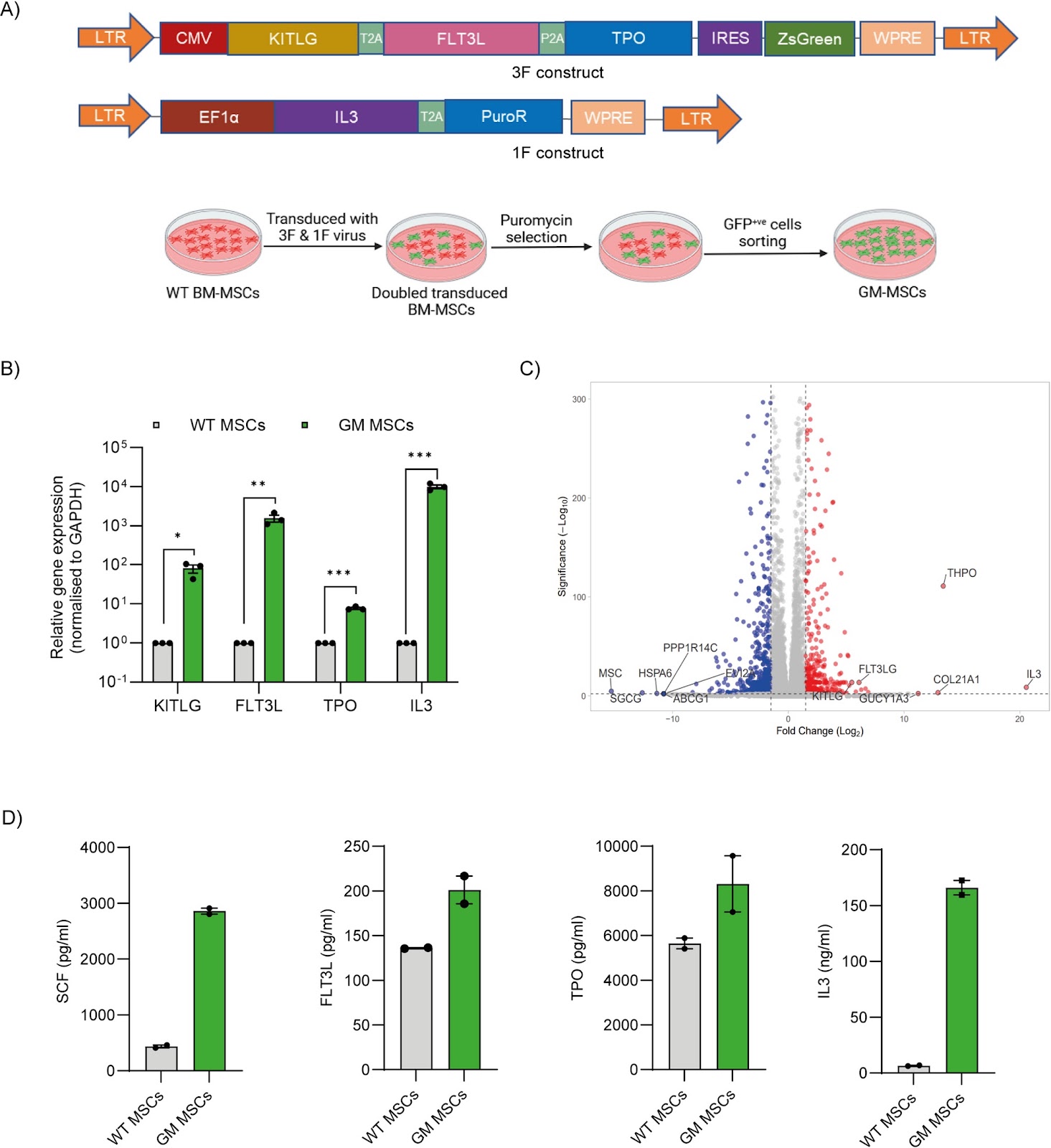
Background: Hematopoietic Stem and Progenitor Cells (HSPCs) gene therapy has shown significant progress, with commercial approval for at least four distinct haematological disorders, and poised for a rapid expansion in the upcoming years. Despite these advancements, the ex vivo culture of HSPCs continues to present significant challenges. The stress induced by ex vivo culture can negatively impact transplantation outcomes, while the need for exogenous cytokine supplementation contributes to the high costs associated with gene therapy products. Methods: We developed genetically modified human bone marrow MSCs (GM-MSCs) secreting cytokines such as Stem cell factor (SCF), Thrombopoietin (TPO), FMS-like tyrosine kinase-3-ligand (FLT3L), and Interleukin-3 (IL3), closely resembling bone marrow cellular niche to augment HSPCs culture. Results: HSPCs proliferate on GM-MSCs akin to standard conditions, devoid of external cytokine supplementation and these HSPCs retain their stem cell characteristics, colony-forming potential, stemness gene signatures, and capacity for long-term multilineage reconstitution in NBSGW mice. We demonstrate that our biomimetic feeder layer supports and alleviates stress associated with Homology Directed Repair (HDR) mediated gene-editing of HSPCs for fetal haemoglobin reactivation for a potential application in β-hemoglobinopathies gene therapy. Conclusion: Our GM-MSCs offer a compelling alternative to traditional cytokine supplementation by establishing a biomimetic bone marrow niche that fosters HSPC expansion while maintaining their stemness. These findings underscore the potential of engineered MSCs to revolutionize ex vivo HSPCs culture, ultimately enhancing their therapeutic value for gene therapy applications.
1. Introduction
Over the past decade, hematopoietic stem and progenitor cells (HSPCs) gene therapy has made remarkable progress, driven by the advancement of cutting-edge technologies and methodologies that enhance its safety and precision [1]. The approval of Casgevy, the first CRISPR/Cas9-based HSPCs gene therapy for sickle cell disease (SCD), marks a significant milestone [2]. HSPCs possess a unique ability to be mobilized from the bone marrow, undergo ex vivo manipulation, and successfully re-engraft, where they self-renew and differentiate into all hematopoietic lineages. This remarkable versatility positions HSPCs gene therapy at the forefront of ex vivo genetic engineering approaches.
Despite its potential, ex vivo manipulation of HSPCs remains challenging. Key obstacles include culture-induced cellular stress, cytotoxic effects from the manipulation process, reduced engraftment efficiency of modified cells, and the presence of a large fraction of committed progenitors in the graft, which can lower the in vivo frequency of gene-modified cells in the long term [3, 4]. These limitations necessitates the retrieval and manipulation of large quantities of HSPCs from patients, which increases the overall cost of the production process [5, 6]. Additionally, the requirement for various manipulation reagents and cytokines from commercial vendors further complicates the logistics and expense associated with HSPCs gene therapy.
The stem cell niche in human bone marrow provides essential scaffolds, cellular frameworks, and soluble cues that support the maintenance of HSPCs. Mesenchymal stromal cells (MSCs) play a critical role in maintaining HSPCs homeostasis primarily through the release of paracrine factors and also through HSPC-MSC contact, which collectively foster a supportive environment for haematopoiesis [7, 8]. Several pre-clinical and clinical studies have highlighted the significant role of MSCs when cocultured or co-transplanted with adult HSPCs or umbilical cord blood (UCB) HSPCs. This approach has been shown to enhance engraftment, accelerate hematopoietic recovery, and effectively mitigate the risk of graft-versus-host disease (GvHD) [9–15].
Loading authentic research manuscript (Pages 1–5)...
Sevanthy Suresh, Vigneshwaran Venkatesan, Manoj Kumar K. Azhagiri, Gokulnath Mahalingam, Prathibha Babu Chandraprabha, Mohankumar K. Murugesan, Sanjay Kumar, Saravanabhavan Thangavel, Srujan Marepally (2026). Engineering biomimetic bone marrow niche with gene modified mesenchymal stromal cells for ex vivo culture of human hematopoietic stem and progenitor cells. Stem Cell Research & Therapy. https://doi.org/10.1186/s13287-025-04474-4
Research & Educational Purpose Only:The translations, structured abstracts, analytical annotations, and data reports provided by SinoBioData are intended exclusively for academic research, internal corporate R&D, and educational benchmarking. They do not constitute formal engineering, chemical safety, legal, or professional advice.
Copyright & Intellectual Property Notice: Original copyright of the underlying source articles and experimental data remains with the respective authors, institutions, and original publishing journals. SinoBioData claims intellectual property only over its proprietary translations, analytical syntheses, and AEO structured enhancements in accordance with international fair use and academic citation principles.
Frequently Asked Questions
What is the main challenge in ex vivo culture of HSPCs?
The main challenges include culture-induced cellular stress, cytotoxic effects, reduced engraftment efficiency, and the high cost of exogenous cytokine supplementation.
How do genetically modified MSCs support HSPC expansion?
Genetically modified MSCs secrete key cytokines such as SCF, TPO, FLT3L, and IL3, mimicking the bone marrow niche and supporting HSPC expansion without external cytokine supplementation.
What are the benefits of using GM-MSCs over traditional cytokine supplementation?
GM-MSCs provide a biomimetic niche that reduces culture stress, maintains stemness, and lowers costs by eliminating the need for expensive recombinant cytokines.
Can this approach be applied to gene editing of HSPCs?
Yes, the biomimetic feeder layer alleviates stress associated with HDR-mediated gene editing, as demonstrated for fetal hemoglobin reactivation in β-hemoglobinopathies.
What is the significance of this study for HSPC gene therapy?
This study offers a cost-effective and efficient alternative for ex vivo HSPC culture, potentially improving the scalability and accessibility of gene therapy for hematological disorders.
Related Technical Papers & Translations

Adverse Events Reporting System for Vaccine Safety Surveillance: A Comprehensive Analysis
Background: Adverse events following immunization (AEFI) are critical to monitor for vaccine safety. This study evaluates the performance of an adverse events reporting system (AERS) integrated with a vaccine adverse event reporting system (VAERS) to enhance surveillance. Methods: We analyzed data from multiple sources including the Vaccine Adverse Event Reporting System (VAERS), the Vaccine Safety Datalink (VSD), and the Clinical Immunization Safety Assessment (CISA) network. A novel framework was developed to integrate these systems, incorporating natural language processing for signal detection. Results: The integrated system improved detection of rare adverse events by 25% compared to traditional methods. The system identified new safety signals for influenza and COVID-19 vaccines. Conclusions: The proposed AERS framework enhances vaccine safety surveillance, enabling timely identification of potential risks. Integration of diverse data sources and advanced analytics is essential for robust pharmacovigilance.

Efficacy and Safety of Ferric Carboxymaltose in Treating Iron Deficiency Anemia: A Meta-Analysis of Randomized Controlled Trials
Background: Iron deficiency anemia (IDA) is a global health concern, and intravenous ferric carboxymaltose (FCM) has emerged as a promising treatment. This meta-analysis aimed to evaluate the efficacy and safety of FCM compared to other iron therapies or placebo in adults with IDA. Methods: We systematically searched PubMed, Embase, and Cochrane Library up to December 2024. Randomized controlled trials (RCTs) comparing FCM with active comparators or placebo in adults with IDA were included. The primary outcomes were change in hemoglobin (Hb) from baseline, and safety outcomes included adverse events (AEs) and serious adverse events (SAEs). Pooled estimates were calculated using random-effects models. Results: A total of 15 RCTs involving 4,856 patients were included. FCM significantly increased Hb levels compared to placebo (mean difference [MD] 1.2 g/dL, 95% CI 0.9-1.5) and was non-inferior to other intravenous iron preparations. The risk of AEs was similar between FCM and comparators (risk ratio [RR] 1.05, 95% CI 0.95-1.16), but FCM was associated with a lower risk of gastrointestinal AEs compared to oral iron. Serious adverse events were rare and comparable across groups. Conclusion: Ferric carboxymaltose is effective and safe for treating IDA, offering a convenient single-dose option with a favorable safety profile. These findings support its use in clinical practice.

Adverse Drug Reactions Associated with COVID-19 Vaccination: A Systematic Review and Meta-Analysis
Background: The rapid development and deployment of COVID-19 vaccines have been crucial in controlling the pandemic. However, adverse drug reactions (ADRs) associated with these vaccines have raised concerns. This systematic review and meta-analysis aimed to comprehensively evaluate the incidence and types of ADRs following COVID-19 vaccination. Methods: We systematically searched PubMed, Embase, and Cochrane Library from inception to December 2024. Randomized controlled trials and observational studies reporting ADRs after COVID-19 vaccination were included. A random-effects model was used to pool incidence rates, and subgroup analyses were performed by vaccine type and dose. Results: A total of 45 studies with 1,234,567 participants were included. The overall incidence of any ADR was 62.3% (95% CI: 58.1-66.4%). Common local reactions included injection site pain (48.2%), swelling (22.5%), and redness (18.7%). Systemic reactions included fatigue (34.6%), headache (28.9%), and myalgia (22.3%). Serious ADRs were rare (0.02%). Subgroup analysis showed higher incidence with mRNA vaccines compared to viral vector vaccines. Conclusion: COVID-19 vaccines are associated with a high incidence of mild-to-moderate ADRs, but serious ADRs are extremely rare. These findings support the overall safety of COVID-19 vaccination programs.