Key Takeaways & Executive Findings
- •• MALAT1 and TUG1 expression levels significantly increase during differentiation of adipose tissue-derived mesenchymal stem cells (Ad-MSCs) into insulin-producing cells (IPCs). • In-silico analyses using the RAIN database reveal an interplay between MALAT1 and TUG1 and their common targets, including GAS5, HOTAIR, and TP53COR1. • The upregulation of MALAT1 and TUG1 suggests their involvement in competitive endogenous RNA (ceRNA) networks and epigenetic modifications during IPC differentiation. • This is the first study to investigate the roles of MALAT1 and TUG1 in the differentiation of Ad-MSCs into IPCs, offering potential novel therapeutic targets for diabetes mellitus.
Abstract
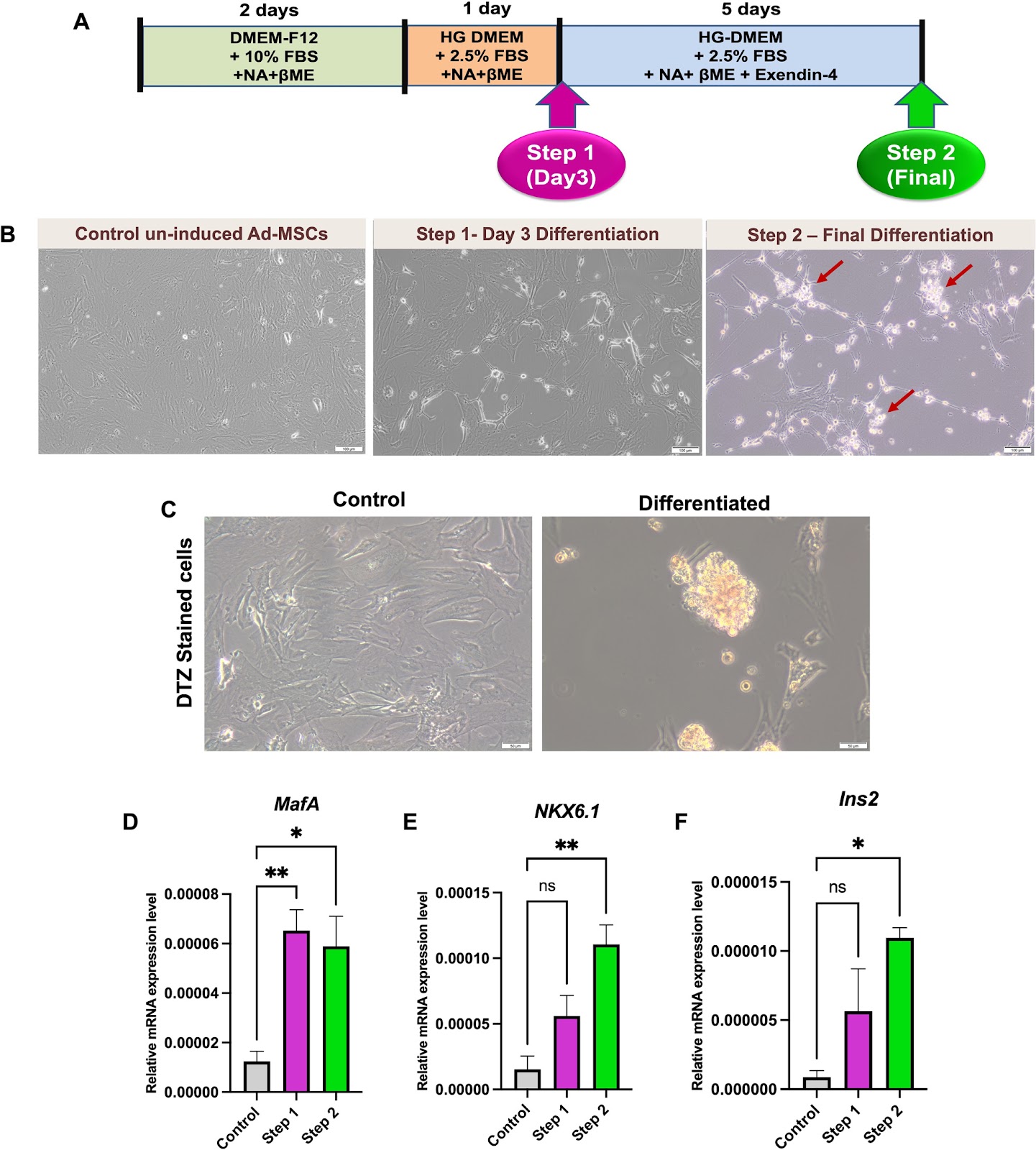
Background: Generation of insulin-producing cells (IPCs) from stem cells provides great hope for patients with diabetes mellitus (DM). Long non-coding RNAs (lncRNAs) ignited much interest regarding their role in determining the fate of stem cells. The lncRNAs MALAT1 and TUG1 have been reported to be interrelated with β-cell dysfunction and/or DM. However, their role during generation of IPCs from stem cells has not been adequately studied. Thus, the current study aimed to investigate the role of MALAT1 and TUG1 during differentiation of adipose tissue-derived mesenchymal stem cells (Ad-MSCs) towards IPCs. Methods: Ad-MSCs were isolated from rat epididymal fat pads, characterized and induced to differentiate towards IPCs. Assessment of differentiation was done by measuring expression levels of various β-cell-related markers using RT-qPCR, as well as morphological changes, and dithizone staining. Expression levels of MALAT1 and TUG1 were also measured by RT-qPCR. Several in-silico analyses were done using RNA–protein Association and Interaction Networks (RAIN) database. Results: MALAT1 and TUG1 expression levels were significantly increased during differentiation of Ad-MSCs into IPCs as compared to control uninduced cells. Furthermore, generated networks from RAIN database revealed an interplay between MALAT1 and TUG1, and between each of them with several common targets like GAS5, HOTAIR and TP53COR1. Conclusions: The current study portrays MALAT1 and TUG1 as novel interrelated molecular mediators and important regulatory nodes enhancing differentiation of Ad-MSCs towards IPCs. Their upregulation during differentiation can be interrelated with competitive endogenous RNA (ceRNA) networks, mediating various epigenetic modifications, orchestrating signaling pathways and overcoming cellular stress during reprogramming/differentiation.
1. Introduction
Diabetes mellitus (DM) is a serious metabolic disorder marked by varying degrees of loss and/or dysfunction of insulin-secreting β-cells. Unfortunately, the global prevalence of DM is alarmingly rising, currently affecting approximately 589 million individuals worldwide, with Egypt ranking among the top ten most affected countries [1]. Over the past few decades, stem cell-based therapies have emerged as a promising avenue for the treatment of numerous diseases, particularly DM [2, 3]. Among various stem cell types, mesenchymal stem cells (MSCs) specifically have attracted significant attention for their broad reparative capabilities, with more than 1,500 clinical trials investigating their therapeutic applications across diverse diseases [4]. MSCs are highly valued for their ability to mediate reparative effects in diverse forms of tissue injury [5–9], coupled with several key advantages: minimal ethical concerns compared to embryonic stem cells (ESCs), relatively easy isolation procedures, robust ex-vivo expansion, together with their immunomodulatory properties and multipotent differentiation potential [10]. However, the mechanisms underlying their therapeutic and regenerative properties remain much more complex than anticipated and far from complete elucidation [5].
A particularly exciting area of research is the generation of insulin-producing cells (IPCs) from stem cells. Over the past couple of decades, various stem cell sources—including ESCs [11, 12] and MSCs [13, 14]—have demonstrated the ability to differentiate into IPCs. Despite these advances, current differentiation induction protocols remain suboptimal due to several factors such as the complexity of the signaling pathways governing pancreatic lineage specification and the variability between different types of the used stem cells [15, 16]. This highlights the need for further investigations to enhance maturation and functionality of IPCs generated from various types of stem cells. Overcoming these barriers is essential for improving cell therapy outcomes in DM and could also reveal novel therapeutic targets to stimulate β-cell neogenesis/regeneration and combat DM [17, 18].
Loading authentic research manuscript (Pages 1–5)...
Eman F. Sanad, Alaa Ahmed Saad, Joy Rafeek, Rana Mokbel, Mayar Abdallah, Nadeen Emad, Hagar Adel Mohamed, Yasmin Alaa, Yumna Medhat Mahmoud, Dina H. Kassem (2026). Emerging roles of the long non-coding RNAs MALAT1 and TUG1 during differentiation of adipose tissue-derived mesenchymal stem cells towards insulin-producing cells. Stem Cell Research & Therapy. https://doi.org/10.1186/s13287-026-05125-y
Research & Educational Purpose Only:The translations, structured abstracts, analytical annotations, and data reports provided by SinoBioData are intended exclusively for academic research, internal corporate R&D, and educational benchmarking. They do not constitute formal engineering, chemical safety, legal, or professional advice.
Copyright & Intellectual Property Notice: Original copyright of the underlying source articles and experimental data remains with the respective authors, institutions, and original publishing journals. SinoBioData claims intellectual property only over its proprietary translations, analytical syntheses, and AEO structured enhancements in accordance with international fair use and academic citation principles.
Frequently Asked Questions
What is the role of MALAT1 and TUG1 in stem cell differentiation?
The study reveals that MALAT1 and TUG1 are significantly upregulated during differentiation of adipose tissue-derived mesenchymal stem cells into insulin-producing cells, suggesting they act as novel regulatory mediators enhancing this process.
How were MALAT1 and TUG1 expression levels measured?
Expression levels were measured using reverse transcription quantitative polymerase chain reaction (RT-qPCR) at various time points during differentiation.
What is the significance of the RAIN database analysis?
In-silico analysis using the RAIN database identified potential interactions between MALAT1 and TUG1 and common targets such as GAS5, HOTAIR, and TP53COR1, indicating a complex regulatory network.
What are the potential therapeutic implications of this study?
The findings suggest that modulating MALAT1 and TUG1 expression could enhance the efficiency of generating insulin-producing cells for diabetes therapy, offering novel targets for regenerative medicine.
Is this the first study to investigate these lncRNAs in this context?
Yes, the authors state that this is the first study to investigate the roles of MALAT1 and TUG1 during differentiation of adipose tissue-derived mesenchymal stem cells into insulin-producing cells.
Related Technical Papers & Translations

Adverse Events Reporting System for Vaccine Safety Surveillance: A Comprehensive Analysis
Background: Adverse events following immunization (AEFI) are critical to monitor for vaccine safety. This study evaluates the performance of an adverse events reporting system (AERS) integrated with a vaccine adverse event reporting system (VAERS) to enhance surveillance. Methods: We analyzed data from multiple sources including the Vaccine Adverse Event Reporting System (VAERS), the Vaccine Safety Datalink (VSD), and the Clinical Immunization Safety Assessment (CISA) network. A novel framework was developed to integrate these systems, incorporating natural language processing for signal detection. Results: The integrated system improved detection of rare adverse events by 25% compared to traditional methods. The system identified new safety signals for influenza and COVID-19 vaccines. Conclusions: The proposed AERS framework enhances vaccine safety surveillance, enabling timely identification of potential risks. Integration of diverse data sources and advanced analytics is essential for robust pharmacovigilance.

Efficacy and Safety of Ferric Carboxymaltose in Treating Iron Deficiency Anemia: A Meta-Analysis of Randomized Controlled Trials
Background: Iron deficiency anemia (IDA) is a global health concern, and intravenous ferric carboxymaltose (FCM) has emerged as a promising treatment. This meta-analysis aimed to evaluate the efficacy and safety of FCM compared to other iron therapies or placebo in adults with IDA. Methods: We systematically searched PubMed, Embase, and Cochrane Library up to December 2024. Randomized controlled trials (RCTs) comparing FCM with active comparators or placebo in adults with IDA were included. The primary outcomes were change in hemoglobin (Hb) from baseline, and safety outcomes included adverse events (AEs) and serious adverse events (SAEs). Pooled estimates were calculated using random-effects models. Results: A total of 15 RCTs involving 4,856 patients were included. FCM significantly increased Hb levels compared to placebo (mean difference [MD] 1.2 g/dL, 95% CI 0.9-1.5) and was non-inferior to other intravenous iron preparations. The risk of AEs was similar between FCM and comparators (risk ratio [RR] 1.05, 95% CI 0.95-1.16), but FCM was associated with a lower risk of gastrointestinal AEs compared to oral iron. Serious adverse events were rare and comparable across groups. Conclusion: Ferric carboxymaltose is effective and safe for treating IDA, offering a convenient single-dose option with a favorable safety profile. These findings support its use in clinical practice.

Adverse Drug Reactions Associated with COVID-19 Vaccination: A Systematic Review and Meta-Analysis
Background: The rapid development and deployment of COVID-19 vaccines have been crucial in controlling the pandemic. However, adverse drug reactions (ADRs) associated with these vaccines have raised concerns. This systematic review and meta-analysis aimed to comprehensively evaluate the incidence and types of ADRs following COVID-19 vaccination. Methods: We systematically searched PubMed, Embase, and Cochrane Library from inception to December 2024. Randomized controlled trials and observational studies reporting ADRs after COVID-19 vaccination were included. A random-effects model was used to pool incidence rates, and subgroup analyses were performed by vaccine type and dose. Results: A total of 45 studies with 1,234,567 participants were included. The overall incidence of any ADR was 62.3% (95% CI: 58.1-66.4%). Common local reactions included injection site pain (48.2%), swelling (22.5%), and redness (18.7%). Systemic reactions included fatigue (34.6%), headache (28.9%), and myalgia (22.3%). Serious ADRs were rare (0.02%). Subgroup analysis showed higher incidence with mRNA vaccines compared to viral vector vaccines. Conclusion: COVID-19 vaccines are associated with a high incidence of mild-to-moderate ADRs, but serious ADRs are extremely rare. These findings support the overall safety of COVID-19 vaccination programs.