Key Takeaways & Executive Findings
- •• hESCs overexpressing the 31 kD FGF2 isoform significantly enhance motoneuron survival and functional recovery after spinal root avulsion. • The combination of hESC therapy with heterologous fibrin biopolymer (HFB) provides a promising scaffold for cell delivery and root repair. • The 31 kD FGF2 isoform outperforms 18 and 23 kD isoforms in neuroprotection, immunomodulation, and attenuation of astrogliosis. • This approach offers a novel therapeutic strategy for preganglionic spinal root injuries, potentially improving quality of life and reducing treatment costs.
Abstract
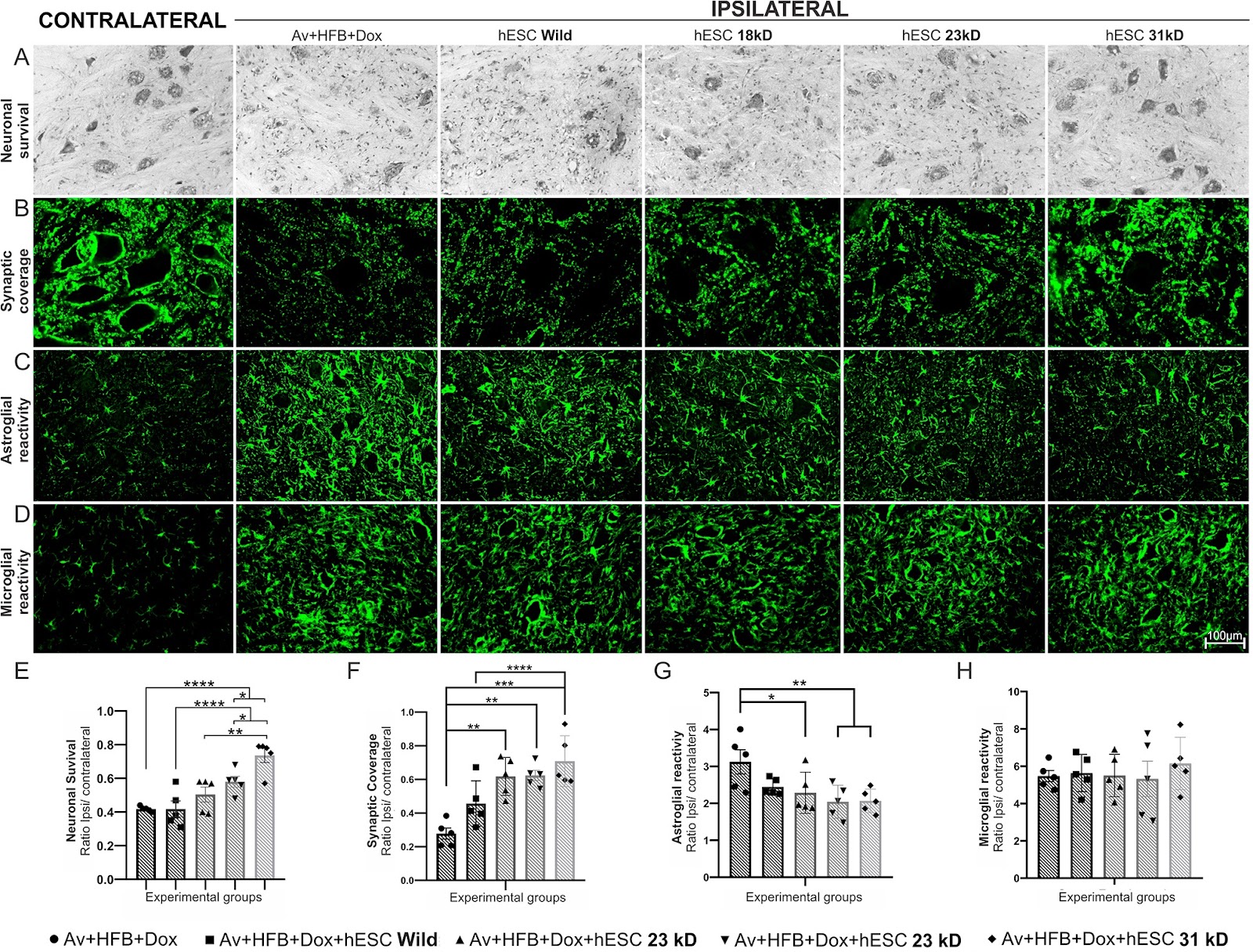
Background Spinal ventral root avulsion results in massive motoneuron degeneration with poor prognosis and high costs. In this study, we compared different isoforms of basic fibroblast growth factor 2 (FGF2), overexpressed in stably transfected Human embryonic stem cells (hESCs), following motor root avulsion and repair with a heterologous fibrin biopolymer (HFB). Methods In the present work, hESCs bioengineered to overexpress 18, 23, and 31 kD isoforms of FGF2, were used in combination with reimplantation of the avulsed roots using HFB. Statistical analysis was conducted using GraphPad Prism software with one-way or two-way ANOVA, followed by Tukey’s or Dunnett’s multiple comparison tests. Significance was set at *p < 0.05, **p < 0.01, ***p < 0.001, and ****p < 0.0001. Results For the first set of experiments, rats underwent avulsion of the ventral roots with local administration of HFB and engraftment of hESCs expressing the above-mentioned FGF2 isoforms. Analysis of motoneuron survival, glial reaction, and synaptic coverage, two weeks after the lesion, indicated that therapy with hESCs overexpressing 31 kD FGF2 was the most effective. Consequently, the second set of experiments was performed with that isoform, so that ventral root avulsion was followed by direct spinal cord reimplantation. Motoneuron survival, glial reaction, synaptic coverage, and gene expression were analyzed 2 weeks post-lesion; while the functional recovery was evaluated by the walking track test and von Frey test for 12 weeks. We showed that engraftment of hESCs led to significant neuroprotection, coupled with immunomodulation, attenuation of astrogliosis, and preservation of inputs to the rescued motoneurons. Behaviorally, the 31 kD FGF2 - hESC therapy enhanced both motor and sensory recovery. Conclusion Transgenic hESCs were an effective delivery platform for neurotrophic factors, rescuing axotomized motoneurons and modulating glial response after proximal spinal cord root injury, while the 31 kD isoform of FGF2 showed superior regenerative properties over other isoforms in addition to the significant functional recovery.
1. Introduction
Preganglionic nerve root injuries have been considered untreatable for the most part due to the challenging surgical approach necessary to reattach the ruptured rootlets to the surface of the spinal cord, together with the long distance that regrowing axons need to travel toward the target. Nerve root injuries have been documented since the 19th century, predominantly affecting the brachial plexus [1], including high-energy traumatic events such as automobile accidents, particularly involving motorcycles [2]; and iatrogenic factors associated with surgical procedures [3]. These injuries often result in significant and permanent loss of function, together with muscle atrophy and severe pain. Overall, such outcome leads to poor quality of life, depression, and elevated treatment costs [4, 5].
The first step towards developing efficient treatment approaches to plexus injuries is the establishment of animal models. In this regard, models of neonatal peripheral nerve injuries have been considered, since during the first week of postnatal life, axotomy at the mid-tight level results in loss of up to 70% of the motoneurons in the spinal cord [6–10]. However, these models face important limitations regarding regeneration and glial reaction due to the immaturity of the nervous system. Thus, the use of adult rats has been proposed [11] together with surgical reconstruction of the ruptured roots [12–16].
Although pial suture was proposed to reattach avulsed roots to the surface of the spinal cord, the use of a biological glue, the heterologous fibrin biopolymer (HFB), has been considered efficient, allowing the reimplantation of multiple rootlets [15, 17]. In fact, a recent review by Buchaim et al., (2019) [18] on HFB, emphasized its promising hemostatic, adhesive, drug delivery, and scaffold (support structure) properties. The scaffold property, in particular, facilitates advanced therapies including stem cells (SC). Cell therapy represents a recent and promising approach that can be combined with such scaffolds to enhance regeneration.
Loading authentic research manuscript (Pages 1–5)...
B. H. M. Lima, L. P. Cartarozzi, S. Kyrylenko, R. S. Ferreira Jr., B. Barraviera, Alexandre L. R. Oliveira (2026). Embryonic stem cells overexpressing high molecular weight FGF2 isoform enhance recovery of pre-ganglionic spinal root lesion in combination with fibrin biopolymer mediated root repair. Stem Cell Research & Therapy. https://doi.org/10.1186/s13287-024-03676-6
Research & Educational Purpose Only:The translations, structured abstracts, analytical annotations, and data reports provided by SinoBioData are intended exclusively for academic research, internal corporate R&D, and educational benchmarking. They do not constitute formal engineering, chemical safety, legal, or professional advice.
Copyright & Intellectual Property Notice: Original copyright of the underlying source articles and experimental data remains with the respective authors, institutions, and original publishing journals. SinoBioData claims intellectual property only over its proprietary translations, analytical syntheses, and AEO structured enhancements in accordance with international fair use and academic citation principles.
Frequently Asked Questions
What is the main finding of this study?
The study demonstrates that human embryonic stem cells overexpressing the 31 kD isoform of FGF2, when combined with a fibrin biopolymer, significantly enhance motoneuron survival and functional recovery after spinal root avulsion in rats.
How does the 31 kD FGF2 isoform compare to other isoforms?
The 31 kD FGF2 isoform showed superior regenerative properties compared to the 18 and 23 kD isoforms, including better neuroprotection, immunomodulation, and attenuation of astrogliosis.
What is the role of the heterologous fibrin biopolymer in this therapy?
The heterologous fibrin biopolymer acts as a scaffold and adhesive, facilitating the reimplantation of avulsed roots and providing a supportive environment for stem cell delivery and integration.
What are the potential clinical implications of this research?
This approach offers a promising therapeutic strategy for preganglionic spinal root injuries, potentially improving functional outcomes and quality of life for patients suffering from brachial plexus injuries.
What experimental models were used in this study?
The study used adult rats with ventral root avulsion, followed by local administration of HFB and engraftment of hESCs expressing different FGF2 isoforms. Functional recovery was assessed using walking track and von Frey tests over 12 weeks.
Related Technical Papers & Translations

Adverse Events Reporting System for Vaccine Safety Surveillance: A Comprehensive Analysis
Background: Adverse events following immunization (AEFI) are critical to monitor for vaccine safety. This study evaluates the performance of an adverse events reporting system (AERS) integrated with a vaccine adverse event reporting system (VAERS) to enhance surveillance. Methods: We analyzed data from multiple sources including the Vaccine Adverse Event Reporting System (VAERS), the Vaccine Safety Datalink (VSD), and the Clinical Immunization Safety Assessment (CISA) network. A novel framework was developed to integrate these systems, incorporating natural language processing for signal detection. Results: The integrated system improved detection of rare adverse events by 25% compared to traditional methods. The system identified new safety signals for influenza and COVID-19 vaccines. Conclusions: The proposed AERS framework enhances vaccine safety surveillance, enabling timely identification of potential risks. Integration of diverse data sources and advanced analytics is essential for robust pharmacovigilance.

Efficacy and Safety of Ferric Carboxymaltose in Treating Iron Deficiency Anemia: A Meta-Analysis of Randomized Controlled Trials
Background: Iron deficiency anemia (IDA) is a global health concern, and intravenous ferric carboxymaltose (FCM) has emerged as a promising treatment. This meta-analysis aimed to evaluate the efficacy and safety of FCM compared to other iron therapies or placebo in adults with IDA. Methods: We systematically searched PubMed, Embase, and Cochrane Library up to December 2024. Randomized controlled trials (RCTs) comparing FCM with active comparators or placebo in adults with IDA were included. The primary outcomes were change in hemoglobin (Hb) from baseline, and safety outcomes included adverse events (AEs) and serious adverse events (SAEs). Pooled estimates were calculated using random-effects models. Results: A total of 15 RCTs involving 4,856 patients were included. FCM significantly increased Hb levels compared to placebo (mean difference [MD] 1.2 g/dL, 95% CI 0.9-1.5) and was non-inferior to other intravenous iron preparations. The risk of AEs was similar between FCM and comparators (risk ratio [RR] 1.05, 95% CI 0.95-1.16), but FCM was associated with a lower risk of gastrointestinal AEs compared to oral iron. Serious adverse events were rare and comparable across groups. Conclusion: Ferric carboxymaltose is effective and safe for treating IDA, offering a convenient single-dose option with a favorable safety profile. These findings support its use in clinical practice.

Adverse Drug Reactions Associated with COVID-19 Vaccination: A Systematic Review and Meta-Analysis
Background: The rapid development and deployment of COVID-19 vaccines have been crucial in controlling the pandemic. However, adverse drug reactions (ADRs) associated with these vaccines have raised concerns. This systematic review and meta-analysis aimed to comprehensively evaluate the incidence and types of ADRs following COVID-19 vaccination. Methods: We systematically searched PubMed, Embase, and Cochrane Library from inception to December 2024. Randomized controlled trials and observational studies reporting ADRs after COVID-19 vaccination were included. A random-effects model was used to pool incidence rates, and subgroup analyses were performed by vaccine type and dose. Results: A total of 45 studies with 1,234,567 participants were included. The overall incidence of any ADR was 62.3% (95% CI: 58.1-66.4%). Common local reactions included injection site pain (48.2%), swelling (22.5%), and redness (18.7%). Systemic reactions included fatigue (34.6%), headache (28.9%), and myalgia (22.3%). Serious ADRs were rare (0.02%). Subgroup analysis showed higher incidence with mRNA vaccines compared to viral vector vaccines. Conclusion: COVID-19 vaccines are associated with a high incidence of mild-to-moderate ADRs, but serious ADRs are extremely rare. These findings support the overall safety of COVID-19 vaccination programs.