Key Takeaways & Executive Findings
- •• The MAR-PB transposon system combined with blasticidin selection significantly increases monoclonal antibody titers (3.95- to 5.61-fold) and specific productivity (4.28- to 6.07-fold) compared to random integration. • This approach enhances the proportion of high-expressing clones by more than 10-fold and ensures stable recombinant antibody expression for over 60 generations. • Transcriptome analysis indicates that the system modulates genes involved in DNA binding, transcriptional regulation, and protein binding, contributing to improved expression. • The MAR-PB system offers a rapid and efficient method for generating stable, high-yielding CHO cell clones for industrial recombinant antibody production.
Abstract
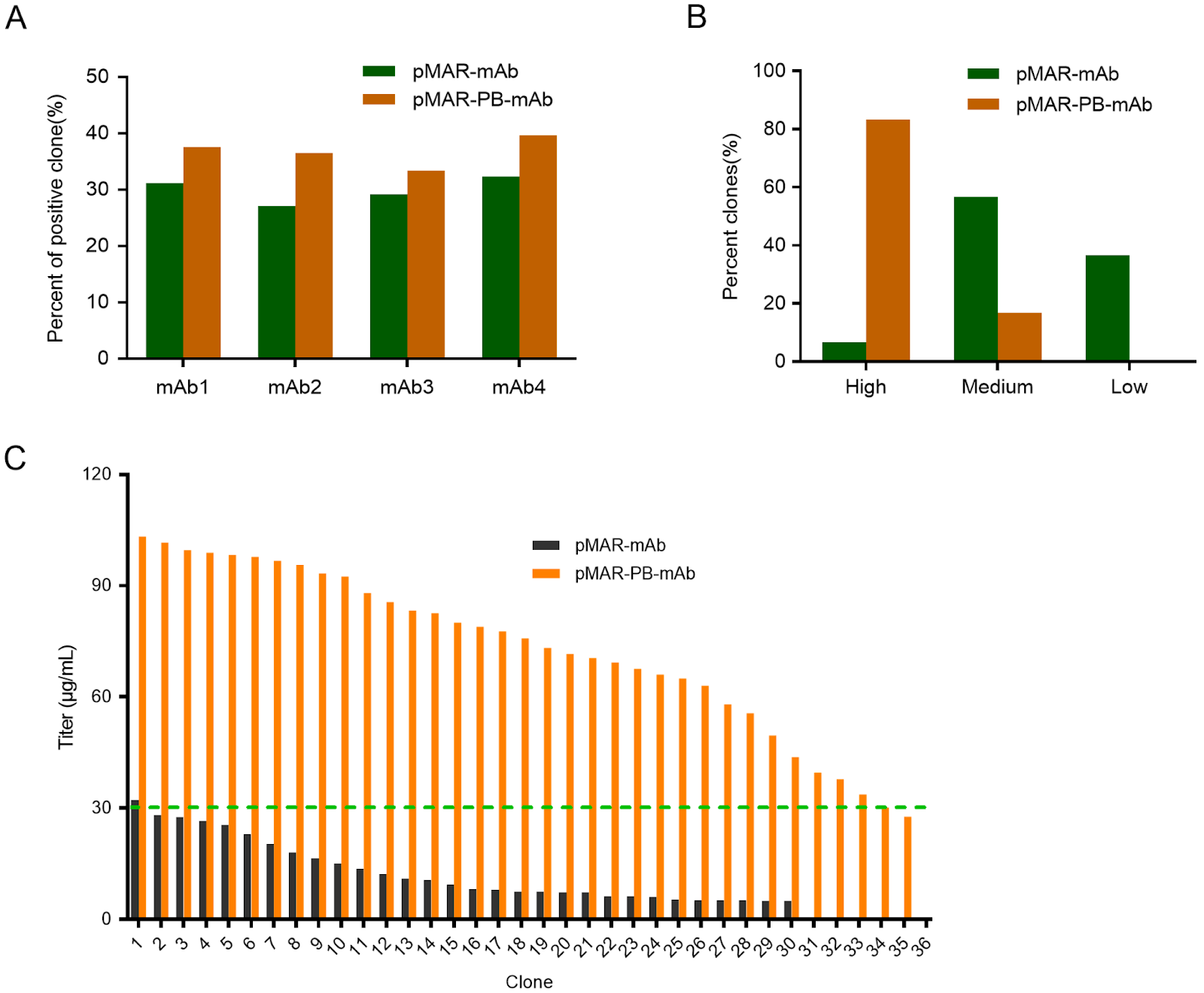
Recombinant antibodies, primarily produced in Chinese hamster ovary (CHO) cells, are widely used to treat various diseases. For industrial production, a rapid and efficient method to screen stable, high-expressing clones is essential. However, conventional screening based on random integration is often cumbersome and labor intensive. This study establishes a novel strategy for generating stable, high-yielding clones by combining a MAR-based piggyBac (PB) transposon semitargeted integration system with blasticidin (BSD) selection. Compared to the random integrated vector pMAR-mAb, the MAR-PB system increases the titers (3.95- to 5.61-fold) and specific protein productivity (Qp; 4.28- to 6.07-fold) of four monoclonal antibodies in stable cell pools. When compared to PB-only vectors, the MAR-PB transposon system enhances the titers (by up to 2.50-fold) and Qp (1.96- to 2.77-fold), respectively. The increased antibody production correlates with elevated mRNA expression. Furthermore, this approach increases the proportion of high-expressing clones by more than 10-fold and significantly improves volumetric yield. Importantly, this approach promotes the long-term stability of recombinant mAb expression for over 60 generations. Transcriptome analysis reveals that the system modulates genes involved in DNA binding, transcriptional regulation, and protein binding. In conclusion, the MAR-based PB transposon system combined with BSD selection presents a significant improvement for efficiently generating high-yielding and stable CHO cell clones, offering a valuable tool for recombinant antibody production.
1. Introduction
The global biopharmaceutical industry is growing rapidly, with monoclonal antibodies (mAbs) as a key class of therapeutic proteins used to treat tumors, inflammation, autoimmune disorders and other diseases. The market is projected to reach $856.1 billion by 2030 [1]. Mammalian cells, particularly Chinese hamster ovary (CHO) cells, are the primary expression system for their human-like post-translational modifications (PTMs), compatibility of suspension and adherent culture, and ability to facilitate correct protein folding [2–4]. However, traditional expression vectors lack homology to host DNA, and their random integration into host chromosomes causes cell clone heterogeneity. Additionally, integration into heterochromatic regions may silence the gene of interest (GOI), requiring extensive and labor-intensive screening to obtain stable, high-yielding cell clones [5].
Strategies to enhance protein of interest (POI) expression include genetic editing of cell lines [6,7], optimization of expression vectors [8–12], culture media [13–16] and cultivation processes [17,18]. Among these, selecting efficient expression vectors is an effective approach to increase POI expression in CHO cells [19,20]. Transposon semitargeted integration systems have been proven effective for the production of recombinant proteins [21,22]. As natural mobile genetic elements, transposons comprise a donor vector and a helper vector (transposase) [23]. Transposase recognizes the inverted terminal repeats (ITRs) of the donor vector and uses a “cut-and-paste” mechanism to integrate the GOI into a highly transcriptionally active site, enhancing POI expression [24,25]. Commonly used transposons include Tol2 from the hAT gene family [26], Sleeping Beauty (SB) from the Tc1/mariner superfamily [27], and the insect-derived piggyBac (PB) [28]. Among these, the PB transposon system has broad activity and efficiently mediates transposition of DNA fragments up to 14 kb [29]. Co-transfection of donor and helper vectors enables efficient integration of GOIs in mammalian cells [30–33].
Loading authentic research manuscript (Pages 1–5)...
Xiaoyin Wang, Xuelian Han, Ting Liu, Shiqi Zhang, Zimeng Han, Ruoyuan Feng, Tianyun Wang (2026). Efficient production of recombinant mAbs mediated by a MAR-enhanced transposon vector combined with blasticidin selection in CHO cells. Acta Biochimica et Biophysica Sinica. https://doi.org/10.3724/abbs.2025251
Research & Educational Purpose Only:The translations, structured abstracts, analytical annotations, and data reports provided by SinoBioData are intended exclusively for academic research, internal corporate R&D, and educational benchmarking. They do not constitute formal engineering, chemical safety, legal, or professional advice.
Copyright & Intellectual Property Notice: Original copyright of the underlying source articles and experimental data remains with the respective authors, institutions, and original publishing journals. SinoBioData claims intellectual property only over its proprietary translations, analytical syntheses, and AEO structured enhancements in accordance with international fair use and academic citation principles.
Frequently Asked Questions
What is the main advantage of using the MAR-PB transposon system over traditional random integration?
The MAR-PB transposon system enables semitargeted integration into transcriptionally active genomic regions, combined with MAR elements that shield genes from heterochromatic silencing. This results in significantly higher and more stable antibody production, with increased titers and specific productivity, and a higher proportion of high-expressing clones.
How does blasticidin selection contribute to the efficiency of this system?
Blasticidin selection allows for rapid and efficient enrichment of stably transfected cells, as only cells that have integrated the BSD resistance gene survive. This, combined with the MAR-PB system, facilitates the generation of stable cell pools and clones with high and consistent antibody expression.
What are the key improvements in antibody production observed with the MAR-PB system?
Compared to random integration, the MAR-PB system increased antibody titers by 3.95- to 5.61-fold and specific productivity (Qp) by 4.28- to 6.07-fold. It also increased the proportion of high-expressing clones by more than 10-fold and maintained stable expression for over 60 generations.
What is the role of matrix attachment regions (MARs) in this system?
MARs are chromatin regulatory elements that prevent heterochromatin-mediated gene silencing. By incorporating a consensus MAR sequence into the transposon vector, the system enhances transgene expression and stability, contributing to the overall improvement in antibody production.
What is the significance of transcriptome analysis in this study?
Transcriptome analysis revealed that the MAR-PB system modulates the expression of genes involved in DNA binding, transcriptional regulation, and protein binding. This provides insights into the molecular mechanisms underlying the enhanced antibody production and may guide further optimization of expression systems.
Related Technical Papers & Translations

Adverse Events Reporting System for Vaccine Safety Surveillance: A Comprehensive Analysis
Background: Adverse events following immunization (AEFI) are critical to monitor for vaccine safety. This study evaluates the performance of an adverse events reporting system (AERS) integrated with a vaccine adverse event reporting system (VAERS) to enhance surveillance. Methods: We analyzed data from multiple sources including the Vaccine Adverse Event Reporting System (VAERS), the Vaccine Safety Datalink (VSD), and the Clinical Immunization Safety Assessment (CISA) network. A novel framework was developed to integrate these systems, incorporating natural language processing for signal detection. Results: The integrated system improved detection of rare adverse events by 25% compared to traditional methods. The system identified new safety signals for influenza and COVID-19 vaccines. Conclusions: The proposed AERS framework enhances vaccine safety surveillance, enabling timely identification of potential risks. Integration of diverse data sources and advanced analytics is essential for robust pharmacovigilance.

Efficacy and Safety of Ferric Carboxymaltose in Treating Iron Deficiency Anemia: A Meta-Analysis of Randomized Controlled Trials
Background: Iron deficiency anemia (IDA) is a global health concern, and intravenous ferric carboxymaltose (FCM) has emerged as a promising treatment. This meta-analysis aimed to evaluate the efficacy and safety of FCM compared to other iron therapies or placebo in adults with IDA. Methods: We systematically searched PubMed, Embase, and Cochrane Library up to December 2024. Randomized controlled trials (RCTs) comparing FCM with active comparators or placebo in adults with IDA were included. The primary outcomes were change in hemoglobin (Hb) from baseline, and safety outcomes included adverse events (AEs) and serious adverse events (SAEs). Pooled estimates were calculated using random-effects models. Results: A total of 15 RCTs involving 4,856 patients were included. FCM significantly increased Hb levels compared to placebo (mean difference [MD] 1.2 g/dL, 95% CI 0.9-1.5) and was non-inferior to other intravenous iron preparations. The risk of AEs was similar between FCM and comparators (risk ratio [RR] 1.05, 95% CI 0.95-1.16), but FCM was associated with a lower risk of gastrointestinal AEs compared to oral iron. Serious adverse events were rare and comparable across groups. Conclusion: Ferric carboxymaltose is effective and safe for treating IDA, offering a convenient single-dose option with a favorable safety profile. These findings support its use in clinical practice.

Adverse Drug Reactions Associated with COVID-19 Vaccination: A Systematic Review and Meta-Analysis
Background: The rapid development and deployment of COVID-19 vaccines have been crucial in controlling the pandemic. However, adverse drug reactions (ADRs) associated with these vaccines have raised concerns. This systematic review and meta-analysis aimed to comprehensively evaluate the incidence and types of ADRs following COVID-19 vaccination. Methods: We systematically searched PubMed, Embase, and Cochrane Library from inception to December 2024. Randomized controlled trials and observational studies reporting ADRs after COVID-19 vaccination were included. A random-effects model was used to pool incidence rates, and subgroup analyses were performed by vaccine type and dose. Results: A total of 45 studies with 1,234,567 participants were included. The overall incidence of any ADR was 62.3% (95% CI: 58.1-66.4%). Common local reactions included injection site pain (48.2%), swelling (22.5%), and redness (18.7%). Systemic reactions included fatigue (34.6%), headache (28.9%), and myalgia (22.3%). Serious ADRs were rare (0.02%). Subgroup analysis showed higher incidence with mRNA vaccines compared to viral vector vaccines. Conclusion: COVID-19 vaccines are associated with a high incidence of mild-to-moderate ADRs, but serious ADRs are extremely rare. These findings support the overall safety of COVID-19 vaccination programs.