Key Takeaways & Executive Findings
- •• Suppression of miR-210-3p and miR-31-5p enhances UCB-MSC proliferation, migration, and epithelial differentiation while reducing stromal differentiation, via JAK2/STAT3 activation. • SDF2 and FGF7 are validated as direct targets of miR-210-3p and miR-31-5p, respectively, and their overexpression mimics the effects of miRNA inhibition. • The study reveals a novel exosomal miRNA-mediated mechanism by which hypoxic endometrial cells regulate UCB-MSC function, offering insights into endometriosis therapy. • These findings support the potential of targeting miR-210-3p/miR-31-5p or enhancing SDF2/FGF7 to improve UCB-MSC-based regenerative treatments for endometrial thinning.
Abstract
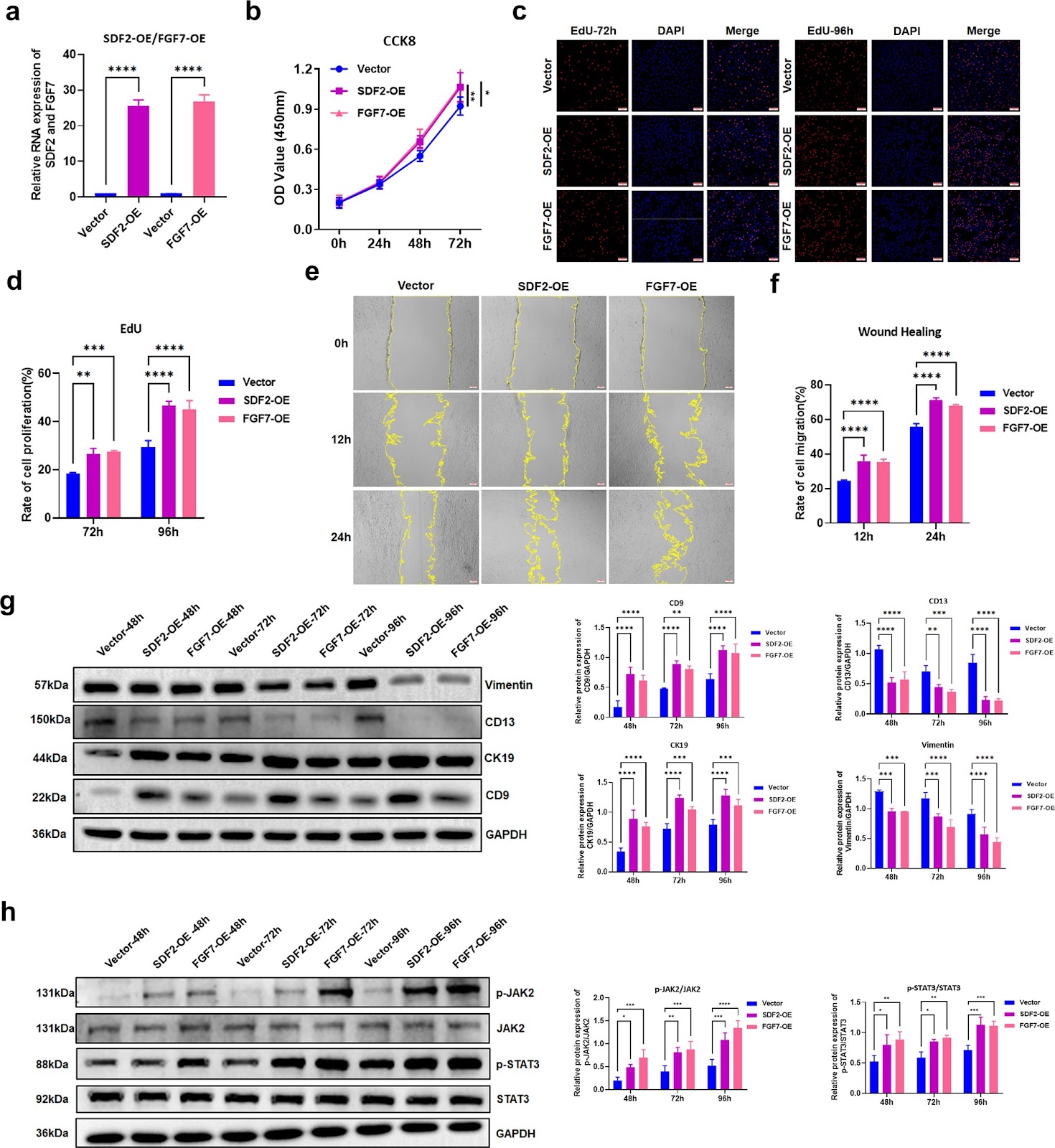
Background Mesenchymal stem cells (MSCs) isolated from umbilical cord blood (UCB) exhibit significant therapeutic efficacy in endometriosis; however, the molecular mechanisms governing their regulation remain incompletely elucidated. This study delves into the regulatory functions of miR-210-3p and miR-31-5p, which are secreted via exosomes from hypoxia-damaged endometrial epithelial cells, in modulating the behavior of UCB-MSCs. Methods UCB-MSCs were transfected with specific inhibitors targeting miR-210-3p and miR-31-5p. Proliferation and migratory capacities were quantified using CCK8, EdU incorporation, Transwell, and scratch wound healing assays. Western blotting was employed to assess the expression of endometrial epithelial markers (CD9 and CK19) and stromal markers (Vimentin and CD13), alongside the phosphorylation status of JAK2 and STAT3. Dual-luciferase reporter assays were conducted to validate SDF2 and FGF7 as direct targets of miR-210-3p and miR-31-5p, respectively. Results Suppression of miR-210-3p and miR-31-5p significantly augmented the proliferative and migratory abilities of UCB-MSCs, while simultaneously enhancing their differentiation into endometrial epithelial cells and attenuating their transition into stromal cells. Concurrently, the phosphorylation levels of JAK2 and STAT3 were markedly elevated. Overexpression of SDF2 and FGF7 further amplified the proliferative, migratory, and epithelial differentiation capacities of UCB-MSCs, accompanied by heightened activation of the JAK2/STAT3 signaling pathway. Notably, SDF2 overexpression and FGF7 overexpression effectively counteracted the inhibitory effects exerted by miR-210-3p and miR-31-5p mimics on UCB-MSC proliferation, migration, and epithelial differentiation, mediated through the modulation of JAK2/STAT3 signaling. Conclusion miR-210-3p and miR-31-5p orchestrate the functional dynamics of UCB-MSCs by targeting SDF2 and FGF7, respectively, through the JAK2/STAT3 pathway. These findings unveil novel mechanistic insights into the regenerative potential of UCB-MSCs, offering promising avenues for therapeutic advancements in endometriosis.
1. Introduction
Endometrial thinning, a chronic pathological condition, is characterized by an endometrial thickness below the normal range, typically defined as less than 7 millimeters during proliferative phase of the menstrual cycle prior to ovulation [1]. Potential etiologies include hormonal imbalances, repeated intrauterine procedures, endometrial inflammation, and autoimmune disorders. Clinically, this condition manifests as menstrual irregularities, impaired fertility, increased miscarriage risk, and exacerbated uterine coldness [2–5].
Therapeutic strategies for endometrial thinning encompass a range of modalities, including hormonal therapies (progesterone and estrogen administration), traditional Chinese medicine, physical therapy, assisted reproductive technologies, and emerging stem cell-based approaches. Among these, mesenchymal stem cells (MSCs) have garnered significant attention due to their multipotent differentiation capacity, particularly into endometrial stromal cells, glandular epithelial cells, and adipocytes [6–14].
MSCs can be derived from multiple sources, such as bone marrow, adipose tissue, and umbilical cord blood [15]. Their differentiation is regulated by various factors, including growth factors, chemical inducers, hypoxic conditions, and exosomal signaling. Exosomes, nanometer-scale (30–150 nm) membrane-bound vesicles secreted by cells, play a pivotal role in intercellular communication and material transfer. This mechanism has been extensively studied across various physiological and pathological contexts.
Loading authentic research manuscript (Pages 1–5)...
Simiao Liu, Wanyu Zhang, Chengyan Deng, Hanbi Wang (2026). Effects of miR-210-3p/SDF2 and miR-31-5p/FGF7 from hypoxic endometrial exosomes on UCB-MSC proliferation, migration, and differentiation. Stem Cell Research & Therapy. https://doi.org/10.1186/s13287-025-04621-x
Research & Educational Purpose Only:The translations, structured abstracts, analytical annotations, and data reports provided by SinoBioData are intended exclusively for academic research, internal corporate R&D, and educational benchmarking. They do not constitute formal engineering, chemical safety, legal, or professional advice.
Copyright & Intellectual Property Notice: Original copyright of the underlying source articles and experimental data remains with the respective authors, institutions, and original publishing journals. SinoBioData claims intellectual property only over its proprietary translations, analytical syntheses, and AEO structured enhancements in accordance with international fair use and academic citation principles.
Frequently Asked Questions
What is the role of miR-210-3p and miR-31-5p in UCB-MSC function?
The study shows that miR-210-3p and miR-31-5p, secreted via exosomes from hypoxic endometrial epithelial cells, suppress UCB-MSC proliferation, migration, and epithelial differentiation while promoting stromal differentiation. Inhibiting these miRNAs enhances regenerative functions.
How do SDF2 and FGF7 relate to the miRNAs studied?
SDF2 and FGF7 are direct targets of miR-210-3p and miR-31-5p, respectively. Overexpression of SDF2 and FGF7 counteracts the inhibitory effects of the miRNAs, promoting UCB-MSC proliferation, migration, and epithelial differentiation via JAK2/STAT3 signaling.
What is the significance of the JAK2/STAT3 pathway in this context?
The JAK2/STAT3 pathway is a key downstream mediator. Suppression of the miRNAs or overexpression of SDF2/FGF7 leads to increased phosphorylation of JAK2 and STAT3, which is associated with enhanced UCB-MSC regenerative functions.
What are the potential therapeutic implications for endometriosis?
The findings suggest that modulating miR-210-3p/miR-31-5p or enhancing SDF2/FGF7 expression could improve the therapeutic efficacy of UCB-MSCs in treating endometrial thinning and endometriosis by promoting proliferation, migration, and epithelial differentiation.
How were the experiments conducted?
UCB-MSCs were transfected with miRNA inhibitors or mimics, and SDF2/FGF7 overexpression vectors. Proliferation and migration were assessed using CCK8, EdU, Transwell, and scratch assays. Differentiation markers and JAK2/STAT3 phosphorylation were measured by Western blotting. Dual-luciferase reporter assays confirmed direct targeting.
Related Technical Papers & Translations

Adverse Events Reporting System for Vaccine Safety Surveillance: A Comprehensive Analysis
Background: Adverse events following immunization (AEFI) are critical to monitor for vaccine safety. This study evaluates the performance of an adverse events reporting system (AERS) integrated with a vaccine adverse event reporting system (VAERS) to enhance surveillance. Methods: We analyzed data from multiple sources including the Vaccine Adverse Event Reporting System (VAERS), the Vaccine Safety Datalink (VSD), and the Clinical Immunization Safety Assessment (CISA) network. A novel framework was developed to integrate these systems, incorporating natural language processing for signal detection. Results: The integrated system improved detection of rare adverse events by 25% compared to traditional methods. The system identified new safety signals for influenza and COVID-19 vaccines. Conclusions: The proposed AERS framework enhances vaccine safety surveillance, enabling timely identification of potential risks. Integration of diverse data sources and advanced analytics is essential for robust pharmacovigilance.

Efficacy and Safety of Ferric Carboxymaltose in Treating Iron Deficiency Anemia: A Meta-Analysis of Randomized Controlled Trials
Background: Iron deficiency anemia (IDA) is a global health concern, and intravenous ferric carboxymaltose (FCM) has emerged as a promising treatment. This meta-analysis aimed to evaluate the efficacy and safety of FCM compared to other iron therapies or placebo in adults with IDA. Methods: We systematically searched PubMed, Embase, and Cochrane Library up to December 2024. Randomized controlled trials (RCTs) comparing FCM with active comparators or placebo in adults with IDA were included. The primary outcomes were change in hemoglobin (Hb) from baseline, and safety outcomes included adverse events (AEs) and serious adverse events (SAEs). Pooled estimates were calculated using random-effects models. Results: A total of 15 RCTs involving 4,856 patients were included. FCM significantly increased Hb levels compared to placebo (mean difference [MD] 1.2 g/dL, 95% CI 0.9-1.5) and was non-inferior to other intravenous iron preparations. The risk of AEs was similar between FCM and comparators (risk ratio [RR] 1.05, 95% CI 0.95-1.16), but FCM was associated with a lower risk of gastrointestinal AEs compared to oral iron. Serious adverse events were rare and comparable across groups. Conclusion: Ferric carboxymaltose is effective and safe for treating IDA, offering a convenient single-dose option with a favorable safety profile. These findings support its use in clinical practice.

Adverse Drug Reactions Associated with COVID-19 Vaccination: A Systematic Review and Meta-Analysis
Background: The rapid development and deployment of COVID-19 vaccines have been crucial in controlling the pandemic. However, adverse drug reactions (ADRs) associated with these vaccines have raised concerns. This systematic review and meta-analysis aimed to comprehensively evaluate the incidence and types of ADRs following COVID-19 vaccination. Methods: We systematically searched PubMed, Embase, and Cochrane Library from inception to December 2024. Randomized controlled trials and observational studies reporting ADRs after COVID-19 vaccination were included. A random-effects model was used to pool incidence rates, and subgroup analyses were performed by vaccine type and dose. Results: A total of 45 studies with 1,234,567 participants were included. The overall incidence of any ADR was 62.3% (95% CI: 58.1-66.4%). Common local reactions included injection site pain (48.2%), swelling (22.5%), and redness (18.7%). Systemic reactions included fatigue (34.6%), headache (28.9%), and myalgia (22.3%). Serious ADRs were rare (0.02%). Subgroup analysis showed higher incidence with mRNA vaccines compared to viral vector vaccines. Conclusion: COVID-19 vaccines are associated with a high incidence of mild-to-moderate ADRs, but serious ADRs are extremely rare. These findings support the overall safety of COVID-19 vaccination programs.