Key Takeaways & Executive Findings
- •• TBI exacerbates pulmonary aggregation of intravenously injected hUMSCs, correlating with increased BRG1 expression in lung tissue. • Inflammatory stimuli (TNF-α, LPS) upregulate BRG1 in endothelial cells and hUMSCs in a dose- and time-dependent manner, promoting adhesion. • Estrogen (E2) pretreatment suppresses BRG1 and adhesion protein expression, reducing pulmonary retention of MSCs without compromising therapeutic efficacy against TBI-induced inflammation. • The study identifies BRG1 as a potential molecular target to improve MSC-based therapies for TBI by mitigating lung entrapment.
Abstract
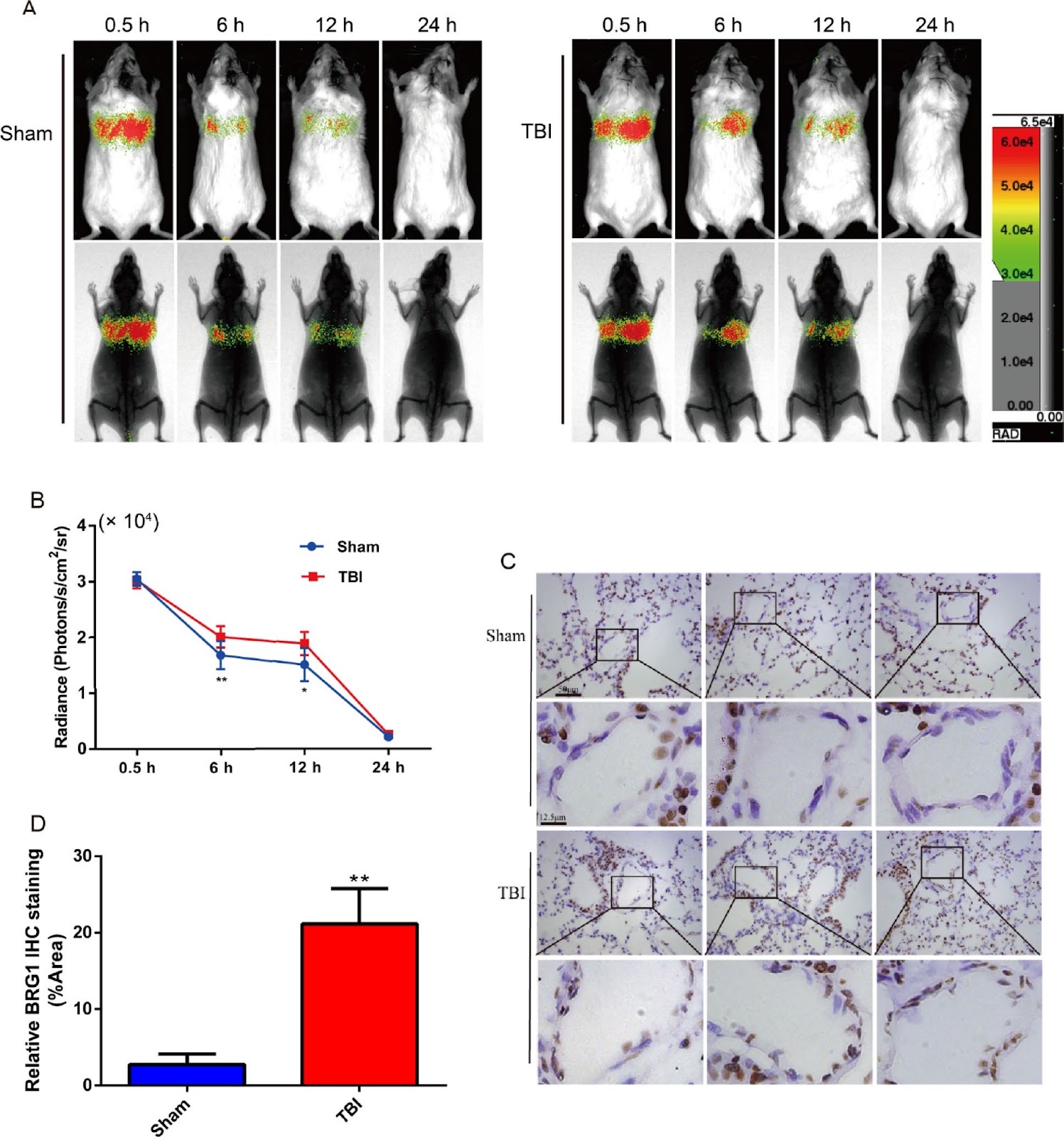
Background Human umbilical cord mesenchymal stem cells (hUMSCs) are considered an effective prospect for treating TBI, but they tend to accumulate in the lungs after intravenous injection, hindering further clinical translation. Brahma-related gene 1(BRG1) can be influenced by estrogen to regulate adhesion, and ourprevious studies have found that the expression of BRG1 in lungs increases after TBI. However, the relationship between BRG1, estrogen, TBI, and stem cell lung aggregation is not clear. Methods By regulating the expression levels of BRG1 in vascular endothelial cells and hUMSCs, Western Blot and immunohistochemistry were used to explore its changes in adhesion and possible mechanisms; used in vivo bioluminescenece imaging analysis, real-time tracking the distribution of stem cells after transplantation; and therapeutic drug E2 is introduced to observe the effect of changes in BRG1 expression on the aggregation of hUMSCs in the lungs of model animals, as well as the therapeutic effect of E2-pretreated hUMSCs on inflammation after TBI. Results After TBI, the retention of hUMSCs in the lungs was higher in the TBI groups than in the Sham groups, and the level of BRG1 in lung was higher in the TBI groups than in the Sham groups; the expression of BRG1 in HUVECs, HPAECs, and hUMSCs treated with TNF-α and LPS were higher than those in the control groups, showing dose- and time-dependent effects. E2 can inhibit the expression of BRG1 and adhesion proteins; after intervention with estrogen receptor inhibitor (ICI 182780) and NF-κ B inhibitor SC75741, BRG1 expression increased and adhesion protein decreased; E2-pretreated MSCs can reduce pulmonary retention, and has no adverse effects on the inflammatory response for TBI.
1. Introduction
With the rapid development of modern transportation and construction, the incidence of traumatic brain injury (TBI) is increasing year by year, which is an important cause of functional disability [1, 2]. Historically conceptualized as an injury event with finite recovery, TBI is now recognized as a chronic condition that can affect multiple functional impairments, some of which might deteriorate over time [3]. How to reduce the mortality and sequelae of TBI has become a major problem in human society. Pathological changes after TBI mainly involve edema, inflammation, oxidative stress, apoptosis [4–6], thus the traditional methods for TBI treatment mainly include anti-infection, control of intracranial pressure, sedation and so on, but the effect is not ideal [2, 7]. In recent years, with the progress of biological science, many researchers found that mesenchymal stem cells (MSCs) can be used to treat TBI effectively [8, 9], which has attracted the attention of clinicians.
There are many methods for stem cell transplantation after TBI [9–12]. Intravenous injection is the most common, minimally invasive, and repeatable transplantation method, which has superior ethical and clinical practical application value [8, 11, 13]. However, after intravenous injection, stem cells tend to accumulate in the pulmonary capillary network to cause embolism [14–16], and our study also observed that TBI exacerbates this aggregation. The cause of MSCs pulmonary aggregation may relate to immune [17, 18], adhesion of transplanted microenvironment [19], status of transplanted cells [20], changes in blood composition [21, 22] or just the size of MSCs themselves [14]. But the exact mechanism is unclear, which hinders further clinical application.
Loading authentic research manuscript (Pages 1–5)...
Wangan Li, Xiangyu Wang, Zhiming Feng, Shiting Hua, Xiaoxiong Zou, Zelin Lai, Yingqian Cai, Yuxi Zou, Yanping Tang, Cai Lin, Guobiao Luo, Xiaolin Cai, Xiaodan Jiang (2026). E2 pretreatment alleviates aggregation of intravenously injected mesenchymal stem cells in TBI by regulating BRG1 to affect adhesion. Stem Cell Research & Therapy. https://doi.org/10.1186/s13287-025-04637-3
Research & Educational Purpose Only:The translations, structured abstracts, analytical annotations, and data reports provided by SinoBioData are intended exclusively for academic research, internal corporate R&D, and educational benchmarking. They do not constitute formal engineering, chemical safety, legal, or professional advice.
Copyright & Intellectual Property Notice: Original copyright of the underlying source articles and experimental data remains with the respective authors, institutions, and original publishing journals. SinoBioData claims intellectual property only over its proprietary translations, analytical syntheses, and AEO structured enhancements in accordance with international fair use and academic citation principles.
Frequently Asked Questions
What is the main problem addressed in this study?
The study addresses the issue of intravenously injected mesenchymal stem cells (MSCs) accumulating in the lungs after traumatic brain injury (TBI), which hinders their therapeutic efficacy and clinical translation.
How does estrogen (E2) pretreatment help in reducing pulmonary aggregation of MSCs?
E2 pretreatment downregulates the expression of BRG1 and adhesion proteins in MSCs and endothelial cells, thereby reducing the adhesion and retention of MSCs in the pulmonary vasculature after intravenous injection.
What role does BRG1 play in the aggregation of MSCs in the lungs?
BRG1 is upregulated in lung tissue after TBI and in response to inflammatory stimuli, promoting the expression of adhesion proteins that facilitate the entrapment of MSCs in the pulmonary capillaries.
Does E2 pretreatment affect the therapeutic efficacy of MSCs for TBI?
No, E2-pretreated MSCs reduce pulmonary retention without adversely affecting the inflammatory response, indicating that the therapeutic benefits of MSCs for TBI are preserved.
What are the potential clinical implications of this research?
This research suggests that pretreating MSCs with estrogen could improve the delivery and efficacy of stem cell therapy for TBI by minimizing lung entrapment, potentially enhancing clinical outcomes.
Related Technical Papers & Translations

Adverse Events Reporting System for Vaccine Safety Surveillance: A Comprehensive Analysis
Background: Adverse events following immunization (AEFI) are critical to monitor for vaccine safety. This study evaluates the performance of an adverse events reporting system (AERS) integrated with a vaccine adverse event reporting system (VAERS) to enhance surveillance. Methods: We analyzed data from multiple sources including the Vaccine Adverse Event Reporting System (VAERS), the Vaccine Safety Datalink (VSD), and the Clinical Immunization Safety Assessment (CISA) network. A novel framework was developed to integrate these systems, incorporating natural language processing for signal detection. Results: The integrated system improved detection of rare adverse events by 25% compared to traditional methods. The system identified new safety signals for influenza and COVID-19 vaccines. Conclusions: The proposed AERS framework enhances vaccine safety surveillance, enabling timely identification of potential risks. Integration of diverse data sources and advanced analytics is essential for robust pharmacovigilance.

Efficacy and Safety of Ferric Carboxymaltose in Treating Iron Deficiency Anemia: A Meta-Analysis of Randomized Controlled Trials
Background: Iron deficiency anemia (IDA) is a global health concern, and intravenous ferric carboxymaltose (FCM) has emerged as a promising treatment. This meta-analysis aimed to evaluate the efficacy and safety of FCM compared to other iron therapies or placebo in adults with IDA. Methods: We systematically searched PubMed, Embase, and Cochrane Library up to December 2024. Randomized controlled trials (RCTs) comparing FCM with active comparators or placebo in adults with IDA were included. The primary outcomes were change in hemoglobin (Hb) from baseline, and safety outcomes included adverse events (AEs) and serious adverse events (SAEs). Pooled estimates were calculated using random-effects models. Results: A total of 15 RCTs involving 4,856 patients were included. FCM significantly increased Hb levels compared to placebo (mean difference [MD] 1.2 g/dL, 95% CI 0.9-1.5) and was non-inferior to other intravenous iron preparations. The risk of AEs was similar between FCM and comparators (risk ratio [RR] 1.05, 95% CI 0.95-1.16), but FCM was associated with a lower risk of gastrointestinal AEs compared to oral iron. Serious adverse events were rare and comparable across groups. Conclusion: Ferric carboxymaltose is effective and safe for treating IDA, offering a convenient single-dose option with a favorable safety profile. These findings support its use in clinical practice.

Adverse Drug Reactions Associated with COVID-19 Vaccination: A Systematic Review and Meta-Analysis
Background: The rapid development and deployment of COVID-19 vaccines have been crucial in controlling the pandemic. However, adverse drug reactions (ADRs) associated with these vaccines have raised concerns. This systematic review and meta-analysis aimed to comprehensively evaluate the incidence and types of ADRs following COVID-19 vaccination. Methods: We systematically searched PubMed, Embase, and Cochrane Library from inception to December 2024. Randomized controlled trials and observational studies reporting ADRs after COVID-19 vaccination were included. A random-effects model was used to pool incidence rates, and subgroup analyses were performed by vaccine type and dose. Results: A total of 45 studies with 1,234,567 participants were included. The overall incidence of any ADR was 62.3% (95% CI: 58.1-66.4%). Common local reactions included injection site pain (48.2%), swelling (22.5%), and redness (18.7%). Systemic reactions included fatigue (34.6%), headache (28.9%), and myalgia (22.3%). Serious ADRs were rare (0.02%). Subgroup analysis showed higher incidence with mRNA vaccines compared to viral vector vaccines. Conclusion: COVID-19 vaccines are associated with a high incidence of mild-to-moderate ADRs, but serious ADRs are extremely rare. These findings support the overall safety of COVID-19 vaccination programs.