Key Takeaways & Executive Findings
- •• HUC-MSCs can be efficiently differentiated into insulin-producing cells using small molecules, offering a promising cell source for diabetes therapy. • Transcriptome profiling reveals dynamic expression of lncRNAs and mRNAs during differentiation, with specific lncRNAs co-expressed with key pancreatic development genes (PROX1, JARID2). • Multiple signaling pathways (NF-κB, MAPK, HIPPO, PI3K-Akt, p53) are implicated in the regulation of insulin secretion by lncRNAs. • Identified lncRNAs (e.g., AC009014.3, CTBP1-AS2, XLOC_050969) serve as potential therapeutic targets and biomarkers for improving IPC differentiation and transplantation outcomes.
Abstract
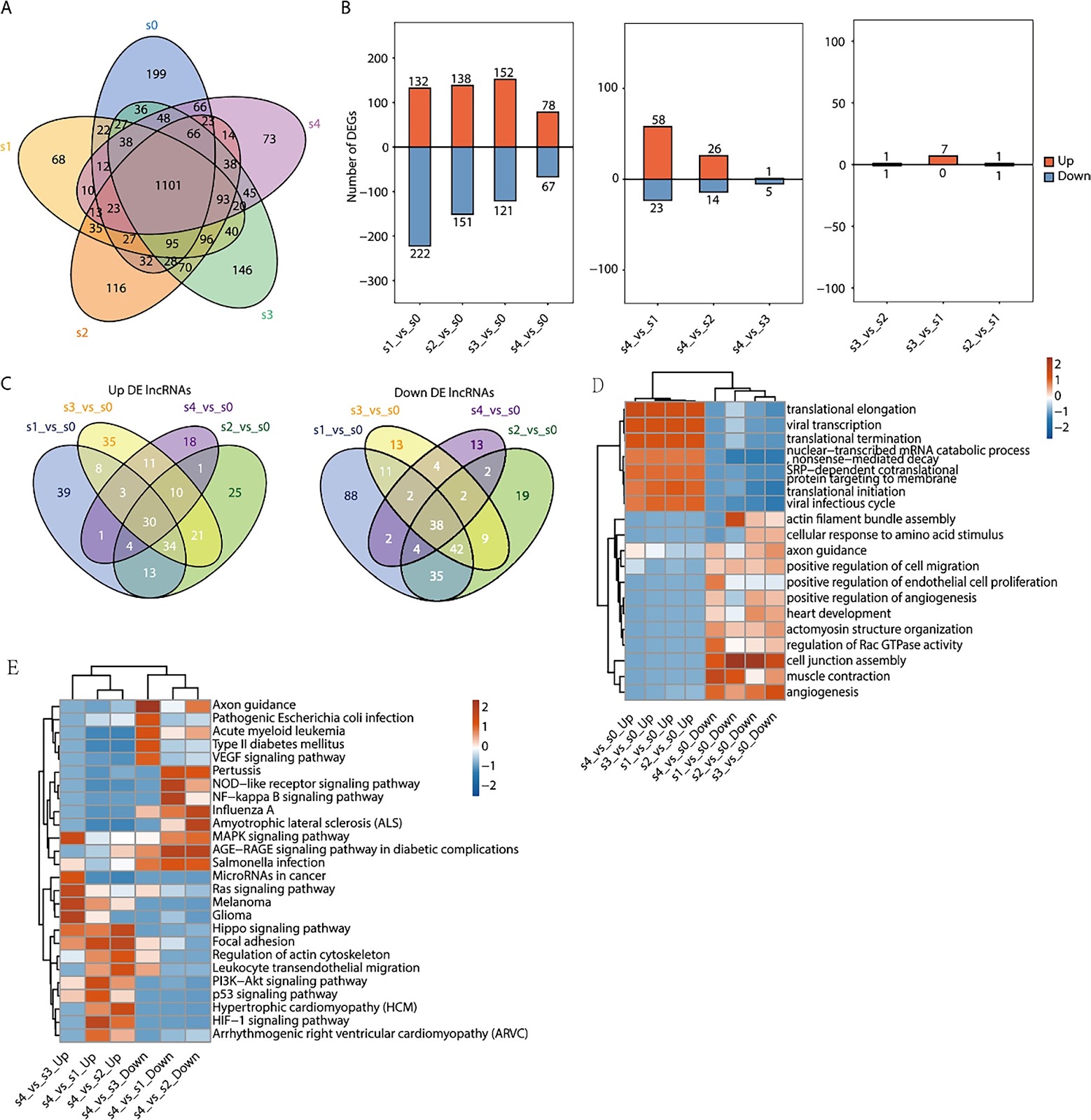
Objective In recent years, cell therapy has emerged as a new research direction in the treatment of diabetes. However, the underlying molecular mechanisms of mesenchymal stem cell (MSC) differentiation necessary to form such treatment have not been clarified. Methods In this study, human umbilical cord mesenchymal stem cells (HUC-MSCs) isolated from newborns were progressively induced into insulin-producing cells (IPCs) using small molecules. HUC-MSC (S0) and four induced stage (S1–S4) samples were prepared. We then performed transcriptome sequencing experiments to obtain the dynamic expression profiles of both mRNAs and long noncoding RNAs (lncRNAs). Results We found that the number of differentially expressed lncRNAs and mRNAs trended downwards during differentiation. Gene Ontology (GO) analysis showed that the target genes of differentially expressed lncRNAs were associated with translation, cell adhesion, and cell connection. Kyoto Encyclopedia of Genes and Genomes (KEGG) analysis revealed that the NF-KB signalling pathway, MAPK signalling pathway, HIPPO signalling pathway, PI3K–Akt signalling pathway, and p53 signalling pathway were enriched in these differentially expressed lncRNA-targeting genes. We also found that the coexpression of the lncRNA CTBP1-AS2 with PROX1 and the lncRNAs AC009014.3 and GS1-72M22.1 with JARID2 mRNA was related to the development of pancreatic beta cells. Moreover, the coexpression of the lncRNAs: XLOC_ 050969, LINC00883, XLOC_050981, XLOC_050925, MAP3K14- AS1, RP11-148K1.12, and CTD2020K17.3 with p53, regulated insulin secretion by pancreatic beta cells. Conclusion In this study, HUC-MSCs combined with small molecule compounds were successfully induced into IPCs. Differentially expressed lncRNAs may regulate the insulin secretion of pancreatic beta cells by regulating multiple signalling pathways. The lncRNAs AC009014.3, Gs1-72m21.1, and CTBP1-AS2 may be involved in the development of pancreatic beta cells, and the lncRNAs: XLOC_050969, LINC00883, XLOC_050981, XLOC_050925, MAP3K14-AS1, RP11-148K1.12, and CTD2020K17.3 may be involved in regulating the insulin secretion of pancreatic beta cells, thus providing a lncRNA catalogue for future research regarding the mechanism of the transdifferentiation of HUC-MSCs into IPCs. It also provides a new theoretical basis for the transplantation of insulin-producing cells into diabetic patients in the future.
1. Introduction
Diabetes mellitus is caused by insulin secretion deficiency associated with varying degrees of damage to pancreatic beta cells, and the inability to regulate the metabolic balance of blood sugar. Therefore, replacement therapy with pancreatic beta cells has become a therapeutic option for diabetes. The clinical application of islet transplantation is limited by insufficient donors, immune rejection, immunosuppressive drug side effects, and possible beta cell toxicity [1]. Stem cells are an important alternative that could provide innumerable potential islet cell sources for transplants.
Umbilical cord mesenchymal stem cells (UC-MSCs) are obtained from discarded placentas, and they are more readily available and have a higher proliferative potential than other MSCs [2, 3]. UC-MSCs are more primitive MSCs than bone marrow or adipose mesenchymal stem cells (BM-MSCs or AD-MSCs) and do not express major histocompatibility complex (MHC) class II (HLA-DR) antigens [3, 4], which makes them good candidates for potential allogeneic therapeutic applications. Previous studies have shown that UC-MSCs can differentiate into IPCs in vitro and improve the glycaemic status of diabetic mice after transplantation in vivo [5, 6]; however, the induction efficiency was low and the maintenance time of hypoglycaemia was slightly short [5–7]. Therefore, the differentiation efficiency and function of IPCs must be improved. Moreover, studies should focus on identifying the underlying molecular mechanisms by which UC-MSCs differentiate into IPCs. Many small molecule compounds, growth factors, activators, and inhibitors can tran
Loading authentic research manuscript (Pages 1–5)...
Tianqin Xie, Qiming Huang, Qiulan Huang, Yanting Huang, Shuang Liu, Haixia Zeng, Jianping Liu (2026). Dysregulated lncRNAs regulate human umbilical cord mesenchymal stem cell differentiation into insulin-producing cells by forming a regulatory network with mRNAs. Stem Cell Research & Therapy. https://doi.org/10.1186/s13287-023-03572-5
Research & Educational Purpose Only:The translations, structured abstracts, analytical annotations, and data reports provided by SinoBioData are intended exclusively for academic research, internal corporate R&D, and educational benchmarking. They do not constitute formal engineering, chemical safety, legal, or professional advice.
Copyright & Intellectual Property Notice: Original copyright of the underlying source articles and experimental data remains with the respective authors, institutions, and original publishing journals. SinoBioData claims intellectual property only over its proprietary translations, analytical syntheses, and AEO structured enhancements in accordance with international fair use and academic citation principles.
Frequently Asked Questions
What is the main objective of this study?
The main objective is to investigate the molecular mechanisms underlying the differentiation of human umbilical cord mesenchymal stem cells (HUC-MSCs) into insulin-producing cells (IPCs) using small molecules, focusing on the role of dysregulated long noncoding RNAs (lncRNAs) and their regulatory networks with mRNAs.
How were HUC-MSCs differentiated into insulin-producing cells?
HUC-MSCs were progressively induced into IPCs using small molecule compounds. Samples were collected at different stages (S0-S4) for transcriptome sequencing to analyze dynamic expression profiles of mRNAs and lncRNAs.
What are the key findings regarding lncRNAs in this study?
The study identified specific lncRNAs (e.g., AC009014.3, CTBP1-AS2, XLOC_050969) that are co-expressed with genes involved in pancreatic beta cell development and insulin secretion, and are associated with multiple signaling pathways such as NF-κB, MAPK, HIPPO, PI3K-Akt, and p53.
What is the potential clinical significance of this research?
The findings provide a lncRNA catalogue and theoretical basis for improving the efficiency of IPC differentiation from HUC-MSCs, which could enhance the therapeutic potential of cell transplantation for diabetes patients.
What methods were used in this study?
The study used transcriptome sequencing to obtain dynamic expression profiles of mRNAs and lncRNAs during HUC-MSC differentiation into IPCs, followed by Gene Ontology (GO) and KEGG pathway enrichment analyses to identify key regulatory networks.
Related Technical Papers & Translations

Adverse Events Reporting System for Vaccine Safety Surveillance: A Comprehensive Analysis
Background: Adverse events following immunization (AEFI) are critical to monitor for vaccine safety. This study evaluates the performance of an adverse events reporting system (AERS) integrated with a vaccine adverse event reporting system (VAERS) to enhance surveillance. Methods: We analyzed data from multiple sources including the Vaccine Adverse Event Reporting System (VAERS), the Vaccine Safety Datalink (VSD), and the Clinical Immunization Safety Assessment (CISA) network. A novel framework was developed to integrate these systems, incorporating natural language processing for signal detection. Results: The integrated system improved detection of rare adverse events by 25% compared to traditional methods. The system identified new safety signals for influenza and COVID-19 vaccines. Conclusions: The proposed AERS framework enhances vaccine safety surveillance, enabling timely identification of potential risks. Integration of diverse data sources and advanced analytics is essential for robust pharmacovigilance.

Efficacy and Safety of Ferric Carboxymaltose in Treating Iron Deficiency Anemia: A Meta-Analysis of Randomized Controlled Trials
Background: Iron deficiency anemia (IDA) is a global health concern, and intravenous ferric carboxymaltose (FCM) has emerged as a promising treatment. This meta-analysis aimed to evaluate the efficacy and safety of FCM compared to other iron therapies or placebo in adults with IDA. Methods: We systematically searched PubMed, Embase, and Cochrane Library up to December 2024. Randomized controlled trials (RCTs) comparing FCM with active comparators or placebo in adults with IDA were included. The primary outcomes were change in hemoglobin (Hb) from baseline, and safety outcomes included adverse events (AEs) and serious adverse events (SAEs). Pooled estimates were calculated using random-effects models. Results: A total of 15 RCTs involving 4,856 patients were included. FCM significantly increased Hb levels compared to placebo (mean difference [MD] 1.2 g/dL, 95% CI 0.9-1.5) and was non-inferior to other intravenous iron preparations. The risk of AEs was similar between FCM and comparators (risk ratio [RR] 1.05, 95% CI 0.95-1.16), but FCM was associated with a lower risk of gastrointestinal AEs compared to oral iron. Serious adverse events were rare and comparable across groups. Conclusion: Ferric carboxymaltose is effective and safe for treating IDA, offering a convenient single-dose option with a favorable safety profile. These findings support its use in clinical practice.

Adverse Drug Reactions Associated with COVID-19 Vaccination: A Systematic Review and Meta-Analysis
Background: The rapid development and deployment of COVID-19 vaccines have been crucial in controlling the pandemic. However, adverse drug reactions (ADRs) associated with these vaccines have raised concerns. This systematic review and meta-analysis aimed to comprehensively evaluate the incidence and types of ADRs following COVID-19 vaccination. Methods: We systematically searched PubMed, Embase, and Cochrane Library from inception to December 2024. Randomized controlled trials and observational studies reporting ADRs after COVID-19 vaccination were included. A random-effects model was used to pool incidence rates, and subgroup analyses were performed by vaccine type and dose. Results: A total of 45 studies with 1,234,567 participants were included. The overall incidence of any ADR was 62.3% (95% CI: 58.1-66.4%). Common local reactions included injection site pain (48.2%), swelling (22.5%), and redness (18.7%). Systemic reactions included fatigue (34.6%), headache (28.9%), and myalgia (22.3%). Serious ADRs were rare (0.02%). Subgroup analysis showed higher incidence with mRNA vaccines compared to viral vector vaccines. Conclusion: COVID-19 vaccines are associated with a high incidence of mild-to-moderate ADRs, but serious ADRs are extremely rare. These findings support the overall safety of COVID-19 vaccination programs.