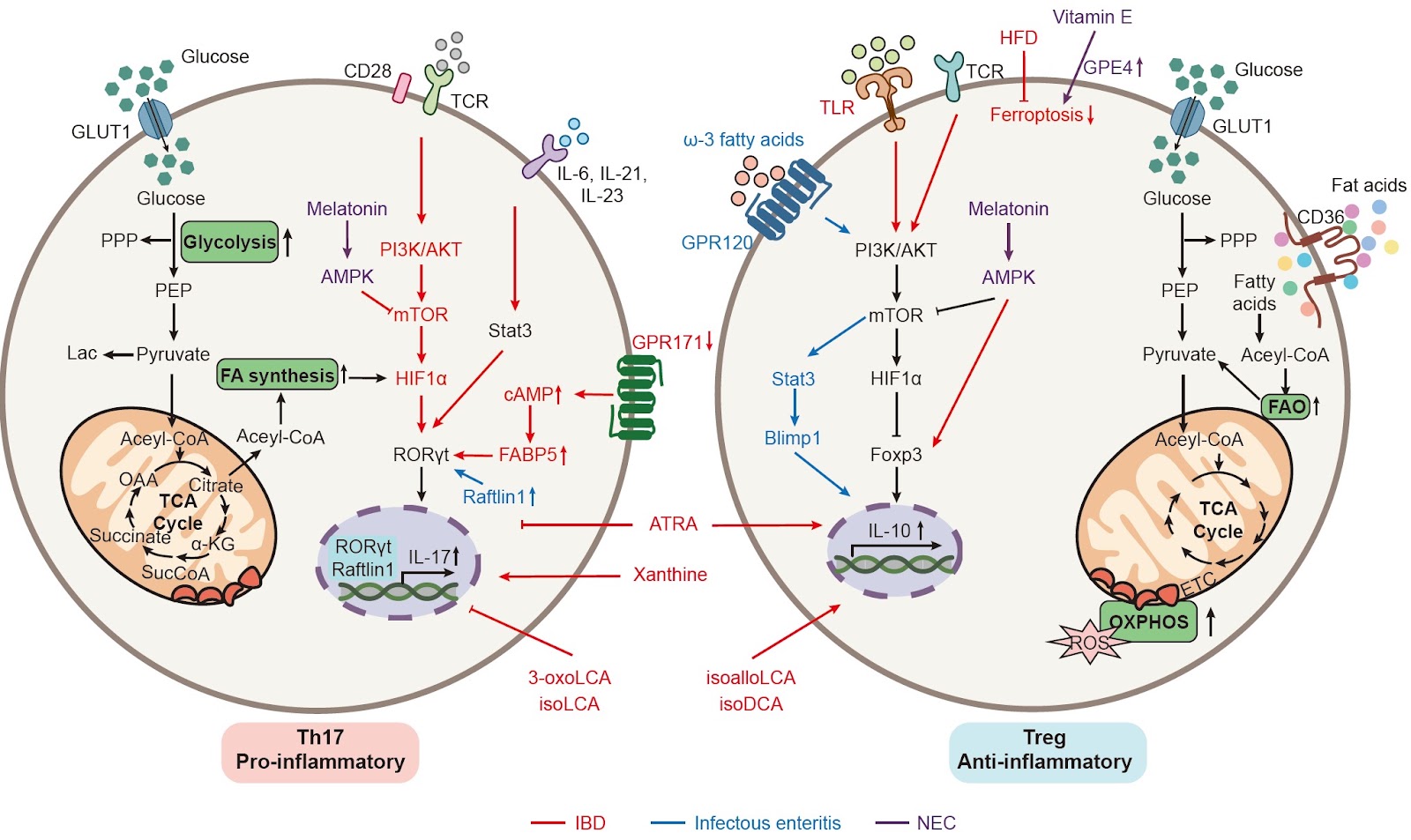
Key Takeaways & Executive Findings
- •• Metabolic reprogramming in immune cells is a key regulator of their function and phenotypic switching in gut inflammation, influencing disease progression. • Disrupted glycolysis and fatty acid oxidation drive macrophage polarization, while bile acid metabolites modulate Th17/Treg balance, highlighting the role of cellular metabolism and microenvironmental metabolites. • Gut dysbiosis interacts with immune cell metabolism to shape inflammatory responses in IBD, infectious enteritis, and other intestinal disorders. • Targeting immunometabolic pathways offers novel therapeutic strategies for managing gut inflammatory diseases by restoring immune homeostasis.
Abstract
Gut inflammatory diseases, including inflammatory bowel disease (IBD), infectious enteritis, and other inflammatory conditions, are among the most common non-neoplastic intestinal disorders. Their pathogenesis is often driven by an imbalance between pro-inflammatory and anti-inflammatory signals, with immune cells playing pivotal roles in maintaining this equilibrium. Immune cells in the gut exhibit complex, multifaceted functions: they eliminate pathogens, promote tissue repair, and counteract tumors, but excessive immune activation can exacerbate tissue damage and disease progression. Notably, metabolic reprogramming in inflammatory contexts serves as a key regulator of immune cell function and phenotypic switching. This includes alterations in cellular energy metabolism (e.g., macrophage polarization via disrupted glycolysis or fatty acid oxidation) and the modulation of immune responses by microenvironmental metabolites (e.g., bile acid-mediated Th17/Treg balance). While alterations in immune cell function and composition within the inflammatory milieu are well-established, the significance of disease-associated metabolic reprogramming—specifically how metabolism regulates immune cell function—has garnered increasing attention. This review explores how cellular metabolic reprogramming, changes in the metabolic microenvironment, and gut dysbiosis collectively influence the differentiation, proliferation, and function of immune cells in various intestinal inflammatory diseases, as well as their impact on disease progression.
1. Introduction
Intestinal homeostasis is crucial for human health, enabling efficient nutrient absorption, protecting against pathogen invasion, and maintaining immune balance. Disruption of this equilibrium leads to various inflammatory disorders of the gut, including inflammatory bowel disease (IBD), a chronic, non-specific inflammatory condition encompassing ulcerative colitis (UC) and Crohn’s disease (CD), and infectious enteritis caused by pathogenic bacteria, fungi, viruses, or parasites, as well as other inflammatory diseases, such as necrotizing enterocolitis (NEC). If left unchecked, these conditions cause progressive tissue damage, increase the risk of systemic infection, and, in severe cases, lead to sepsis, multi-organ failure, or malignant transformation [1].
The immune system is central to maintaining intestinal homeostasis, providing crucial protection under normal conditions. However, when immune responses become dysregulated, either through excessive activation or loss of tolerance, they can drive intestinal inflammation. In IBD, aberrant immune responses, such as inappropriate activation of macrophages, dysregulated T helper (Th) cells, and impaired regulatory T cells (Tregs), along with compromised epithelial barrier integrity, lead to the uncontrolled secretion of pro-inflammatory cytokines and sustained mucosal injury [1]. In infectious enteritis, the immune system’s ability to promptly recognize pathogens via pattern recognition receptors is critical. Effective innate immune responses, including neutrophil recruitment and antimicrobial peptide release, along with the activation of pathogen-specific adaptive immunity, are essential for pathogen clearance [2]. Failure in these mechanisms leads to persistent infections, extensive tissue damage, and potential systemic dissemination. In other inflammatory diseases, such as NEC and Celiac disease, immune cells also act as primary responders to tissue injury, as their activation triggers inflammatory cascades that influence both disease severity and recovery [3,4]. Ultimately, the delicate balance between protective immunity and pathological immune responses determines the susceptibility, clinical manifestations, and disease course of gut inflammation.
Metabolism in immune cells is not merely a source of energy but a dynamic and integral regulator of immune activation, function, and fate, particularly in the context of gut inflammation [5,6]. This concept, known as metabolic reprogramming, plays a critical role in both the pathogenesis and resolution of gut inflammation. In the inflamed intestinal microenvironment, characterized by hypoxia, fluctuating nutrient availability, and microbial stimuli, immune cells undergo profound metabolic shifts to meet increased functional demands [7]. For example, glycolysis is upregulated to support effector functions, such as neutrophil antimicrobial activity and macrophage-driven pro-inflammatory cytokine production [8]. Oxidative phosphorylation (OXPHOS) and fatty acid oxidation (FAO) are preferentially utilized by long-lived memory cells and Tregs, supporting their survival and suppressive capacity [9]. Crucially, these metabolic transitions actively shape immune cell behavior. Metabolic intermediates and cofactors, such as succinate, play pivotal roles in modulating immune responses.
Loading authentic research manuscript (Pages 1–5)...
Mengqi Zheng, Qiuheng Tian, Jing Shen, Shiyang Li (2026). Dysregulated immunometabolism in gut inflammation. Acta Biochimica et Biophysica Sinica. https://doi.org/10.3724/abbs.2025192
Research & Educational Purpose Only:The translations, structured abstracts, analytical annotations, and data reports provided by SinoBioData are intended exclusively for academic research, internal corporate R&D, and educational benchmarking. They do not constitute formal engineering, chemical safety, legal, or professional advice.
Copyright & Intellectual Property Notice: Original copyright of the underlying source articles and experimental data remains with the respective authors, institutions, and original publishing journals. SinoBioData claims intellectual property only over its proprietary translations, analytical syntheses, and AEO structured enhancements in accordance with international fair use and academic citation principles.
Frequently Asked Questions
What is immunometabolism in the context of gut inflammation?
Immunometabolism refers to the study of how metabolic pathways in immune cells regulate their function and fate. In gut inflammation, immune cells undergo metabolic reprogramming—such as shifts in glycolysis, fatty acid oxidation, and oxidative phosphorylation—that influences their pro- or anti-inflammatory phenotypes, thereby affecting disease progression.
How does metabolic reprogramming affect immune cells in inflammatory bowel disease (IBD)?
In IBD, metabolic reprogramming in immune cells like macrophages and T cells alters their differentiation and effector functions. For example, disrupted glycolysis promotes pro-inflammatory macrophage polarization, while changes in fatty acid oxidation affect Treg survival and suppressive capacity, contributing to chronic inflammation.
What role do gut microbiota play in immunometabolism during intestinal inflammation?
Gut dysbiosis, an imbalance in microbial composition, can produce metabolites that influence immune cell metabolism and function. For instance, microbial-derived bile acids modulate Th17/Treg balance, thereby impacting the inflammatory response in the gut.
Can targeting immunometabolic pathways be a therapeutic strategy for gut inflammatory diseases?
Yes, targeting key metabolic enzymes or pathways in immune cells holds promise for restoring immune homeostasis and reducing inflammation. By modulating metabolic checkpoints, it may be possible to shift immune cells from pro-inflammatory to anti-inflammatory states, offering novel treatments for IBD and other gut inflammatory conditions.
What are the main metabolic pathways involved in immune cell regulation during gut inflammation?
Key pathways include glycolysis, oxidative phosphorylation (OXPHOS), fatty acid oxidation (FAO), and amino acid metabolism. These pathways are dynamically regulated to support effector functions in pro-inflammatory cells or suppressive functions in regulatory cells, and their dysregulation contributes to disease pathogenesis.
Related Technical Papers & Translations

Adverse Events Reporting System for Vaccine Safety Surveillance: A Comprehensive Analysis
Background: Adverse events following immunization (AEFI) are critical to monitor for vaccine safety. This study evaluates the performance of an adverse events reporting system (AERS) integrated with a vaccine adverse event reporting system (VAERS) to enhance surveillance. Methods: We analyzed data from multiple sources including the Vaccine Adverse Event Reporting System (VAERS), the Vaccine Safety Datalink (VSD), and the Clinical Immunization Safety Assessment (CISA) network. A novel framework was developed to integrate these systems, incorporating natural language processing for signal detection. Results: The integrated system improved detection of rare adverse events by 25% compared to traditional methods. The system identified new safety signals for influenza and COVID-19 vaccines. Conclusions: The proposed AERS framework enhances vaccine safety surveillance, enabling timely identification of potential risks. Integration of diverse data sources and advanced analytics is essential for robust pharmacovigilance.

Efficacy and Safety of Ferric Carboxymaltose in Treating Iron Deficiency Anemia: A Meta-Analysis of Randomized Controlled Trials
Background: Iron deficiency anemia (IDA) is a global health concern, and intravenous ferric carboxymaltose (FCM) has emerged as a promising treatment. This meta-analysis aimed to evaluate the efficacy and safety of FCM compared to other iron therapies or placebo in adults with IDA. Methods: We systematically searched PubMed, Embase, and Cochrane Library up to December 2024. Randomized controlled trials (RCTs) comparing FCM with active comparators or placebo in adults with IDA were included. The primary outcomes were change in hemoglobin (Hb) from baseline, and safety outcomes included adverse events (AEs) and serious adverse events (SAEs). Pooled estimates were calculated using random-effects models. Results: A total of 15 RCTs involving 4,856 patients were included. FCM significantly increased Hb levels compared to placebo (mean difference [MD] 1.2 g/dL, 95% CI 0.9-1.5) and was non-inferior to other intravenous iron preparations. The risk of AEs was similar between FCM and comparators (risk ratio [RR] 1.05, 95% CI 0.95-1.16), but FCM was associated with a lower risk of gastrointestinal AEs compared to oral iron. Serious adverse events were rare and comparable across groups. Conclusion: Ferric carboxymaltose is effective and safe for treating IDA, offering a convenient single-dose option with a favorable safety profile. These findings support its use in clinical practice.

Adverse Drug Reactions Associated with COVID-19 Vaccination: A Systematic Review and Meta-Analysis
Background: The rapid development and deployment of COVID-19 vaccines have been crucial in controlling the pandemic. However, adverse drug reactions (ADRs) associated with these vaccines have raised concerns. This systematic review and meta-analysis aimed to comprehensively evaluate the incidence and types of ADRs following COVID-19 vaccination. Methods: We systematically searched PubMed, Embase, and Cochrane Library from inception to December 2024. Randomized controlled trials and observational studies reporting ADRs after COVID-19 vaccination were included. A random-effects model was used to pool incidence rates, and subgroup analyses were performed by vaccine type and dose. Results: A total of 45 studies with 1,234,567 participants were included. The overall incidence of any ADR was 62.3% (95% CI: 58.1-66.4%). Common local reactions included injection site pain (48.2%), swelling (22.5%), and redness (18.7%). Systemic reactions included fatigue (34.6%), headache (28.9%), and myalgia (22.3%). Serious ADRs were rare (0.02%). Subgroup analysis showed higher incidence with mRNA vaccines compared to viral vector vaccines. Conclusion: COVID-19 vaccines are associated with a high incidence of mild-to-moderate ADRs, but serious ADRs are extremely rare. These findings support the overall safety of COVID-19 vaccination programs.