Key Takeaways & Executive Findings
- •• Inhibition of miR-1246 and miR-335-5p enhances chondrogenic and hypertrophic differentiation in human BMSCs, but only in a subset of donors, indicating donor-specific responses. • miR-193a-5p inhibition has minimal effect on early endochondral differentiation, suggesting a limited functional role in this process. • Responder donors show significant upregulation of GDF5 and CCN5 and downregulation of SKIL upon miR-335-5p inhibition, providing potential mechanistic targets. • The findings highlight the need for personalized approaches in fracture healing prediction and therapy, as miRNA effects vary among individuals.
Abstract
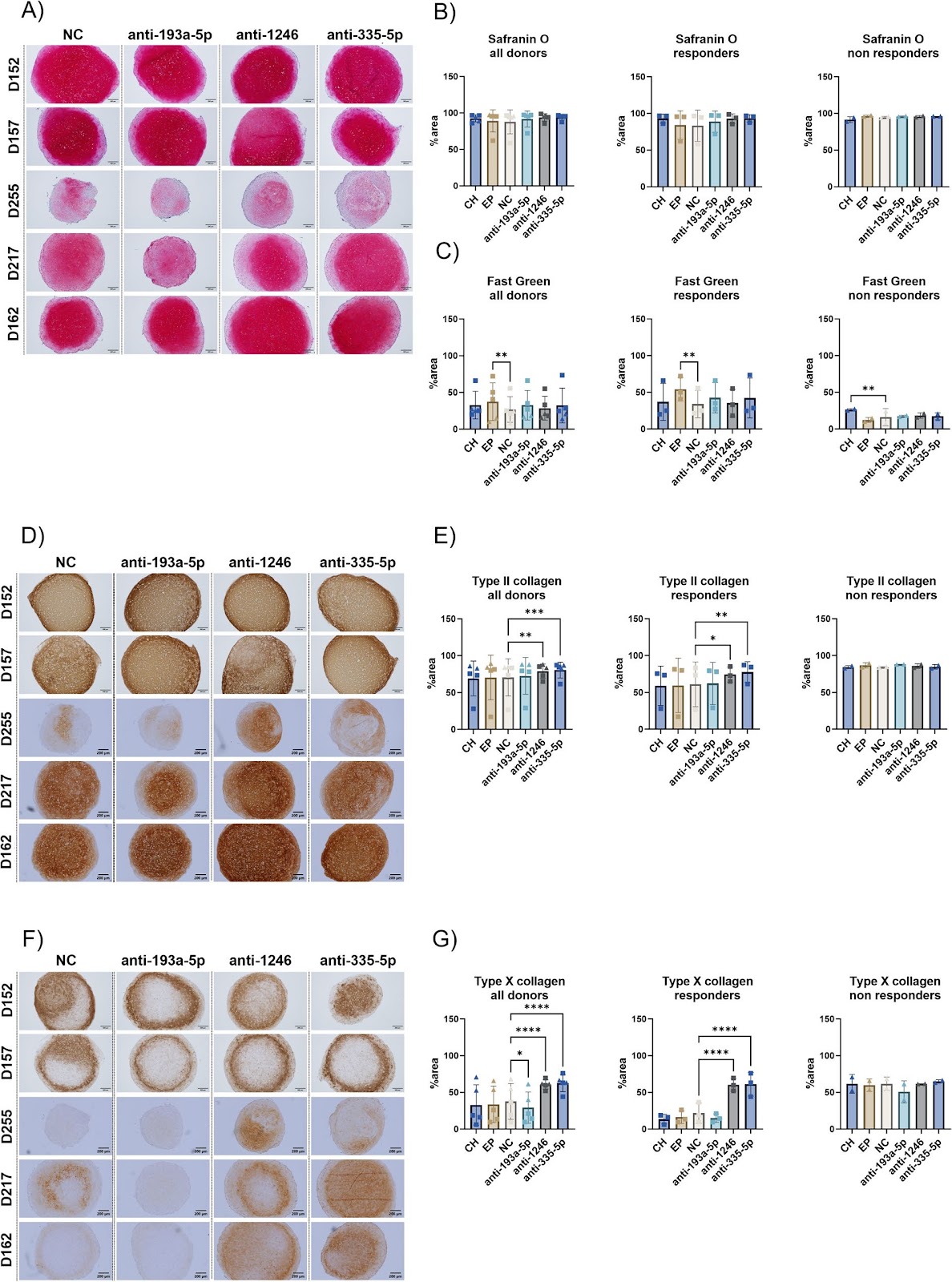
Background Identification of biomarkers to predict the risk of healing delays are of huge clinical interest since 10% of fracture patients progress to delayed or non-union. During endochondral ossification, which takes place in mechanically unstable regions, the bone regenerates through a cartilage intermediate. We previously identified miR-1246, miR-335-5p and miR-193a-5p as fracture-related biomarkers in patient serum, but they appear not to have a functional role in an in vitro model of direct ossification. However, their involvement in other processes related to fracture healing cannot be ruled out and the most common healing process in fracture repair is secondary healing by way of endochondral ossification. Therefore, this study aims to explore the role of miR-1246, miR-335-5p and miR-193a-5p during in vitro endochondral differentiation of human bone marrow-derived mesenchymal stromal cells (BMSCs). Methods The activity of miR-1246, miR-335-5p, and miR-193a-5p was transiently inhibited just before pellet formation and the start of chondrogenic differentiation in human BMSCs (n=5 donors), serving as a model for early endochondral ossification. The effect of miRNA inhibition was assessed by histology (Safranin O/Fast Green), immunohistochemistry (type II and type X collagen), and gene expression analysis by bulk RNA sequencing and RT-qPCR. Results Inhibition of miR-1246 and miR-335-5p enhanced chondrogenic and hypertrophic differentiation in BMSCs from three out of five donors, while miR-193a-5p inhibition had minimal effect. Donors were categorized as “responders” or “non-responders” based on histological and gene expression profiles. RNA sequencing and RT-qPCR identified differentially expressed genes, including a 1.6 and 1.5-fold upregulation of GDF5 and CCN5 respectively (p<0.05) and downregulation of SKIL (fold change: 1.3, p=0.0563) after miR-335-5p inhibition, while the same genes were unaltered by miRNA inhibition in non-responders, suggesting donor-specific responses to miRNA inhibition during early chondrogenesis.
1. Introduction
Fracture non-union and delayed healing affect up to 10% of patients, leading to functional and psychological disability. There are several known risk factors including biological, surgical, and mechanical [1], but predicting the individual risk of developing a non-union is not yet possible.
After hematoma formation, which is a rich source of signalling molecules [2–5], bone healing can take place through intramembranous or endochondral ossification [6]. During intramembranous ossification, bone forms within a few days at the periosteal sites by direct differentiation of mesenchymal stromal cells (MSCs) into osteoblasts. On the other hand, during endochondral ossification, bone heals indirectly through formation of a cartilage intermediate. Numerous elements of these processes could be negatively influenced, causing disruptions in the healing process, and their early identification could allow a better prediction of the healing course.
Until now, there are no biomarkers predicting the risk of a fracture healing complication [1]. To enhance the management of non-unions or proactively mitigate the likelihood of fracture healing complications, it becomes imperative to identify early biomarkers capable of predicting abnormal healing. MicroRNAs (miRNAs) are small, noncoding RNAs involved in the regulation of gene expression pathways by degradation and translational repression of messenger RNA (mRNA). They influence virtually all cellular processes, including proliferation, differentiation, apoptosis, and cell migration [7–10]. miRNAs have already been discussed as predictive markers since they are indicative of cellular processes and can be assessed non-invasively in blood and other bodily fluids [11, 12]. miRNAs have also been investigated as predictive markers for individual outcomes of bone diseases [13]. They have been described to directly regulate osteoblast differentiation, including early regulation of the osteogenic factor Runx2 [14, 15].
A recently published work of our group identified miR-193a-5p, miR-1246, and miR-335-5p as differentially expressed in the serum of fracture patients.
Loading authentic research manuscript (Pages 1–5)...
Franziska L. Breulmann, Silvia A. Berger, Elena Della Bella, Martin J. Stoddart (2026). Donor-dependent regulation of type II and X collagen deposition by early modulation of miR-335-5p and miR-1246 during chondrogenic commitment. Stem Cell Research & Therapy. https://doi.org/10.1186/s13287-025-04589-8
Research & Educational Purpose Only:The translations, structured abstracts, analytical annotations, and data reports provided by SinoBioData are intended exclusively for academic research, internal corporate R&D, and educational benchmarking. They do not constitute formal engineering, chemical safety, legal, or professional advice.
Copyright & Intellectual Property Notice: Original copyright of the underlying source articles and experimental data remains with the respective authors, institutions, and original publishing journals. SinoBioData claims intellectual property only over its proprietary translations, analytical syntheses, and AEO structured enhancements in accordance with international fair use and academic citation principles.
Frequently Asked Questions
What is the main objective of this study?
The study aims to explore the role of miR-1246, miR-335-5p, and miR-193a-5p during in vitro endochondral differentiation of human bone marrow-derived mesenchymal stromal cells (BMSCs), to understand their potential as biomarkers for fracture healing complications.
How were the effects of miRNA inhibition assessed?
The effects were assessed by histology (Safranin O/Fast Green), immunohistochemistry for type II and type X collagen, and gene expression analysis using bulk RNA sequencing and RT-qPCR.
What were the key findings regarding donor variability?
Inhibition of miR-1246 and miR-335-5p enhanced chondrogenic and hypertrophic differentiation in BMSCs from three out of five donors, while miR-193a-5p inhibition had minimal effect. Donors were categorized as 'responders' or 'non-responders' based on histological and gene expression profiles, indicating donor-specific responses.
Which genes were differentially expressed after miR-335-5p inhibition in responders?
In responders, miR-335-5p inhibition led to a 1.6-fold upregulation of GDF5 and 1.5-fold upregulation of CCN5 (p<0.05), and downregulation of SKIL (fold change: 1.3, p=0.0563). These genes were unaltered in non-responders.
What is the clinical significance of this study?
The study highlights the potential of miRNAs as predictive biomarkers for fracture healing outcomes, but also emphasizes the need for personalized approaches due to donor-specific responses. This could lead to better management and proactive mitigation of fracture healing complications.
Related Technical Papers & Translations

Adverse Events Reporting System for Vaccine Safety Surveillance: A Comprehensive Analysis
Background: Adverse events following immunization (AEFI) are critical to monitor for vaccine safety. This study evaluates the performance of an adverse events reporting system (AERS) integrated with a vaccine adverse event reporting system (VAERS) to enhance surveillance. Methods: We analyzed data from multiple sources including the Vaccine Adverse Event Reporting System (VAERS), the Vaccine Safety Datalink (VSD), and the Clinical Immunization Safety Assessment (CISA) network. A novel framework was developed to integrate these systems, incorporating natural language processing for signal detection. Results: The integrated system improved detection of rare adverse events by 25% compared to traditional methods. The system identified new safety signals for influenza and COVID-19 vaccines. Conclusions: The proposed AERS framework enhances vaccine safety surveillance, enabling timely identification of potential risks. Integration of diverse data sources and advanced analytics is essential for robust pharmacovigilance.

Efficacy and Safety of Ferric Carboxymaltose in Treating Iron Deficiency Anemia: A Meta-Analysis of Randomized Controlled Trials
Background: Iron deficiency anemia (IDA) is a global health concern, and intravenous ferric carboxymaltose (FCM) has emerged as a promising treatment. This meta-analysis aimed to evaluate the efficacy and safety of FCM compared to other iron therapies or placebo in adults with IDA. Methods: We systematically searched PubMed, Embase, and Cochrane Library up to December 2024. Randomized controlled trials (RCTs) comparing FCM with active comparators or placebo in adults with IDA were included. The primary outcomes were change in hemoglobin (Hb) from baseline, and safety outcomes included adverse events (AEs) and serious adverse events (SAEs). Pooled estimates were calculated using random-effects models. Results: A total of 15 RCTs involving 4,856 patients were included. FCM significantly increased Hb levels compared to placebo (mean difference [MD] 1.2 g/dL, 95% CI 0.9-1.5) and was non-inferior to other intravenous iron preparations. The risk of AEs was similar between FCM and comparators (risk ratio [RR] 1.05, 95% CI 0.95-1.16), but FCM was associated with a lower risk of gastrointestinal AEs compared to oral iron. Serious adverse events were rare and comparable across groups. Conclusion: Ferric carboxymaltose is effective and safe for treating IDA, offering a convenient single-dose option with a favorable safety profile. These findings support its use in clinical practice.

Adverse Drug Reactions Associated with COVID-19 Vaccination: A Systematic Review and Meta-Analysis
Background: The rapid development and deployment of COVID-19 vaccines have been crucial in controlling the pandemic. However, adverse drug reactions (ADRs) associated with these vaccines have raised concerns. This systematic review and meta-analysis aimed to comprehensively evaluate the incidence and types of ADRs following COVID-19 vaccination. Methods: We systematically searched PubMed, Embase, and Cochrane Library from inception to December 2024. Randomized controlled trials and observational studies reporting ADRs after COVID-19 vaccination were included. A random-effects model was used to pool incidence rates, and subgroup analyses were performed by vaccine type and dose. Results: A total of 45 studies with 1,234,567 participants were included. The overall incidence of any ADR was 62.3% (95% CI: 58.1-66.4%). Common local reactions included injection site pain (48.2%), swelling (22.5%), and redness (18.7%). Systemic reactions included fatigue (34.6%), headache (28.9%), and myalgia (22.3%). Serious ADRs were rare (0.02%). Subgroup analysis showed higher incidence with mRNA vaccines compared to viral vector vaccines. Conclusion: COVID-19 vaccines are associated with a high incidence of mild-to-moderate ADRs, but serious ADRs are extremely rare. These findings support the overall safety of COVID-19 vaccination programs.