Key Takeaways & Executive Findings
- •• Preoperative high blood HSPC ratio is a potential biomarker for predicting acute rejection after liver transplantation. • Alloresponse triggers mobilization of both recipient- and donor-derived HSPCs into peripheral blood and migration to target tissues during AR and GVHD episodes. • Tacrolimus-based immunosuppression is associated with myeloid-biased differentiation of HSPCs in LTx recipients. • Blood HSPC levels decline after successful treatment of rejection or GVHD, suggesting a dynamic response to alloresponse.
Abstract
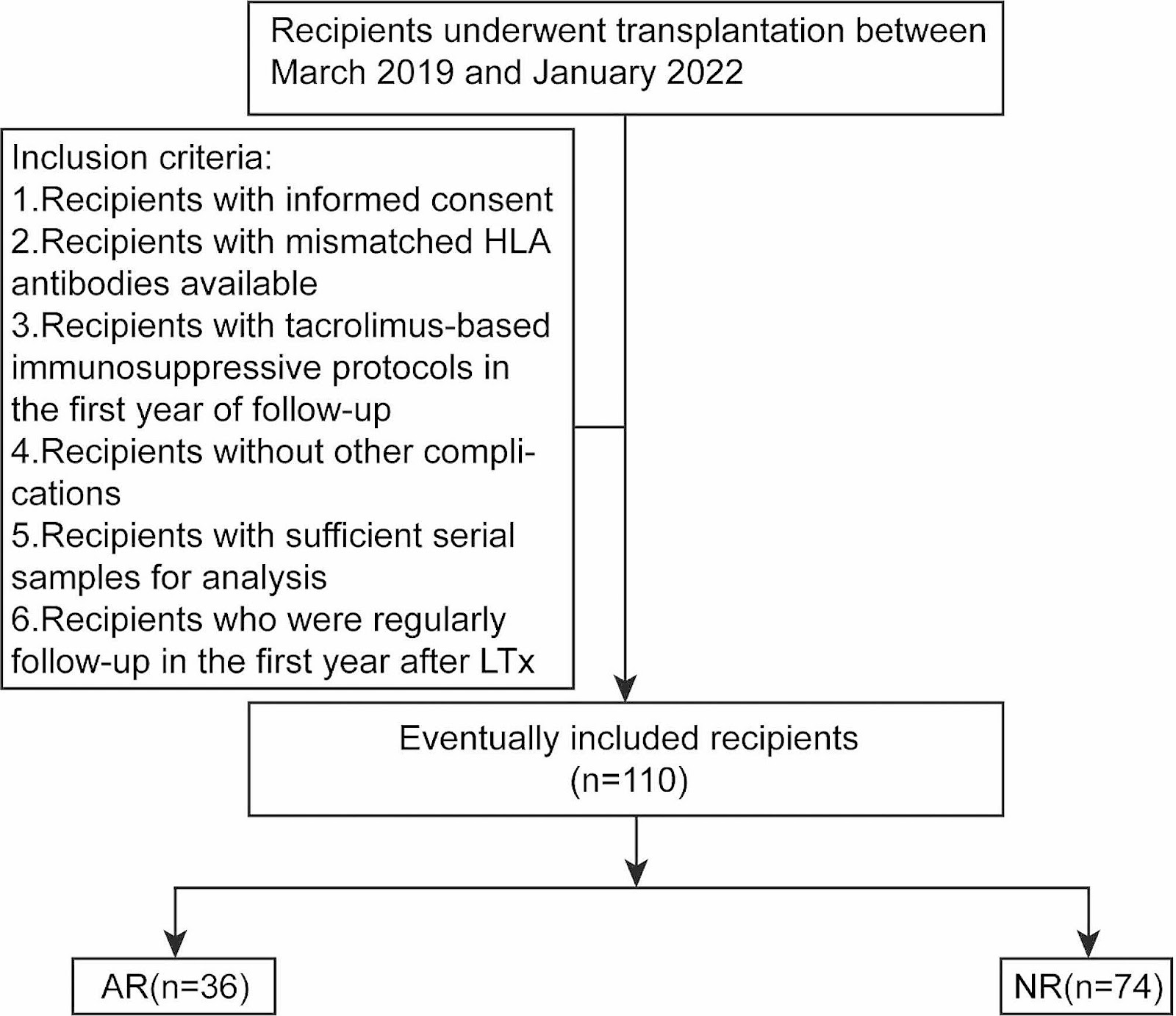
Background Hematopoietic stem and progenitor cells (HSPCs) mobilize from bone marrow to peripheral blood in response to stress. The impact of alloresponse-induced stress on HSPCs mobilization in human liver transplantation (LTx) recipients remains under-investigated. Methods Peripheral blood mononuclear cell (PBMC) samples were longitudinally collected from pre- to post-LTx for one year from 36 recipients with acute rejection (AR), 74 recipients without rejection (NR), and 5 recipients with graft-versus-host disease (GVHD). 28 PBMC samples from age-matched healthy donors were collected as healthy control (HC). Multi-color flow cytometry (MCFC) was used to immunophenotype HSPCs and their subpopulations. Donor recipient-distinguishable major histocompatibility complex (MHC) antibodies determined cell origin. Results Before LTx, patients who developed AR after transplant contained more HSPCs in PBMC samples than HC, while the NR group patients contained fewer HSPCs than HC. After LTx, the HSPC ratio in the AR group sharply decreased and became less than HC within six months, and dropped to a comparable NR level afterward. During the one-year follow-up period, myeloid progenitors (MPs) biased differentiation was observed in all LTx recipients who were under tacrolimus-based immunosuppressive treatment. During both AR and GVHD episodes, the recipient-derived and donor-derived HSPCs mobilized into the recipient’s blood-circulation and migrated to the target tissue, respectively. The HSPCs percentage in blood reduced after the disease was cured. Conclusions A preoperative high HSPC ratio in blood characterizes recipients who developed AR after LTx. Recipients exhibited a decline in blood-circulating HSPCs after transplant, the cells mobilized into the blood and migrated to target tissue during alloresponse.
1. Introduction
Liver transplantation (LTx) has been established as an essential clinical option in the treatment of patients with end-stage liver failure [1]. Alloresponse is an immune reaction towards allogeneic antigens, it plays a central role in both acute rejection (AR) and graft versus host disease (GVHD) following LTx to hinder the success of LTx [2]. AR occurs in about 30% of LTx patients on tacrolimus-based immunosuppressive protocols, it increases the risk of graft failure, all-cause mortality, and graft failure-related death by damaging the liver graft [3]. Despite the rarity, GVHD is a deadly immune complication following LTx that severely damages several of the recipient’s target tissues including skin, gastrointestinal tract and hematopoietic tissues [4, 5]. Both of the inflammatory processes trigger stress responses in the transplanted recipients.
Hematopoietic stem and progenitor cells (HSPCs) possess the ability of self-renewal and multi-lineage differentiation to sustain hematopoietic homeostasis. Typically, most of the HSPCs reside in the bone marrow, with only a tiny portion circulating in peripheral blood and tissues. Under emergency stress, hematopoietic stem cells (HSCs) are activated and proliferate, a phenomenon known as emergency myelopoiesis [6, 7]. Several studies have reported that stress-induced conditions, such as infection and inflammation, can induce the mobilization of HSPCs. During this process, HSPCs exhibit the capacity to discern signals indicative of inflammation to mobilize and accumulate within peripheral tissues that are subject to inflammatory processes to contribute to the enhancement of the immune cell population, thereby boosting the tissue’s defensive capabilities against infection [8–10]. However, the HSPC mobilization before and after LTx and during an AR or GVHD episode in LTx recipients has been inadequately explored.
Loading authentic research manuscript (Pages 1–5)...
Yao Zhi, Wei Qiu, Guangyao Tian, Shifei Song, Wenchao Zhao, Xiaodong Du, Xiaodong Sun, Yuguo Chen, Heyu Huang, Jing Li, Ying Yu, Mingqian Li, Guoyue Lv (2026). Donor and recipient hematopoietic stem and progenitor cells mobilization in liver transplantation patients. Stem Cell Research & Therapy. https://doi.org/10.1186/s13287-024-03855-5
Research & Educational Purpose Only:The translations, structured abstracts, analytical annotations, and data reports provided by SinoBioData are intended exclusively for academic research, internal corporate R&D, and educational benchmarking. They do not constitute formal engineering, chemical safety, legal, or professional advice.
Copyright & Intellectual Property Notice: Original copyright of the underlying source articles and experimental data remains with the respective authors, institutions, and original publishing journals. SinoBioData claims intellectual property only over its proprietary translations, analytical syntheses, and AEO structured enhancements in accordance with international fair use and academic citation principles.
Frequently Asked Questions
What is the main finding of this study?
The study found that a high preoperative blood HSPC ratio characterizes recipients who develop acute rejection after liver transplantation, and that HSPCs mobilize into the blood and migrate to target tissues during alloresponse episodes.
How were HSPCs measured in the study?
HSPCs and their subpopulations were immunophenotyped using multi-color flow cytometry (MCFC) on peripheral blood mononuclear cell (PBMC) samples collected longitudinally from pre- to post-liver transplantation.
What is the clinical significance of HSPC mobilization in liver transplantation?
HSPC mobilization may serve as a biomarker for predicting acute rejection and monitoring alloresponse, potentially aiding in early diagnosis and management of rejection and GVHD.
Did the study observe any differentiation bias in HSPCs?
Yes, during the one-year follow-up, myeloid progenitors (MPs) biased differentiation was observed in all liver transplant recipients under tacrolimus-based immunosuppressive treatment.
What are the implications for future research?
The findings suggest that HSPC dynamics could be further explored as therapeutic targets or for developing non-invasive monitoring strategies for alloresponse in transplant patients.
Related Technical Papers & Translations

Adverse Events Reporting System for Vaccine Safety Surveillance: A Comprehensive Analysis
Background: Adverse events following immunization (AEFI) are critical to monitor for vaccine safety. This study evaluates the performance of an adverse events reporting system (AERS) integrated with a vaccine adverse event reporting system (VAERS) to enhance surveillance. Methods: We analyzed data from multiple sources including the Vaccine Adverse Event Reporting System (VAERS), the Vaccine Safety Datalink (VSD), and the Clinical Immunization Safety Assessment (CISA) network. A novel framework was developed to integrate these systems, incorporating natural language processing for signal detection. Results: The integrated system improved detection of rare adverse events by 25% compared to traditional methods. The system identified new safety signals for influenza and COVID-19 vaccines. Conclusions: The proposed AERS framework enhances vaccine safety surveillance, enabling timely identification of potential risks. Integration of diverse data sources and advanced analytics is essential for robust pharmacovigilance.

Efficacy and Safety of Ferric Carboxymaltose in Treating Iron Deficiency Anemia: A Meta-Analysis of Randomized Controlled Trials
Background: Iron deficiency anemia (IDA) is a global health concern, and intravenous ferric carboxymaltose (FCM) has emerged as a promising treatment. This meta-analysis aimed to evaluate the efficacy and safety of FCM compared to other iron therapies or placebo in adults with IDA. Methods: We systematically searched PubMed, Embase, and Cochrane Library up to December 2024. Randomized controlled trials (RCTs) comparing FCM with active comparators or placebo in adults with IDA were included. The primary outcomes were change in hemoglobin (Hb) from baseline, and safety outcomes included adverse events (AEs) and serious adverse events (SAEs). Pooled estimates were calculated using random-effects models. Results: A total of 15 RCTs involving 4,856 patients were included. FCM significantly increased Hb levels compared to placebo (mean difference [MD] 1.2 g/dL, 95% CI 0.9-1.5) and was non-inferior to other intravenous iron preparations. The risk of AEs was similar between FCM and comparators (risk ratio [RR] 1.05, 95% CI 0.95-1.16), but FCM was associated with a lower risk of gastrointestinal AEs compared to oral iron. Serious adverse events were rare and comparable across groups. Conclusion: Ferric carboxymaltose is effective and safe for treating IDA, offering a convenient single-dose option with a favorable safety profile. These findings support its use in clinical practice.

Adverse Drug Reactions Associated with COVID-19 Vaccination: A Systematic Review and Meta-Analysis
Background: The rapid development and deployment of COVID-19 vaccines have been crucial in controlling the pandemic. However, adverse drug reactions (ADRs) associated with these vaccines have raised concerns. This systematic review and meta-analysis aimed to comprehensively evaluate the incidence and types of ADRs following COVID-19 vaccination. Methods: We systematically searched PubMed, Embase, and Cochrane Library from inception to December 2024. Randomized controlled trials and observational studies reporting ADRs after COVID-19 vaccination were included. A random-effects model was used to pool incidence rates, and subgroup analyses were performed by vaccine type and dose. Results: A total of 45 studies with 1,234,567 participants were included. The overall incidence of any ADR was 62.3% (95% CI: 58.1-66.4%). Common local reactions included injection site pain (48.2%), swelling (22.5%), and redness (18.7%). Systemic reactions included fatigue (34.6%), headache (28.9%), and myalgia (22.3%). Serious ADRs were rare (0.02%). Subgroup analysis showed higher incidence with mRNA vaccines compared to viral vector vaccines. Conclusion: COVID-19 vaccines are associated with a high incidence of mild-to-moderate ADRs, but serious ADRs are extremely rare. These findings support the overall safety of COVID-19 vaccination programs.