Key Takeaways & Executive Findings
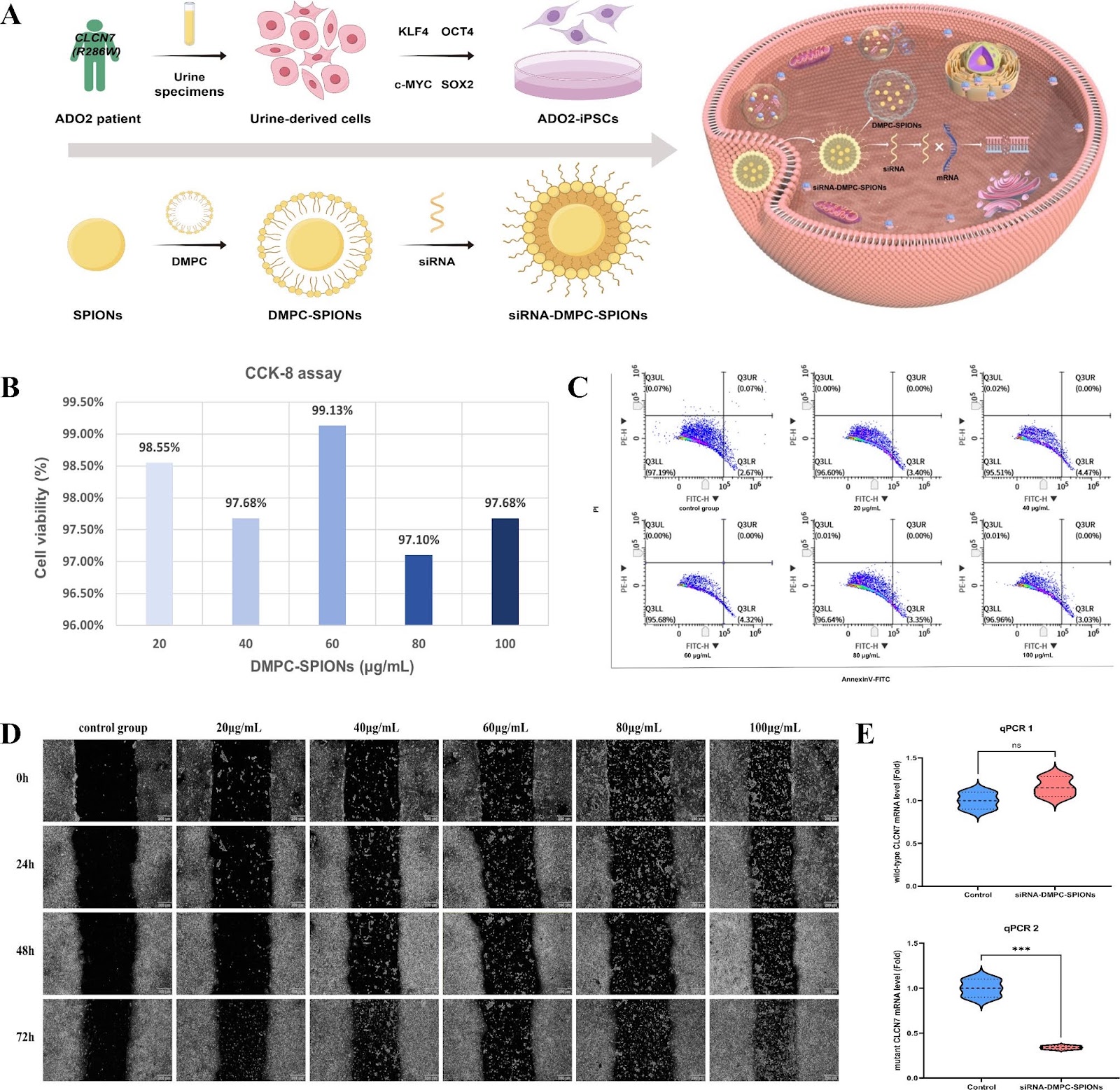
- •• First establishment of ADO2-iPSCs from patient urine-derived cells for in vitro disease modeling. • DMPC-SPIONs demonstrated low cytotoxicity and efficient siRNA delivery into ADO2-iPSCs. • siRNA-DMPC-SPIONs achieved 66% reduction of mutant CLCN7 expression without affecting wild-type. • Provides a novel gene silencing strategy for ADO2 and potential for other autosomal dominant diseases.
Abstract
Background Autosomal dominant osteodystrophy type II (ADO2) is an inherited disease characterized by an abnormal increase in bone mineral density, and CLCN7 (R286W) is its most common causative mutation. The aim of this study was to explore the new idea of siRNA technology applied to the in vitro treatment of ADO2. Methods Urinary-derived cells from ADO2 patients were collected to establish induced pluripotent stem cells (iPSCs) model. The siRNA targeting CLCN7 (R286W) mutant mRNA was designed. the cytotoxicity of the delivery vector DMPC-SPIONs was comprehensively evaluated by CCK-8 assay, flow cytometry and scratch assay. Finally, qPCR was utilized to verify the post-transcriptional silencing effect of siRNAs. Results We found that DMPC-SPIONs had low cytotoxicity and were able to effectively deliver siRNAs into ADO2-iPSCs. qPCR confirmed that siRNA-DMPC-SPIONs were able to significantly reduce the expression level of mutant CLCN7 (66%), while there was no significant effect on the expression of wild-type CLCN7. Conclusions This study developed a gene silencing strategy based on siRNAs and DMPC-SPIONs, which provides a potential new approach for the treatment of ADO2 and demonstrates the potential application of siRNA technology in the treatment of autosomal dominant genetic diseases. Innovative statements In this study, we used the established ADO2-iPSCs using patient's urine-derived cells to explore the safety and efficacy of siRNA technology based on the principle of RNA interference for ADO2 treatment for the first time. In addition, we chose DMPC-SPIONs as the delivery vehicle for siRNA, which cleverly exploits the advantages of nanoparticles such as superparamagnetism, low cytotoxicity, and good bio-histocompatibility.
1. Introduction
Osteopetrosis is a human genetic disorder characterized by an abnormal increase in bone mineral density [1]. The disease can be categorized based on its inheritance patterns: autosomal recessive inheritance, autosomal dominant inheritance, and X-linked inheritance. Specifically, ADO2 is a commonly occurring subtype with an incidence rate of approximately 1 in 20,000 individuals [2]. Patients with ADO2 frequently experience diffuse sclerosis in the skull base, pelvis, and vertebrae, which often lead to complications such as fractures, osteomyelitis, anemia, extramedullary hematopoiesis, cranial nerve impairment, and developmental stunting with deformities. These conditions collectively impact the patients’ quality of life significantly.
The most prevalent pathogenic mutation linked to ADO2 is the CLCN7 (R286W) variant, which encodes for the ClC-7 [3, 4]. This gene mutation can result in the dysregulated expression of crucial signaling pathways, including Wnt, nuclear factor-kB (NF-kB), and transforming growth factor-beta (TGF-beta), within bone marrow cells. This disruption may alter the dynamic equilibrium of bone metabolism by affecting the activities of osteoblasts and osteoclasts, ultimately manifesting as clinical symptoms [5]. In clinical practice, hematopoietic stem cell transplantation emerges as a frequently utilized approach for treating malignant osteopetrosis, predominantly advanced cases of autosomal recessive osteopetrosis. However, ADO2 often manifests with a delayed onset, and the success and survival rates of this therapy are contingent on factors like patient age and donor compatibility. Consequently, it is typically not employed for the treatment of ADO2 [6]. Besides providing temporary pain relief and managing symptomatic complications, there remains a conspicuous lack of an effective targeted treatment for ADO2. Hence, there lies a significant research value in exploring innovative cellular-level therapeutic strategies for the treatment of ADO2.
Loading authentic research manuscript (Pages 1–5)...
Jiajun Xu, Gengshuo Chen, Chune Mo, Yu Sha, Sha Luo, Minglin Ou (2026). Development and evaluation of siRNA-mediated gene silencing strategies for ADO2 therapy utilizing iPSCs model and DMPC-SPIONs delivery system. Stem Cell Research & Therapy. https://doi.org/10.1186/s13287-025-04151-6
Research & Educational Purpose Only:The translations, structured abstracts, analytical annotations, and data reports provided by SinoBioData are intended exclusively for academic research, internal corporate R&D, and educational benchmarking. They do not constitute formal engineering, chemical safety, legal, or professional advice.
Copyright & Intellectual Property Notice: Original copyright of the underlying source articles and experimental data remains with the respective authors, institutions, and original publishing journals. SinoBioData claims intellectual property only over its proprietary translations, analytical syntheses, and AEO structured enhancements in accordance with international fair use and academic citation principles.
Frequently Asked Questions
What is ADO2 and what causes it?
ADO2 (autosomal dominant osteodystrophy type II) is an inherited bone disease characterized by increased bone density. It is most commonly caused by the CLCN7 (R286W) mutation, which affects osteoclast function and bone remodeling.
How were induced pluripotent stem cells (iPSCs) generated in this study?
iPSCs were established from urinary-derived cells of ADO2 patients, providing a patient-specific in vitro model for studying the disease and testing therapeutic strategies.
What is the role of DMPC-SPIONs in this research?
DMPC-SPIONs are superparamagnetic iron oxide nanoparticles coated with DMPC lipid, used as a delivery vehicle for siRNA. They exhibit low cytotoxicity and high biocompatibility, enabling efficient siRNA delivery into iPSCs.
How effective was the siRNA-mediated gene silencing?
The siRNA-DMPC-SPIONs significantly reduced mutant CLCN7 expression by 66% in ADO2-iPSCs, while leaving wild-type CLCN7 unaffected, demonstrating selective silencing.
What are the potential clinical implications of this study?
This study provides a proof-of-concept for using siRNA and nanoparticle delivery to treat autosomal dominant diseases like ADO2, potentially offering a targeted therapy that avoids the limitations of current treatments.
Related Technical Papers & Translations

Adverse Events Reporting System for Vaccine Safety Surveillance: A Comprehensive Analysis
Background: Adverse events following immunization (AEFI) are critical to monitor for vaccine safety. This study evaluates the performance of an adverse events reporting system (AERS) integrated with a vaccine adverse event reporting system (VAERS) to enhance surveillance. Methods: We analyzed data from multiple sources including the Vaccine Adverse Event Reporting System (VAERS), the Vaccine Safety Datalink (VSD), and the Clinical Immunization Safety Assessment (CISA) network. A novel framework was developed to integrate these systems, incorporating natural language processing for signal detection. Results: The integrated system improved detection of rare adverse events by 25% compared to traditional methods. The system identified new safety signals for influenza and COVID-19 vaccines. Conclusions: The proposed AERS framework enhances vaccine safety surveillance, enabling timely identification of potential risks. Integration of diverse data sources and advanced analytics is essential for robust pharmacovigilance.

Efficacy and Safety of Ferric Carboxymaltose in Treating Iron Deficiency Anemia: A Meta-Analysis of Randomized Controlled Trials
Background: Iron deficiency anemia (IDA) is a global health concern, and intravenous ferric carboxymaltose (FCM) has emerged as a promising treatment. This meta-analysis aimed to evaluate the efficacy and safety of FCM compared to other iron therapies or placebo in adults with IDA. Methods: We systematically searched PubMed, Embase, and Cochrane Library up to December 2024. Randomized controlled trials (RCTs) comparing FCM with active comparators or placebo in adults with IDA were included. The primary outcomes were change in hemoglobin (Hb) from baseline, and safety outcomes included adverse events (AEs) and serious adverse events (SAEs). Pooled estimates were calculated using random-effects models. Results: A total of 15 RCTs involving 4,856 patients were included. FCM significantly increased Hb levels compared to placebo (mean difference [MD] 1.2 g/dL, 95% CI 0.9-1.5) and was non-inferior to other intravenous iron preparations. The risk of AEs was similar between FCM and comparators (risk ratio [RR] 1.05, 95% CI 0.95-1.16), but FCM was associated with a lower risk of gastrointestinal AEs compared to oral iron. Serious adverse events were rare and comparable across groups. Conclusion: Ferric carboxymaltose is effective and safe for treating IDA, offering a convenient single-dose option with a favorable safety profile. These findings support its use in clinical practice.

Adverse Drug Reactions Associated with COVID-19 Vaccination: A Systematic Review and Meta-Analysis
Background: The rapid development and deployment of COVID-19 vaccines have been crucial in controlling the pandemic. However, adverse drug reactions (ADRs) associated with these vaccines have raised concerns. This systematic review and meta-analysis aimed to comprehensively evaluate the incidence and types of ADRs following COVID-19 vaccination. Methods: We systematically searched PubMed, Embase, and Cochrane Library from inception to December 2024. Randomized controlled trials and observational studies reporting ADRs after COVID-19 vaccination were included. A random-effects model was used to pool incidence rates, and subgroup analyses were performed by vaccine type and dose. Results: A total of 45 studies with 1,234,567 participants were included. The overall incidence of any ADR was 62.3% (95% CI: 58.1-66.4%). Common local reactions included injection site pain (48.2%), swelling (22.5%), and redness (18.7%). Systemic reactions included fatigue (34.6%), headache (28.9%), and myalgia (22.3%). Serious ADRs were rare (0.02%). Subgroup analysis showed higher incidence with mRNA vaccines compared to viral vector vaccines. Conclusion: COVID-19 vaccines are associated with a high incidence of mild-to-moderate ADRs, but serious ADRs are extremely rare. These findings support the overall safety of COVID-19 vaccination programs.