Key Takeaways & Executive Findings
- •• CXCR5-engineered MSCs (MSCCXCR5) exhibit enhanced homing to splenic CXCL13-rich B-cell zones, improving targeted delivery to sites of immune dysregulation. • MSCCXCR5 therapy significantly reduces sepsis-induced lymphopenia and preserves follicular and germinal center B-cell populations, restoring humoral immunity. • Treatment with MSCCXCR5 confers dual-phase protection in a CLP mouse model, improving survival during both the hyperinflammatory and immunosuppressive phases of sepsis. • This engineered MSC approach offers a promising strategy to prevent secondary infections and mitigate post-sepsis syndrome, addressing a critical unmet clinical need.
Abstract
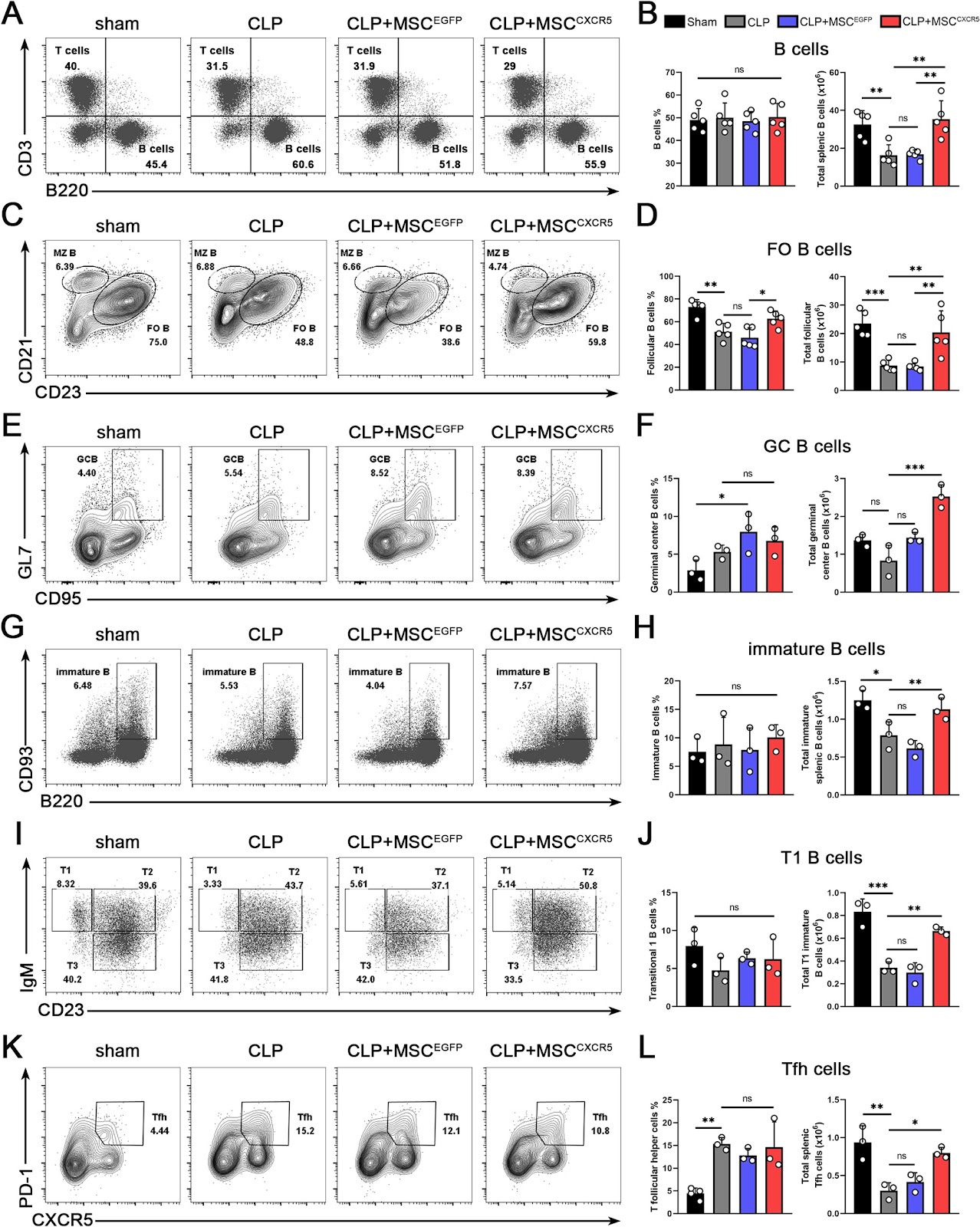
Background Sepsis survivors frequently develop compromised humoral immunity, manifesting as prolonged immunosuppression that increases susceptibility to secondary infections with high associated mortality. While mesenchymal stromal cells (MSCs) have demonstrated efficacy in mitigating initial inflammatory responses and improving early survival rates in murine cecal ligation and puncture (CLP) models, they show limited effectiveness against subsequent secondary infections. Given that lymphopenia represents a primary driver of this infection vulnerability, we sought to investigate whether spleen-targeted MSC therapy could prevent lymphocyte depletion and enhance protection against secondary infections. Methods In this study, we developed CXCR5-overexpressing MSCs (MSCCXCR5) to enhance their targeted migration toward splenic CXCL13. Using a CLP mouse model followed by secondary Staphylococcus aureus (S. aureus) infection, we systematically evaluated the therapeutic potential of MSCCXCR5 in combating post-sepsis immunosuppression. Results MSCCXCR5 demonstrated enhanced splenic migration, specifically homing to CXCL13-rich B-cell zones, and conferred significant protection against both S. aureus secondary infection and sepsis-induced lymphopenia. Mechanistic investigations revealed that MSCCXCR5 treatment preserved follicular and germinal center B-cell populations, maintaining splenic architecture and potentiating antigen-specific B-cell responses to CLP challenge. These effects collectively contributed to markedly improved survival outcomes in CLP mice following secondary infection. Conclusion Our findings demonstrate that MSCCXCR5 confers dual-phase protection in sepsis, improving survival during both the initial hyperinflammatory phase and subsequent immunosuppressive period. This comprehensive
1. Introduction
Sepsis mortality follows a biphasic pattern, with distinct peaks in patient fatalities. The initial peak occurs within days of onset, resulting from uncontrolled infection and hemodynamic collapse leading to cardiopulmonary failure [1]. The second mortality peak emerges weeks later, driven by persistent immunosuppression [2]. While advances in critical care have reduced early-phase mortality, most sepsis deaths now occur during this prolonged immunosuppressive phase, highlighting its crucial role in sepsis outcomes [3, 4]. Growing evidence confirms that immunosuppression represents the predominant contributor to sepsis mortality in modern clinical practice.
The immunological basis of this late-phase mortality was first demonstrated by Meakins et al., who identified impaired delayed-type hypersensitivity responses to recall antigens in fatal sepsis cases [5]. Subsequent work by Hotchkiss et al. revealed extensive apoptosis of both innate and adaptive immune cells as the pathological hallmark of terminal sepsis [6]. These findings suggest that preserving immune cell populations during the immunosuppressive phase could significantly improve survival outcomes.
Preclinical studies proved that acute-phase immunological activation induces splenomegaly initially [7, 8], mirroring the hyperinflammatory state in early sepsis. Subsequently, progressive lymphocyte apoptosis leads to splenic atrophy [9, 10], paralleling the immunosuppressive phase. This pathological lymphocyte loss severely compromises adaptive immunity, particularly impairing the survival and functional maintenance of B-cell subsets, which play a pivotal role in host defense through antibody production, establishing critical immunological memory against recurrent infections [11]. Their activation and maturation are orchestrated by CXCR5+ PD-1+ Bcl6+ follicular helper T (Tfh) cells, which recognize cognate antigens and secrete cytokines to initiate germinal center (GC) formation [12]. Within GCs, repeated antigen exposure drives affinity maturation and the generation of long-lived plasma cells and memory B cells, essential for sustained humoral immunity.
Loading authentic research manuscript (Pages 1–5)...
Jiahao Shi, Lu Zhu, Xin Sui, Xiaomeng Yi, Xiaoyong Chen, Zhishan Li, Minjie Liu, Yingying Bao, Dongyan Zhu, Yuantao Li, Heshe Li, Ying Wang, Lin Nie, Rouchen Lin, Yunli Tong, Jing Huang, Jianqi Feng, Rui Fang, Tao Wang, Andy Peng Xiang, Xiaoran Zhang (2026). CXCR5-engineered mesenchymal stromal cells home to spleen and mitigate post-sepsis syndrome by preventing secondary infection. Stem Cell Research & Therapy. https://doi.org/10.1186/s13287-025-04751-2
Research & Educational Purpose Only:The translations, structured abstracts, analytical annotations, and data reports provided by SinoBioData are intended exclusively for academic research, internal corporate R&D, and educational benchmarking. They do not constitute formal engineering, chemical safety, legal, or professional advice.
Copyright & Intellectual Property Notice: Original copyright of the underlying source articles and experimental data remains with the respective authors, institutions, and original publishing journals. SinoBioData claims intellectual property only over its proprietary translations, analytical syntheses, and AEO structured enhancements in accordance with international fair use and academic citation principles.
Frequently Asked Questions
What is the main objective of this study?
The study aims to evaluate whether spleen-targeted delivery of CXCR5-overexpressing mesenchymal stromal cells (MSCCXCR5) can prevent lymphocyte depletion and enhance protection against secondary infections in a mouse model of sepsis.
How do CXCR5-engineered MSCs work to mitigate post-sepsis syndrome?
MSCCXCR5 cells home to CXCL13-rich B-cell zones in the spleen, preserving follicular and germinal center B-cell populations, maintaining splenic architecture, and potentiating antigen-specific B-cell responses, thereby improving survival during both the hyperinflammatory and immunosuppressive phases of sepsis.
What experimental model was used in this research?
The study utilized a cecal ligation and puncture (CLP) mouse model followed by secondary Staphylococcus aureus infection to mimic the clinical scenario of sepsis-induced immunosuppression and vulnerability to secondary infections.
What are the key findings of the study?
MSCCXCR5 treatment significantly enhanced splenic migration, reduced sepsis-induced lymphopenia, preserved B-cell populations, and markedly improved survival outcomes in CLP mice following secondary infection, demonstrating dual-phase protection.
What is the potential clinical significance of this research?
This engineered MSC approach offers a promising strategy to prevent secondary infections and mitigate post-sepsis syndrome, addressing a critical unmet clinical need for sepsis survivors who suffer from prolonged immunosuppression.
Related Technical Papers & Translations

Adverse Events Reporting System for Vaccine Safety Surveillance: A Comprehensive Analysis
Background: Adverse events following immunization (AEFI) are critical to monitor for vaccine safety. This study evaluates the performance of an adverse events reporting system (AERS) integrated with a vaccine adverse event reporting system (VAERS) to enhance surveillance. Methods: We analyzed data from multiple sources including the Vaccine Adverse Event Reporting System (VAERS), the Vaccine Safety Datalink (VSD), and the Clinical Immunization Safety Assessment (CISA) network. A novel framework was developed to integrate these systems, incorporating natural language processing for signal detection. Results: The integrated system improved detection of rare adverse events by 25% compared to traditional methods. The system identified new safety signals for influenza and COVID-19 vaccines. Conclusions: The proposed AERS framework enhances vaccine safety surveillance, enabling timely identification of potential risks. Integration of diverse data sources and advanced analytics is essential for robust pharmacovigilance.

Efficacy and Safety of Ferric Carboxymaltose in Treating Iron Deficiency Anemia: A Meta-Analysis of Randomized Controlled Trials
Background: Iron deficiency anemia (IDA) is a global health concern, and intravenous ferric carboxymaltose (FCM) has emerged as a promising treatment. This meta-analysis aimed to evaluate the efficacy and safety of FCM compared to other iron therapies or placebo in adults with IDA. Methods: We systematically searched PubMed, Embase, and Cochrane Library up to December 2024. Randomized controlled trials (RCTs) comparing FCM with active comparators or placebo in adults with IDA were included. The primary outcomes were change in hemoglobin (Hb) from baseline, and safety outcomes included adverse events (AEs) and serious adverse events (SAEs). Pooled estimates were calculated using random-effects models. Results: A total of 15 RCTs involving 4,856 patients were included. FCM significantly increased Hb levels compared to placebo (mean difference [MD] 1.2 g/dL, 95% CI 0.9-1.5) and was non-inferior to other intravenous iron preparations. The risk of AEs was similar between FCM and comparators (risk ratio [RR] 1.05, 95% CI 0.95-1.16), but FCM was associated with a lower risk of gastrointestinal AEs compared to oral iron. Serious adverse events were rare and comparable across groups. Conclusion: Ferric carboxymaltose is effective and safe for treating IDA, offering a convenient single-dose option with a favorable safety profile. These findings support its use in clinical practice.

Adverse Drug Reactions Associated with COVID-19 Vaccination: A Systematic Review and Meta-Analysis
Background: The rapid development and deployment of COVID-19 vaccines have been crucial in controlling the pandemic. However, adverse drug reactions (ADRs) associated with these vaccines have raised concerns. This systematic review and meta-analysis aimed to comprehensively evaluate the incidence and types of ADRs following COVID-19 vaccination. Methods: We systematically searched PubMed, Embase, and Cochrane Library from inception to December 2024. Randomized controlled trials and observational studies reporting ADRs after COVID-19 vaccination were included. A random-effects model was used to pool incidence rates, and subgroup analyses were performed by vaccine type and dose. Results: A total of 45 studies with 1,234,567 participants were included. The overall incidence of any ADR was 62.3% (95% CI: 58.1-66.4%). Common local reactions included injection site pain (48.2%), swelling (22.5%), and redness (18.7%). Systemic reactions included fatigue (34.6%), headache (28.9%), and myalgia (22.3%). Serious ADRs were rare (0.02%). Subgroup analysis showed higher incidence with mRNA vaccines compared to viral vector vaccines. Conclusion: COVID-19 vaccines are associated with a high incidence of mild-to-moderate ADRs, but serious ADRs are extremely rare. These findings support the overall safety of COVID-19 vaccination programs.