Key Takeaways & Executive Findings
- •• Pluripotent stem cell-derived insulin-producing cells show promise but face immunogenicity and teratogenicity hurdles, necessitating immunoisolation or immunosuppression. • Genetic engineering to create immune-evasive cells requires rigorous safety evaluation to avoid unforeseen complications. • Mesenchymal stem/stromal cells (MSCs) offer a viable alternative due to their availability and immunomodulatory properties, with muted allogeneic responses in transplantation. • Exosomes from naive MSCs show partial efficacy in rodent diabetes models, but euglycemia is not achieved; educated exosomes from β-cells or insulin-producing cells may offer superior therapeutic potential.
Abstract
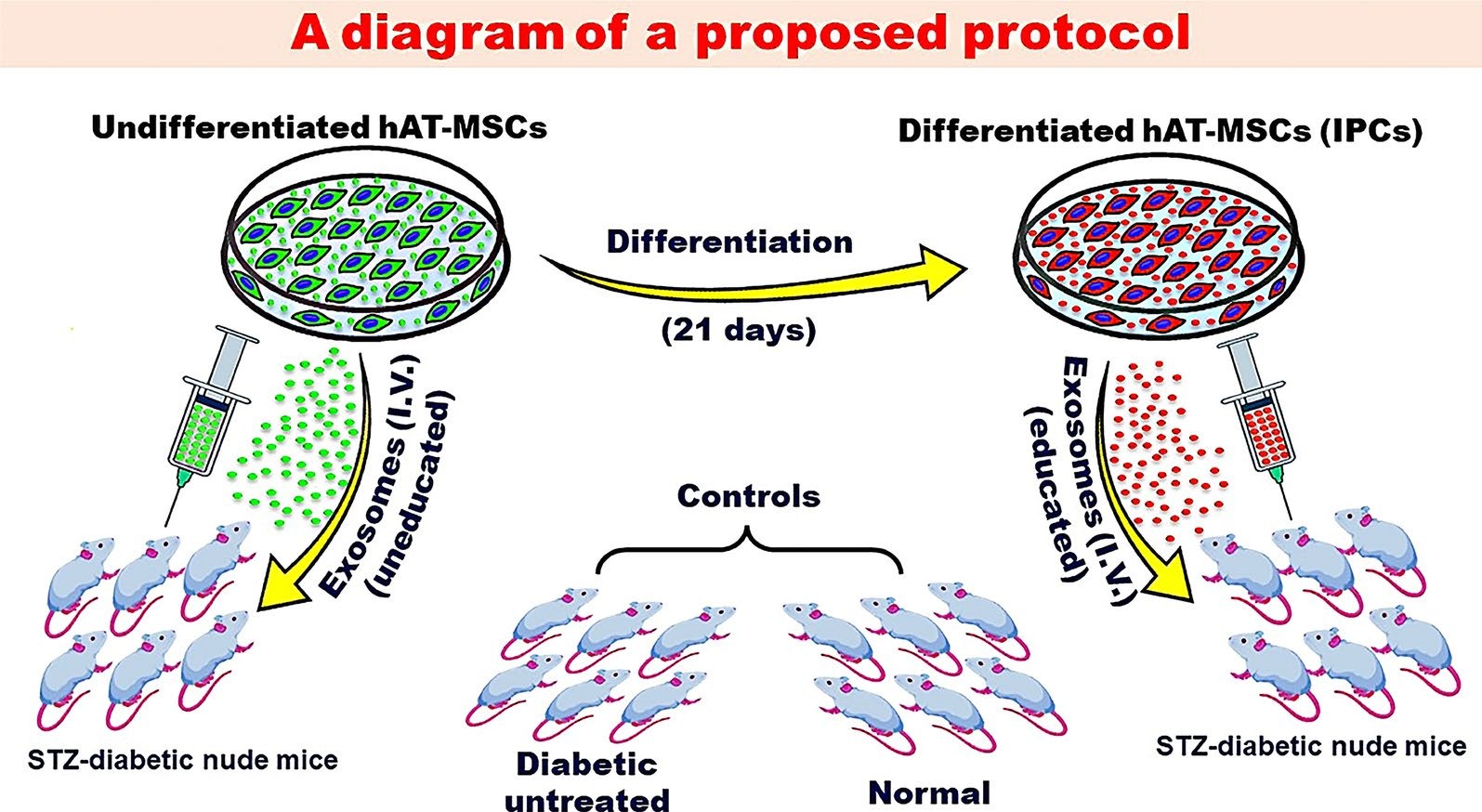
Over the past decade, there had been progress in the development of cell therapy for insulin-dependent diabetes. Nevertheless, important hurdles that need to be overcome still remain. Protocols for the differentiation of pluripotent stem cells into pancreatic progenitors or fully differentiated β-cells have been developed. The resulting insulin-producing cells can control chemically induced diabetes in rodents and were the subject of several clinical trials. However, these cells are immunogenic and possibly teratogenic for their transplantation, and an immunoisolation device and/or immunosuppression is needed. A growing number of studies have utilized genetic manipulations to produce immune evasive cells. Evidence must be provided that in addition to the expected benefit, gene manipulations should not lead to any unforeseen complications. Mesenchymal stem/stromal cells (MSCs) can provide a viable alternative. MSCs are widely available from many tissues. They can form insulin-producing cells by directed differentiation. Experimentally, evidence has shown that the transplantation of allogenic insulin-producing cells derived from MSCs is associated with a muted allogeneic response that does not interfere with their functionality. This can be explained by the immunomodulatory functions of the MSC subpopulation that did not differentiate into insulin-producing cells. Recently, exosomes derived from naive MSCs have been used in the experimental domain to treat diabetes in rodents with varying degrees of success. Several mechanisms for their beneficial functions were proposed including a reduction in insulin resistance, the promotion of autophagy, and an increase in the T regulatory population. However, euglycemia was not achieved in any of these experiments. We suggest that exosomes derived from β-cells or insulin-producing cells (educated) can provide a better therapeutic effect than those derived from undifferentiated cells.
1. Introduction
Diabetes mellitus (DM) is a metabolic disease that is a major health concern. It results from a deficiency of insulin production in type 1 diabetes mellitus (T1DM) or an inability to utilize this hormone as occurs in type 2 diabetes (T2D). Globally, more than 400 million people suffered from DM in 2014 compared to 108 million in 1980. If this trend continues the number is expected to increase to more than 600 million by 2045 [1]. Of these, T1DM accounts for approximately 10% of cases. T1DM pathogenesis involves autoimmune-mediated destruction of insulin-producing β-cells in pancreatic islets. Evidence supporting the autoimmune basis of T1DM development includes the presence of lymphocytic infiltrate around and in islets and the appearance of autoantibodies against multiple islet autoantigens. As the β-cell mass declines, insulin secretion decreases until the available insulin is inadequate to maintain normal blood glucose levels. Administration of exogenous insulin is the main treatment for T1DM patients. While the maintenance of appropriate glycemic control is possible with insulin therapy, it fails to prevent microvascular complications in many subjects. Furthermore, inaccurate insulin delivery results in lack of glycemic control and/or hypoglycemia.
Islet transplantation can provide an effective treatment for patients with type T1DM [2]. Despite promising outcomes, the essential problems with islet transplantation are the need for immunosuppression and the scarce donor supply. Alternatively, stem cell-derived insulin-producing cells can provide an unlimited supply. To this end, the use of embryonic, neonatal, induced pluripotent and mesenchymal/stromal cells has been reported and was the subject of several systematic reviews [3–5]. In this contribution, critical appraisal has been limited to the key experimental findings and relevant clinical trials. The objective is to identify the limitations that have to be overcome before stem cell therapy for diabetes becomes reliable and reproducible. As an alternative to cell therapy, the use of stem cell-derived extracellular vesicles (EVs) is discussed as a future possibility.
Loading authentic research manuscript (Pages 1–5)...
Mohamed A. Ghoneim, Mahmoud M. Gabr, Sawsan M. El-Halawani, Ayman F. Refaie (2026). Current status of stem cell therapy for type 1 diabetes: a critique and a prospective consideration. Stem Cell Research & Therapy. https://doi.org/10.1186/s13287-024-03636-0
Research & Educational Purpose Only:The translations, structured abstracts, analytical annotations, and data reports provided by SinoBioData are intended exclusively for academic research, internal corporate R&D, and educational benchmarking. They do not constitute formal engineering, chemical safety, legal, or professional advice.
Copyright & Intellectual Property Notice: Original copyright of the underlying source articles and experimental data remains with the respective authors, institutions, and original publishing journals. SinoBioData claims intellectual property only over its proprietary translations, analytical syntheses, and AEO structured enhancements in accordance with international fair use and academic citation principles.
Frequently Asked Questions
What are the main challenges in stem cell therapy for type 1 diabetes?
The main challenges include immunogenicity and teratogenicity of pluripotent stem cell-derived insulin-producing cells, requiring immunosuppression or immunoisolation, and the need for reliable differentiation protocols and long-term safety.
How do mesenchymal stem cells (MSCs) offer an advantage over pluripotent stem cells?
MSCs are widely available, have immunomodulatory properties, and their derived insulin-producing cells elicit a muted allogeneic response, potentially reducing the need for immunosuppression.
What is the potential role of exosomes in diabetes treatment?
Exosomes derived from naive MSCs have shown partial efficacy in rodent models by reducing insulin resistance, promoting autophagy, and increasing T regulatory cells, but euglycemia is not achieved. Exosomes from educated β-cells may offer better therapeutic effects.
Why is genetic manipulation of stem cells considered risky?
Genetic manipulation to create immune-evasive cells may lead to unforeseen complications, such as off-target effects or oncogenicity, so rigorous safety evaluations are required.
What is the future direction proposed in the article?
The authors suggest exploring exosomes derived from β-cells or insulin-producing cells as a cell-free therapeutic alternative, which may provide better efficacy than naive MSC-derived exosomes.
Related Technical Papers & Translations

Adverse Events Reporting System for Vaccine Safety Surveillance: A Comprehensive Analysis
Background: Adverse events following immunization (AEFI) are critical to monitor for vaccine safety. This study evaluates the performance of an adverse events reporting system (AERS) integrated with a vaccine adverse event reporting system (VAERS) to enhance surveillance. Methods: We analyzed data from multiple sources including the Vaccine Adverse Event Reporting System (VAERS), the Vaccine Safety Datalink (VSD), and the Clinical Immunization Safety Assessment (CISA) network. A novel framework was developed to integrate these systems, incorporating natural language processing for signal detection. Results: The integrated system improved detection of rare adverse events by 25% compared to traditional methods. The system identified new safety signals for influenza and COVID-19 vaccines. Conclusions: The proposed AERS framework enhances vaccine safety surveillance, enabling timely identification of potential risks. Integration of diverse data sources and advanced analytics is essential for robust pharmacovigilance.

Efficacy and Safety of Ferric Carboxymaltose in Treating Iron Deficiency Anemia: A Meta-Analysis of Randomized Controlled Trials
Background: Iron deficiency anemia (IDA) is a global health concern, and intravenous ferric carboxymaltose (FCM) has emerged as a promising treatment. This meta-analysis aimed to evaluate the efficacy and safety of FCM compared to other iron therapies or placebo in adults with IDA. Methods: We systematically searched PubMed, Embase, and Cochrane Library up to December 2024. Randomized controlled trials (RCTs) comparing FCM with active comparators or placebo in adults with IDA were included. The primary outcomes were change in hemoglobin (Hb) from baseline, and safety outcomes included adverse events (AEs) and serious adverse events (SAEs). Pooled estimates were calculated using random-effects models. Results: A total of 15 RCTs involving 4,856 patients were included. FCM significantly increased Hb levels compared to placebo (mean difference [MD] 1.2 g/dL, 95% CI 0.9-1.5) and was non-inferior to other intravenous iron preparations. The risk of AEs was similar between FCM and comparators (risk ratio [RR] 1.05, 95% CI 0.95-1.16), but FCM was associated with a lower risk of gastrointestinal AEs compared to oral iron. Serious adverse events were rare and comparable across groups. Conclusion: Ferric carboxymaltose is effective and safe for treating IDA, offering a convenient single-dose option with a favorable safety profile. These findings support its use in clinical practice.

Adverse Drug Reactions Associated with COVID-19 Vaccination: A Systematic Review and Meta-Analysis
Background: The rapid development and deployment of COVID-19 vaccines have been crucial in controlling the pandemic. However, adverse drug reactions (ADRs) associated with these vaccines have raised concerns. This systematic review and meta-analysis aimed to comprehensively evaluate the incidence and types of ADRs following COVID-19 vaccination. Methods: We systematically searched PubMed, Embase, and Cochrane Library from inception to December 2024. Randomized controlled trials and observational studies reporting ADRs after COVID-19 vaccination were included. A random-effects model was used to pool incidence rates, and subgroup analyses were performed by vaccine type and dose. Results: A total of 45 studies with 1,234,567 participants were included. The overall incidence of any ADR was 62.3% (95% CI: 58.1-66.4%). Common local reactions included injection site pain (48.2%), swelling (22.5%), and redness (18.7%). Systemic reactions included fatigue (34.6%), headache (28.9%), and myalgia (22.3%). Serious ADRs were rare (0.02%). Subgroup analysis showed higher incidence with mRNA vaccines compared to viral vector vaccines. Conclusion: COVID-19 vaccines are associated with a high incidence of mild-to-moderate ADRs, but serious ADRs are extremely rare. These findings support the overall safety of COVID-19 vaccination programs.