Key Takeaways & Executive Findings
- •• The DESE439K mutation disrupts cardiomyocyte cytoarchitecture, including cell size and morphology, and leads to mitochondrial dysfunction. • Mutant cardiomyocytes exhibit impaired mitochondrial architecture, respiratory capacity, and metabolic activity, mirroring defects in patient heart tissue. • Transfer of normal mitochondria into mutant cardiomyocytes restores mitochondrial and contractile functions, highlighting a potential therapeutic strategy. • This study provides a human iPSC-derived cardiomyocyte model for desmin-related cardiomyopathy, enabling mechanistic studies and drug testing.
Abstract
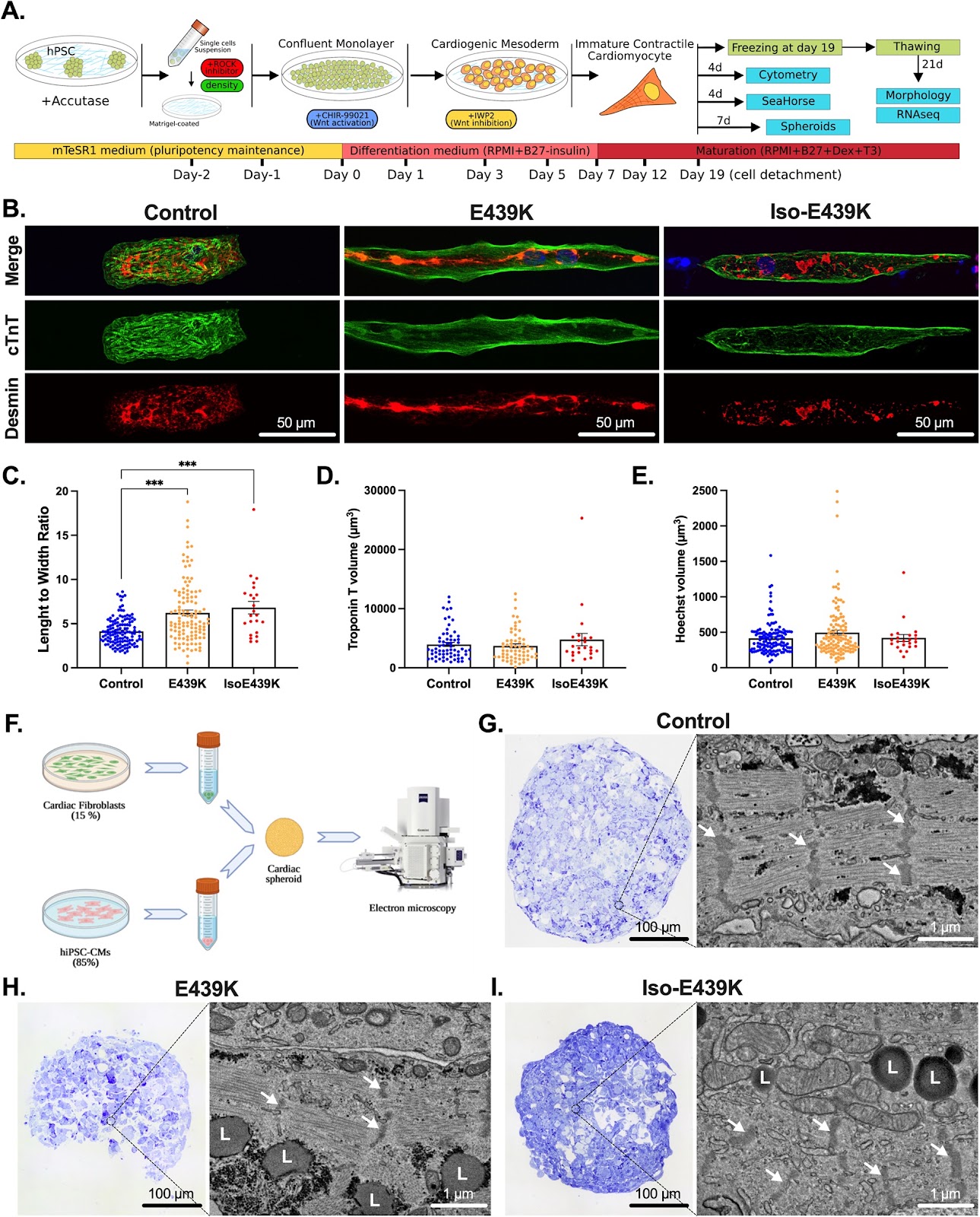
Background Beyond the observed alterations in cellular structure and mitochondria, the mechanisms linking rare genetic mutations to the development of heart failure in patients affected by desmin mutations remain unclear due in part, to the lack of relevant human cardiomyocyte models. Methods To shed light on the role of mitochondria in these mechanisms, we investigated cardiomyocytes derived from human induced pluripotent stem cells carrying the heterozygous DESE439K mutation that were either isolated from a patient or generated by gene editing. To increase physiological relevance, cardiomyocytes were either cultured on an anisotropic micropatterned surface to obtain elongated and aligned cardiomyocytes, or as a cardiac spheroid to create a micro-tissue. Moreover, when applicable, results from cardiomyocytes were confirmed with heart biopsies of suddenly died patient of the same family harboring DESE439K mutation, and post-mortem heart samples from five control healthy donors. Results The heterozygous DESE439K mutation leads to dramatic changes in the overall cytoarchitecture of cardiomyocytes, including cell size and morphology. Most importantly, mutant cardiomyocytes display altered mitochondrial architecture, mitochondrial respiratory capacity and metabolic activity reminiscent of defects observed in patient’s heart tissue. Finally, to challenge the pathological mechanism, we transferred normal mitochondria inside the mutant cardiomyocytes and demonstrated that this treatment was able to restore mitochondrial and contractile functions of cardiomyocytes. Conclusions This work highlights the deleterious effects of DESE439K mutation, demonstrates the crucial role of mitochondrial abnormalities in the pathophysiology of desmin-related cardiomyopathy, and opens up new potential therapeutic perspectives for this disease.
1. Introduction
Desmin-related myofibrillar myopathy (MFM1, OMIM:601419) represents a group of skeletal and cardiac muscle disorders caused by mutations in the desmin-encoding DES gene. Desmin is the major component of intermediate filaments (IFs) in striated and smooth muscle cells and tissues and plays an essential role in the tensile strength and integrity of muscle fibers [1–4]. In humans, about a hundred mutations of the DES gene have been identified which usually disrupt the ability of desmin to form filamentous networks and/or to interact with partner proteins [3, 5]. Consequently, desmin mutations alter the mechanical properties of the desmin network, resulting in multiple functional and structural abnormalities in muscle cells, leading to progressive skeletal myopathy and cardiomyopathy, the most common clinical manifestations of MFM1 [6]. Impairment of desmin network is also closely associated to the etiology of many striated muscle pathologies. It is worth to note that desmin IFs remodeling also occurs when proteostasis is disturbed, during inflammatory process, or during aging [7–9].
Beyond its role in muscle cell integrity and organization, several studies conducted with genetically modified cell lines carrying human desmin mutations or in desmin knockout mice indicated that desmin critically modulates mitochondria functions [10–15]. Importantly, it has been noticed that mutated desmin leads to severe mitochondria abnormalities that directly contribute to MFM1 development. Consistent with this finding, abnormalities in the distribution and morphology of mitochondria as well as in their respiratory function have been reported with DES mutations using transiently transfected human or animal cells carrying human DES mutations [15, 16], transgenic mouse hearts with DES mutations [17] as well as human heart and skeletal biopsy samples of MFM1 patients [18–20]. Moreover, several publications describe that DES mutations are associated with Cytochrome c oxidase (COX)-negative fibers.
Loading authentic research manuscript (Pages 1–5)...
Yeranuhi Hovhannisyan, Zhenlin Li, Domitille Callon, Rodolphe Suspène, Vivien Batoumeni, Alexis Canette, Jocelyne Blanc, Hakim Hocini, Cécile Lefebvre, Nora El-Jahrani, Maria Kitsara, Aurore L’honoré, Ekaterini Kordeli, Paul Fornes, Jean-Paul Concordet, Gérard Tachdjian, Anne-Marie Rodriguez, Jean-Pierre Vartanian, Anthony Béhin, Karim Wahbi, Pierre Joanne, Onnik Agbulut (2026). Critical contribution of mitochondria in the development of cardiomyopathy linked to desmin mutation. Stem Cell Research & Therapy. https://doi.org/10.1186/s13287-023-03619-7
Research & Educational Purpose Only:The translations, structured abstracts, analytical annotations, and data reports provided by SinoBioData are intended exclusively for academic research, internal corporate R&D, and educational benchmarking. They do not constitute formal engineering, chemical safety, legal, or professional advice.
Copyright & Intellectual Property Notice: Original copyright of the underlying source articles and experimental data remains with the respective authors, institutions, and original publishing journals. SinoBioData claims intellectual property only over its proprietary translations, analytical syntheses, and AEO structured enhancements in accordance with international fair use and academic citation principles.
Frequently Asked Questions
What is the role of mitochondria in desmin-related cardiomyopathy?
The study demonstrates that the DESE439K mutation leads to mitochondrial dysfunction, including altered architecture, reduced respiratory capacity, and metabolic changes, which are critical in the pathophysiology of desmin-related cardiomyopathy.
How was the DESE439K mutation studied?
Cardiomyocytes derived from human induced pluripotent stem cells carrying the heterozygous DESE439K mutation were used, either from a patient or generated by gene editing, and cultured on anisotropic micropatterned surfaces or as cardiac spheroids to mimic physiological conditions.
Can mitochondrial transfer restore function in mutant cardiomyocytes?
Yes, transferring normal mitochondria into mutant cardiomyocytes restored mitochondrial and contractile functions, suggesting a potential therapeutic approach for desmin-related cardiomyopathy.
What are the clinical implications of this research?
The findings highlight mitochondrial abnormalities as a key target for therapy and provide a human cell model for testing drugs, potentially leading to new treatments for desmin-related cardiomyopathy.
Related Technical Papers & Translations

Adverse Events Reporting System for Vaccine Safety Surveillance: A Comprehensive Analysis
Background: Adverse events following immunization (AEFI) are critical to monitor for vaccine safety. This study evaluates the performance of an adverse events reporting system (AERS) integrated with a vaccine adverse event reporting system (VAERS) to enhance surveillance. Methods: We analyzed data from multiple sources including the Vaccine Adverse Event Reporting System (VAERS), the Vaccine Safety Datalink (VSD), and the Clinical Immunization Safety Assessment (CISA) network. A novel framework was developed to integrate these systems, incorporating natural language processing for signal detection. Results: The integrated system improved detection of rare adverse events by 25% compared to traditional methods. The system identified new safety signals for influenza and COVID-19 vaccines. Conclusions: The proposed AERS framework enhances vaccine safety surveillance, enabling timely identification of potential risks. Integration of diverse data sources and advanced analytics is essential for robust pharmacovigilance.

Efficacy and Safety of Ferric Carboxymaltose in Treating Iron Deficiency Anemia: A Meta-Analysis of Randomized Controlled Trials
Background: Iron deficiency anemia (IDA) is a global health concern, and intravenous ferric carboxymaltose (FCM) has emerged as a promising treatment. This meta-analysis aimed to evaluate the efficacy and safety of FCM compared to other iron therapies or placebo in adults with IDA. Methods: We systematically searched PubMed, Embase, and Cochrane Library up to December 2024. Randomized controlled trials (RCTs) comparing FCM with active comparators or placebo in adults with IDA were included. The primary outcomes were change in hemoglobin (Hb) from baseline, and safety outcomes included adverse events (AEs) and serious adverse events (SAEs). Pooled estimates were calculated using random-effects models. Results: A total of 15 RCTs involving 4,856 patients were included. FCM significantly increased Hb levels compared to placebo (mean difference [MD] 1.2 g/dL, 95% CI 0.9-1.5) and was non-inferior to other intravenous iron preparations. The risk of AEs was similar between FCM and comparators (risk ratio [RR] 1.05, 95% CI 0.95-1.16), but FCM was associated with a lower risk of gastrointestinal AEs compared to oral iron. Serious adverse events were rare and comparable across groups. Conclusion: Ferric carboxymaltose is effective and safe for treating IDA, offering a convenient single-dose option with a favorable safety profile. These findings support its use in clinical practice.

Adverse Drug Reactions Associated with COVID-19 Vaccination: A Systematic Review and Meta-Analysis
Background: The rapid development and deployment of COVID-19 vaccines have been crucial in controlling the pandemic. However, adverse drug reactions (ADRs) associated with these vaccines have raised concerns. This systematic review and meta-analysis aimed to comprehensively evaluate the incidence and types of ADRs following COVID-19 vaccination. Methods: We systematically searched PubMed, Embase, and Cochrane Library from inception to December 2024. Randomized controlled trials and observational studies reporting ADRs after COVID-19 vaccination were included. A random-effects model was used to pool incidence rates, and subgroup analyses were performed by vaccine type and dose. Results: A total of 45 studies with 1,234,567 participants were included. The overall incidence of any ADR was 62.3% (95% CI: 58.1-66.4%). Common local reactions included injection site pain (48.2%), swelling (22.5%), and redness (18.7%). Systemic reactions included fatigue (34.6%), headache (28.9%), and myalgia (22.3%). Serious ADRs were rare (0.02%). Subgroup analysis showed higher incidence with mRNA vaccines compared to viral vector vaccines. Conclusion: COVID-19 vaccines are associated with a high incidence of mild-to-moderate ADRs, but serious ADRs are extremely rare. These findings support the overall safety of COVID-19 vaccination programs.