Key Takeaways & Executive Findings
- •• Connexin 25 (Cx25) is identified as the dominant gap junction protein mediating intercellular Ca2+ communication in human airway basal cell (hBC) clones, essential for maintaining self-renewal and pluripotency. • Cx25 regulates both in vitro differentiation and in vivo regeneration potential of hBCs in an airway damage model, highlighting its therapeutic relevance for airway repair. • Abnormal Cx25 expression is observed in respiratory diseases including IPF, COVID-19, and bronchiectasis, suggesting a potential biomarker or therapeutic target. • The study provides a novel screening method using femtosecond laser-induced Ca2+ waves to identify functional gap junction proteins in stem cell clones.
Abstract
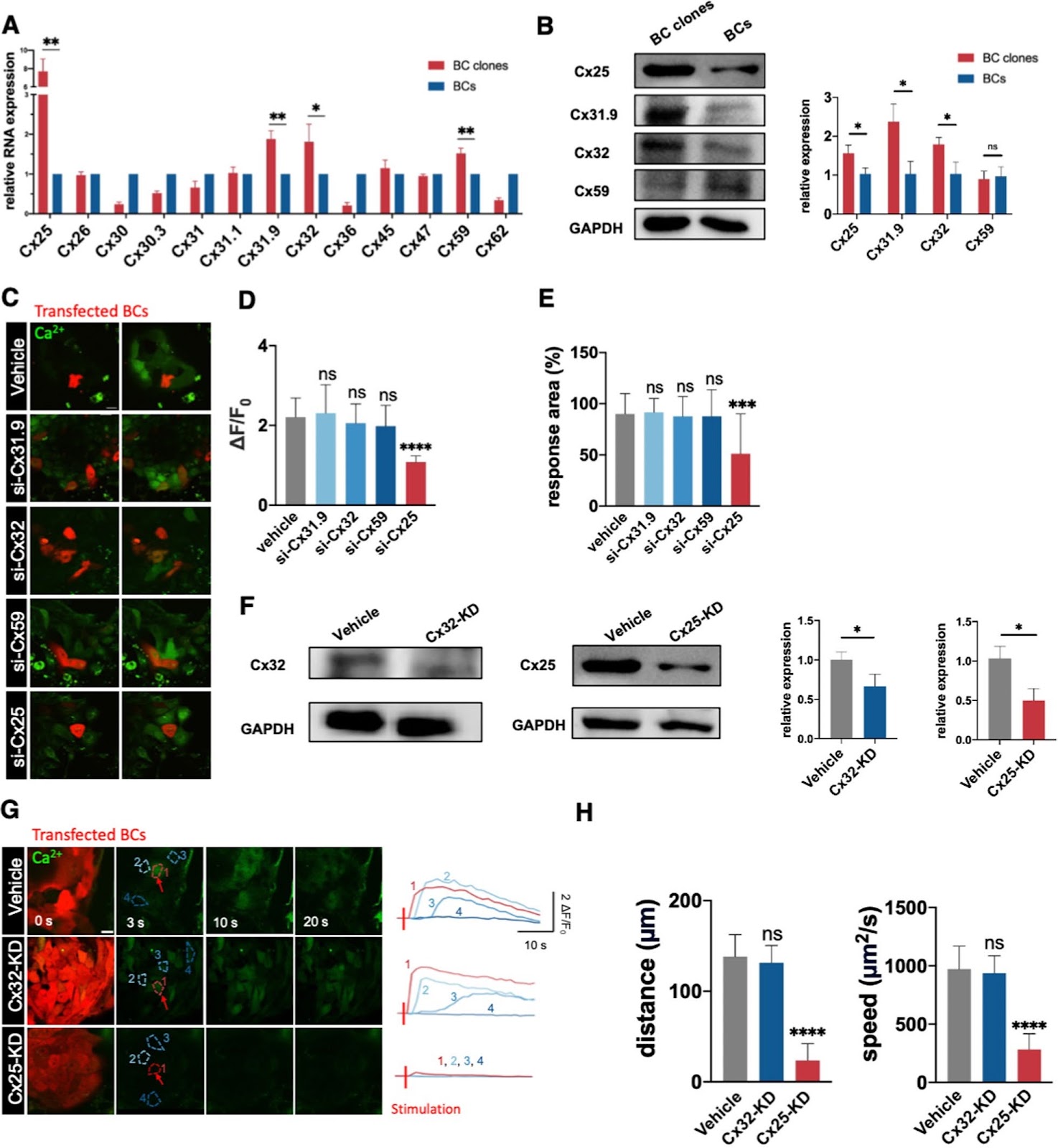
Background The formation of stem cell clones enables close contact of stem cells inside. The gap junctions in such clone spheres establish a microenvironment that allows frequent intercellular communication to maintain self-renewal and functions of stem cells. Nevertheless, the essential gap junction protein for molecular signaling in clones is poorly known. Methods Primary human airway basal cells (hBCs) were isolated from brushing samples through bronchoscopy and then cultured. A tightly focused femtosecond laser was used to excite the local Ca2+ in an individual cell to initiate an internal Ca2+ wave in a clone to screen gap junction proteins. Immunoflourescence staining and clonogenicity assay were used to evaluate self-renewal and functions. RNA and protein levels were assessed by PCR and Western blot. Air–liquid interface assay was conducted to evaluate the differentiation potential. A Naphthalene injury mouse model was used to assess the regeneration potential. Results Herein, we identify Connexin 25 (Cx25) dominates intercellular Ca2+ communications in clones of hBCs in vitro to maintain the self-renewal and pluripotency of them. The self-renewal and in vitro differentiation functions and in vivo regeneration potential of hBCs in an airway damage model are both regulated by Cx25. The abnormal expression of Cx25 is validated in several diseases including IPF, Covid-19 and bronchiectasis. Conclusion Cx25 is essential for hBC clones in maintaining self-renewal and functions of hBCs via gap junctions.
1. Introduction
Stem-cell clones are believed to establish a microenvironment for self-renewal of each member inside during in vitro culture [1, 2]. The morphology of cell clone spheres ensures close contact of stem cells, probably for intercellular molecular signalings. Previous studies report the cell density, space, morphology and physical contact of clones are able to regulate the fate of stem cells [3–6]. The size and distance of cell clones greatly influence differentiation and self-renewal of human embryo stem cells [4, 7]. Therefore, the densely packed cells in clones might regulate the internal interactions of each cell to sustain their self-renewal capabilities.
Gap junctions, clusters of intercellular channels located on the cell membrane, facilitate the direct passage of ions and small molecules into the cytoplasm of neighboring cells, thereby playing a significant role in mediating intercellular communication [8–10]. It has been reported that gap junctions contribute to the differentiation in various stem cell types including adipose-derived stem cells and human-induced pluripotent stem cells [11, 12]. Specifically, calcium signals traverse gap junctions between cells without decrement [13], which serve as a guidance to many biological processes such as cell fate determination, proliferation and differentiation [14–17]. However, the role of gap junctions in molecular communications inside clones remains poorly understood.
Airway basal cells (BCs), a type of pluripotent stem cells, universally exist in airway epithelium to drive homeostasis of epithelium and hold good potential for tissue regeneration [18–20]. BCs are crucial for therapeutic intervention in lung diseases, encompassing both chronic lung conditions and acute epithelial injuries [21, 22], and thus widely used in medical researches and even in clinic which usually requires significant quantities of human BCs (hBCs) for transplantation [22–24]. For this purpose, hBCs need to be extracted from patients and cultured for tens of days to expand them to a large amount in vitro while maintaining their self-renewal ability. Different signaling pathways, such as the Notch and Rock pathways, as well as proteins like LC3B and GPR87, regulate the differentiation of hBCs [25–28].
Loading authentic research manuscript (Pages 1–5)...
Jingyuan Zhang, Shaoyang Wang, Zeyu Liu, Cheng Zhong, Yuqiong Lei, Qi Zheng, Yongle Xu, Shan Shan, Hao He, Tao Ren (2026). Connexin 25 maintains self-renewal and functions of airway basal cells for airway regeneration. Stem Cell Research & Therapy. https://doi.org/10.1186/s13287-024-03908-9
Research & Educational Purpose Only:The translations, structured abstracts, analytical annotations, and data reports provided by SinoBioData are intended exclusively for academic research, internal corporate R&D, and educational benchmarking. They do not constitute formal engineering, chemical safety, legal, or professional advice.
Copyright & Intellectual Property Notice: Original copyright of the underlying source articles and experimental data remains with the respective authors, institutions, and original publishing journals. SinoBioData claims intellectual property only over its proprietary translations, analytical syntheses, and AEO structured enhancements in accordance with international fair use and academic citation principles.
Frequently Asked Questions
What is the main finding of this study?
The study identifies Connexin 25 (Cx25) as the key gap junction protein that maintains self-renewal and functions of human airway basal cells (hBCs) by mediating intercellular calcium communication in clones.
How was Cx25 identified as the essential gap junction protein?
The researchers used a tightly focused femtosecond laser to excite local Ca2+ in individual cells within hBC clones, initiating intercellular Ca2+ waves to screen for functional gap junction proteins. This approach revealed that Cx25 dominates these communications.
What are the clinical implications of this research?
Cx25 expression is abnormal in respiratory diseases such as IPF, COVID-19, and bronchiectasis, suggesting that Cx25 could serve as a biomarker or therapeutic target for airway regeneration and disease treatment.
How does Cx25 affect airway regeneration?
Cx25 regulates both in vitro differentiation and in vivo regeneration potential of hBCs in an airway damage model, indicating its crucial role in repairing airway epithelium after injury.
What methods were used to assess hBC function?
The study employed immunofluorescence staining, clonogenicity assays, PCR, Western blot, air-liquid interface assays for differentiation, and a naphthalene injury mouse model for regeneration potential.
Related Technical Papers & Translations

Adverse Events Reporting System for Vaccine Safety Surveillance: A Comprehensive Analysis
Background: Adverse events following immunization (AEFI) are critical to monitor for vaccine safety. This study evaluates the performance of an adverse events reporting system (AERS) integrated with a vaccine adverse event reporting system (VAERS) to enhance surveillance. Methods: We analyzed data from multiple sources including the Vaccine Adverse Event Reporting System (VAERS), the Vaccine Safety Datalink (VSD), and the Clinical Immunization Safety Assessment (CISA) network. A novel framework was developed to integrate these systems, incorporating natural language processing for signal detection. Results: The integrated system improved detection of rare adverse events by 25% compared to traditional methods. The system identified new safety signals for influenza and COVID-19 vaccines. Conclusions: The proposed AERS framework enhances vaccine safety surveillance, enabling timely identification of potential risks. Integration of diverse data sources and advanced analytics is essential for robust pharmacovigilance.

Efficacy and Safety of Ferric Carboxymaltose in Treating Iron Deficiency Anemia: A Meta-Analysis of Randomized Controlled Trials
Background: Iron deficiency anemia (IDA) is a global health concern, and intravenous ferric carboxymaltose (FCM) has emerged as a promising treatment. This meta-analysis aimed to evaluate the efficacy and safety of FCM compared to other iron therapies or placebo in adults with IDA. Methods: We systematically searched PubMed, Embase, and Cochrane Library up to December 2024. Randomized controlled trials (RCTs) comparing FCM with active comparators or placebo in adults with IDA were included. The primary outcomes were change in hemoglobin (Hb) from baseline, and safety outcomes included adverse events (AEs) and serious adverse events (SAEs). Pooled estimates were calculated using random-effects models. Results: A total of 15 RCTs involving 4,856 patients were included. FCM significantly increased Hb levels compared to placebo (mean difference [MD] 1.2 g/dL, 95% CI 0.9-1.5) and was non-inferior to other intravenous iron preparations. The risk of AEs was similar between FCM and comparators (risk ratio [RR] 1.05, 95% CI 0.95-1.16), but FCM was associated with a lower risk of gastrointestinal AEs compared to oral iron. Serious adverse events were rare and comparable across groups. Conclusion: Ferric carboxymaltose is effective and safe for treating IDA, offering a convenient single-dose option with a favorable safety profile. These findings support its use in clinical practice.

Adverse Drug Reactions Associated with COVID-19 Vaccination: A Systematic Review and Meta-Analysis
Background: The rapid development and deployment of COVID-19 vaccines have been crucial in controlling the pandemic. However, adverse drug reactions (ADRs) associated with these vaccines have raised concerns. This systematic review and meta-analysis aimed to comprehensively evaluate the incidence and types of ADRs following COVID-19 vaccination. Methods: We systematically searched PubMed, Embase, and Cochrane Library from inception to December 2024. Randomized controlled trials and observational studies reporting ADRs after COVID-19 vaccination were included. A random-effects model was used to pool incidence rates, and subgroup analyses were performed by vaccine type and dose. Results: A total of 45 studies with 1,234,567 participants were included. The overall incidence of any ADR was 62.3% (95% CI: 58.1-66.4%). Common local reactions included injection site pain (48.2%), swelling (22.5%), and redness (18.7%). Systemic reactions included fatigue (34.6%), headache (28.9%), and myalgia (22.3%). Serious ADRs were rare (0.02%). Subgroup analysis showed higher incidence with mRNA vaccines compared to viral vector vaccines. Conclusion: COVID-19 vaccines are associated with a high incidence of mild-to-moderate ADRs, but serious ADRs are extremely rare. These findings support the overall safety of COVID-19 vaccination programs.