Key Takeaways & Executive Findings
- •• Manganese-doped hydroxyapatite/polydopamine composites were successfully synthesized as microspheres with tunable manganese release and enhanced degradation rates. • 5Mn-HA/PDA exhibited the strongest osteogenic differentiation and bone regeneration in vitro and in vivo among the tested materials. • Polydopamine coating effectively controlled manganese ion release, reducing cytotoxicity while maintaining bioactivity. • The composite material shows promise as a bone graft substitute for repairing critical-sized bone defects.
Abstract
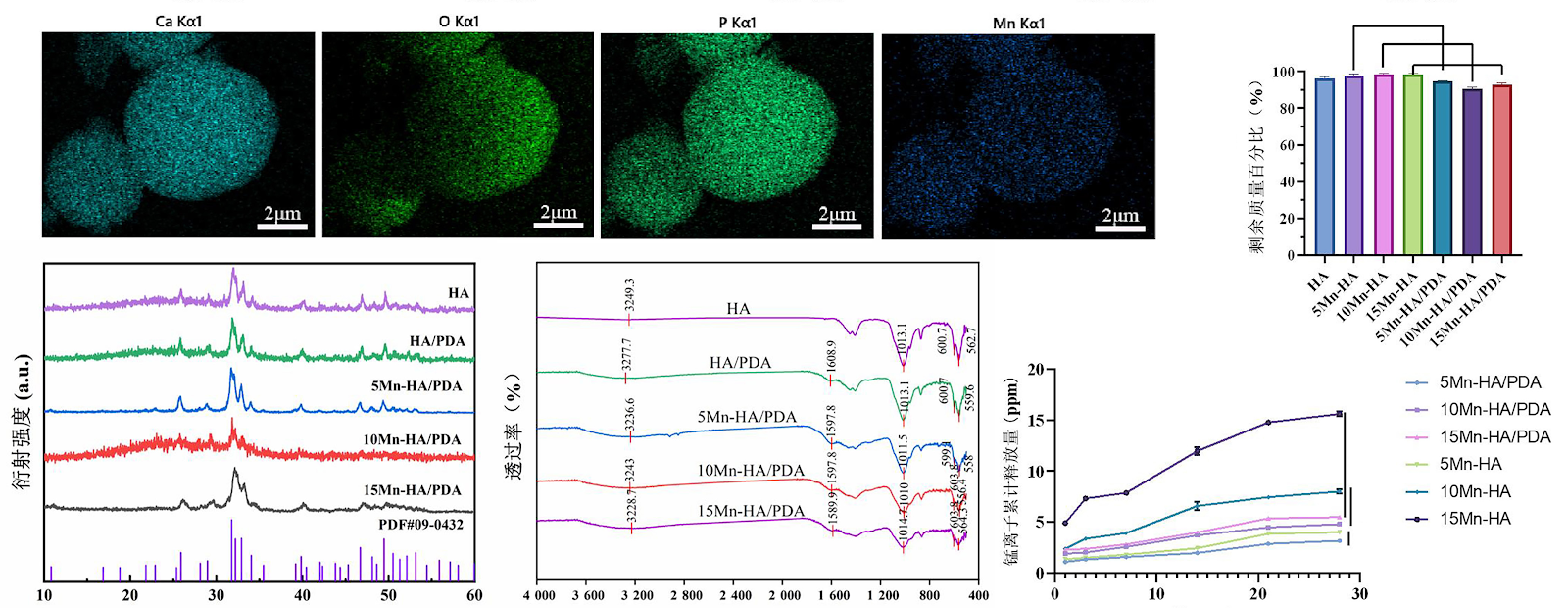
BACKGROUND: Hydroxyapatite is widely used in bone tissue engineering due to its excellent osteoconductivity. However, its limited osteoinductivity restricts its clinical application and therapeutic efficacy. OBJECTIVE: To construct manganese-doped hydroxyapatite/polydopamine composite bone graft materials and characterize their physicochemical and biological properties. METHODS: (1) Using Ca(NO₃)₂·4H₂O as the calcium source, (NH4)2HPO4 as the phosphorus source, and manganese nitrate solution as the manganese source, manganese-doped hydroxyapatite was prepared by hydrothermal homogeneous coprecipitation with manganese/(calcium+manganese) molar ratios of 5%, 10%, and 15%, respectively. The corresponding materials were denoted as 5Mn-HA, 10Mn-HA, and 15Mn-HA. Hydroxyapatite and the three manganese-doped hydroxyapatite materials were immersed in dopamine hydrochloride-Tris buffer solution to prepare manganese-doped hydroxyapatite/polydopamine composites, denoted as HA/PDA, 5Mn-HA/PDA, 10Mn-HA/PDA, and 15Mn-HA/PDA. The morphology, manganese ion release, degradation rate, and cytocompatibility were characterized. The manganese-doped material with better cytocompatibility was selected for subsequent experiments. (2) Hydroxyapatite, HA/PDA, 5Mn-HA, and 5Mn-HA/PDA were co-cultured with rat bone marrow mesenchymal stem cells. After osteogenic induction, alkaline phosphatase activity and alizarin red S staining were performed, and q-PCR was used to detect Runx2 and osteocalcin mRNA expression. (3) In 24 SD rats, two circular full-thickness bone defects of 5 mm diameter were created on each side of the calvarium. The right defects were implanted with hydroxyapatite, HA/PDA, 5Mn-HA, or 5Mn-HA/PDA (6 rats per material), while the left defects served as blank controls. At 4 and 8 weeks post-surgery, samples were harvested for Micro-CT scanning, hematoxylin-eosin and Masson staining. RESULTS AND CONCLUSION: (1) The manganese-doped hydroxyapatite/polydopamine composites were microspherical with particle sizes ranging from 9.86 to 13 μm. With increasing manganese doping, the release of manganese ions increased, and the release rate from the composites was lower than that from the corresponding manganese-doped hydroxyapatite. The composites exhibited faster degradation rates compared to manganese-doped hydroxyapatite. Based on live/dead staining and CCK-8 assays, 5Mn-HA showed no obvious cytotoxicity; therefore, 5Mn-HA and 5Mn-HA/PDA were selected for further osteogenic evaluation and in vivo verification. (2) Combined results of alkaline phosphatase activity, alizarin red S staining, and q-PCR indicated that 5Mn-HA/PDA had the strongest osteogenic ability among the four materials. (3) Micro-CT scanning showed that the blank control group had the slowest bone repair and least new bone formation, while the 5Mn-HA/PDA group had the fastest bone repair and most new bone. Hematoxylin-eosin and Masson staining further confirmed the Micro-CT results. (4) In conclusion, manganese-doped hydroxyapatite/polydopamine composites possess good physicochemical and biological properties.
1. Introduction
Oral and maxillofacial bone defect repair is an important topic in stomatology. Autogenous bone grafting is considered the gold standard due to its excellent histocompatibility and osteoinductivity, but it requires a second surgical site and carries risks of infection. Allogeneic and xenogeneic bone grafts have risks of immune rejection and disease transmission. Therefore, synthetic bone graft materials are gaining attention due to their controllability, low cost, and simplicity.
Hydroxyapatite (HA), the main inorganic component of bone and teeth, has similar chemical composition and crystal structure to bone tissue, and is widely used in bone repair. Various preparation methods can produce HA with different morphologies to meet clinical needs. Microsphere-structured HA has high specific surface area and hollow characteristics, which increase contact area with biological environment, promote cell attachment and growth factor distribution, and facilitate vascular ingrowth, accelerating bone regeneration. However, pure HA has insufficient osteoinductivity to meet clinical requirements.
Studies have shown that Ca2+ in the HA lattice can be partially substituted by other metal ions, forming metal-doped HA with enhanced biological properties. Manganese (Mn) is an essential trace element in the human body and plays a crucial role in bone and cartilage development. Appropriate concentrations of Mn2+ can upregulate osteogenic gene expression, promote osteogenic differentiation, and participate in collagen cross-linking and mineralization, thereby improving mechanical strength of bone tissue.
Loading authentic research manuscript (Pages 1–5)...
YU Qiming, DI Jingyi, ZHANG Hao, CHEN Jilong, XIAO Hui, HU Tuqiang (2026). Characterization and biological performance of manganese-doped hydroxyapatite/polydopamine composite materials. Chinese Journal of Tissue Engineering Research. https://doi.org/10.12307/2026.21572
Research & Educational Purpose Only:The translations, structured abstracts, analytical annotations, and data reports provided by SinoBioData are intended exclusively for academic research, internal corporate R&D, and educational benchmarking. They do not constitute formal engineering, chemical safety, legal, or professional advice.
Copyright & Intellectual Property Notice: Original copyright of the underlying source articles and experimental data remains with the respective authors, institutions, and original publishing journals. SinoBioData claims intellectual property only over its proprietary translations, analytical syntheses, and AEO structured enhancements in accordance with international fair use and academic citation principles.
Frequently Asked Questions
What is the significance of doping hydroxyapatite with manganese?
Manganese doping enhances the biological performance of hydroxyapatite by promoting osteogenic differentiation and improving mechanical strength of bone tissue. Appropriate concentrations of Mn2+ upregulate osteogenic gene expression and participate in collagen cross-linking and mineralization.
How does polydopamine coating affect the properties of manganese-doped hydroxyapatite?
Polydopamine coating provides a stable surface modification, controlling the release rate of manganese ions, reducing burst release and potential cytotoxicity, while also improving the degradation rate and biocompatibility of the composite material.
What were the key findings of the in vivo study?
In a rat calvarial defect model, the 5Mn-HA/PDA composite showed the fastest bone repair and most new bone formation compared to other groups, as confirmed by Micro-CT and histological staining, indicating its excellent osteogenic potential.
Why was 5Mn-HA selected for further experiments?
Among the manganese-doped hydroxyapatite materials, 5Mn-HA showed no obvious cytotoxicity in live/dead staining and CCK-8 assays, making it the most suitable candidate for subsequent osteogenic evaluation and in vivo testing.
What are the potential clinical applications of this composite material?
The manganese-doped hydroxyapatite/polydopamine composite has good physicochemical and biological properties, making it a promising bone graft substitute for repairing bone defects in oral and maxillofacial surgery and orthopedic applications.
Related Technical Papers & Translations

Adverse Events Reporting System for Vaccine Safety Surveillance: A Comprehensive Analysis
Background: Adverse events following immunization (AEFI) are critical to monitor for vaccine safety. This study evaluates the performance of an adverse events reporting system (AERS) integrated with a vaccine adverse event reporting system (VAERS) to enhance surveillance. Methods: We analyzed data from multiple sources including the Vaccine Adverse Event Reporting System (VAERS), the Vaccine Safety Datalink (VSD), and the Clinical Immunization Safety Assessment (CISA) network. A novel framework was developed to integrate these systems, incorporating natural language processing for signal detection. Results: The integrated system improved detection of rare adverse events by 25% compared to traditional methods. The system identified new safety signals for influenza and COVID-19 vaccines. Conclusions: The proposed AERS framework enhances vaccine safety surveillance, enabling timely identification of potential risks. Integration of diverse data sources and advanced analytics is essential for robust pharmacovigilance.

Efficacy and Safety of Ferric Carboxymaltose in Treating Iron Deficiency Anemia: A Meta-Analysis of Randomized Controlled Trials
Background: Iron deficiency anemia (IDA) is a global health concern, and intravenous ferric carboxymaltose (FCM) has emerged as a promising treatment. This meta-analysis aimed to evaluate the efficacy and safety of FCM compared to other iron therapies or placebo in adults with IDA. Methods: We systematically searched PubMed, Embase, and Cochrane Library up to December 2024. Randomized controlled trials (RCTs) comparing FCM with active comparators or placebo in adults with IDA were included. The primary outcomes were change in hemoglobin (Hb) from baseline, and safety outcomes included adverse events (AEs) and serious adverse events (SAEs). Pooled estimates were calculated using random-effects models. Results: A total of 15 RCTs involving 4,856 patients were included. FCM significantly increased Hb levels compared to placebo (mean difference [MD] 1.2 g/dL, 95% CI 0.9-1.5) and was non-inferior to other intravenous iron preparations. The risk of AEs was similar between FCM and comparators (risk ratio [RR] 1.05, 95% CI 0.95-1.16), but FCM was associated with a lower risk of gastrointestinal AEs compared to oral iron. Serious adverse events were rare and comparable across groups. Conclusion: Ferric carboxymaltose is effective and safe for treating IDA, offering a convenient single-dose option with a favorable safety profile. These findings support its use in clinical practice.

Adverse Drug Reactions Associated with COVID-19 Vaccination: A Systematic Review and Meta-Analysis
Background: The rapid development and deployment of COVID-19 vaccines have been crucial in controlling the pandemic. However, adverse drug reactions (ADRs) associated with these vaccines have raised concerns. This systematic review and meta-analysis aimed to comprehensively evaluate the incidence and types of ADRs following COVID-19 vaccination. Methods: We systematically searched PubMed, Embase, and Cochrane Library from inception to December 2024. Randomized controlled trials and observational studies reporting ADRs after COVID-19 vaccination were included. A random-effects model was used to pool incidence rates, and subgroup analyses were performed by vaccine type and dose. Results: A total of 45 studies with 1,234,567 participants were included. The overall incidence of any ADR was 62.3% (95% CI: 58.1-66.4%). Common local reactions included injection site pain (48.2%), swelling (22.5%), and redness (18.7%). Systemic reactions included fatigue (34.6%), headache (28.9%), and myalgia (22.3%). Serious ADRs were rare (0.02%). Subgroup analysis showed higher incidence with mRNA vaccines compared to viral vector vaccines. Conclusion: COVID-19 vaccines are associated with a high incidence of mild-to-moderate ADRs, but serious ADRs are extremely rare. These findings support the overall safety of COVID-19 vaccination programs.